

Kumamoto Karashi Renkon Guide: Where to Eat & Buy This Spicy Specialty
Where to eat and buy Kumamoto karashi renkon, how the spicy mustard-stuffed lotus root is made, and tips for storing and transporting it home.
On this page
Last updated August 2026, Kumamoto karashi renkon is lotus root stuffed with mustard-miso paste, coated in turmeric batter, and deep-fried until crisp. The dish originated in the Edo period, reportedly served to a Hosokawa clan lord for its nutritional value. This guide covers where to eat it fresh, how to buy it as a souvenir, and what the mustard sting feels like before your first bite.
What Is Kumamoto Karashi Renkon?
Karashi renkon is a whole lotus root filled with a mustard-and-miso paste, dipped in a turmeric-yellow batter, and deep-fried before it's sliced into rounds. Kumamoto Prefecture's official tourism site traces the dish to the Edo period, when it was first prepared for the third-generation lord of the Hosokawa clan, who was in poor health at the time. The mustard-miso filling was meant to help restore his strength, and the recipe stayed local to Kumamoto ever since. Historical accounts connect the dish's ingredients to remedies for anemia and low stamina, which is one reason it stuck as more than an ordinary snack. It's often described as a Kyushu regional dish, though it originated in and remains most closely associated with Kumamoto specifically. Outside baseline search results, karashi renkon sometimes reads like a place name. It isn't one. Instead, it's a specific regional dish tied to Kumamoto City and the wider prefecture, not a town or district on a map. Karashi renkon shows up at izakayas, in bento lunch boxes, and at formal tea ceremonies, which says a lot about how central it is to everyday and ceremonial eating in Kumamoto. For a wider view of what else the city serves, the 11 Best Kumamoto Foods and Dining Tips (2026) rounds up the rest of the local specialties.
The Flavor and Texture: What the First Bite Feels Like
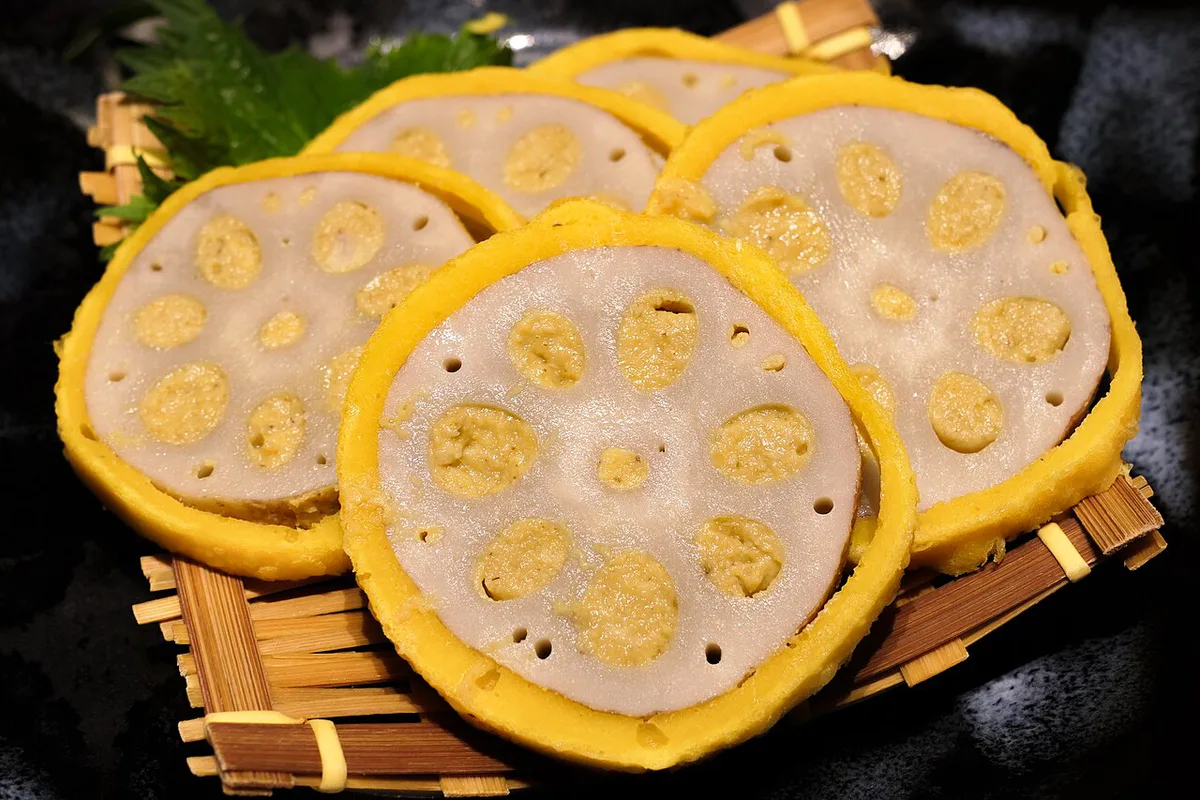
Karashi mustard delivers a sharp, sinus-clearing heat that's closer to fresh wasabi than to chili. It builds fast, fades quickly, and mostly hits the back of the nose rather than the tongue. Namiko Hirasawa Chen, who tasted the dish at Negibouzu izakaya in Kumamoto, described the mustard flavor as milder than expected once it's balanced against sweet white miso. That balance is the point. Sugar and mirin in the filling round off the mustard's edge, so the heat reads as bright rather than punishing. First-time tasters sometimes expect a chili-style burn and are surprised when the sting fades within seconds instead of lingering. Texture does the rest of the work. Lotus root keeps its natural crunch even after boiling and frying, and its signature holes stay intact inside the batter. Each slice delivers three distinct textures in one bite: crunchy root, soft mustard-miso filling, and a crackling turmeric crust. A well-made slice shows filling packed evenly into every hole, with no gaps or pale patches. That even fill is an easy way to judge quality at a shop counter before you buy.
When and Where Kumamoto Eats Karashi Renkon
Karashi renkon isn't reserved for special occasions, but it does show up at more of them than most snack foods. Locals eat it as a side with sake or beer at izakayas on an ordinary night. It also turns up in bento lunch boxes and, more formally, at tea ceremonies, where its texture and presentation suit the slower pace of the setting. That range, from casual bar snack to ceremonial dish, is part of why it's treated as a defining regional food rather than a niche specialty. Because it holds up reasonably well when kept cold, it also works as a gift for hosts elsewhere in Japan, not just as something to eat on the spot. Travelers who want to sample it the way residents do should look for it on an izakaya's appetizer list rather than treating it purely as a to-go souvenir.
Where to Eat It in Kumamoto: Shops and Izakayas
Mori Karashi Renkon is Kumamoto's best-known specialty shop, a long-established business that locals credit with keeping the traditional recipe consistent for generations. It's a reliable first stop if you want to taste a benchmark version before comparing others. Izakayas across the city also serve karashi renkon as a side dish, and Negibouzu is one specific spot travelers can look for it on the menu. For more izakaya and restaurant picks around the city, the Kumamoto restaurant guide covers a wider range of options. Specialty shops typically sell karashi renkon two ways. Whole roots suit travelers who want to slice and share it later, while pre-cut, ready-to-eat portions suit anyone who wants to eat right away, on foot or at a counter. If you're building a broader food stop in the city, pair a visit to a karashi renkon shop with a bowl of ramen nearby. The Kumamoto Ramen Guide: 7 Essential Facts and Top Shops lists specific shops. This dish also sits well alongside Kumamoto's other signature specialty, horse sashimi, if you're planning a single meal built around local dishes rather than one dish at a time.
- Mori Karashi Renkon: long-established specialty shop selling whole and pre-sliced roots
- Negibouzu: izakaya where karashi renkon appears on the menu as a side dish
- Souvenir counters at shops and stations: pre-packed, vacuum-sealed portions sized for travel
How to Eat Karashi Renkon Like a Local
Karashi renkon is almost always served cold or at room temperature, sliced into thin rounds that show off the lotus root's natural holes. It's rarely reheated, since the batter is meant to stay firm rather than piping hot. Most locals eat it plain, since the mustard-miso filling already carries enough seasoning on its own. A small dish of soy sauce is optional if you want it, though it's not considered traditional or necessary. As a drinking snack, karashi renkon pairs naturally with Kumamoto sake or with Kuma Shochu, a rice-based shochu style associated with the region. Order a plate alongside either at an izakaya, and treat it the way locals do: a few slices between rounds of drinks rather than a full meal on its own. If you'd rather balance the mustard's heat with something sweet afterward, ikinari dango is Kumamoto's other signature snack. It makes an easy contrast on the same food crawl.
Karashi renkon's shelf life of three to seven days limits its practicality as a souvenir since it's always served cold and never reheated, requiring continuous refrigeration from shop to home, making same-trip consumption the realistic option for travelers.
Buying Karashi Renkon as a Souvenir: Storage and Logistics
Bringing karashi renkon home on a long trip is risky, and most shops are upfront about that. Typical shelf life runs about three to seven days, and nearly every version needs refrigeration once it leaves the shop's counter. Two purchasing options solve two different problems. Freshly fried karashi renkon has the best texture, with a crust that's still crisp, so buy it that way if you're eating it within a day or two in Kumamoto. Vacuum-packed portions trade some of that crispness for a longer window, and they travel far better packed in a suitcase or cooler bag. Both Kumamoto Station and Aso Kumamoto Airport stock karashi renkon among their souvenir food sections. That makes it realistic to buy some on the way out of the city instead of tracking down a shop earlier in the trip. Because the mustard-miso stuffing has to be packed by hand into every hole of the root, karashi renkon is rarely made at home. That labor is exactly why most travelers treat it as a must-buy rather than a recipe to attempt later. If you're stacking a shopping stop onto a sightseeing day, visit Kumamoto's attractions first, then buy karashi renkon on the way to the station, when refrigeration matters least.
How Karashi Renkon Is Made: The Traditional Process
Making karashi renkon at home is possible, but the process explains why most residents leave it to specialty shops. One widely published recipe breaks the process into two stages across two days. Lotus root is peeled, scraped to help the batter stick, and boiled for about six minutes until tender but still firm. The mustard-miso paste is usually a mix of karashi mustard, white miso, panko, and a little sugar. It's pressed into the root by hand, repeatedly, until it fills every hole and overflows slightly at the top. The stuffed root rests in the refrigerator for at least six hours, often overnight, so the filling firms up before frying. On the second day, the root is dipped in a turmeric, egg, and flour batter, which gives the finished crust its yellow color. It's then deep-fried in oil heated to roughly 350°F (180°C) until the crust turns crisp. The slices are cut only after frying, which is why a good shop's rounds show filling packed evenly from edge to edge.
Slicing the fried root only after cooking, rather than before, preserves each of the three distinct textures—crunchy root, soft filling, and crackling turmeric crust—packed evenly from edge to edge rather than with gaps.
- Boil the peeled, scraped lotus root for about six minutes until tender but firm.
- Press mustard-miso paste into the root's holes by hand until it overflows slightly.
- Refrigerate the stuffed root for at least six hours, often overnight, to set the filling.
- Dip the root in a turmeric-egg batter for its signature yellow crust.
- Deep-fry the whole root at roughly 350°F (180°C) until crisp, then slice it into rounds.
Frequently Asked Questions
Is Kumamoto karashi renkon too spicy for children?
The mustard heat is sharp but brief, closer to the sinus-clearing sting of fresh wasabi than to the lingering burn of chili. Some children handle it without trouble, though the initial sting can catch first-time eaters off guard, adult or child. If you're ordering for a child who hasn't tried karashi mustard before, ask a shop or server for a smaller sample slice first, since portion size affects how strong the hit feels. Milder versions with less mustard in the filling do exist, though menus don't always list heat level up front.
Can you bring karashi renkon on an international flight?
Most karashi renkon needs refrigeration and carries a shelf life of roughly three to seven days, so it doesn't travel well in checked luggage on a long-haul flight. Vacuum-packed versions hold up better than freshly fried ones, since they're sealed and don't need immediate refrigeration the way a fresh-fried piece does. Even so, check your airline's specific rules on carrying perishable or vacuum-packed food through customs before you fly, since policies differ by country and airline. Treat karashi renkon as a same-trip souvenir to eat during your stay, rather than something to carry home across time zones.
How is karashi renkon different from other renkon dishes?
Most Japanese lotus root dishes are simmered, stir-fried, or pickled and served as a plain side dish. Karashi renkon stands apart because the root is stuffed with a mustard-miso paste, coated in a turmeric batter, and deep-fried whole before it's sliced. That combination, stuffing plus frying plus the mustard's sinus-clearing heat, is specific to Kumamoto's regional version. You won't typically find lotus root prepared this way elsewhere in Japan.
Where can you buy karashi renkon in Kumamoto?
Specialty shops such as Mori Karashi Renkon sell it whole or pre-sliced, and izakayas like Negibouzu serve it as a side dish alongside drinks. Kumamoto Station and Aso Kumamoto Airport also carry packaged versions in their souvenir food sections, which is convenient if you're buying on your way out of the city rather than earlier in the trip. Comparing a shop's freshly fried counter against a station's pre-packaged shelf is the fastest way to decide between better texture and easier transport.
Is karashi renkon usually homemade in Kumamoto?
Rarely. Packing mustard-miso paste into every hole of a lotus root by hand is slow, repetitive work, and the stuffed root then needs at least six hours of refrigeration before it's even battered and fried. That timeline is one reason most Kumamoto residents buy it from a specialty shop instead of making it at home for a casual meal. The labor-intensive process is also part of why karashi renkon is treated as a must-buy souvenir rather than a recipe travelers commonly attempt after returning home.
How much does Kumamoto karashi renkon cost?
Exact prices vary by shop and by whether you buy a whole root or a smaller pre-sliced portion, so check the specific shop or souvenir counter for current pricing. As a rule of thumb, a whole root costs more than a pre-sliced portion, since you're paying for a full-size souvenir instead of a snack-sized serving. Freshly fried orders from a specialty counter can cost more than pre-packaged, shelf-stable versions sold at the station or airport, largely because of how they're prepared and packaged.
What's the best way to try karashi renkon on a short visit to Kumamoto?
Stop at a specialty shop such as Mori Karashi Renkon for a benchmark whole root, then order a plate at an izakaya like Negibouzu to taste it freshly served with sake or shochu. Save the vacuum-packed souvenir version for the end of your trip, since freshness and crisp texture matter less once you're focused on transport. That sequence lets you taste the dish at its best before switching to a version built to survive the trip home.
Free: The Kumamoto Essentials guide
Top things to do, where to stay, a perfect day plan, getting around, and the best time to go — a Kumamoto mini-guide you can take offline.
You might also like



Continue reading
More guides you'll find useful


