10 Best Day Trips from Kumamoto: 3-Day Travel Guide
Plan the best day trips from Kumamoto with our 3-day itinerary. Includes Mount Aso, Takachiho Gorge, car rental tips, and local food guides for first-timers.
On this page
Kumamoto sits at the geographic heart of Kyushu and makes an ideal base for day trips across the island. Within two hours of the city you can stand at the rim of an active volcano, row through a mythical river gorge, and soak in a riverside onsen town that looks unchanged since the Edo period. This guide covers the best day trips from Kumamoto in 2026, with specific transport times, entry costs, and the logistics that most travel blogs skip.
Most travelers arrive from Fukuoka by Shinkansen, spend a night or two, then move on. That is a mistake. The prefecture rewards three full days. Use the city as your anchor each evening and push outward by rental car or rail each morning. The following sections cover every major destination, plus a few that rarely appear in English-language guides.
How to Get to Kumamoto from Fukuoka
The fastest option is the Shinkansen from Hakata Station to Kumamoto Station. The Sakura or Mizuho services cover the route in roughly 35 to 40 minutes. A standard unreserved fare costs around 4,700 yen one-way. Reserved seats on the Mizuho add about 530 yen but guarantee you a seat during busy holiday periods.
If you hold a JR Kyushu Rail Pass, this Shinkansen leg is fully covered. The Northern Kyushu Area Pass (8,660 yen for 3 days) also covers local trains to Aso Station and the Amakusa-Misumi Line, making it good value if you plan to take rail for multiple day trips. Travelers heading south toward Miyazaki should consider the All Kyushu Area Pass instead at 15,280 yen for 3 days.
Highway buses from Fukuoka's Tenjin Bus Center reach Kumamoto in about two hours and cost 2,000 yen. They are slower but cheaper and depart frequently throughout the day. A rental car from Fukuoka Airport is viable if you plan to drive the entire Kyushu loop without returning to Kumamoto each night.
Mount Aso: Japan's Largest Active Volcano
The Mount Aso caldera is the single most compelling reason to base yourself in Kumamoto. The caldera measures 25 km across and holds five volcanic peaks, active farmland, and an entire city within its rim. Most visitors head straight for the Nakadake Crater, the only currently active vent, where on clear days you can see the turquoise sulfurous lake below the crater lip.
By car, the drive from Kumamoto Station takes about 75 to 90 minutes via National Route 57. Trains on the JR Hohi Main Line reach Aso Station in around 90 minutes, with crater buses running from there to the Aso Volcano Museum (Kusasenri area). Buses from the station to the crater road are timed to the trains but run infrequently — check the schedule before you go. Kusasenri plateau, just below the crater, is worth an hour of your own time: horses and cattle graze the vast grasslands, and the volcano museum (admission 840 yen) provides excellent eruption context.
Always check the current Volcano Alert Level before setting out. The Japan Meteorological Agency issues levels 1 through 5 for Nakadake. Level 1 means the crater rim is accessible on foot. Level 2 closes the 1 km exclusion zone around the crater. Level 3 closes the entire mountain approach road. In 2026 the crater has been open at Level 1 for extended stretches, but conditions change within hours. Check Welcome Kyushu Emergency Info the morning of your visit, not the night before.
Always check the Volcano Alert Level the morning of your visit, not the night before. Conditions can change within hours. Level 2 or higher may close access to the crater rim or entire mountain approach road.
Arrive at Daikanbo by 09:30 when morning fog typically burns off, then follow the Milk Road south to Kusasenri to catch the late-morning light. This timing avoids crowds and gives you the best panoramic views before buses arrive at midday.
Daikanbo and the Milk Road Drive
Daikanbo is the highest viewpoint on the northern caldera rim, sitting at 936 metres, and the panorama stretches across all five volcanic peaks at once. The five summits together form the silhouette of a reclining Buddha when seen from this angle — a profile that has made Daikanbo one of the most photographed spots in Kyushu. On mornings with low cloud, the peaks appear to float above a sea of white.
The drive that connects Daikanbo to the Kusasenri plateau is the Milk Road, a local name for the route that follows the northern caldera rim before descending through grasslands to the crater zone. This route is strictly daytime driving — mist rolls in fast after 15:00, and there are no guardrails on some of the steepest bends. The best strategy is to stop at Daikanbo by 09:30, when morning fog typically burns off, then follow the Milk Road south to Kusasenri for a 10:30 arrival at the crater bus stop. This sequence gives you the panoramic views before crowds arrive and positions you for the crater just as the late-morning light improves.
A small souvenir shop and snack stand operate at the Daikanbo car park. Parking is free. The drive from Kumamoto Station to Daikanbo takes about 75 minutes if you go via the Ueki Interchange and join the caldera rim road from the north.
| Destination | Travel Time from Kumamoto | Best For | Entry Cost |
|---|---|---|---|
| Mount Aso Crater | 90 min by car / 90 min by train | Active volcano & panoramic views | Museum 840 yen |
| Daikanbo Viewpoint | 75 min by car | Five volcanic peaks silhouette | Free |
| Takachiho Gorge | 2 hours by car | Rowing through basalt canyons | Boat 3,000 yen / 30 min |
| Kurokawa Onsen | 90 min by car | Traditional hot spring retreat | Bath pass 1,500 yen |
| Amakusa Islands | 2 hours by car | Dolphin watching & Christian sites | Boat 3,000 yen / Museum 300 yen |
| Yanagawa Canal | 70 min by train | Boat punting through canals | Boat 1,600 yen / 70 min |
Takachiho Gorge: Rowing Through Mythical Chasms
Takachiho lies in Miyazaki Prefecture but is almost always approached as a day trip from Kumamoto. The drive takes about two hours each way via National Highway 218 through the mountains. The gorge itself is a 1 km stretch of the Gokase River sliced through basalt columns, with a 17-metre waterfall — Manai Falls — dropping directly into the rowing area. Arriving by 09:00 on weekdays gives you a reasonable shot at a short queue for the boats.
Rowing boats cost 3,000 yen for 30 minutes and hold up to three passengers. Queues during spring and autumn peak season can reach two to three hours. The boats open at 08:30 and are first-come, first-served — there is no online booking. A walking trail above the gorge runs the full length of the canyon and is free. The trail takes about 30 minutes at a slow pace and gives better overhead views of the rock formations than the boat does.
Public transport to Takachiho from Kumamoto is technically possible but impractical for a day trip. Buses run from Kumamoto Kotsu Center to Takachiho roughly twice daily, with a journey time of about two and a half hours. The last return bus typically departs Takachiho around 16:00, leaving very little time at the gorge. A rental car is the only realistic option if you want a full day here.
After the gorge, the Amano Iwato Shrine sits 10 minutes further north by car. This is one of Japan's oldest Shinto sites, set in a cedar forest above a river where the sun goddess Amaterasu is said to have hidden. Entry to the outer shrine and grounds is free.
Kurokawa Onsen: A Traditional Riverside Retreat
Kurokawa Onsen sits on the border of Kumamoto and Oita prefectures, about 90 minutes by car from Kumamoto Station via the Kyushu Expressway and Route 442. The town is a compact cluster of ryokan and bathhouses built along the Chikugo River gorge. It ranks among Japan's most celebrated onsen towns largely because all construction is held to traditional timber and thatch aesthetic standards — no concrete hotels, no neon signs.
The town's signature experience is the nyuto tegata, a wooden bath pass (1,500 yen in 2026) that grants access to three rotenburo (outdoor baths) from participating inns across town. You pick it up at the Kurokawa Onsen tourism office near the main car park. Most baths are gender-separated, but a few ryokan offer mixed baths (konyoku) in the early morning hours — check the sign at each entrance. Recommended standalone bathhouses include Yamamizuki and Sanga, both with forested gorge-side pools.
Day trippers can visit without staying overnight. Parking at the central lot costs 200 yen for the first hour. The onsen town can be combined with an Aso visit on the same day if you leave Kumamoto early — drive the Milk Road in the morning and stop in Kurokawa on the way back by mid-afternoon.
Kikuchi Valley: Emerald Water and Forest Trails
Kikuchi Valley (Kikuchi Keikoku) is one of the least crowded natural escapes accessible from Kumamoto, about 50 minutes north of the city by car. The valley trail follows the Kikuchi River upstream through a forest of giant oaks and maples for about 4 km, passing a series of small waterfalls and natural pools. Summer brings lush green light through the canopy; autumn turns the entire valley orange and red by late October.
Entry to the valley costs 300 yen per adult. The trail is gentle and walkable in trail shoes — hiking boots are not required. A small rest house near the entrance sells local citrus juices and grilled corn. The valley is open year-round and is at its most photogenic in the two weeks before and after Japan's official autumn foliage peak, which falls around early to mid-November in this part of Kyushu.
Kikuchi Valley works well as a half-day addition to a Kurokawa Onsen day, since both lie in the same northerly direction from Kumamoto. Stop at the valley in the morning while the forest is cool and quiet, then continue to Kurokawa for a late-morning bath before the afternoon crowds arrive.
Amakusa Islands: Dolphin Watching and Christian History
The Amakusa Islands lie two hours south of Kumamoto by car across the Pearl Line bridges. The archipelago is unusual in Japanese terms: it has a documented history of hidden Christianity dating from the 16th century, when European missionaries converted much of the local population during a period of nationwide religious suppression. The Amakusa Rosario Museum in Kawaura tells this story through original artifacts, and entry costs 300 yen.
The main draw for most day trippers is dolphin watching. Indo-Pacific bottlenose dolphins number around 200 in the surrounding Yatsushiro Sea and appear with remarkable consistency year-round. Tours depart from Ushibuka Harbor and from Itsuwa, with 60-minute cruises costing around 3,000 yen per adult. Operators offer a guaranteed-return voucher on the rare occasions the pod does not appear. Book online at least a week ahead during Golden Week and summer school holidays.
Seafood is the main reason to eat in Amakusa. Local specialties include tai (sea bream), lobster, and the Amakusa-Dekopon orange, a sweet mandarin hybrid grown on the hillside terraces. The fish market at Hondomachi sells fresh shellfish to grill on outdoor charcoal stands from early morning.
Yanagawa: Canal Punting in the Venice of Kyushu
Yanagawa sits in Fukuoka Prefecture, about 70 minutes from Kumamoto by limited express on the Nishitetsu Omuta Line via Omuta. The town is built around a network of canals fed by the Chikugo River, and the punting boat ride (dochu kudari) is the reason most visitors come. The boatmen pole their flat-bottomed craft through 4 km of narrow waterways while singing traditional folk songs. The ride lasts about 70 minutes and costs 1,600 yen.
Spring brings the most popular season: wisteria (fuji) blooms hang over the canals in late April and early May, creating a purple tunnel effect that draws weekend crowds from Fukuoka and beyond. Autumn is quieter and the light on the water is sharp and clear. Winter features a uniquely theatrical event called Sagemon, where red-and-white decorative hangings appear above the canals in February and March.
After the boat ride, the Ohana Estate (admission 500 yen) is Yanagawa's finest historical house, a sprawling Meiji-era garden and villa once belonging to the Tachibana clan. The unagi (eel) dishes at restaurants along the canal are a local institution — the seiro mushi style, where eel is steamed over rice in a cedar box, is specific to this region and worth seeking out.
How to Rent a Car from Kumamoto Station
Driving is the only practical way to reach Takachiho, Daikanbo, and Kikuchi Valley on a single-day schedule. A Nippon Rent-A-Car office operates directly outside the Shinkansen (west) exit of Kumamoto Station. Staff handle international travelers routinely and can process paperwork in about 20 minutes if you arrive with documents ready.
You need two items: your original driver's license from your home country and a valid International Driving Permit (IDP) obtained before leaving home. Japan does not accept foreign licenses alone, and Swiss and German licenses are the only exceptions under bilateral agreements. An IDP costs approximately 3,000 yen in Japan but is not issued there — it must come from your home country's automobile association. Daily rental rates for a compact car run 7,000 to 10,000 yen at the station, with automatic transmission models available. Manual-only cars are sometimes offered at a discount.
Most rental cars come fitted with English-language car navigation. Fuel is predominantly regular unleaded (regular or haioku); gas stations are plentiful around Kumamoto City but thin on the caldera approaches and mountain roads to Takachiho. Fill the tank before leaving the city. Tolls on the Kyushu Expressway between Kumamoto and Hitoyoshi run about 1,200 yen each way; carry a mix of cash and an IC card as not all toll booths accept credit cards.
Kumamoto Specialties: Ramen, Basashi, and Kumamon
Kumamoto ramen is tonkotsu-based like Hakata ramen but lighter in texture — most versions blend pork bone broth with chicken stock, producing a cleaner, more aromatic bowl. The defining addition is mayu, a black burnt garlic oil drizzled over the surface. Fried garlic chips are often scattered on top as well. The result is distinctly garlicky and far bolder than the milky Hakata style. Recommended shops within walking distance of the station include Kokuteiya (3-minute walk, south exit) and the original Kurokan branch in Shimotori arcade.
Basashi (horse meat sashimi) is the region's most discussed delicacy. The tradition traces to the Hosokawa samurai clan and has been part of Kumamoto cuisine for centuries. Loin cuts are the mildest entry point, served cold and thin-sliced with ginger and soy. Most izakaya in the Shimotori area carry it; expect to pay 900 to 1,500 yen for a starter plate. Aso beef (Akaushi wagyu) is the other meat worth seeking out — it is served as donburi or yakiniku at several Aso caldera restaurants.
Ikinari Dango is the local sweet to know. These are steamed buns filled with sweet potato and azuki bean paste, named because you can eat them immediately (ikinari means "suddenly" or "right away"). The best versions near the castle are sold at Ikinari-ya on Sakuranobaba Josaien's shopping street, about a 5-minute walk from the castle entrance. Near the station, Aoyagi Confectionery in the underground arcade stocks boxed sets for takeaway. A single piece costs 130 to 160 yen.
Kumamon, the black bear mascot, has his own dedicated store at Kumamon Square (inside the prefectural government building, free entry, 10:00 to 19:00 on weekdays). The mascot himself makes scheduled live appearances on weekdays — check the monthly calendar posted outside the building. Kumamon merchandise also fills most souvenir shops in Sakuranobaba Josaien next to the castle.
The Kumamoto Castle Reconstruction in 2026
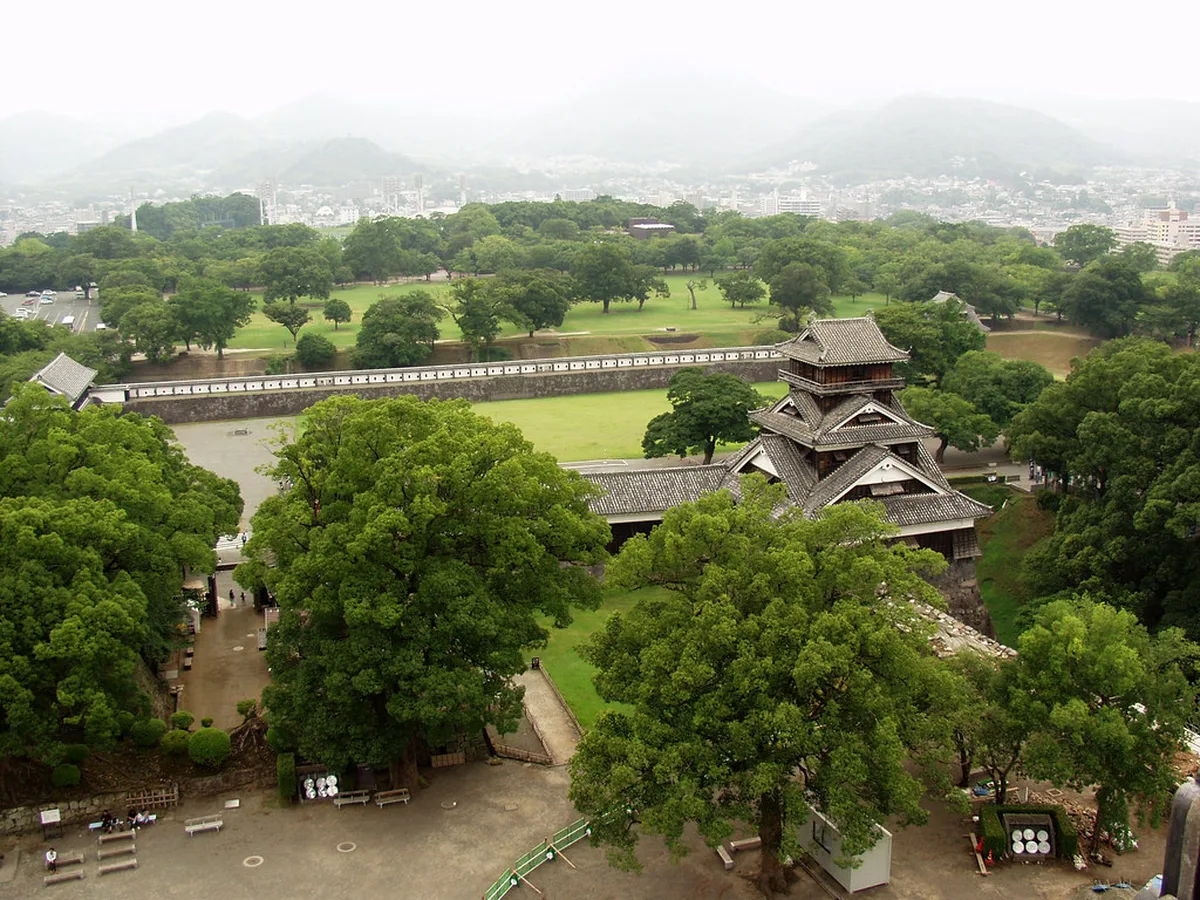
The 2016 Kumamoto earthquake caused severe damage across the castle complex — stone walls collapsed, turrets fell, and the main keep suffered structural damage. The main keep (tenshu) reopened fully in 2021 after a 540-million-dollar restoration. In 2026, the interior is accessible daily from 09:00 to 17:00 (last entry 16:30), with admission at 800 yen for adults. The castle reconstruction itself is worth documenting: elevated wooden walkways run alongside the stone walls where work continues, giving visitors a close-up view of traditional stone-setting techniques being applied by craftsmen trained in Edo-period methods.
The full restoration of the entire complex is scheduled for completion in 2052. What you see in 2026 is roughly 70% of the pre-earthquake stone wall area restored. Several secondary towers (yagura) and the Uto Turret — the only original 17th-century structure to survive — are viewable from the external grounds. The Suizenji Garden, 20 minutes east by tram, makes a natural second stop on a castle-focused city day.
Is Kumamoto Worth Visiting?
Is Kumamoto Worth Visiting? A Guide to Japan's Land of Fire if your time in Kyushu is limited? The honest answer is yes, but for different reasons than most travelers expect. The city itself is relatively compact and navigable in a single day. The real value is geographic — no other city on Kyushu puts you within a two-hour drive of an active volcano (Aso), a mythological river gorge (Takachiho), a historic onsen town (Kurokawa), a coastal dolphin cruise (Amakusa), and a canal-punt town (Yanagawa) simultaneously.

Travelers transiting between Fukuoka and Kagoshima by Shinkansen often stop for one night. That works for the castle and the ramen. Anyone wanting to see the Aso caldera and one more destination needs two nights minimum. Three nights is the right call if you want Takachiho plus either Kurokawa or Amakusa without rushing. Three days also gives you a buffer if Aso's volcano alert level closes the crater on your planned day.
Frequently Asked Questions
How do I get from Kumamoto to Mount Aso?
The best way is by rental car or the JR Hohi Main Line train. Driving takes about 90 minutes from the city center. Trains run regularly to Aso Station, where you can catch a local crater bus.
Can you do a day trip to Takachiho from Kumamoto?
Yes, it is a very popular day trip option. The drive takes approximately two hours each way via Highway 218. Public buses are available but offer very limited schedules for a single day.
Is Kumamoto Castle open to the public now?
The interior of the main keep is fully open to visitors. You can walk along elevated paths to see the ongoing stone wall repairs. Most areas are accessible daily from 9:00 AM to 5:00 PM.
Kumamoto is a fantastic gateway to the rugged beauty of central Kyushu. The city sits at the right distance from every major destination — close enough for comfortable day trips, far enough that each feels like a genuine excursion. Mount Aso, Takachiho, Kurokawa, and Amakusa are four completely different experiences, and all four are reachable in a single day from the same hotel room.
Rent a car, check the volcano alert level each morning, book the Takachiho boat well in advance, and save your evenings for garlic ramen and basashi. That formula covers the best of what this part of Kyushu offers in 2026.
Planning the rest of your trip? See our complete Kumamoto attractions guide for the complete Kumamoto overview.
For more Kumamoto planning, see our How Many Days In Kumamoto? (The Complete 1-3 Day Guide) and 12 Kumamoto Hidden Gems Locals Recommend guides.
Free: The Kumamoto Essentials guide
Top things to do, where to stay, a perfect day plan, getting around, and the best time to go — a Kumamoto mini-guide you can take offline.
You might also like

Continue reading
More guides you'll find useful