Kenrokuen Garden stands as a masterpiece of Japanese landscape design in the heart of Kanazawa. Officially designated one of Japan's Three Great Gardens, the 11.4-hectare grounds bring together six qualities that ancient Chinese scholars considered essential to a perfect landscape.
Visitors often describe the garden as a living painting that changes with every season — cherry blossoms in April, iris-lined streams in June, crimson maples in November, and snow-rope displays in winter. No single visit captures everything, which is part of its enduring appeal.
This kenrokuen garden visitor guide covers the must-see landmarks, seasonal timing, practical entry details, and the lesser-known tips that help you get the most from your time here in 2026.
What Is Kenrokuen Garden?
Kenrokuen (兼六園) is a nationally designated Special Place of Scenic Beauty in Kanazawa, Ishikawa Prefecture, and earns a top three-star rating in the Michelin Green Guide Japan. The name means "garden combining six qualities," a reference to the six virtues described in a Song-dynasty text on ideal landscapes: spaciousness, seclusion, human craftsmanship, antiquity, water features, and panoramic views. Most historic gardens achieve three or four of these qualities. Kenrokuen achieves all six in one cohesive space, which is why it consistently ranks among Japan's most rewarding garden experiences.
The garden sits directly beside Kanazawa Castle, making the two natural companions on the same half-day route. The castle's Ishikawa-mon Gate stands just a few meters from the garden's main entrance at Katsurazaka Gate.
A Brief History of Kenrokuen Garden
The garden's origins trace back to 1676 (Enpō 4), when Maeda Tsunanori, the fifth lord of the Kaga Domain, built a villa called Renchi-Goten on the outer grounds of Kanazawa Castle and began developing the surrounding land into a private garden. Successive Maeda lords expanded the grounds over the next two centuries, each adding new ponds, teahouses, and plantings to reflect the clan's cultural ambitions.
In 1822 (Bunsei 5), the scholar Matsudaira Sadanobu formally named the garden "Kenrokuen" after the six virtues — the name that has stuck ever since. The garden was opened to the public for the first time in 1871, shortly after the Meiji Restoration ended the domain system. What visitors walk through today is essentially the complete vision that the Maeda clan refined across more than 200 years of continuous stewardship.
This long development cycle is visible in the garden itself. The stonework near the central pond dates from the late Edo period, while the Meiji Monument near the west edge was added in the 1880s. Walking the full loop is, in a sense, a walk through the history of one of Japan's most powerful feudal families.
Best Time to Visit Kenrokuen Garden
Each season at Kenrokuen offers something genuinely different, so the best time depends on what you want to see rather than any single "peak" period.
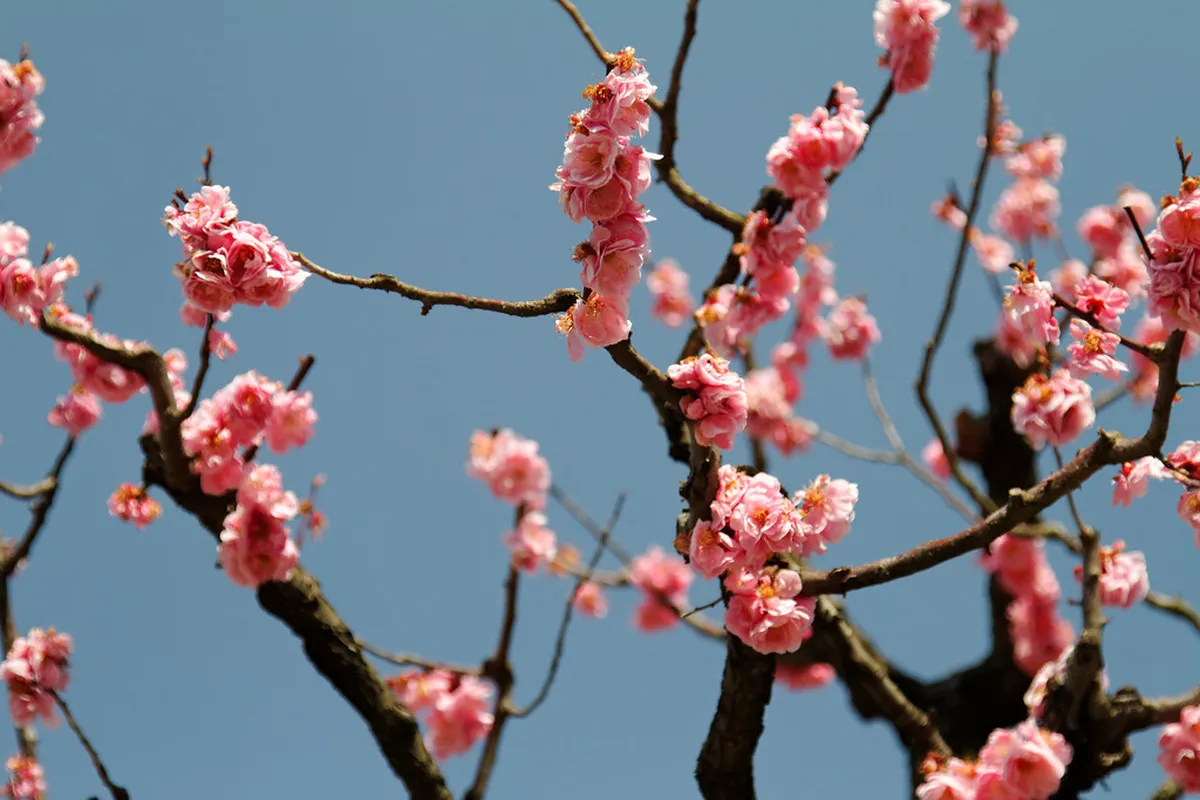
- Spring (late March – early April): Around 420 cherry blossom trees bloom across the grounds, and the area near Kasumiga-ike Pond turns pink. During peak bloom, the garden opens free night illumination sessions — the cherry blossoms reflected in the dark water create one of the most striking sights in Kanazawa.
- Summer (June – August): Crowds thin out and the garden becomes lush and green. Japanese irises bloom along the winding streams in June. Early morning free entry in summer starts as early as 04:00, giving you nearly three hours in the garden before regular crowds arrive.
- Autumn (mid to late November): Around 300 maple trees around Yamazaki-yama Hill and Kasumiga-ike Pond turn deep red and gold. Autumn foliage illumination events ("Shiki Monogatari") run in the evenings — entry is free. Mid-November on weekdays is the sweet spot: color is near peak but tour groups have not yet peaked.
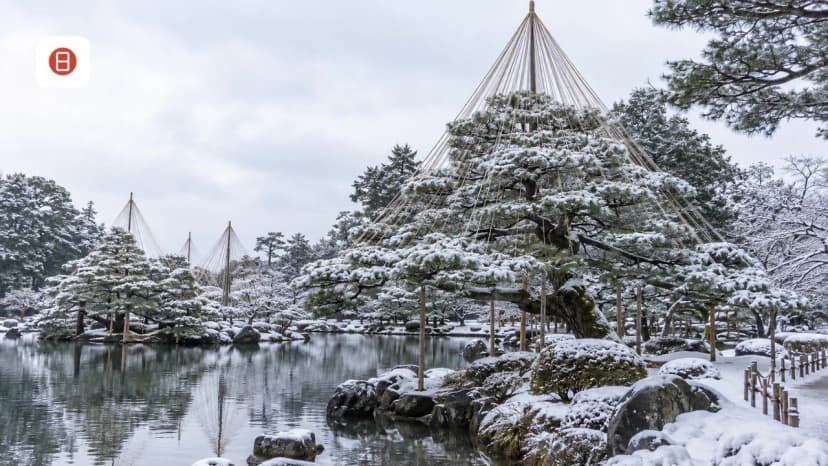
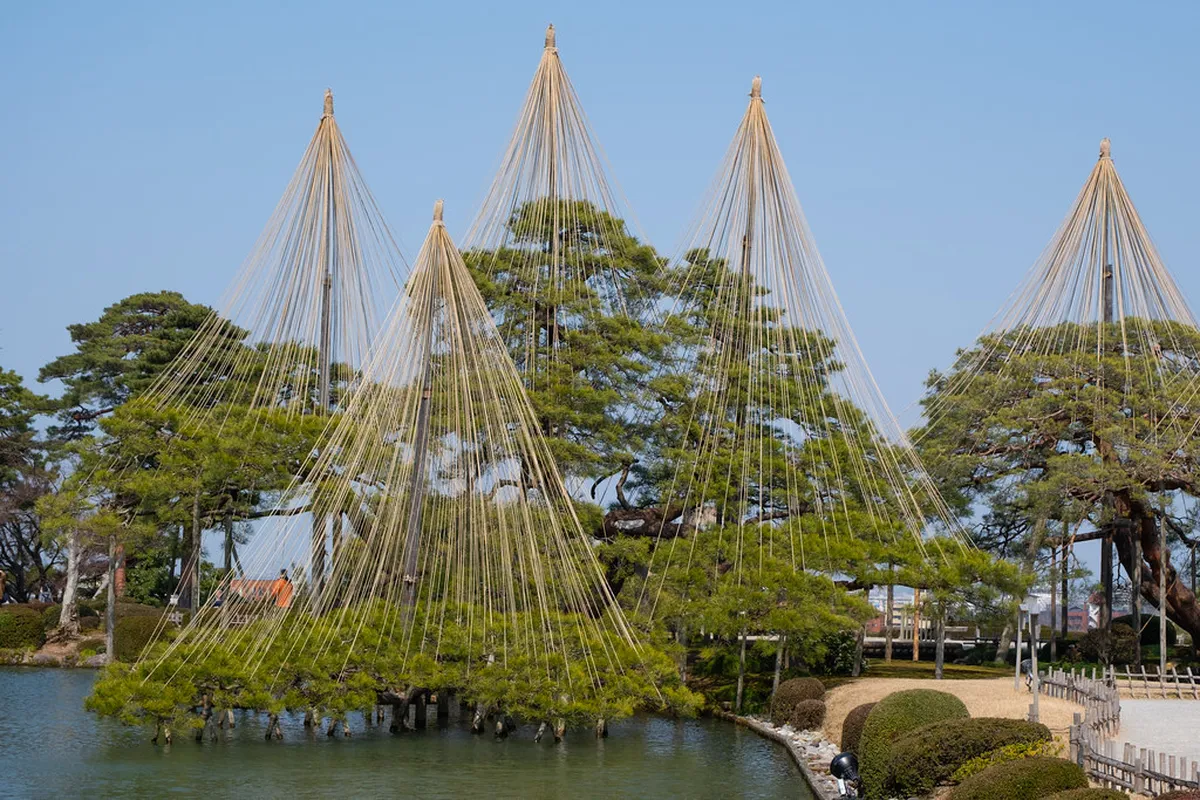
- Winter (November – March): The yukitsuri rope supports go up on November 1 each year, starting with Karasaki Pine. About 800 straw ropes fan out from the pine in a geometric cone pattern. Seeing those ropes dusted with fresh snow is a uniquely Kanazawa winter scene that you will not find anywhere else in Japan.
Regardless of season, arriving at opening time significantly reduces crowds. Morning light also provides the softest conditions for photography across the ponds.
| Season | Highlight | Free Night Events | Best Timing |
|---|---|---|---|
| Spring (late Mar – early Apr) | ~420 cherry blossom trees; pink reflections in Kasumiga-ike Pond | Yes – cherry blossom illumination | First two weeks of April |
| Summer (Jun – Aug) | Lush greenery; Japanese irises in June | No | Early morning (free entry from 04:00) |
| Autumn (mid–late Nov) | ~300 maple trees turn red and gold around Yamazaki-yama Hill | Yes – "Shiki Monogatari" illumination | Mid-November weekdays |
| Winter (Nov 1 – Mar) | Yukitsuri rope supports; ~800 straw ropes on Karasaki Pine | No | After first snowfall |
Must-See Spots Inside Kenrokuen (Do Not Miss These)
The garden is large enough that visitors who rush through miss several of the best landmarks. These are the spots that consistently reward a slower pace.
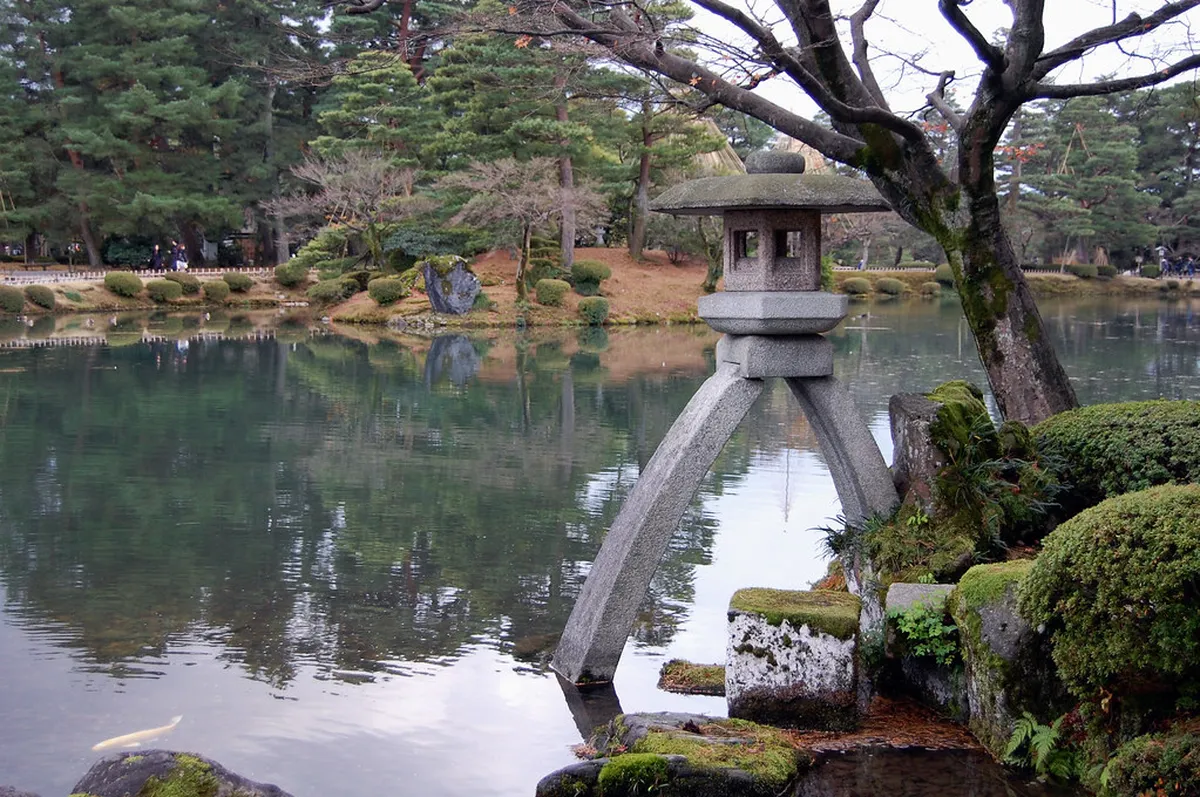
Kotoji-toro Stone Lantern. The two-legged stone lantern standing at the edge of Kasumiga-ike Pond is the defining symbol of Kenrokuen. Its unusual shape mimics the bridge pegs (kotoji) that support the strings of a traditional koto instrument. The lantern looks different at every hour of the day and every season — sunrise with mist on the water is particularly striking.
Kasumiga-ike Pond. The garden's largest pond covers about 5,800 square meters. The small island at its center, Horai Island, symbolizes immortality in Japanese garden tradition. Walk the full perimeter to see how the reflection of the pines and bridges changes as you move.
Hisago-ike Pond and Kaisekito Pagoda. A six-tier stone pagoda on a small island in Hisago-ike Pond is said to have been brought from Korea by a Maeda general. A small footbridge leads to it, and a gentle waterfall runs nearby. When crowds are low, it is one of the quietest and most photogenic corners of the entire garden.
Hanami-bashi Bridge. The wooden flower-viewing bridge near the iris beds offers perfect framing during cherry blossom season, when branches arch over the water and petals float below. Early morning or late afternoon light is best here.
Karasaki Pine. This massive pine was grown from a single seed brought from Lake Biwa. Its branches extend far over the water and require the geometric yukitsuri rope supports every winter. The tree stands roughly 10 meters tall and represents the longevity and care that characterizes the entire garden.
Japan's Oldest Surviving Fountain. Near the center of the garden, a small fountain rises without any mechanical pump, driven entirely by the natural water pressure from Kasumiga-ike Pond at higher elevation. It dates from the early 19th century and stands as a quiet testament to Edo-period engineering precision.
Tea Houses in Kenrokuen – Matcha with a View
Stopping for matcha at one of the garden's historic tea houses is not a tourist add-on — it is part of how the space was designed to be experienced. The Maeda clan built these structures as places for contemplation, and that purpose translates directly for modern visitors.
Shigure-tei, rebuilt in 2000 near the Renchi-mon gate area, is the main option. You sit on tatami mats and look out over the garden while sipping matcha served with a seasonal wagashi sweet. Prices run between 310 and 730 yen depending on the style you choose. The etiquette is straightforward: remove your shoes at the entrance, keep your voice low, and do not photograph other guests without permission.
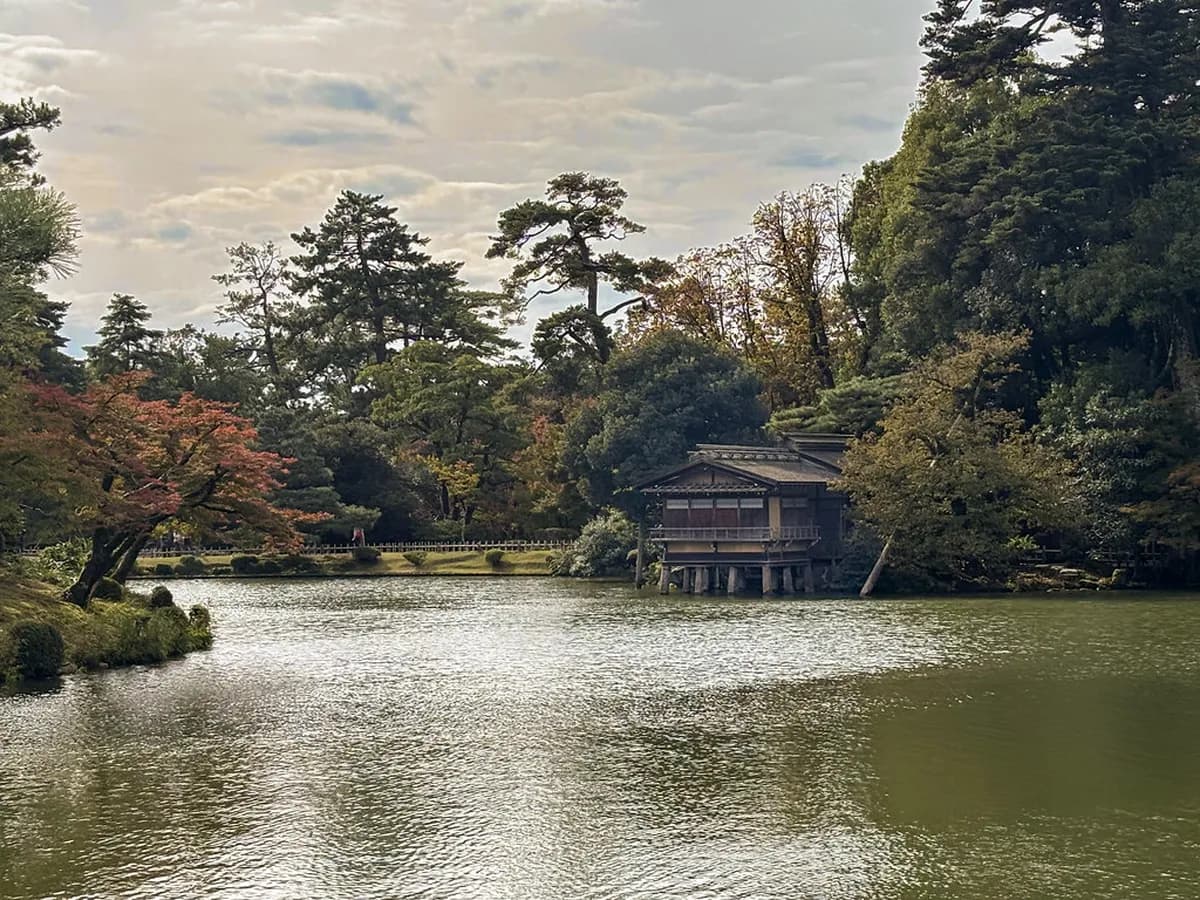
Uchihashi-tei is the better-positioned option for the classic view — it sits directly over the water of Kasumiga-ike Pond and offers a clear sightline to the Kotoji Lantern. If Shigure-tei is full, this is an excellent alternative. Beyond the two main tea houses, twelve smaller tea shops within the grounds serve sweets and light snacks.
Visiting Kenroku-en at Night (Cherry Blossom Season)
During peak cherry blossom season — typically the first two weeks of April — the garden opens for free night illumination sessions as part of the "Kanazawa Castle and Kenrokuen Shiki Monogatari" events. The trees are lit from below, and the blossoms reflect in the dark surface of Kasumiga-ike Pond in a way that is genuinely different from any daytime experience.
The atmosphere is relaxed rather than chaotic. Unlike Kyoto's top cherry blossom venues during the same period, Kenrokuen at night draws mostly local residents and independent travelers rather than large tour groups. Entry is free for the illumination period, which typically runs from sunset to around 21:00.
Photography at night requires a steady hand or a small travel tripod. Crowd management paths are in place, so plan to arrive a few minutes before sunset to secure position near the pond before the official lighting begins. Bring a jacket — spring evenings in Kanazawa are cold, and temperatures often drop below 10°C after dark even in early April.
Spring evenings in Kanazawa can drop below 10°C even during cherry blossom season in early April. Bring a warm layer if you plan to attend the night illumination events around Kasumiga-ike Pond.
Autumn foliage illuminations follow the same free-entry format, usually in mid-November. Check the official Kenrokuen website or Japan-Guide.com for the exact dates, which shift by a week or two each year depending on bloom and foliage conditions.
Practical Visitor Information
Entry fees: Adults (18 and over) pay ¥320. Children aged 6–17 pay ¥100. Children under 6 enter free. Visitors aged 65 and over enter free with a valid ID. Payment by credit card, IC card, and e-ticket is available at the main gates.
Opening hours: 07:00–18:00 from March 1 to October 15. 08:00–17:00 from October 16 to the end of February. The garden is open every day of the year with no closing days.
Free early-morning entry: Before regular opening time, you can enter at no charge. The start time varies by season: 04:00 from April through August, 05:00 in March, September, and October, and 06:00 from November through February. You must exit before the standard opening time. This is the single best budget and crowd-avoidance move for any Kenrokuen visit.
Free early-morning entry lets you explore the garden before the crowds arrive — as early as 04:00 in summer. You must exit before regular hours begin, but that still gives you up to two hours of peaceful access to the ponds and lanterns at no charge.
Getting there: From Kanazawa Station (east exit), take the Kanazawa Loop Bus, the Hokutetsu Bus, or the Kenrokuen Shuttle. Journey time is approximately 15–20 minutes. Alight at "Kenrokuen-shita / Kanazawa Castle" and walk 3 minutes to the Katsurazaka Gate. The Loop Bus one-day pass costs ¥800 and covers all major landmarks. JR buses are covered by the Japan Rail Pass. By car, allow about 20 minutes from Kanazawa-Higashi IC; paid parking lots at Kenroku Parking (482 spaces) and Ishibiki Parking (370 spaces) are the closest options.
Address: 1 Kenroku-machi, Kanazawa, Ishikawa Prefecture 920-0936.
Accessibility and Guided Tours
Kenrokuen is more wheelchair-accessible than most traditional Japanese gardens, but the accessibility is uneven across the grounds. The main circuit around Kasumiga-ike Pond uses paved or compacted gravel paths with gentle gradients suitable for wheelchairs and strollers. Yamazaki-yama Hill and some of the stone-stepped inner paths are steep and difficult to navigate with wheels. Free wheelchair loans are available at the ticket booths at all four main gates: Katsurazaka, Renchi-mon, Kodatsuno, and Zuishin-zaka. Staff at the entrance can advise on the most barrier-free route, which covers all the major landmarks including the Kotoji Lantern and Karasaki Pine.
For visitors who want more context than a self-guided walk provides, the "Kenrokuen Meguri" guided tour and the volunteer guide network known as "Maido-san" are worth considering. Some Maido-san guides offer English-language tours, and they are well-informed on the garden's historical layers that are easy to miss on a solo walk. Contact the Kanazawa tourism office near the Katsurazaka Gate entrance to check availability and book in advance, particularly during spring and autumn peak seasons.
How to Combine Kenrokuen with Nearby Attractions
Kenrokuen's location in central Kanazawa makes it the natural anchor for a full-day itinerary. Kanazawa Castle Park is literally adjacent — the Ishikawa-mon Gate is visible from the main garden entrance, and most visitors walk between the two without backtracking.
A ten-minute walk southwest leads to the 21st Century Museum of Contemporary Art, which provides a striking contrast between centuries-old landscaping and late-modern architecture. Most visitors spend 90 minutes to two hours there. In the afternoon, the Higashi Chaya District is about 15 minutes on foot or one bus stop — its preserved wooden tea house facades make a natural continuation of the cultural themes you start in the garden.
If you are building a full day: start at Kenrokuen for early-morning free entry, walk to the castle by mid-morning, lunch near the Omicho Market (the city's fresh seafood market, 15 minutes by foot or bus), then take the Loop Bus to Higashi Chaya for the afternoon. This route uses the ¥800 Loop Bus day pass efficiently and keeps walking distances manageable.
For a shorter half-day version: Kenrokuen plus the castle is a comfortable two to three hours, and the castle grounds are free to enter.
Photography Tips for Kenrokuen Garden
Early morning and late afternoon provide the softest natural light across the pond surfaces. Midday sun creates harsh reflections that flatten the depth of the water. If you are shooting in summer, the 04:00 free-entry window gives you two hours before direct sunlight hits the central pond.
- The Kotoji Lantern photograph works best from the east bank of Kasumiga-ike, with the lantern framed against the maple canopy behind it.
- Hisago-ike Pond and the Kaisekito Pagoda is the most reliably crowd-free spot — earlier in the morning than the main pond.
- Hanami-bashi Bridge during cherry blossom season is best accessed before 08:00 to avoid people in the frame.
- Night illumination events require at least ISO 800 or a small tripod. The designated walking paths limit where you can set up, so scout your position before the lights come on.
- Winter yukitsuri: the conical rope structures photograph well against an overcast sky, which diffuses the geometric patterns. Karasaki Pine in light snow is the signature winter shot.
Frequently Asked Questions
What is the best time of day to visit Kenrokuen Garden?
Early morning is the best time to visit Kenrokuen to avoid large crowds and enjoy the peaceful atmosphere. Arriving at sunrise during the free entry period offers the most serene experience for photographers and nature lovers. You can find more details on planning your trip at Kanazawa travel guides.
How much does it cost to enter Kenrokuen Garden?
The standard admission fee for adults is 320 yen, while children aged six to eighteen pay 100 yen. Seniors over sixty-five can often enter for free with a valid passport or ID. These prices are subject to change, so verify current rates on the official tourism website before your arrival.
Can I visit Kenrokuen Garden for free?
Yes, the garden offers free entry during early morning hours before the regular ticket booths open. These times vary by season, usually starting around 5:00 AM or 6:00 AM and ending about fifteen minutes before regular hours. This is a great budget-friendly option for early risers visiting Kanazawa.
How much time should I spend at Kenrokuen Garden?
Most visitors spend between ninety minutes and two hours exploring the main paths and landmarks of the garden. If you plan to stop for tea or visit the nearby Seisonkaku Villa, allow for at least three hours. The garden is large enough to reward a slow and steady pace.
Is Kenrokuen Garden accessible for travelers with disabilities?
The garden features several paved or flat gravel paths that are suitable for wheelchairs and strollers. However, some areas involve steep hills or stone steps that may be difficult to navigate. Accessible maps are usually available at the main gates to help you plan a barrier-free route.
A visit to Kenrokuen Garden is a highlight of any trip to Kanazawa and offers a deep connection to Japan's cultural past. By following this kenrokuen garden visitor guide, you can maximize your time and see the most beautiful spots on the grounds.
Remember to plan your arrival for the early morning to enjoy the quietest views of the ponds and historic lanterns. Whether you visit in the snows of winter or the blossoms of spring, the landscape will leave a lasting impression.
Take the time to explore the surrounding museums and districts to fully appreciate the rich history of the Maeda clan. This garden is more than just a park; it is a living testament to centuries of artistic and natural harmony.
For official details, visit the Kenrokuen Garden official site and Kenrokuen Garden on Wikipedia.