
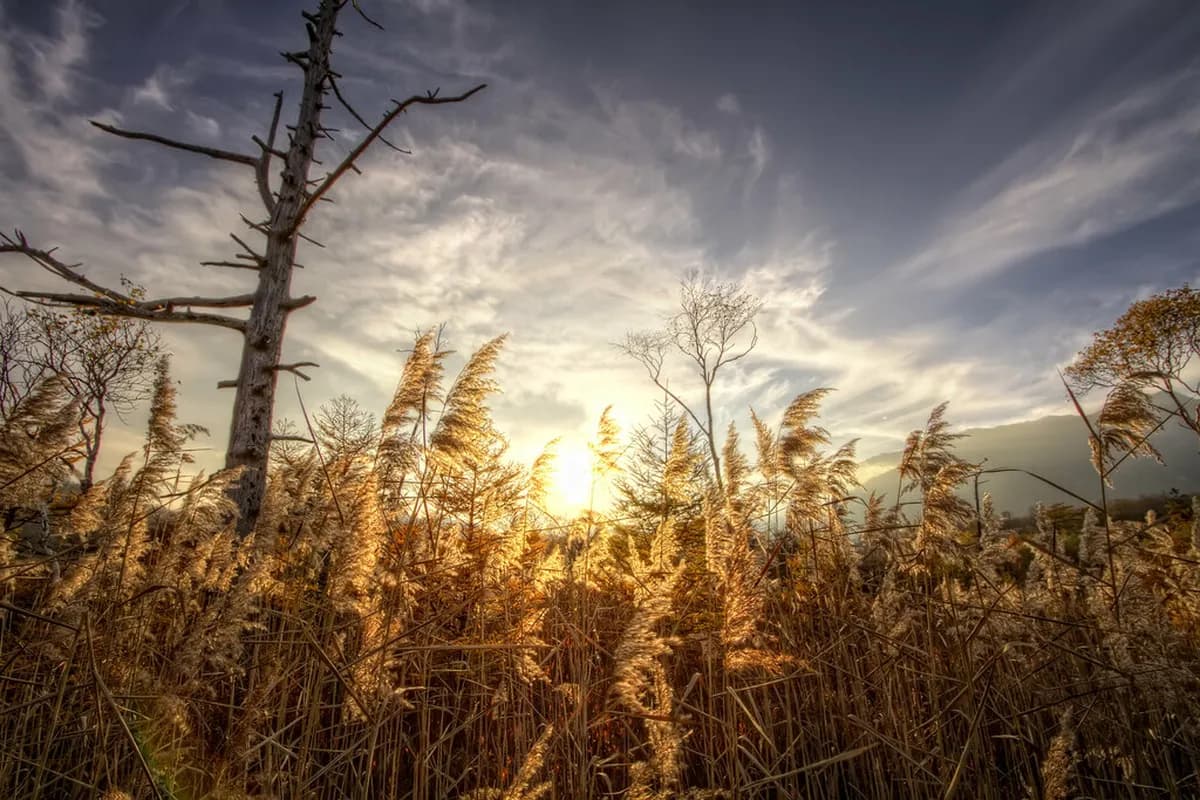
Senjogahara Marshland sits at 1,400 meters above sea level in Oku-Nikko, covering roughly 400 hectares of protected wetland. This high-altitude moor formed some 20,000 years ago when a lava flow from Mount Nantai dammed the valley, turning it into a lake that slowly became a marsh. Today it ranks among Japan's most famous wetlands and is protected under the Ramsar Convention.
A network of flat wooden boardwalks crosses the marsh, keeping visitors on dry ground while protecting the fragile ecosystem beneath. The trail follows the Yukawa River from Yudaki Falls through a deciduous forest, then opens onto the broad, treeless plateau. You can reach the starting points from the historic Nikko city center by Tobu bus.
Planning a trip requires knowing which bus stop to use and which direction to walk. Most first-timers take the downhill route from Yudaki Waterfall toward Akanuma, which gives the best mountain views ahead of them. This guide covers the trail options, transport specifics, seasonal timing, and nearby hikes for a smooth 2026 visit.
Must-See Senjogahara Attractions
The raised wooden boardwalks are the defining feature of Senjogahara. They run for several kilometers across the open marsh, wide enough for two people to pass comfortably. Entering from the Akanuma bus stop, you step onto the plateau immediately, with unobstructed views of Mount Nantai (2,486 m) rising directly ahead.
The Yudaki Waterfall at the northern end of the trail is worth pausing at before or after your hike. The cascade drops roughly 70 meters through a rocky channel, and there is a viewpoint platform with benches. Vending machines and a small rest house at the Yudaki bus stop let you stock up on drinks before heading out onto the exposed moor.
The Sanbonmatsu observation point sits near the midpoint of the main plateau and offers the widest panoramic view of the marsh. The grasses here turn rust-red in late September and rich gold through October, making this the most photographed spot on the trail. Admission to the entire marshland is free.
| Route | Distance | Time | Entry fee |
|---|---|---|---|
| Yudaki → Akanuma (main boardwalk) | 6 km | ~2 hrs | Free |
| Full trail incl. Ryuzu Falls extension | 8 km | 3–4 hrs | Free |
| Sanbonmatsu observation deck | 1-min walk | 5 min | Free |
| Yudaki Waterfall viewpoint | At bus stop | 15 min | Free |
- Boardwalk trail from Yudaki to Akanuma: 6 km, roughly 2 hours, almost entirely flat
- Full trail including Ryuzu Falls extension: 8 km, 3 to 4 hours total
- Sanbonmatsu observation deck: 1-minute walk from the Sanbonmatsu bus stop, no cost
- Yudaki Waterfall viewpoint: free, open year-round, vending machines and rest house on site
Myths, Ecology, and Cultural Context of Senjogahara
The name Senjogahara translates literally as "Battlefield Plain." The legend behind it describes the deity of Mount Nantai, who transformed into a giant serpent, fighting the deity of distant Mount Akagi, who took the form of a massive centipede. The serpent won, and the scarred plain left behind became the marshland we walk today. This mythology ties the landscape directly to the spiritual heritage of Toshogu Shrine, where the deities of the region are also venerated.
Entry is free and the trail is open year-round. The two-day Tobu World Heritage Pass (~¥3,500 adult) covers all marshland bus stops — better value than single-journey tickets if you also visit Kegon Falls or Yumoto Onsen on the same trip.
Ecologically, Senjogahara supports more than 350 species of native plants, including hare's-tail cottongrass and bridewort, which bloom from mid-June through early August. The wetland also hosts numerous wild bird species. Because part of the area is registered under the Ramsar Convention on Wetlands, strict rules apply: stay on the boardwalks at all times, do not pick plants, and carry out all rubbish.
The nearby Nikko Natural Science Museum in Chuzenji explains the volcanic origins of the plateau and the biodiversity of the national park. It is a useful stop if you arrive early and want context before heading out onto the moor. The museum also posts seasonal trail condition updates, which matters during early spring snowmelt and late-autumn frost.
Parks, Gardens, and Outdoor Spots in Senjogahara
Odashirogahara is a smaller marshland adjoining Senjogahara to the south, reached by continuing past Akanuma on a connecting path. It is known for its Japanese white birch trees, including one isolated specimen nicknamed "the Lady of Odashiro." The two-and-a-half-hour circular trail from Akanuma that loops through both marshlands is ideal if you want to avoid backtracking on the same path.
The wetland sits four kilometers north of Lake Chuzenji, making it easy to combine both in a single day. Birdwatchers frequently spot the Siberian stonechat in the tall grasses along the marsh edge, and clear days reveal Mount Nantai's full profile reflected in the ponds. The entire area falls within Nikko National Park, so no fees apply anywhere along the trail.
Ryuzu Waterfall sits at the southern end of the main trail and marks a natural finishing point for anyone walking from Yudaki. The waterfall is named for its dragon-head shape and splits into two streams over a broad rock face. From the Ryuzu bus stop you can catch a bus directly back to Nikko Station or onward to see the falls up close before boarding.
Family-Friendly and Budget-Friendly Options in Senjogahara
The trail costs nothing to hike. There are no gate fees, no timed-entry tickets, and no reservation system. Budget travelers should budget mainly for bus fares and any food or drinks purchased at the Yudaki rest house or the Ryuzu Falls cafe at the southern end.
The Tobu World Heritage Pass (two-day version, around ¥3,500 per adult in 2026) covers unlimited Tobu bus travel between Nikko Station and the Oku-Nikko area, including all marshland bus stops. For families doing multiple Oku-Nikko destinations over two days — Kegon Falls, the marshland, and Yumoto Onsen — it typically costs less than buying single-journey tickets each way. Purchase it at Tobu Nikko Station before boarding.
The flat boardwalk surface is genuinely manageable for children and older visitors. Benches appear at regular intervals and the path never rises steeply. Kids tend to enjoy spotting frogs, dragonflies, and water beetles in the pools alongside the boardwalk — the low, open terrain keeps them visible and the marshland wildlife within easy reach. Strollers are technically usable on the boardwalks but narrow sections near Akanuma make a child carrier a better choice for toddlers.
How to Plan a Smooth Senjogahara Visit
Take a Tobu bus bound for Yumoto Onsen from JR Nikko Station or Tobu Nikko Station. Buses run once or twice an hour. The ride to Yudaki Falls bus stop (the northern trailhead) takes about 75 minutes; Akanuma (the southern end) is slightly shorter at around 65 minutes. Check schedules at the station, as the first bus of the day leaves too early to miss if you are staying in central Nikko.
Walk from north to south — start at Yudaki and finish at Akanuma or Ryuzu Falls — to keep Mount Nantai and the open plateau in front of you rather than at your back. This direction is downhill in gradient and generally feels easier. From the Akanuma bus stop, buses back to Nikko run until early evening. The marshland location is Chugushi, Nikko, Tochigi 321-1661.
Stay on the boardwalks at all times — Senjogahara is a Ramsar-protected wetland and stepping off the path damages an ecosystem that took thousands of years to form. Violations can also incur fines under national park rules.
Autumn weekends are notoriously congested. Buses from Nikko can run 30 to 60 minutes late during the October foliage peak, and traffic on the single-lane mountain road backs up especially on Saturdays and Sundays. If you visit in October, aim for a weekday. For gear: the plateau is almost entirely exposed to wind and sun, so bring sunscreen, a hat, and a packable rain layer. Sturdy shoes or light trail runners are sufficient; the boardwalks do not require hiking boots.
Secluded Lakeshore Hike: Lake Sainoko to Senjugahama Beach and Ryuzu Falls
Lake Sainoko sits tucked behind the south shore of Lake Chuzenji and sees far fewer visitors than the main Senjogahara trail. The path there runs through dense forest, so expect shade and a quiet, contemplative atmosphere rather than open moor views. The lake surface mirrors the surrounding trees and is a consistently calm spot even on weekends when the boardwalk trail is busy.
From Sainoko, the route continues toward Senjugahama Beach along the northern edge of Lake Chuzenji. The beach is a narrow strip of pale gravel rather than sand, with views across the lake toward the surrounding peaks. Japanese primrose blooms here in late May and early June. It is one of the few spots in Oku-Nikko where you can sit quietly by open water without a crowd.
The trail connects south to Ryuzu Waterfall, which marks a natural end point. The waterfall's split cascade — two streams flowing around a central rock formation resembling a dragon's head — is the most photographed feature on the south side of the marshland area. From the Ryuzu bus stop you can catch the Tobu bus back to Nikko Station directly.
Mountain Lakes Hike: Lake Kirikomi and Lake Karikomi
The twin lakes hike is the most demanding option in the Oku-Nikko area and should not be confused with the flat Senjogahara boardwalk. The trail climbs several hundred meters through dense forest and involves rocky, uneven ground. Sturdy hiking boots are required, not just recommended. Start from the Yumoto Onsen area, which is the furthest Tobu bus stop into Oku-Nikko.
Lake Kirikomi is reached first, with a surface area roughly half that of its twin, Lake Karikomi. Both are known for their intensely cold, clear green water — a result of depth and the surrounding volcanic geology. The forest closes tightly around the lakes with no open viewpoints, so the experience is intimate rather than panoramic. Wildlife sightings, including Japanese macaque and sika deer, are common on this less-traveled trail.
Allow three to four hours for the round trip from Yumoto Onsen. There are no facilities or water sources on the trail, so carry at least 1.5 liters per person. Check conditions at the Nikko visitor center or the Yumoto rest house before departing, particularly in early spring when sections can remain icy into late April.
River Gorge Hike: Ryuokyo Valley
Ryuokyo Valley is a lower-altitude alternative to Senjogahara and works well on days when the mountain weather is poor. The gorge was carved by the Kinugawa River through columns of volcanic rock, and the name translates as Dragon King Gorge after the jagged formations. It sits between Kinugawa Onsen and Kawaji Onsen, well to the east of the Oku-Nikko plateau.
The trail hugs the river for about two kilometers, crossing several suspension bridges that give clear views straight down into the gorge. The path is shaded by trees for most of its length, which makes it more pleasant than the exposed Senjogahara boardwalk on hot summer days. There are no significant elevation changes and the path surface is compacted earth and stone.
Access is by Tobu Kinugawa Line train to Kinugawa Onsen Station, then a short walk or taxi to the trailhead. This is a separate line from the Tobu Nikko Line used to reach Senjogahara, so combining both in a single day requires careful timetable planning. Most visitors treat Ryuokyo as a standalone half-day excursion on a day dedicated to the Kinugawa Onsen area rather than Oku-Nikko.
Day-by-Day Itineraries for Nikko
A one-day nature loop works well in Oku-Nikko: take the morning bus to Yudaki Falls, walk the six-kilometer boardwalk south to Akanuma, then bus to Kegon Falls for the late afternoon. This route covers both major waterfalls and the full marshland in under eight hours. End with dinner in Nikko city and the last bus or train back to Tokyo.
Two-day trips allow a proper split between culture and nature. Day one: the shrines and temples of central Nikko — Toshogu, Futarasan, and Rinno-ji — followed by an early dinner in the city. Day two: take the first bus to Yumoto and spend the full morning on the Senjogahara trail, then stop at Ryuzu Waterfall on the way back. The two-day Tobu bus pass makes this financially sensible. Use our Nikko itinerary guide to fine-tune the exact sequence and bus times.
If you base yourself overnight in the Lake Chuzenji area rather than central Nikko, you gain a 45-minute head start over day-trippers from Tokyo. Guesthouses and small hotels around the lake are quieter than city-center options and place you within 20 minutes of the marshland trailheads at Akanuma. Yumoto Onsen, at the far end of the trail, also has a handful of traditional ryokan for an overnight stay entirely within the natural park.
What's the Weather Like at Senjogahara?
The plateau sits at 1,400 meters and runs five to ten degrees Celsius cooler than Nikko city at any time of year. In July and August, when central Nikko reaches 30°C, the marshland plateau stays around 22–24°C with a reliable afternoon breeze. This makes it one of the few places in Tochigi Prefecture that feels genuinely comfortable during the Japanese summer heat. Recent Google reviewers confirmed the pleasant conditions in warmer months.
Autumn delivers the most dramatic scenery. The marsh grasses begin turning rust-red from late September, with the full plateau reaching peak color between early and mid-October. The surrounding larch trees go gold in the same window. At 1,400 meters, this happens about two to three weeks ahead of the foliage season in central Nikko city, so plan accordingly.
Winter keeps the area open but significantly reduces bus frequency. Snow arrives by December and can persist into March. The trail becomes a snowshoeing route used by a small community of outdoor regulars, but the Tobu buses run on a reduced winter schedule, so confirm departure times the day before. During tsuyu (rainy season, mid-June to mid-July), the boardwalk surface can be slippery. Traction devices are not needed but non-slip footwear matters.
Frequently Asked Questions
What are the Senjogahara Marshlands?
Senjogahara Marshlands are a high-altitude moorland located in Nikko National Park. They cover 400 hectares and sit at 1,400 meters above sea level. This area is famous for its wooden boardwalks and diverse bird species. You can find more about Futarasan Shrine which is nearby.
What are the legends of Senjogahara Marshlands?
Local legends describe the marshland as a battlefield where the gods of Mt. Nantai and Mt. Akagi fought. They took the forms of giant serpents and centipedes to claim the territory. The name Senjogahara literally translates to 'Battlefield Plain' in reference to this ancient myth.
When’s the best time to visit Senjogahara?
The best time to visit is during the autumn foliage season in October. Spring and summer also offer beautiful greenery and wildflowers along the trails. Winter is ideal for snowshoeing enthusiasts who enjoy a quiet and snowy landscape away from the crowds.
How do I get to Senjogahara?
You can reach the marshland by taking a Tobu bus from JR Nikko or Tobu Nikko Station. The ride takes about 75 minutes toward Yumoto Onsen. Get off at the Sanbonmatsu or Akanuma bus stops to access the main boardwalk trailheads easily.
Senjogahara Marshland is one of the most accessible high-alpine experiences in Japan. The flat boardwalk, free entry, and reliable bus connections make it viable for any traveler who can reach Nikko Station. The 6-kilometer north-to-south trail from Yudaki to Akanuma remains the best single route, combining the waterfall, open moor, and Mount Nantai views in one linear walk.
The practical details matter here more than most Nikko attractions. Book a weekday visit in October, hold a Tobu bus pass, and start from Yudaki by 09:00 to have the plateau mostly to yourself before the day-tripper buses arrive. For wider planning across the region, see our Nikko travel guide and Nikko National Park guide for complete site coverage.
Stay on the boardwalks at all times. The Ramsar-protected marsh ecosystem has taken thousands of years to develop and cannot recover quickly from foot traffic off the path. Pack out all rubbish, keep noise low, and the marshland will reward you with exactly the kind of undisturbed natural quiet that is increasingly hard to find anywhere in Japan. Before you leave Nikko, explore our Nikko travel guide to make sure you haven't missed any other must-see sites.
For authoritative information, refer to the Senjogahara Marshland official site and Senjogahara Marshland on Wikipedia.
