Japanese Etiquette for Travelers: Do's, Don'ts & Why
Chopsticks, shoes, onsen, shrines, trains: what to do and what to avoid in Japan, with the reason behind each rule so you don't offend anyone.
On this page
Japan rewards visitors who take the time to understand how people behave. The rules are not complicated, but they are consistent — and locals notice the difference. A short read now will spare you dozens of awkward moments on the ground.
This guide covers the situations you will actually encounter: restaurants, trains, shrines, onsen, and everyday interactions on the street. Each section explains not just what to do, but why it matters in Japanese culture. For broader trip planning, see our Japan Travel Guide: Plan Your Trip with Expert Tips & Itineraries.
Why Etiquette Matters More in Japan Than Most Countries
Japan's social norms are built on two connected values: consideration for others (meiwaku, or not causing inconvenience) and selfless hospitality (omotenashi). These are not abstract ideals — they shape how people behave in queues, on trains, at restaurants, and at home. When visitors ignore them, the friction is felt by everyone nearby, even if no one says a word.
Overtourism has made the stakes higher in 2026. Regions like Kyoto and Hakone have introduced lodging taxes and crowd-management barriers precisely because disruptive visitor behaviour has reached a tipping point. Locals rarely confront tourists directly, which means you often will not know you have caused offence. That silence is itself a cultural cue worth understanding.
The good news is that no one expects perfection. Making a genuine effort — removing your shoes, saying itadakimasu before a meal, bowing slightly when thanked — is noticed and appreciated far more than tourists usually realise. For first-time visitors, our first-time Japan travel tips cover the practical side of getting started.
Shoe Etiquette: When and Where to Remove Your Shoes
Removing your shoes at the right moment is one of the most visible etiquette rules in Japan and one of the easiest to get wrong. The core rule is straightforward: remove shoes whenever you step up onto a different floor level inside a building, or whenever you see a row of shoes lined up near an entrance. This applies to private homes, many traditional restaurants, some temples, ryokan, and certain museums.
When you remove your shoes, slippers will almost always be provided. Wear them. Do not walk around in socked feet unless specifically told to. The one trap that catches visitors repeatedly is the toilet slipper swap: separate slippers are left inside or just outside the bathroom specifically for use in that room. Put them on when you enter, and take them off before you walk back into the rest of the space. Returning to the dining room in toilet slippers is one of the few etiquette mistakes that will prompt a Japanese person to actually say something — gently, but unmistakably.
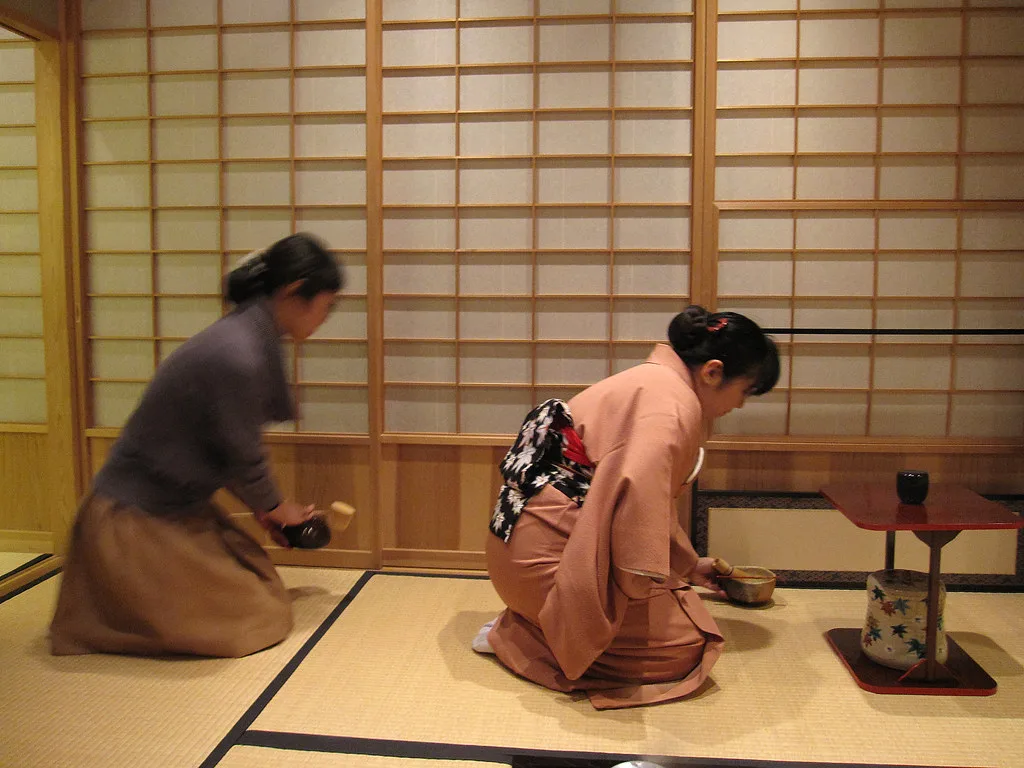
On tatami mat floors, remove slippers entirely. Tatami is delicate and considered a clean surface. Position your shoes near the entrance with the toes pointing outward toward the door, which makes them easy to slip back on when you leave. This small detail signals that you know your way around a traditional space.
Check for separate toilet slippers before entering any bathroom in Japan — they are usually placed right inside or just outside the door. Forgetting to swap them before leaving is one of the few etiquette mistakes that will prompt a gentle correction from locals.
General Social Etiquette and Daily Interactions
Bowing (ojigi) covers greetings, thanks, and apologies. Depth signals the degree of respect: a slight 15-degree nod works for passing thanks, a 30-degree bow is standard for introductions and thank-yous, and a deep 45-degree bow conveys formal apology. As a visitor, a moderate 30-degree bow is appropriate in almost every situation. Do not worry about perfect form — the effort itself communicates respect.
Physical contact between strangers is rare. Avoid hugging, back-patting, or unsolicited handshakes. If a Japanese person extends their hand, accept it warmly. Otherwise, a bow is always the safer default. Personal space is highly valued, particularly on crowded transport.
Indirect communication is the norm. If someone says "that might be a little difficult" (chotto muzukashii), they are politely saying no. Pushing for a direct answer in these moments creates discomfort for everyone. Pay attention to tone and body language rather than the literal words.
Gift-giving (omiyage) is a genuine social ritual, not a formality. Present gifts with both hands, wrapped neatly. Do not expect the recipient to open the gift in front of you — waiting to open it privately is a sign of restraint, not indifference. Avoid sets of four items, as the number four (shi) sounds like the word for death.
| Situation | Do | Don't |
|---|---|---|
| Greeting or thanking someone | Bow at 15–30 degrees | Hug or pat their back |
| Presenting a gift | Use both hands and offer it wrapped | Hand it with one hand or present it unwrapped |
| Receiving a compliment | Accept graciously with "thank you" or a slight bow | Brag or over-accept the praise |
| Communication that seems unclear | Read body language and tone for the real answer | Push for direct verbal confirmation |
| Physical space around you | Respect personal distance on trains and streets | Touch, lean on, or crowd strangers |
| Eye contact in conversation | Make natural eye contact for respect | Stare intensely or avoid eye contact entirely |
Dining and Table Manners in Japan
Before eating, say itadakimasu (ee-tah-dah-kee-mah-soo) — it means "I humbly receive" and expresses gratitude for the food, the people who made it, and everything that went into it. At the end of the meal, say gochisousama deshita (go-chee-soh-sah-mah deh-shee-tah) to the server or host. Both phrases matter and both are used by everyone, not just in formal settings.
Chopstick rules have real cultural weight. Never stick them upright in a bowl of rice — this resembles the incense offerings made at funerals. Do not pass food from chopstick to chopstick for the same reason. When not using chopsticks, rest them on the provided hashioki (chopstick rest) rather than across your bowl. When eating from a communal dish, use the clean, reversed end of your chopsticks, not the end that has touched your mouth.
Slurping noodles and soup is entirely acceptable — it signals enjoyment and helps cool hot food. Picking up your rice bowl to bring it closer to your mouth is correct form (eating hunched over a bowl on the table is considered dog-like, inugui). Avoid pouring soy sauce directly over white rice; it is meant to be eaten plain to appreciate the quality. The oshibori (wet towel) provided at the start of the meal is for your hands only — do not use it on your face or neck.
Never refill your own drink. Scan the table and top up glasses around you; someone will take care of yours in return. This reciprocal gesture is a quiet but meaningful part of Japanese social dining. At group meals, wait until the highest-ranking or oldest person begins eating or drinking before you start.
Never tip at restaurants, bars, hotels, or taxis in Japan — staff will often return extra money to you, and tipping can be interpreted as an insult to their professionalism. The fair price for excellent service is already included in what you pay.
Tipping in Japan: Why You Should Not Do It
Tipping is not customary in Japan and is not a grey area — it is genuinely unwelcome in most contexts. If you leave cash on the table or hand extra money to a server, they will often run after you to return it. The logic is that a fair price for excellent service is already built into what you pay. Tipping implies that the standard service was not good enough without a bonus, which can feel like an insult to staff who take professional pride in their work.
The same applies in taxis, hotels, and at ryokan. The correct response to outstanding service is arigato gozaimasu (ah-ree-gah-toh goh-zah-ee-mah-soo), said sincerely, often accompanied by a small bow. At ryokan, the standard practice is to bring a small wrapped gift or omiyage for your host rather than cash.
One exception worth knowing: some licensed private guides and long-duration tour operators are accustomed to receiving tips from international visitors, and a discreet envelope with a note is not out of place. But in restaurants, bars, taxis, and hotels, keep your wallet closed and your words warm. For budgeting help, our Japan on a budget guide has realistic price expectations across different spending levels.
Japanese Drinking Etiquette
Sharing drinks is a significant part of social bonding in Japan, especially among colleagues. The key rule is that you do not pour your own drink when sharing a bottle. Hold the bottle with both hands when pouring for someone else; if someone pours for you, lift your glass slightly with one or both hands to receive it. This exchange happens continuously throughout a meal and signals mutual respect.
Before anyone takes a first sip, raise glasses and say kanpai! (kahn-pie) — the Japanese equivalent of "cheers." Wait until everyone at the table has a drink in hand before the toast. Starting to drink before the group is a noticeable breach. If you do not drink alcohol, oolong tea or a soft drink is a perfectly acceptable substitute — the ritual of the toast is what matters, not the contents of the glass.
Do not feel obligated to drain every glass offered. If you have had enough, it is acceptable to leave your glass partially full — an empty glass is an invitation for someone to refill it immediately. Blowing your nose at the table is considered particularly rude in Japan; excuse yourself to the bathroom if necessary.
Onsen, Sento, and Bathing Etiquette
Public bathing in Japan follows a specific sequence, and getting it right matters because you are sharing the water with strangers. Before entering any communal bath — whether an outdoor onsen (hot spring) or an indoor sento (public bath) — wash yourself thoroughly at the shower stations provided. This is non-negotiable. The bath is for soaking, not for cleaning.
Bathing is done completely nude. Bring your small modesty towel into the bathing area, but do not let it touch the water. Place it folded on your head or set it on the bath edge. Before lowering yourself into a new pool, scoop a few ladles of water over your body to help acclimatise and avoid temperature shock. Keep conversation quiet; onsens are spaces for calm, not socialising loudly.
Tattoos remain restricted at many establishments — the association with organised crime (yakuza) has historical roots that modern management is slow to change. Some onsens in major tourist areas now allow small covered tattoos; others are strict. Check the policy before you go, either via the onsen's website or by calling ahead. A few tourist-focused private baths (kashikiri onsen) offer fully enclosed tubs for parties of one or two, which sidesteps the issue entirely.
At a ryokan, additional slipper rules apply (see the shoe section above). Do not walk in corridor slippers on tatami mats, and do not bring outdoor shoes into the inn beyond the entrance foyer. Ryokan meals are often served at a set time — being late is considered disrespectful to the kitchen staff who time preparation carefully.
Public Transport and Street Etiquette
Japanese trains run on silence as much as on electricity. Set your phone to silent or vibrate before boarding. Avoid phone calls entirely. Keep voice volume low, even in conversation. Eating and drinking (anything beyond a sealed bottle of water) is frowned upon on most urban trains; on long-distance Shinkansen, eating is acceptable. Priority seats near the carriage doors are reserved for the elderly, pregnant passengers, and people with disabilities — the Help Mark tag (a red tag with a white heart) indicates someone who needs consideration, even if their disability is not visible.
Women-only carriages operate on many lines during morning rush hour (typically 07:00–09:30). These are clearly marked and colour-coded. Male passengers should check signage before boarding during those hours.
On escalators, stand on the left in Tokyo (Kanto region) and on the right in Osaka and Kyoto (Kansai region). Leave the opposite side clear for people walking. Queuing is observed strictly at train doors — wait at the marked positions on the platform, let passengers exit before boarding, and do not push.
Eating while walking is considered bad manners. If you buy street food at a festival or market stall, step to one side and finish it before moving on. Littering is essentially absent in Japan, but public bins are also scarce — carry a small bag for wrappers and packaging until you find a convenience store or station bin. Jaywalking carries a fine of up to ¥50,000, and locals reliably wait for the green pedestrian signal even when the road is empty.
Shrine and Temple Etiquette
Shinto shrines and Buddhist temples operate under similar but distinct codes. At a shrine, bow once before passing through the torii gate, then walk along the side of the approach path (sando) — the centre is for the gods. At the temizuya water pavilion, purify your hands in sequence: ladle in right hand, rinse left; switch to left hand, rinse right; scoop water into your cupped left hand and rinse your mouth; tilt the ladle upright to rinse the handle before returning it. Do not drink directly from the ladle.
At the main hall, toss a coin into the offering box. A ¥5 coin is considered especially auspicious: the Japanese word for five yen (go-en, 五円) is homophonous with go-en (御縁), meaning "good connection" or "fate." Locals specifically look for ¥5 coins before a shrine visit for this reason — it is a detail few guidebooks mention but most Japanese visitors observe instinctively. After tossing the coin, bow twice, clap twice, offer a silent prayer, then bow once more.
At Buddhist temples, the prayer ritual differs: light incense at the burner, waft the smoke gently toward yourself (it is believed to have healing properties), then bow and pray with hands pressed together. There is no clapping at temples. Dress modestly at both types of sites and speak quietly throughout. Photography is generally permitted in open areas but prohibited in inner sanctuaries — look for signs and err on the side of putting the camera away during active ceremonies.
For trip planning around Japan's most significant sites, see our 20 Best Places to Visit in Japan (2026): Ultimate Travel Guide guide, which covers major shrine and temple destinations across the country.
Business Card and Professional Etiquette
If you are in Japan for any professional or semi-formal purpose, the business card exchange (meishi koukan) is a ritual you need to know. Cards are presented and received with both hands, accompanied by a slight bow. When presenting, hold the card so the Japanese side faces the recipient with text right-side up. When receiving, take a moment to read the card carefully — this shows genuine respect. Do not write on it, fold it, or stuff it into your back pocket while the person is still present.
If you are seated for a meeting, place received cards on the table in front of you for the duration. At the end, store them carefully in a card holder. Punctuality is treated as a baseline requirement, not a courtesy: arriving ten minutes early is normal, arriving on time is the minimum, and being late without warning is a serious breach.
In group settings, observe the hierarchy. Wait for the most senior person to begin eating, drinking, or speaking before you follow. Modesty and deference to seniority — even when you outrank the other party in your own culture — go a long way in building trust with Japanese business contacts.
Common Mistakes and How to Recover
The most frequent visitor mistakes cluster around a handful of situations. Sticking chopsticks upright in rice, tipping at a restaurant, and wearing toilet slippers back to the table are the three that generate the most visible discomfort. If you commit any of these, a brief apology — sumimasen (soo-mee-mah-sen) for mild situations, moushiwake gozaimasen for anything more serious — accompanied by a small bow, closes the moment cleanly. Japanese people appreciate the apology and move on quickly.
Pointing with a single finger is considered rude; use an open hand instead. Blowing your nose in public — particularly at the dining table — is frowned upon across the country. Step away to a bathroom. Loud conversation on public transport draws stares rather than complaints; if you notice the carriage getting quieter around you, take the hint.
Leaving food on your plate is mildly impolite, particularly at a ryokan or home meal where care has gone into preparation. Finish what you can, and if you have dietary restrictions, it is worth communicating them before the meal rather than leaving food untouched. A useful phrase before sitting down: arerugii ga arimasu (I have an allergy) followed by the specific item. Most restaurants in tourist areas can accommodate common restrictions if warned in advance. For a full itinerary that accounts for these cultural moments, our 2-week Japan itinerary maps out each day with context.
Frequently Asked Questions
Why is etiquette important for travelers in Japan?
Understanding Japanese etiquette shows respect for the local culture. It helps you avoid unintentional offense and enhances your travel experience. Adhering to customs fosters positive interactions with locals. This also allows for deeper cultural immersion.
Is Japanese etiquette difficult for foreigners to learn?
While Japanese etiquette has many nuances, basic rules are easy to grasp. Locals appreciate any effort visitors make to follow customs. Do not worry about perfection. Focus on showing respect and thoughtfulness in your interactions.
What are common Japanese dining etiquette rules?
Key dining rules include using chopsticks properly and slurping noodles. Say itadakimasu before eating and gochisousama deshita afterward. Avoid tipping, as it is not customary. Always wait for others to be served before starting.
How should I use chopsticks correctly in Japan?
Never stick chopsticks upright in your rice or pass food between them. Rest them on a chopstick rest when not in use. Avoid pointing with chopsticks. These practices prevent cultural misunderstandings.
What is the etiquette for visiting a Japanese shrine or temple?
Bow at the torii gate and purify your hands and mouth at the temizuya. Make an offering and follow the specific prayer rituals for shrines. Maintain a respectful demeanor and avoid loud noises. Always check for photography restrictions.
Japanese etiquette is not a long list of prohibitions — it is a consistent underlying logic of consideration for people around you. Most rules follow naturally from that principle once you understand it.
Start with the highest-impact habits: shoes off at the right moment, chopsticks held correctly, phone silenced on trains, and a genuine itadakimasu before every meal. The rest will follow with observation.
Locals will meet your effort with warmth. Enjoy your trip.
Free guide: Japan's Hidden Gems
12 under-the-radar places beyond Tokyo & Kyoto — with the best season to visit each and a local tip you won't find in the guidebooks.
You might also like

Continue reading
More guides you'll find useful