
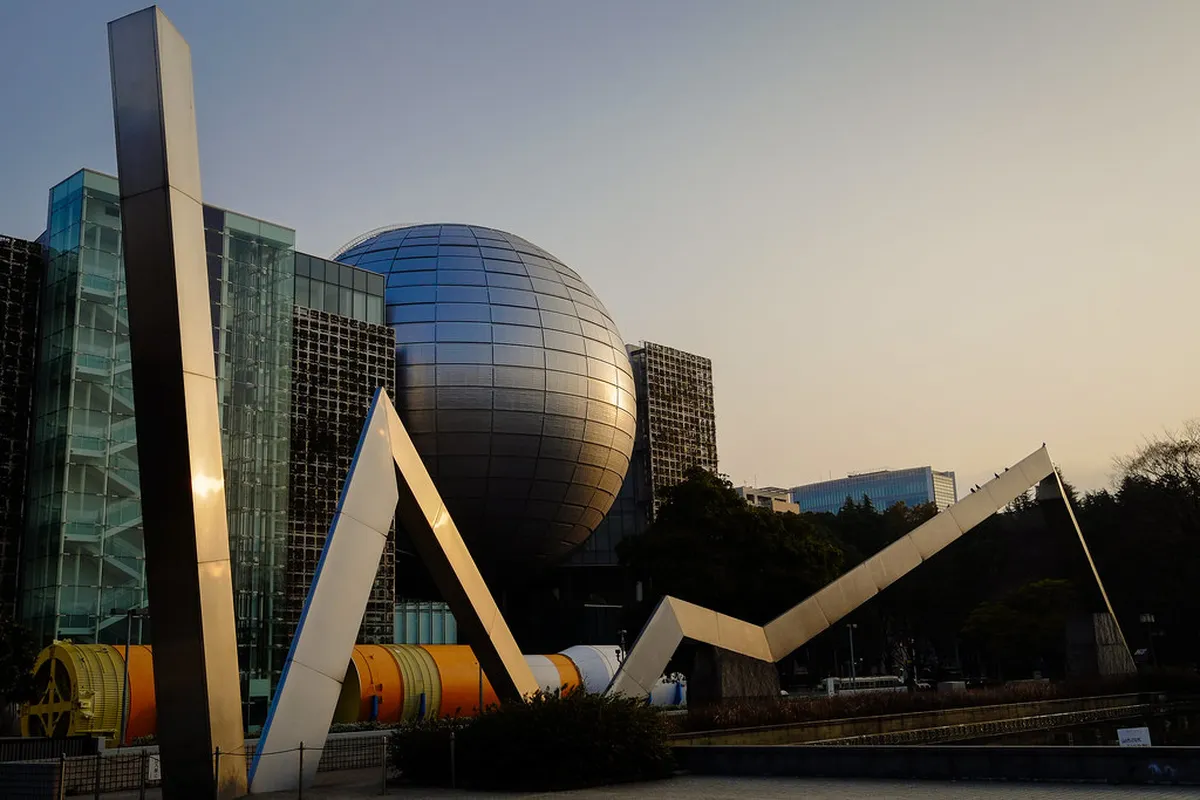
The Nagoya City Science Museum stands as a brilliant landmark in the heart of Japan’s fourth-largest city. Its iconic silver sphere houses the world’s largest planetarium and draws thousands of curious visitors every year. Travelers visit this site to experience extreme-scale interactive laboratories and hands-on scientific exhibits across seven floors. This Nagoya visitor guide covers the practical details international travelers need to know before they arrive.
Located within the scenic Shirakawa Park in the Sakae district, the museum is divided into three interconnected wings: Life Science, Science and Technology, and the Astronomy Building that anchors the famous silver sphere. Exhibits range from human biology and polar ice samples to a nine-metre tornado generator and man-made lightning. Planning a successful trip requires understanding the specific timing of laboratory demonstrations and the ticketing rules that catch many foreign visitors off guard.
Many visitors are surprised by how strict the scheduling is here compared to other Japanese museums. The three main live-demonstration labs each run on timed slots that are easy to miss if you arrive without a plan. This guide covers the Big Three labs, the planetarium language question, closure traps, and what the Sakae district offers once you step outside. Read on to make the most of your time at one of Nagoya’s most popular attractions in 2026.
Essential Visitor Information: Hours, Fees, and Access
Operating hours run from 09:30 to 17:00, with last entry at 16:30. The museum closes every Monday and on the third Friday of each month for maintenance. If that third Friday falls on a public holiday, the closure shifts to the following fourth Friday instead — a detail that catches many tourists off guard. Always verify the current schedule on the official site before you visit.
Ticket pricing in 2026 breaks down as follows:
- Museum only — Adults: ¥400 / High school & university students: ¥200 / Junior high and under: free
- Museum + Planetarium — Adults: ¥800 / High school & university students: ¥500 / Junior high and under: free
| Ticket type | Museum only | Museum + Planetarium |
|---|---|---|
| Adults | ¥400 | ¥800 |
| High school / university students | ¥200 | ¥500 |
| Junior high and under | Free | Free |
International travelers must know the Student ID Trap before reaching the ticket counter. The museum accepts only local Japanese student cards for reduced fares. Foreign university IDs and international ISIC cards are routinely rejected. Expect to pay the full adult price unless you are travelling with children under junior-high age, who enter at no charge.
The museum only accepts local Japanese student cards for reduced fares. Foreign university IDs and ISIC cards are routinely rejected. International visitors should plan to pay full adult admission.
Reaching the museum is straightforward via the Nagoya Municipal Subway. Take the Higashiyama or Tsurumai Line to Fushimi Station and use Exit 4 or 5 for a five-minute walk to the silver sphere in Shirakawa Park. The central location makes it easy to combine your visit with other Nagoya industrial attractions nearby.
The World’s Largest Planetarium: Is It Worth the Visit?
The Brother Earth planetarium holds a 35-metre diameter dome and is one of the world’s largest planetariums by dome size. The high-resolution projectors produce a night sky that fills your entire field of vision from the reclining seats. The visual quality is genuinely world-class and unlike anything available at smaller facilities. Shows run to about 50 minutes per session.
Non-Japanese speakers should weigh one honest trade-off: the narration is delivered entirely in Japanese with no English audio or subtitles. Some Chinese text appears briefly on screen for planet names, but this is the extent of any non-Japanese support. If you rely on verbal commentary to stay engaged during a 50-minute show, the language gap may make the experience feel long. Visual learners who enjoy the star-field spectacle will still find it worthwhile purely for the scale.
The planetarium also enforces some of the strictest audience conduct rules in Nagoya. Children must remain completely silent throughout the show; those who cannot are escorted out by staff who actively patrol the aisles during the presentation. This is worth knowing if you are travelling with young children who find it hard to sit still in the dark for 50 minutes. The seats are exceptionally comfortable, which helps — but the enforcement is real.
Planetarium tickets are limited and often sell out within the first hour after opening. Queue before 09:30 on weekends or holidays. Staff distribute timed-slot tickets at the door until capacity is reached, and you cannot swap your allocated slot for a different time. If you are undecided on the combo ticket, decide before you join the general admission queue — returning to upgrade later risks losing available planetarium slots.
The Deep Freezing Lab requires a separate numbered ticket collected at the lab entrance — pick it up first thing upon arrival, as afternoon slots fill before lunch. The Tornado Lab and Electric Discharge Lab use open-seating areas, so arriving five minutes early secures a front-row position.
Must-See Interactive Exhibits: The "Big Three" Labs
The museum is famous for three large-scale laboratory demonstrations that run on timed daily schedules. Because each lab operates independently, seeing all three in one visit requires planning your floor-by-floor route before you enter. Check the schedule board posted near the main entrance as soon as you arrive and note the start times for each lab that day. Missing a slot usually means waiting 60 to 90 minutes for the next one.
The Deep Freezing Lab drops visitors into a room held at minus 30 degrees Celsius. Real ice samples from polar regions are on display, and staff explain the science of extreme cold. This exhibit requires a separate numbered ticket collected at the lab entrance — pick it up first thing, as afternoon slots fill before lunch. The lab session lasts about 20 minutes including the briefing.
The Tornado Lab generates a nine-metre-tall air vortex on a fixed schedule, typically every hour. Watching the mist spiral into a full column overhead is one of the most visually dramatic moments in the entire museum. The Electric Discharge Lab produces man-made lightning from two large coils, with sessions producing sparks at around 1.2 million volts. Both of these labs use open-seating viewing areas, so arriving five minutes early secures a front-row position.
Beyond the Big Three, the Science and Technology wing contains a detailed model railway on the third floor that is popular with children and adults drawn to industrial history. The Chubu region’s contributions to Japanese manufacturing are given particular focus here, making it a distinctive section you won’t find at science museums in Tokyo or Osaka. Plan at least two hours for the main gallery floors after you have secured your lab tickets, and keep an eye on the schedule board throughout the day.
Planning Your Visit: Timing and Crowd Management
Weekdays during the school term are the quietest times to visit. Weekends and public holidays bring large numbers of local families and school groups, especially on Saturday mornings. If a weekend visit is unavoidable, arrive 30 minutes before the 09:30 opening to secure planetarium tickets and Deep Freezing Lab numbered passes before they run out. By midday on busy days, both are commonly gone.
A practical floor strategy saves significant time. Start at the top floor and work downward, collecting lab tickets as you pass each registration point. Most arriving groups head straight for the ground and first floors, so starting high gives you a quieter experience in the upper galleries before the crowds migrate upward. Allow four to five hours for a full visit across all three wings.
Lunch inside the museum is limited to a small cafe and vending machines. Many visitors leave for an hour, eat in the Sakae district, and return using their ticket stub for same-day re-entry. This is an underused option that lets you recharge properly before afternoon laboratory sessions. The Sakae area immediately around the museum has a wide range of restaurants at every budget, from ramen counters to department store food halls. For a broader overview of visiting options, see our Nagoya itinerary.
Navigating the Museum: Map and District Context
The museum’s three interconnected buildings can disorient first-time visitors. The Life Science Building covers human biology and the natural world. The Science and Technology Building holds the transport exhibits, mechanics displays, and the model railway. The Astronomy Building is dominated by the planetarium sphere with space-themed galleries wrapping the dome on every floor.
Large floor maps are posted near every elevator bank, and staff on each floor can provide directions in basic English. Elevators are wide enough for pushchairs and wheelchairs, making every floor accessible. The entire facility is designed to be navigable by families, though the distance between wings on the upper floors adds walking time that first-timers tend to underestimate.
Shirakawa Park surrounds the building and provides an immediate green buffer from the city. The Nagoya City Art Museum sits just steps away in the same park grounds. The contrast between the park’s trees and the giant silver sphere overhead makes this area one of the most photographed corners of central Nagoya. Allow ten minutes at the park before or after your museum visit.
The broader Sakae district is Nagoya’s primary commercial and entertainment hub. Major department stores, the Nagoya TV Tower, and a dense network of restaurants and cafes are all within a ten-minute walk. Multiple subway lines and bus routes converge at Sakae, making onward travel to other city attractions fast and straightforward.
Beyond the Museum: Exploring Shirakawa Park and Sakae
After leaving the museum, Shirakawa Park is worth a short walk. The park has sculptures, fountains, and benches where locals sit during lunch breaks. It makes a calm transition between the dense stimulation of the science exhibits and the busier shopping streets of Sakae immediately to the north.
History-focused travelers can head north to Nagoya Castle, one of the most significant sites in the Chubu region. The castle grounds are reachable in about 15 minutes by subway. Combining the science museum with the castle in a single day gives a sharp contrast between Nagoya’s industrial modernity and its feudal past.
For a cultural shift after all that science, Osu Kannon temple and its surrounding shopping arcade are about a ten-minute walk from Shirakawa Park. The arcade offers street food, vintage clothing shops, and electronics stalls in a lively covered market atmosphere. It is a strong antidote to the hushed, exhibit-focused pace of the science museum. If you are planning to venture further afield, check out our Nagoya day trips guide for destinations just beyond the city.
If ceramics and craft history interest you, Noritake Garden is another option that pairs well with the museum’s industrial focus. Nagoya’s identity as a manufacturing city runs through both the science museum’s Chubu industry exhibits and Noritake’s porcelain heritage. The two together give visitors a more complete picture of what makes Nagoya distinct from other Japanese cities.
Frequently Asked Questions
Is the Nagoya City Science Museum planetarium in English?
No, the planetarium shows are conducted entirely in Japanese. While the visuals are world-class and immersive, there are currently no English audio guides or subtitles available for the narration. Most international visitors still find the experience worthwhile for the incredible 35-meter dome display and high-resolution star projections.
How much are tickets for the Nagoya City Science Museum?
Standard admission to the museum exhibits costs 400 yen for adults. If you wish to include the planetarium show, the total price is 800 yen. High school and university students pay 200 yen for the museum or 500 yen for both, provided they have a valid Japanese student ID.
Do I need a student ID for discounts at Nagoya museums?
Yes, the museum is very strict about student discounts and usually requires a local Japanese student ID. International student cards or ISIC cards are often not accepted for the reduced fare. Most foreign travelers should expect to pay the standard adult admission price unless they are under 15 years old.
How long does it take to see the Nagoya City Science Museum?
Most visitors spend between three and five hours exploring the seven floors of exhibits. This timeframe allows you to see the major labs and attend one planetarium show. If you are a science enthusiast, you might need a full day to interact with every display in the Nagoya city center.
What are the best exhibits at the Nagoya City Science Museum?
The 'Big Three' labs are widely considered the best attractions: the Tornado Lab, the Electric Discharge Lab, and the Deep Freezing Lab. The planetarium is also a must-see as it is the largest in the world. Children often enjoy the water science area and the giant railway model on the upper floors.
The Nagoya City Science Museum is a premier destination that perfectly blends education with entertainment. Its world-record planetarium and massive interactive labs offer experiences you cannot find anywhere else. By following this guide, you can navigate the ticket rules and schedules with total confidence. Make sure to arrive early to secure your spot for the most popular demonstrations.
Beyond the science exhibits, the museum's location in Sakae makes it a convenient stop for any traveler. You can easily pair your visit with a trip to the art museum or a shopping spree in the city center. The facility remains one of the most affordable high-quality attractions in all of Japan. It provides lasting memories for families, students, and solo explorers alike.
We hope this visitor guide helps you make the most of your time in this fascinating city. Nagoya's commitment to scientific progress is clearly visible in every corner of this iconic building. Prepare for a day of wonder as you explore the mysteries of the universe and the laws of nature. Safe travels as you discover the many wonders waiting for you in the heart of Nagoya.


