

The CUPNOODLES Museum Yokohama is one of Japan's most interactive and rewarding food museums. It celebrates the invention of instant ramen and the remarkable life of Momofuku Ando, the man who changed how the world eats. Located in the Minato Mirai waterfront district, the four-story building packs hands-on workshops, a global food court, and a striking exhibit hall into a single half-day outing. Admission is ¥500 for adults, and children of high school age and younger enter free.
Visiting this museum is a highlight for anyone exploring the vibrant city of Yokohama as part of a broader Yokohama itinerary. The workshops sell out fast, especially on weekends, so knowing the booking rules before you arrive is essential. This guide covers the key exhibits, both factory workshops, the food court, the children's play area, and everything you need to plan a smooth 2026 visit.
The Yokohama Cup Noodles Museum
The Yokohama Cup Noodles Museum sits at 2-3-4 Shinko, Naka-ku, in the heart of the Minato Mirai waterfront area. It was founded by Nissin Foods to honor Momofuku Ando — the inventor of both Chicken Ramen in 1958 and Cup Noodles in 1971. The building is open 10:00–18:00, with last admission at 17:00. It is closed on Tuesdays, though when Tuesday falls on a national holiday the museum stays open and closes the following day instead.
The second floor is where most visitors begin: the Instant Noodles History Cube displays over 3,000 instant noodle packages from around the world, arranged as a visual timeline of the product's global spread. From there, the Momofuku Theatre runs a short film about Ando's life, and a faithful replica of his backyard shed shows the makeshift lab where he invented flash-fried noodles. English audio guide devices are available at the ticket counter along with Chinese and Korean versions.
The museum shop near the entrance does not require a ticket to browse. It sells exclusive Nissin merchandise, limited-edition ramen flavors, Chicken Ramen stationery, and space-food noodles. Lockers are available on-site, and the building is fully accessible for strollers and wheelchairs.
A History of Instant Noodles
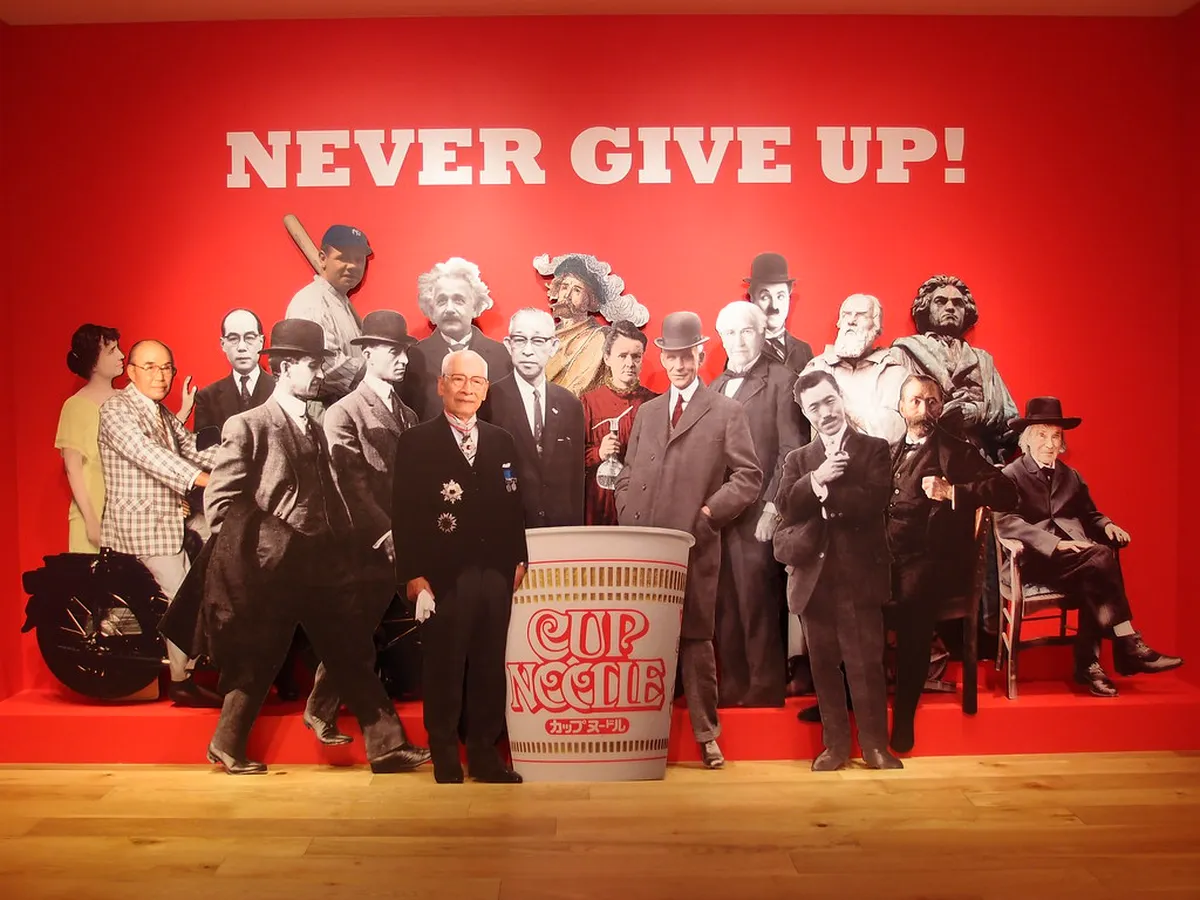
The story begins in 1958, when Momofuku Ando — then 48 years old — spent a year in a small backyard shed in Ikeda, Osaka, trying to solve Japan's post-war food shortage. He watched long queues forming outside noodle stalls and decided there had to be a faster way. His breakthrough came while watching his wife fry tempura: he realized that flash-frying fresh noodles in oil would remove moisture, and that hot water would later restore them to the right texture. Chikin Ramen was born.
The leap to Cup Noodles came from an unexpected direction. During a 1971 business visit to the United States, Ando watched American executives break his noodle block into a cup of hot water and eat it with a fork rather than chopsticks. Rather than being offended, he saw an opportunity to make the product truly global. Back in Japan he designed the first waterproof polystyrene cup, and Cup Noodles reached the market that same year.
Ando's final innovation arrived in 2005, at the age of 94: Space Ram, the first instant noodles engineered to be eaten in zero gravity. Japanese astronaut Soichi Noguchi carried it into orbit on 26 July 2005. Ando died in 2007 at age 96, and his famous quote — "It's never too late to do anything in life" — is displayed prominently on the museum walls. Today, over 100 billion servings of instant noodles are consumed worldwide each year.
Thank the Americans for Noodles in a Cup
The Cup Noodles origin story is one of the museum's most memorable exhibits. It re-creates the moment in 1971 when Ando visited the United States and observed a business meeting where executives improvised with his noodle block, a styrofoam coffee cup, and a fork. That casual improvisation sparked the idea for the self-contained cup format. The museum displays the original prototype cup alongside the export packaging that followed shortly after.
This detail matters for visitors because it frames the whole museum differently. The CUPNOODLES Museum is not simply about Japanese food — it is about how a Japanese inventor watched another culture adapt his product and then used that observation to make it accessible to everyone. The exhibits on this theme are among the most engaging on the second floor, and the Momofuku Theatre film covers it directly. Budget 20–30 minutes for this section before heading upstairs to the workshops.
My CUPNOODLES Factory: How to Get Your Ticket
The My CUPNOODLES Factory on the third floor is the most popular attraction in the building. For ¥500 per cup (charged separately from admission), you purchase a blank white cup from a vending machine, decorate it with markers at a design station, and then move along a guided production line. At each station an aproned factory worker helps you choose a soup flavour — Classic, Curry, Seafood, or Chili Tomato — and up to four toppings from a list of twelve options including shrimp, corn, egg, kimchi, and crab-flavoured fish cake. The finished cup is heat-sealed and pumped into an air-cushion bag that protects it on the journey home. This factory experience is one of the highlights covered in detail in our dedicated Cup Noodles Museum guide.
The single most common mistake is exploring the second-floor exhibits first. By the time visitors reach the third floor, the day's My CUPNOODLES Factory tickets are exhausted. Collect your numbered ticket the moment you walk through the entrance.
There is no advance online booking for the My CUPNOODLES Factory. Timed entry is managed entirely through numbered tickets distributed at the museum on the day. Time slots run every 30 minutes from 10:00 to 17:00, and once all tickets are gone for the day reception closes. The single most common first-timer mistake is exploring the second-floor exhibits first — by the time they reach the third floor, the day's tickets are exhausted. Collect your numbered ticket as soon as you clear the admission desk, then go back and enjoy the History Cube and Momofuku Theatre while you wait for your slot.
On busy weekends and school holidays in 2026, tickets for the most popular mid-morning slots are typically gone within the first hour of opening. Arriving at 10:00 when the doors open is the safest approach. Weekday mornings between 10:00 and 11:30 are the quietest windows if your schedule allows flexibility.
Make Your Own Chicken Ramen
The Chicken Ramen Factory is the museum's deeper, slower workshop — and it is frequently overlooked by visitors who focus only on the My CUPNOODLES Factory. Here you make noodles entirely from scratch: mixing wheat flour and water, kneading, rolling, steaming, and then flash-frying the dough the same way Ando did in his 1958 shed. The finished packet is custom-designed by you and sealed to take home. The workshop takes 90 minutes and provides a hands-on lesson in why Ando's flash-frying technique was such a breakthrough.
There are eight time slots each day starting at 10:15 and ending at 16:45, spaced 45 minutes apart. Each station is built for two people working together, so groups must have an even number of participants. Unlike the My CUPNOODLES Factory, this workshop requires an advance reservation — you can apply online from three months before your visit up until the day before. The cost is ¥1,500 per person. Slots fill up weeks in advance during Golden Week and summer school holidays, so book as early as possible at the official museum reservation page.
The Chicken Ramen Factory is best suited to visitors aged around 10 and up who want a more immersive experience than decorating a cup. It is also the better choice for anyone who wants to understand the food science behind instant noodles rather than just the packaging experience.
The Cup Noodles Park for Children
The Cup Noodles Park is an indoor playground designed for children aged 3 through elementary school. The play area re-creates the instant noodle production process from the perspective of the noodles themselves: children crawl through tunnels, slide down chutes, and bounce through giant mixing chambers, acting out each stage of manufacture. It is a clever way to turn factory logistics into a physical game, and it burns off energy while delivering something genuinely educational.
Entry costs ¥500 per child and visits are divided into 30-minute time slots running from 10:30 to 17:30, with last entry at 17:00. The number of children per slot is capped, so collect a ticket for this attraction at the same time as you pick up your My CUPNOODLES Factory ticket — both run on numbered day tickets that are distributed on arrival. Adults accompanying children do not need to pay the ¥500 fee to watch from the viewing area.
Eat Around the World at the Noodles Bazaar
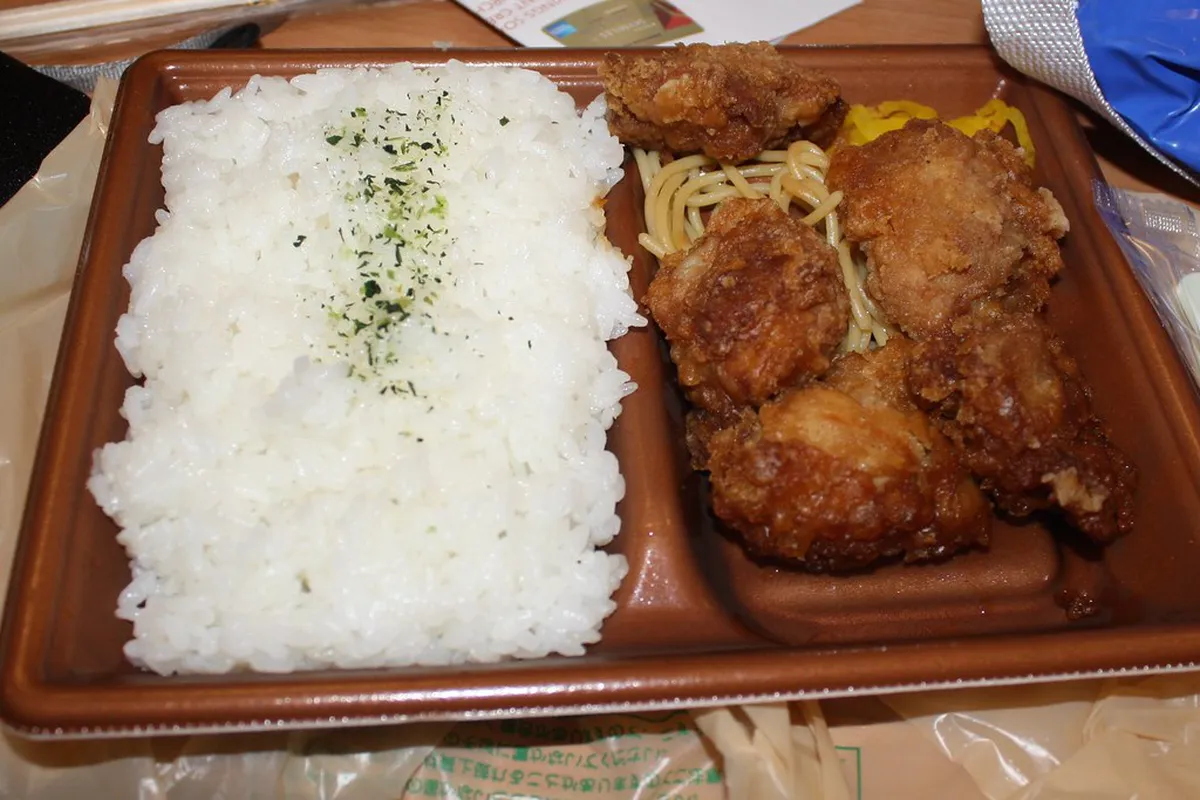
The Noodles Bazaar on the top floor is designed to look like a bustling Asian night market. Eight stalls each serve a half-portion noodle dish from a different country, including Malaysian Laksa, Indonesian Mie Goreng, Vietnamese Pho, Kazakhstani Lagman, Italian pasta, and a mini bowl of the original Chicken Ramen. Dishes cost ¥500 each; beverages are ¥250. Because portions are deliberately small, two or three dishes make a satisfying lunch and let you compare flavour profiles across cultures.
The food court is communal, with picnic tables in the center where groups can spread out and share. This layout makes it significantly better for families than a conventional restaurant — everyone can choose a different dish and sit together. The noon hour is the busiest window; arriving at 11:30 or after 13:30 usually means shorter queues at the stalls. You can also try a cup-noodle-flavoured soft-serve ice cream here, a niche but popular novelty that no competitor page seems to mention.
If you are still hungry after the Noodles Bazaar, Yokohama Chinatown is about 20 minutes on foot or one train stop away. It is one of the largest Chinatowns in Asia and offers a very different but complementary food experience.
Family-Friendly and Budget-Friendly Options
The museum shop near the entrance is free to browse without buying a ticket — it stocks limited-edition ramen flavours, space-food noodle packs, and ramen-themed stationery not found in ordinary convenience stores.
The CUPNOODLES Museum is one of the most cost-effective major attractions in Yokohama. Adults pay ¥500 admission and children of high school age and younger enter free. The My CUPNOODLES Factory adds ¥500 per person, the Cup Noodles Park costs ¥500 per child, and the Chicken Ramen Factory is ¥1,500 per person. A family of two adults and two children doing every paid activity spends roughly ¥5,500 total — considerably less than a comparable half-day at most theme parks.
The museum shop near the entrance is free to enter without a ticket, which makes it a useful last stop for anyone who wants to browse exclusive Nissin goods without committing to admission. Limited-edition ramen flavours, space-food noodle packs, and ramen-themed stationery are among the items you will not find in ordinary convenience stores. Many visitors pick up a few extra cups of rare flavours as gifts.
| Experience | Cost | Booking |
|---|---|---|
| General admission (adults) | ¥500 | Walk-in |
| Children (high school age and younger) | Free | — |
| My CUPNOODLES Factory | ¥500 per cup | Numbered ticket on arrival |
| Cup Noodles Park (per child, 30 min) | ¥500 | Numbered ticket on arrival |
| Chicken Ramen Factory | ¥1,500 per person | Advance reservation required |
| Noodles Bazaar dishes | ¥500 each | Walk-in |
Cup Noodles Museum vs Shin-Yokohama Ramen Museum
Two ramen-focused museums in Yokohama draw different types of visitors. The Shin-Yokohama Ramen Museum is located in Shin-Yokohama, a separate neighbourhood reachable by a transfer on the Blue or Yokohama Line from Sakuragicho. It focuses on traditional hand-crafted ramen rather than instant noodles, and its basement food court re-creates an Edo-period street market with pop-up restaurants serving regional specialty ramens, some from Michelin-noted kitchens. Entry is ¥310 for a one-day pass.
The CUPNOODLES Museum is the better choice for families with children, large groups, and first-time visitors who want hands-on creativity. The Cup Noodles Park, the My CUPNOODLES Factory, and the communal food court all cater explicitly to mixed-age groups. The Shin-Yokohama Ramen Museum suits ramen connoisseurs, Japanese culture enthusiasts, and adults who prefer sitting down to a full-sized artisan bowl over a decorating workshop. Its basement atmosphere — wood-panelled facades, soft lantern lighting, the feel of old Japan — is unmatched by the Cup Noodles Museum's more contemporary, theme-park-adjacent design.
If your schedule allows, visiting both in one day is feasible. From Minatomirai Station, take the Minatomirai Line to Kikuna, transfer to the Yokohama Line, and alight at Shin-Yokohama — about 30 minutes total. Do the CUPNOODLES Museum in the morning so you can collect your My CUPNOODLES Factory ticket at opening, then head to Shin-Yokohama for a late lunch.
How to Get to the CUPNOODLES Museum
The closest station is Minatomirai on the Minatomirai Line, a 10-minute walk from the museum. From Tokyo, take the Tokyu Toyoko Line from Shibuya directly to Minatomirai Station — the journey takes about 30 minutes. You can also arrive at Sakuragicho Station (JR Negishi Line or Yokohama Municipal Subway Blue Line) and walk 15 minutes through the Minato Mirai 21 waterfront promenade.
For a more scenic approach, the Yokohama Air Cabin ropeway departs from Sakuragicho and drops you near World Porters mall, a 5-minute walk from the museum. It is a fun addition for families and saves you from a longer waterfront walk. Plan for a 10-minute walk from either station regardless of which route you take.
The museum is closed on Tuesdays (with the national-holiday exception noted above) and during the year-end and New Year period. Check the official website before you travel, especially around Golden Week in late April and early May when holiday schedules may shift closure days. Budget 2.5 to 4 hours total if you are doing the My CUPNOODLES Factory, the Noodles Bazaar, and the main exhibits.
What to Do Near the Museum
The museum is perfectly positioned for a broader Minato Mirai day — in fact, it pairs well with many other things to do in Yokohama. The historic Red Brick Warehouse is a 10-minute walk along the waterfront and houses restaurants, boutique shops, and regular events. In the other direction, the Yokohama Landmark Tower is about 15 minutes on foot and offers a sky-garden observation deck with panoramic city views. The Yamashita Park promenade runs along the bay and connects easily to the museum area for a relaxing waterfront stroll.
The World Porters shopping mall sits directly across the street from the museum and offers international stores, a food court, and a useful transport hub if you are heading onward by bus. Yokohama Cosmoworld amusement park, with its iconic illuminated Ferris wheel, is a short walk away and makes an easy evening add-on. The entire Minato Mirai district is pedestrian-friendly and well-lit at night, so there is no need to rush your itinerary.
Frequently Asked Questions
What is the Cupnoodles Museum Yokohama?
The Cupnoodles Museum Yokohama is an interactive facility dedicated to the history of instant ramen. It features hands-on workshops, educational exhibits, and a global food court. Visitors can learn about the inventive spirit of Momofuku Ando while creating their own custom noodle cups.
So Which Should You Visit? The Yokohama Cup Noodles Museum or the Shin-Yokohama Ramen Museum?
The Cup Noodles Museum is better for families and those seeking interactive workshops. The Shin-Yokohama Ramen Museum focuses more on the history of traditional ramen and offers a wider variety of full-sized restaurant meals. Choose the former for creativity and the latter for a deep culinary tasting experience.
Which Yokohama Ramen Museum is better for visiting with kids?
The Cup Noodles Museum in Minato Mirai is the superior choice for children. It features an indoor playground, creative craft workshops, and colorful exhibits that are easy to understand. The Yokohama Air Cabin nearby also adds to the family-friendly appeal of this specific location.
Do I need to book tickets in advance for the museum?
General entry tickets can usually be purchased at the door without much trouble. However, you must book the My CupNoodles Factory and Chicken Ramen Factory workshops in advance online. These popular activities often sell out weeks ahead of time during peak travel seasons and school holidays.
The CUPNOODLES Museum Yokohama is a rare attraction that works equally well for solo travelers, couples, and families. The history of instant noodles turns out to be a genuinely compelling story about creativity, cultural adaptation, and persistence — told through exhibits, films, and workshops that keep you engaged far longer than you might expect. Admission is low, children enter free, and the hands-on activities deliver lasting memories.
The single most important piece of advice for 2026: collect your My CUPNOODLES Factory numbered ticket the moment you walk through the entrance. Do not leave it until after you have explored the History Cube. Tickets are finite and distributed on a first-come basis — securing yours first is the difference between a complete visit and a disappointing one. Everything else in this guide follows logically from that one step.