
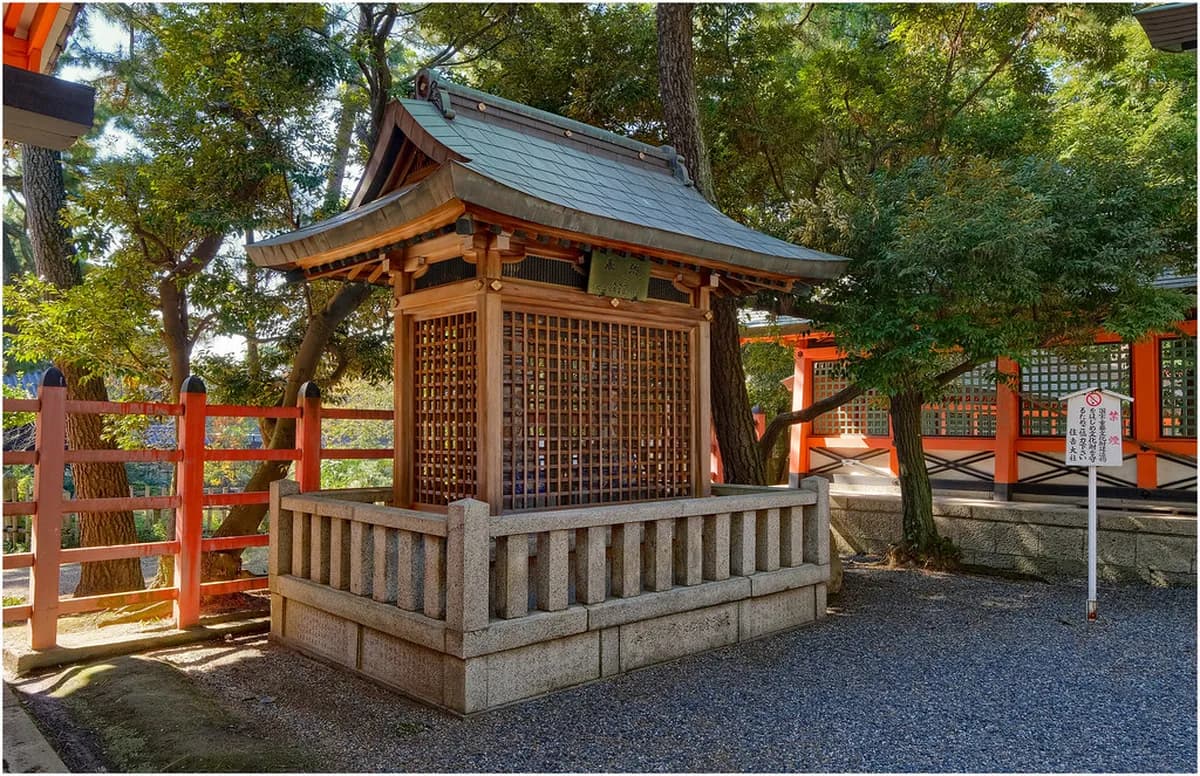
Atsuta Shrine stands as one of Japan's most important Shinto sites and a must-visit destination in Nagoya. This sacred forest complex houses the legendary Kusanagi sword, making it a central pillar of Japanese imperial history and one of the country's Three Imperial Regalia. The shrine attracts close to 10 million visitors a year, yet its 200,000-square-meter forested grounds absorb the crowds remarkably well. This atsuta shrine visitor guide covers everything you need to plan your 2026 visit — from the fastest train routes to the best moment to order eel.
The History and Significance of Atsuta Jingu
The shrine is nearly 2,000 years old. According to the Kojiki (712 AD) and Nihonshoki (720 AD) — Japan's oldest written histories — it was founded when Prince Yamato Takeru died in 113 AD and his widow enshrined his possessions alongside the Kusanagi-no-tsurugi sword at this location. The sword is one of the Three Sacred Treasures of Japan, representing the virtue of valor, and was said to have been gifted by the sun goddess Amaterasu. You can read the full foundational legend on the Atsuta Shrine Wikipedia page.
The architecture of the main buildings follows the Shinmei-zukuri style — one of the three most important forms of traditional Japanese architecture — using unpainted cypress wood and clean, unadorned lines. Most structures were rebuilt after World War II but faithfully replicate the original designs. The overall effect is one of deliberate simplicity that feels deeply formal rather than austere.
One of the most historically significant features on the grounds is the Nobunaga-bei wall. In 1560, warlord Oda Nobunaga prayed here before the Battle of Okehazama, in which his 2,500-man force defeated an enemy army ten times its size. As an act of gratitude, he donated this two-meter-high, roughly 400-meter-long stone wall to the shrine. It remains the oldest stone wall in Nagoya and still stands today along the eastern path of the complex — look for the distinctive Otsuchi-style construction using layered roof tiles set in cement.
How to Get to Atsuta Shrine (Access Guide)
Three train lines serve the shrine, each with a different trade-off between price, walk time, and pass compatibility. Most first-time visitors prefer the Meitetsu Line for the shortest total journey from central Nagoya.
- Meitetsu Railway — Jingumae Station: Depart from Meitetsu Nagoya Station; ride takes about 5 minutes; fare approximately 250 yen one way; the shrine entrance is a 3-minute walk from the station. Best for general visitors who want the fastest connection.
- JR Tokaido Line — Atsuta Station: Depart from JR Nagoya Station; ride takes about 10 minutes; fare approximately 200 yen; the shrine is a 5–10-minute walk. Best for JR Pass holders who can ride at no additional cost.
- Subway Meijo Line — Jingu Nishi Station: Useful if you are coming from Sakae or Kanayama; fare covered by the 24-hour subway day pass (740 yen); 7-minute walk to the shrine. Best for visitors already using the subway network that day.
| Line | Station | Ride time | Fare | Walk to shrine |
|---|---|---|---|---|
| Meitetsu Railway | Jingumae | ~5 min | ~¥250 | 3 min |
| JR Tokaido Line | Atsuta | ~10 min | ~¥200 | 5–10 min |
| Subway Meijo Line | Jingu Nishi | varies | day pass ¥740 | 7 min |
By car, the shrine has a paid parking lot that fills quickly on weekends and during festivals. On weekday mornings before 09:00 you will usually find spaces available. Taxis from Nagoya Station run about 1,200–1,500 yen and take 15–20 minutes depending on traffic.
The Sacred Kusanagi Sword and Main Sanctuary (Hongu)
The Hongu, or Main Sanctuary, is the spiritual core of the entire complex. It enshrines the Kusanagi-no-tsurugi alongside the sun goddess Amaterasu-Omikami and other principal deities. The sword itself is never shown to the public — in fact, Shinto tradition holds that no person is ever permitted to look upon it directly. This invisible presence is part of what gives the Hongu its particular weight: you are standing before something that has been protected from view for nearly two millennia.
The sanctuary is surrounded by tall wooden fences that prevent a direct view of the inner chamber. The wooden structure uses the same unpainted cypress as the broader Shinmei-zukuri style. While you cannot photograph the inner sanctum, the approach path and exterior architecture are visually striking against the surrounding forest canopy. For a broader sense of the city's historic architecture, Nagoya Castle makes a natural companion stop on the same day.
Is the sword actually there? This is the most common question from international visitors. The short answer is: no one outside the Imperial Household Agency can verify it. The legend is recorded in Japan's oldest texts, replicas exist in the Treasure House, and the shrine has maintained the tradition for nearly 2,000 years — but the original artifact has never been independently examined. Most visitors find that uncertainty is part of the experience rather than a disappointment.
How to Worship at Atsuta Shrine: Etiquette for First-Time Visitors
Before approaching any of the shrines, stop at the temizuya — the stone water basin near the main gate. Use the wooden ladle to rinse your left hand, then your right hand, then cup water in your left hand to rinse your mouth (spit discreetly to the side), and finally tilt the ladle upright to let water run down the handle to clean it. This purification ritual, called misogi, signals a transition from the everyday world to sacred space. Skip it and you will be in good company with most tourists, but performing it is noticed and appreciated by local worshippers.
Mobile phones must be silenced before you enter the inner precinct path. Photographs of the Hongu facade are fine, but pointing a camera over or through the fence toward the inner chamber is not permitted.
At the Hongu itself, follow the standard Shinto sequence: bow deeply twice at roughly 90 degrees, clap your hands together twice at chest height (this is called kashiwade — the sound calls the kami's attention), hold a moment of silent prayer or intention, and then bow once more at 90 degrees before stepping back. This two-bow, two-clap, one-bow sequence applies at all the main sanctuaries. At smaller sub-shrines on the grounds, the same form is correct.
A few practical points: speak quietly throughout the grounds, not just inside the buildings. Mobile phones should be silenced before you enter the inner precinct path. Photographs of the Hongu facade are fine; pointing a camera over or through the fence toward the inner chamber is not. Dress has no formal requirement, but covering shoulders and knees is a quiet sign of respect at a site this significant.
Must-See Power Spots: Camphor Trees and Shimizu-sha
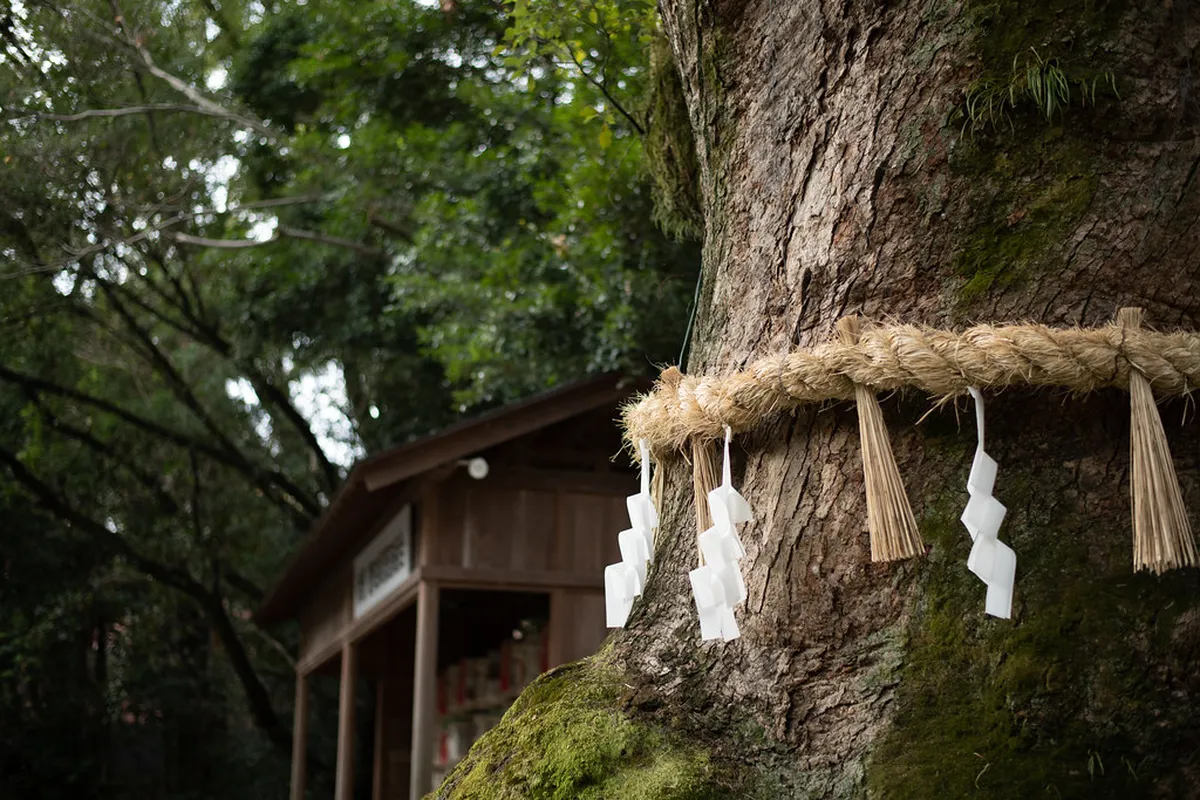
Power spots are locations within shrine grounds believed to concentrate spiritual energy. The Great Camphor Tree near the main entrance is over 1,000 years old and classified as the Goshinboku, or sacred tree. It is said to have been planted by the Buddhist priest Kukai (Kobo Daishi) during his travels. Many visitors place their palms against its bark for a moment — the tree's scale alone is impressive, with a trunk circumference that requires several people to fully encircle.
Shimizu-sha is a small auxiliary shrine known for its healing spring. Visitors perform a specific ritual here: use the ladle to pour water over a smooth stone three times while focusing on a wish, usually relating to health or clear skin. The spring is connected to the legend of Yang Guifei, a Tang Dynasty imperial consort whose image was said to be enshrined at this spot. The ritual takes about two minutes and is easy to follow by watching other visitors.
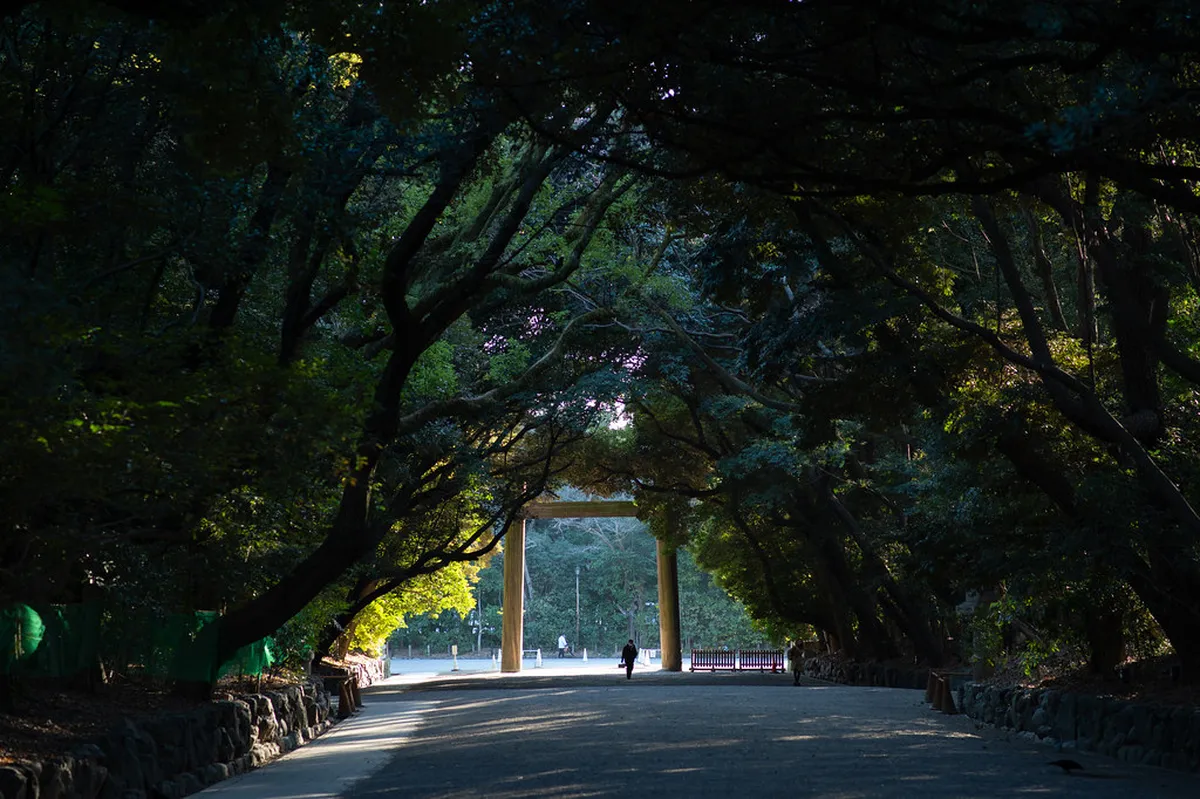
The forested pilgrimage path that connects these power spots is itself worth walking slowly. A sign at the entrance to the inner path asks for silence and respectful behavior — this is one of the few places in the complex where the request is genuinely observed. Early morning light filtering through the camphor canopy makes this path one of the most visually memorable parts of any Nagoya itinerary.
Exploring the Sword Treasure House (Kusanagi-kan)
The Kusanagi-kan opened in late 2021 as a dedicated display hall for the shrine's sword collection. It holds more than 450 blades, of which 20 are designated national treasures or important cultural properties and 12 are designated cultural properties of Aichi Prefecture. The facility is distinctly modern in its presentation, with large digital displays and English-language panels throughout. You can find the museum at the Bunkaden Treasure House on Google Maps.
The hands-on exhibit is the standout feature. A full-size replica katana — replicating the weight and dimensions of a real sword — is available for visitors to hold. Most people are surprised by how heavy it is; a typical tachi sword weighs between 800 grams and 1.2 kilograms, and holding one gives you an immediate physical understanding of why sword-fighting required years of conditioning. Photography is permitted in the hands-on corner but restricted in the main display galleries — follow the posted signs.
Admission to the Kusanagi-kan is 500 yen for adults and 200 yen for elementary and junior high school students. A combined ticket covering both the Kusanagi-kan and the older Bunkaden Treasure Hall costs 800 yen for adults and 300 yen for students. Both museums share the same closing days: the last Wednesday and Thursday of each month, plus December 25–31. Opening hours are 09:00–16:30 with last entry at 16:10.
The Kusanagi-kan includes a hands-on corner where visitors can hold a full-size replica katana. Photography is permitted in that section but restricted in the main display galleries — follow posted signs.
Smaller Shrines: Kamichikama and Shimochikama
Scattered across the grounds are several auxiliary shrines that attract different types of visitors. Kamichikama Shrine is popular with students and anyone seeking success in examinations or professional advancement. The approach is quieter than the main sanctuary, and the atmosphere here is often more intimate. If you are also visiting Osu Kannon on the same trip, note that it also has a strong association with academic and business prayers.
Shimochikama Shrine focuses on safe travel for those about to embark on journeys. Many locals stop here before international trips or long commutes. The architecture mirrors the main buildings in style but at a much reduced scale, which makes the craftsmanship easier to examine up close. The small stone statues lining the approach path are an often-photographed detail.
Exploring these side routes is the best way to understand the real scale of the grounds. The mapped footpaths cover roughly 3.5 kilometers if walked in full; most visitors naturally cover about half of this over a 1.5–2 hour visit. Comfortable shoes are not optional — the paths include uneven stone surfaces and tree roots throughout.
Goshuin, Omamori, and Spiritual Luck
Collecting a Goshuin (hand-drawn vermilion stamp with calligraphy) is one of the most meaningful souvenirs you can take from a Japanese shrine. At Atsuta, you present your Goshuin-cho (dedicated stamp book, sold at the counter for around 1,500–2,000 yen) or a single sheet of paper and wait while a priest completes the calligraphy by hand. The process takes 5–10 minutes and costs approximately 500 yen per entry. The counter is located near the main hall and typically runs from 08:00 to 16:30.
Omamori are protective charms sold at the main counter in a wide range of designs and purposes — health, love, traffic safety, academic success. Each charm is considered valid for one year; after that, you return it to any shrine (not necessarily Atsuta) to be ritually burned rather than throwing it away as ordinary refuse. You can also try Omikuji fortune slips: if you draw a bad fortune (kyo or kyokkyou), tie the slip to the designated rack near the counter to leave the bad luck behind.
The Kusunagi Plaza, opened in July 2021 adjacent to the museums, has a souvenir shop with a broader selection of shrine-branded goods alongside a Kishimen noodle restaurant and a small garden pond. It is a good place to browse after you finish the main circuit. If you collect regional craft souvenirs, Noritake Garden is about 20 minutes north by subway and sells ceramics made on-site.
Where to Eat: Hitsumabushi and Miya Kishimen
Hitsumabushi is Nagoya's most famous dish — grilled freshwater eel (unagi) over rice, eaten in three stages: first plain, then with condiments like wasabi, scallions, and nori, and finally as a kind of ochazuke (poured with dashi broth). The definitive place to try it near the shrine is Atsuta Horaiken, located just outside the south entrance. The restaurant was established in 1873 and the Jingu branch draws consistent 2–3 hour waits during lunch (11:30–14:30) and dinner (16:30–20:30). The practical move: walk to the restaurant first, add your name to the paper waiting list, then explore the shrine while your time approaches. Meals cost approximately 4,000–6,000 yen per person. The restaurant is closed every Tuesday and the 2nd and 4th Monday of each month.
If you prefer eating on the grounds without a long wait, head to Miya Kishimen near the South Gate. They serve Kishimen — Nagoya's regional flat wheat noodles, broader and thinner than standard udon — in a savory dashi broth topped with braised pork, spinach, and bonito flakes. Outdoor seating under the shrine trees makes this one of the more atmospheric lunch spots in Nagoya. Opening hours are 09:00–16:30. Both restaurants are cash-preferred; carry at least 5,000 yen in notes.
Seasonal snacks are sold near the main entrance during the major festival periods. During the Atsuta Festival in June, food stalls line the approach road with traditional sweets and grilled items. Check our Nagoya city guide for a broader overview of the local food scene beyond the shrine.
Annual Festivals and Best Time to Visit
The Atsuta Festival on June 5th is the largest event of the year, featuring traditional Bugaku court dances, martial arts demonstrations, food stalls, and a closing fireworks display. In 2026, it falls on a Friday, making it accessible for weekend visitors arriving on Thursday evening. The Honensai Festival on May 8th draws crowds for a harvest prayer ceremony involving priests carrying elaborate dioramas of crops. The Hatsu-Ebisu Festival starts at midnight on January 5th and celebrates business prosperity and family safety; visitors purchase a fuku-kumade (lucky rake) to "rake in" good fortune for the new year.
New Year's Hatsumode is the single busiest period. Millions of people visit during the first three days of January to make their first shrine prayer of the year. Queues for the Hongu can stretch for well over an hour. If crowds are a concern, a weekday morning arrival before 09:00 is the most effective strategy year-round — the grounds open continuously and the forest paths feel genuinely quiet before the tour groups arrive from around 10:30 onward.
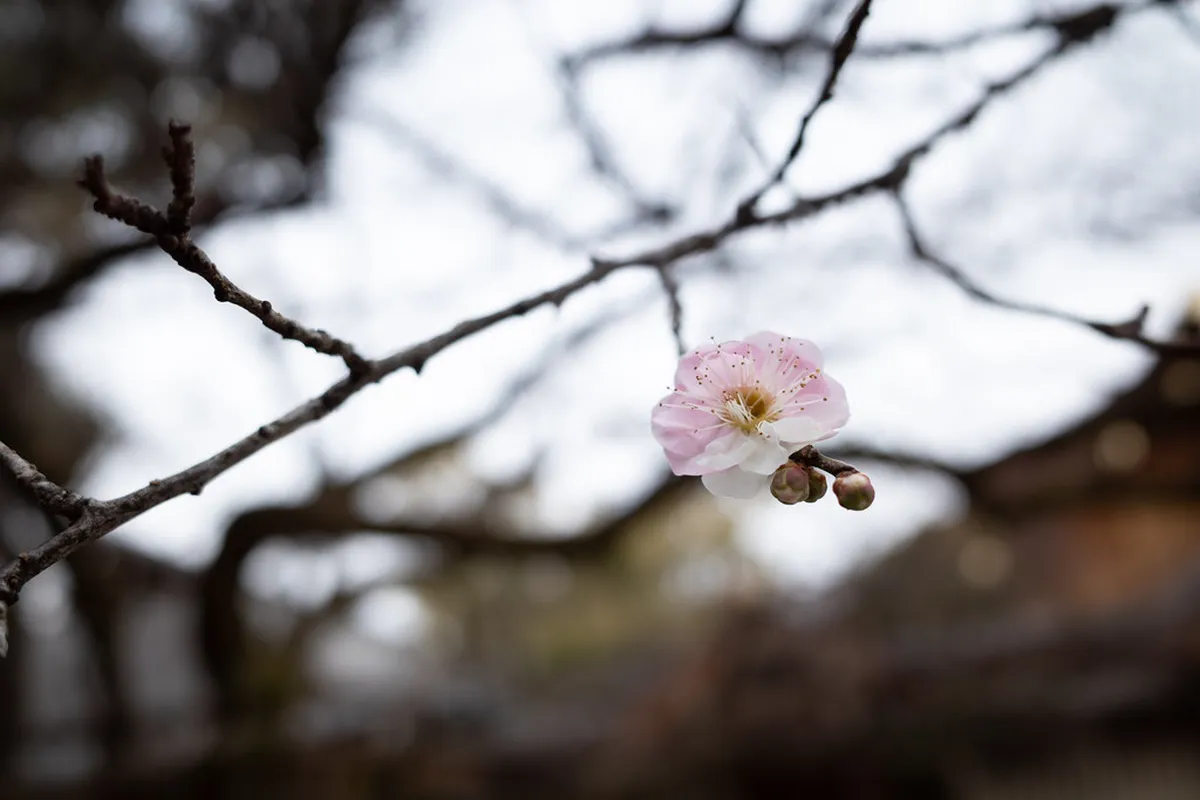
Season matters for the visual experience. Spring (late March to early May) brings fresh green growth throughout the camphor canopy. Autumn in late October and early November adds subtle gold and red tones, though the evergreen camphor trees mean the color change is less dramatic here than at dedicated maple-viewing parks. Winter mornings are cold but clear, and the low light through bare branches creates a stark beauty along the inner pilgrimage path. The shrine grounds do not close for rain, and visiting in light rain on a weekday is arguably the most peaceful experience available.
Frequently Asked Questions
Is the Kusanagi sword actually on display at Atsuta Shrine?
No, the Kusanagi-no-tsurugi is never shown to the public because it is a sacred imperial treasure. However, you can see similar historical blades and learn about the legend at the Kusanagi-kan museum. The sword remains hidden within the inner sanctum of the Hongu to preserve its spiritual power.
How much does it cost to enter Atsuta Jingu?
Entry to the main shrine grounds and the sanctuary is completely free for all visitors. You only need to pay if you choose to enter the Bunkaden Treasure House or the Kusanagi-kan sword museum. These museums typically cost between 300 and 800 yen for adults.
What is the best way to get to Atsuta Shrine from Nagoya Station?
The fastest way is taking the Meitetsu Railway from Meitetsu Nagoya Station to Jingumae Station. The ride takes about 7 minutes and the shrine entrance is just a short walk away. Alternatively, you can take a JR train to Atsuta Station if you have a Japan Rail Pass.
Can you eat inside the Atsuta Shrine grounds?
Yes, you can eat at the Miya Kishimen restaurant located near the South Gate. It offers outdoor seating where you can enjoy traditional Nagoya noodles. For a more formal meal, the famous Atsuta Horaiken eel restaurant is located just outside the shrine's main entrance.
How long does it take to walk through the entire shrine complex?
Most visitors spend about 1 to 2 hours exploring the main buildings and power spots. If you plan to visit the sword museum and have lunch, you should allow for 3 to 4 hours. The grounds are large, so comfortable walking shoes are highly recommended for your visit.
Atsuta Shrine rewards visitors who slow down. The legendary sword, the ancient camphor tree, the Nobunaga wall, the quiet pilgrimage path — each layer adds depth to a site that most people arrive at expecting a brief photo stop and leave having spent three hours. Whether you come for the history, the spiritual atmosphere, or the eel restaurant, leave the schedule flexible. After your visit, consider heading to the Sky Promenade for a modern view of the city skyline.
For more Nagoya planning, explore our things to do in Nagoya and Nagoya shrines and temples guide.


