Iwakuni Sushi Guide: Tonosama Zushi Near Kintaikyo Bridge
Iwakuni sushi guide to Tonosama Zushi: ingredients, layers, where to eat near Kintaikyo Bridge, and the ¥2,200 hands-on workshop.
On this page
Last updated August 2026. This Iwakuni sushi guide covers Tonosama Zushi, the five-layer pressed sushi once served to the Kikkawa clan's lord in Yamaguchi Prefecture. You'll find the ingredients, the restaurants near Kintaikyo Bridge that serve it, and how a tasting fits into a full day trip through Iwakuni's food scene.
Iwakuni Sushi Guide: What Tonosama Zushi Actually Is
Iwakuni sushi is a chirashi-zushi built in pressed-sushi style, distinct from single-serving nigiri or maki. Cooks pack a wooden mold with vinegared rice and seasonal toppings in alternating layers, then press the block before slicing it into squares. Japan's Ministry of Agriculture, Forestry and Fisheries records that the dish was presented to Lord Yoshikawa of the Iwakuni Clan during the Edo period, 1603 to 1868. That royal connection earned it a second name: tonosama-zushi, or lord's sushi. Locals still use both names today. The dish traveled well as a preserved food, useful for a castle town built along the Nishiki River below Mount Yokoyama. Expect a mix of sweet vinegared rice, savory simmered shiitake, and crunchy pickled lotus root in almost every bite. Iwakuni is also home to Marine Corps Air Station Iwakuni, so many visitors already live nearby.
Inside the Layers: Lotus Root, Color, and the Pressing Method
Local tradition holds that Iwakuni renkon, the region's lotus root, grows with nine holes in cross-section instead of the usual eight. Residents read the extra hole as a sign of seeing clearly ahead, which is why the vegetable appears at weddings and New Year celebrations. The nine-hole lotus root gets a brief soak in sweet vinegar before it goes into the mold, which keeps it crisp against the richer rice.
Molds reach 60 centimeters and traditionally feed 20 to 30 people, making Iwakuni sushi ideal for celebrations where the lotus root's cultural symbolism of clear sight enhances group gatherings.
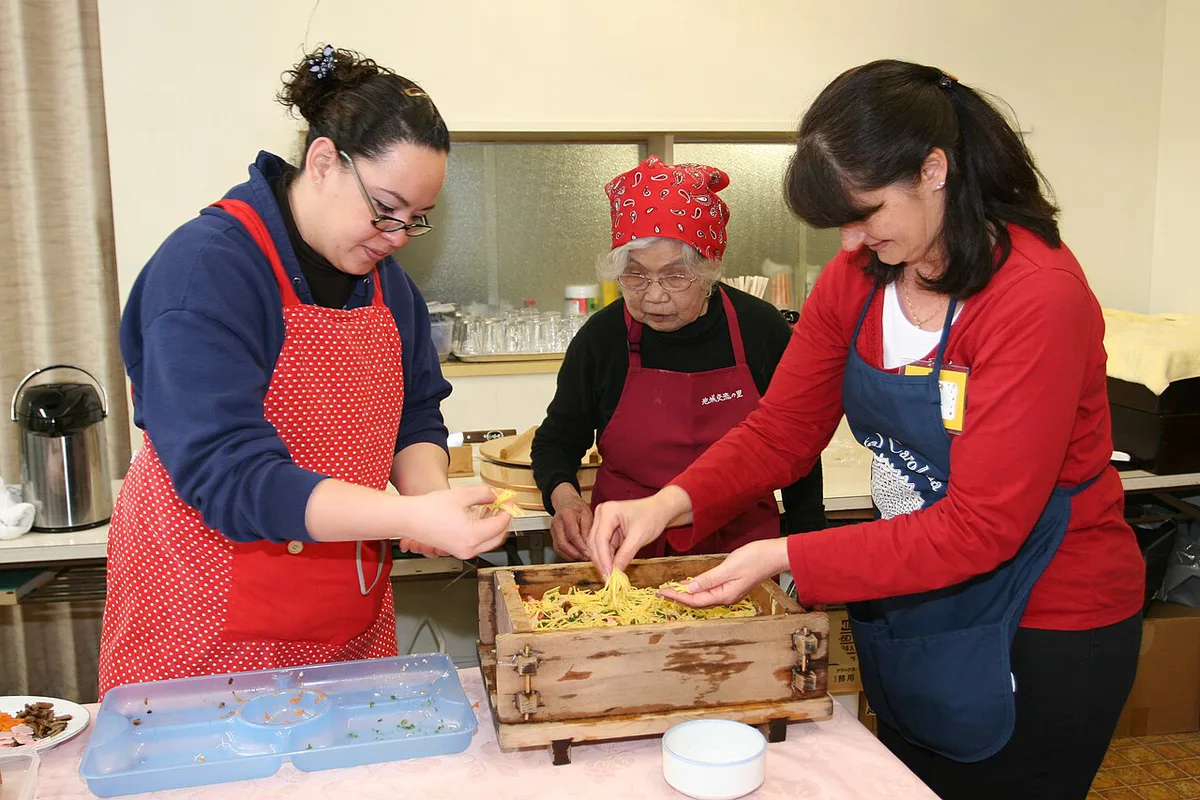
A single wooden mold can run up to 60 centimeters square and feed 20 to 30 people. Traditional recipes cap the stack at five tiers, since a taller block loses its shape once it's sliced. Craftsmen sometimes pressed the sushi by standing on the mold's lid, using body weight to compact the layers before cutting. That physical step is why texture defines a well-made block as much as flavor does.
Home cooks without a traditional wooden frame can substitute a bottomless cake mold or a lunch box. Japan's Ministry of Agriculture's own recipe notes even suggest a milk carton lined with plastic wrap.
- Kinshi tamago (thin egg strips) adds yellow
- Sakura denbu (sea bream flakes) adds pink
- Chisha leaf, a Yamaguchi lettuce variety, adds green
- Simmered shiitake mushrooms add a savory brown band
Why Iwakuni Sushi Is a Celebration Food
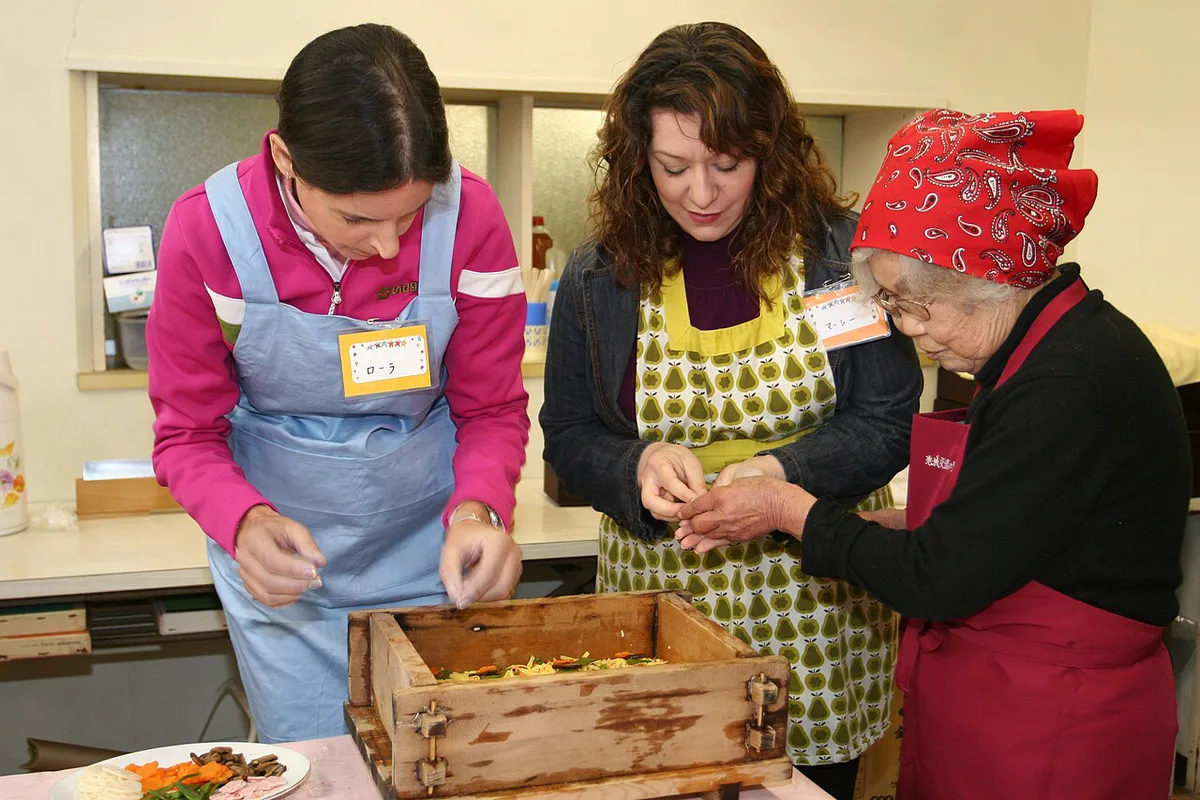
A single Iwakuni sushi mold traditionally feeds 20 to 30 people, which made it impractical for daily cooking but ideal for community events. New Year's gatherings, wedding banquets, and regional festivals have long featured the dish. Japan's Ministry of Agriculture, Forestry and Fisheries recognizes it as one of the country's traditional regional cuisines.
Preparing it took hours of coordinated work: cooking the rice, pickling the lotus root, simmering shiitake, and pressing the finished block. Families and community groups traditionally made it together, turning the cooking itself into part of the celebration rather than just a meal to serve.
That festive framing is also why Iwakuni sushi rarely appears alone. Ohira, the chicken-and-vegetable soup, has long paired with it at celebration tables, a pattern still followed at restaurants like Yoshida today.
Where to Eat Iwakuni Sushi Near Kintaikyo Bridge
Most restaurants that serve Iwakuni sushi cluster around Kintaikyo Bridge. Iwakuni's official tourism website confirms it's mainly sold at shops and restaurants in that district. Hirasei sits directly across from the bridge and serves it teishoku-style, with views of both the bridge and the castle above. Hangetsuan, a long-established inn, skips ready-made sauces and chemical seasoning entirely. Its version pairs lotus root and conger eel with fresh tempura.
Sasakiya Kojiro Shoten, Midori No Sato, and Yoshida have all been listed as places to try Iwakuni sushi near the bridge, but menus, prices, hours, and closing days change. Check the current local gourmet listing and confirm directly before choosing one for a timed lunch. Station souvenir shops may also carry packaged portions for travelers who want to take some home.
For a fast bite, compare current menus and same-day opening notices around the bridge rather than relying on older price or hours listings. For a slower, more formal teishoku experience, Hangetsuan and Yoshida may suit a longer sit-down meal when open. The Iwakuni restaurant guide covers the wider dining area.
| Restaurant | Price | Hours |
|---|---|---|
| Sasakiya Kojiro Shoten | Check current menu | Confirm current hours and closing days |
| Hangetsuan | Set meal (confirm current pricing by phone) | Lunch 11:00-14:00 (last order 13:50); dinner 17:30-22:00 |
| Yoshida | Set meal with Ohira soup | 10:00-14:00, closed Thursdays |
| Midori No Sato | Check current menu | Confirm current hours and closing days |
Make Your Own Iwakuni Sushi at Iwakuni Kokusai Kanko Hotel
Older hotel listings described a mini-mold Iwakuni sushi workshop at Iwakuni Kokusai Kanko Hotel, but current official sources checked for this update do not confirm its schedule, price, or availability.
Contact Iwakuni Kokusai Kanko Hotel directly before planning around a workshop; do not treat the older ¥2,200 price or 11:00am-2:30pm window as current.
The hotel is near the Kintaikyo bus stop, but workshop participation should be treated as unavailable unless the hotel confirms a current session.
What to Pair With Iwakuni Sushi
Sake is the traditional drink pairing, and Yamaguchi Prefecture has a strong brewing reputation behind it. The Iwakuni Sake Breweries Guide: Tours, Tastings, and the Gozo Five covers which local breweries to look for. Renkon, the nine-hole lotus root already layered into the sushi, also turns up as a standalone side dish and souvenir near Kintaikyo Bridge.
Kikko Park is the spot for dessert after lunch. Two rival soft-serve stands compete there, between them offering hundreds of flavors. One standout is the ayu, or sweetfish, flavor, which smells faintly of watermelon when made from fresh-caught fish. Check the Kintaikyo food and ice cream guide for a fuller flavor list.
Even so, the traditional festive pairing is Ohira: chicken and vegetable soup served in a wide wooden bowl called an ohirawan. Order it with your sushi at Yoshida for the closest match to how the dish was traditionally served at celebrations.
Planning the Day: Getting to Iwakuni and Budgeting the Loop
Iwakuni has two train stations, and mixing them up costs time. Shin-Iwakuni Station serves the JR Tokaido-Sanyo Shinkansen and sits about 15 minutes from Hiroshima by bullet train, but it's a distance from Kintaikyo Bridge. Iwakuni Station serves local JR lines and connects directly to Bus Stop #2, which runs to the bridge through the old town streets.
From September 1, 2026, the official adult fee is ¥310 for the bridge alone and ¥970 for the bridge, ropeway, and castle combination ticket. Check the official Kintaikyo page for the fee applying on your visit date. A simple loop starts at the bridge, continues into Kikko Park for lunch and ice cream, then rides the ropeway up to the castle. Budget about half a day for the full loop.
From Miyajimaguchi, the City Liner toward Hiroshima takes about 20 minutes and costs ¥320, useful if you're stacking Iwakuni onto a Miyajima day. The City Liner to central Hiroshima itself runs about 45 minutes for ¥760.
| Shin-Iwakuni Station | Iwakuni Station | |
|---|---|---|
| Serves | JR Tokaido-Sanyo Shinkansen | Local JR lines |
| From Hiroshima | About 15 minutes by bullet train | Under an hour by regular train |
| Access to Kintaikyo Bridge | Requires a transfer or taxi | Direct bus from Bus Stop #2 |
- Bridge crossing from September 1, 2026: ¥310 per adult
- Bridge, ropeway, and castle combination ticket from September 1, 2026: ¥970 per adult
- Sushi lunch near the bridge: check the restaurant's current menu
- DIY sushi workshop: confirm whether the hotel currently offers it
Beyond the Plate: Kintaikyo Bridge, the White Snakes, and Iwakuni Castle
Kintaikyo Bridge was built in 1673 at the base of Mount Yokoyama, spanning the Nishiki River with five wooden arches designed to withstand flooding that destroyed earlier versions. Stone piers support the timber arches, and sections are replaced on a rotating maintenance schedule. Kintaikyo hosts its own festival in late April, including a feudal-lord procession called sankin-koutai that reenacts a samurai-era parade across the bridge. Cherry blossoms line the river each spring, and maple color draws views of the bridge and castle together in autumn. For the full attraction list, including hours and seasonal events, see the Iwakuni attractions guide.
Across the bridge in Kikko Park, the Imazu White Snakes Museum houses Iwakuni's protected albino snakes. Locals consider the white, red-eyed snakes messengers of Benten, the goddess of wealth, rather than something to fear. Kikko Park also holds the former residence grounds of the Kikkawa family, the feudal lords who built the castle and ruled the area through the 17th century. Plaster-walled buildings and ditches there recall how the samurai class once lived.
Iwakuni Castle sits above the park on Mount Shiroyama, reachable by a three-minute ropeway ride. The castle took five years to build, was completed in 1608, then stood for only seven years before it was destroyed. Today's reconstruction dates to 1962 and rises four stories above the surrounding trees. Cormorant fishing runs on the Nishiki River from around June through September; check current dates each year since they can shift.
Mistakes to Avoid on an Iwakuni Sushi Trip
Skip Shin-Iwakuni Station unless you're arriving by Shinkansen. It sits well away from the bridge, and getting off there by mistake adds an extra transfer to reach Kintaikyo. Use Iwakuni Station and its direct bus instead.
Confirm hours before visiting the art museum or castle. Regional museums and castles in Japan frequently close on set weekdays, so a quick check beforehand avoids a wasted ropeway ride.
Don't order Iwakuni sushi alone if the goal is the full traditional experience. Ask for it with Ohira soup, the pairing that turns the meal from a snack into the celebration set it was designed to be.
How This Guide Was Verified
Food availability, access details, seasonal rules, and the time-sensitive claims in this guide were checked on August 22, 2026 against the official sources below. Independent restaurant menus, prices, opening days, and sell-outs can change, so confirm the operator's same-day notice before making a special trip.
Frequently Asked Questions
What is Iwakuni sushi called locally, and why?
Locals call it tonosama-zushi, or lord's sushi, because it was served to the lord of the Iwakuni domain during the Edo period. That royal association is why the dish uses more elaborate ingredients than everyday pressed sushi.
How much does Iwakuni sushi cost near Kintaikyo Bridge?
Check the current menu at the restaurant you plan to visit. The older Sasakiya, Midori No Sato, and hotel-workshop prices repeated online were not confirmed by current official sources for this update.
Which station should you use to reach Kintaikyo Bridge?
Use Iwakuni Station, which connects to a direct bus toward the bridge. Shin-Iwakuni Station serves the Shinkansen but sits farther from Kintaikyo, so only get off there if you're transferring from a bullet train.
Can travelers make their own Iwakuni sushi?
Older listings described a mini-mold workshop at Iwakuni Kokusai Kanko Hotel, but its current availability, schedule, and price were not confirmed. Contact the hotel directly before planning a visit around it.
When can you see cormorant fishing on the Nishiki River?
Cormorant fishing runs roughly June through September, with lantern-lit boats and trained cormorants working the river after dark near Kintaikyo Bridge. Confirm exact dates for the current season before you plan around it.
Why does Iwakuni lotus root have nine holes?
Local tradition holds that Iwakuni renkon grows with nine holes in cross-section instead of the usual eight. Residents read the extra hole as a sign of seeing clearly ahead. That belief is why the lotus root appears at weddings and New Year celebrations, and it's layered directly into Iwakuni sushi.
Free guide: Japan's Hidden Gems
12 under-the-radar places beyond Tokyo & Kyoto — with the best season to visit each and a local tip you won't find in the guidebooks.
You might also like


Continue reading
More guides you'll find useful