Nada Sake Breweries Kobe: A 2026 Guide to Nada-go-go's Five Villages
A 2026 guide to Nada sake breweries Kobe: Hanshin Line routes, hours, admission, and which of Hakutsuru, Kikumasamune, and Sawanotsuru to visit first.
On this page
Last updated August 2026, the Nada sake breweries Kobe travelers visit most sit along the Hanshin Line, a 15-minute ride east of Sannomiya. Nada-go-go's five villages produce roughly a quarter of Japan's sake using Miyamizu water from the Rokko mountain range. This guide breaks down transit, the standout breweries, and the mistakes that waste a visitor's limited hours.
Understanding Nada-go-go: Kobe's Five Sake Villages
Nada-go-go means the five villages of Nada, a brewing corridor running roughly 7.5 miles from Nada Ward in eastern Kobe to the neighboring city of Nishinomiya. Kura, the local word for a working brewery, cluster inside each village listed below. Japan's official tourism site profiles the Nada Gogo sake district as a Higashinada-ku destination in Hyogo Prefecture. Nadagogo also carries a Geographical Indication designation, one of only five such labels in Japan, tied to its distinct local water and rice. Miyamizu, a hard water drawn from beneath the Rokko mountain range, gives Nada sake a firmer, more mineral character than sake brewed elsewhere. Yamada Nishiki, the rice strain behind that flavor, was developed in Hyogo Prefecture in 1923 and now goes into most award-winning sake nationwide. Toji, master brewers historically drawn from the Tamba guild, still oversee production at several of the kura open to visitors. Rivers flowing down from the Rokko range once powered mills that polished that rice. Nada's coastal position also made it easy to import rice and ship finished sake to Osaka and, historically, Edo.
- Nishi-Go
- Mikage-Go
- Uozaki-Go
- Nishinomiya-Go
- Imazu-Go
Getting to the Nada District: Hanshin Line vs. JR
Three train lines run parallel along the coast: the Hanshin Railway, Hankyu Railway, and JR Tokaido Line. Hanshin stations sit closest to the breweries, and JR access requires a longer walk. From Hanshin Sannomiya, the ride to Hanshin Sumiyoshi Station takes about 10 minutes and costs ¥200. JR Sannomiya to JR Sumiyoshi Station runs about 8 minutes. That walk from there to Hakutsuru adds another 15 to 20 minutes, so a Japan Rail Pass holder pays in time what a Hanshin fare would have saved. Hanshin Uozaki Station and Hanshin Oishi Station both work as a starting point for a route through Mikage-Go and Nishi-Go, since each sits within a 10-minute walk of a flagship museum. Hankyu Railway also runs parallel to the coast, but its stations sit farther from the breweries, so it suits the return trip into central Kobe rather than the outbound leg.
- Hanshin Sumiyoshi Station – 5-minute walk to Hakutsuru Sake Brewery Museum
- Hanshin Uozaki Station – 10-minute walk to Kikumasamune Sake Museum
- Hanshin Oishi Station – 10-minute walk to Sawanotsuru Sake Museum
- JR Sumiyoshi Station – 15- to 20-minute walk to Hakutsuru, for Japan Rail Pass holders
Nada Sake Breweries Kobe Visitors Should See First
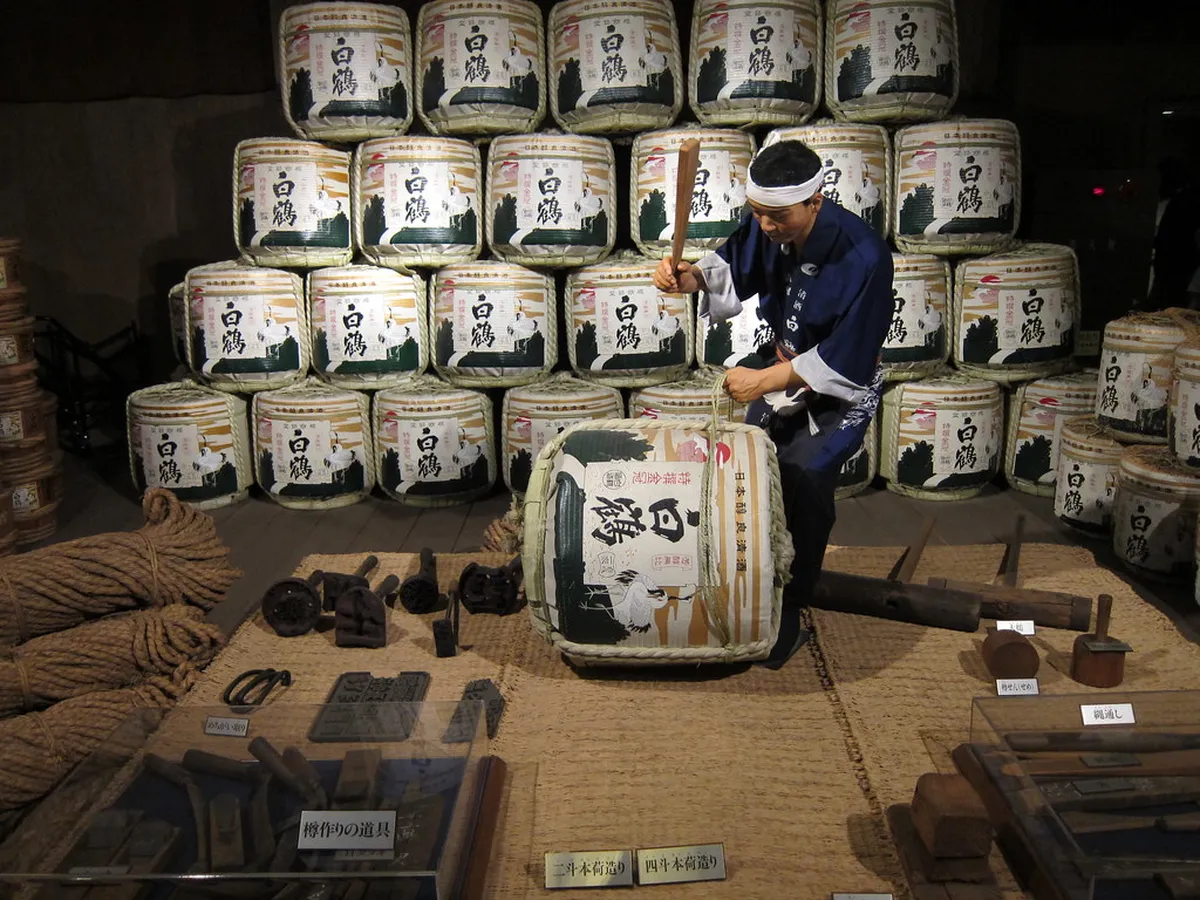
Hakutsuru Sake Brewery Museum occupies a renovated brewhouse on the grounds of a working sake factory. Life-size figures walk visitors through each brewing step, backed by English pamphlets and videos. Founded in 1743, Hakutsuru is Nada-go-go's largest producer and one of Japan's leading sake exporters. A rice-breeding program at the brewery produced the Hakutsuru Nishiki strain, officially recognized in 2007 after eight years of development. Visitors can taste freshly pressed, unpasteurized Hakutsuru sake at the counter, a pour not sold elsewhere. Admission is free, with hours running 9:30 AM to 4:30 PM and last entry at 4:00 PM. Kikumasamune Sake Museum fills a wooden-and-plaster building with tools, containers, and brewing machinery displayed under low lighting. Founded in 1659, Kiku-Masamune still uses the kimoto method for its yeast starter, one of the few kura that does. Across the road, the Taru Sake Meister Factory shows how workers build the cedar barrels used for taru sake, and entry requires an online reservation at least two days ahead. Sakamanju, sake-flavored buns found only here, are sold at the shop alongside sake tastings. Hours match Hakutsuru's: 9:30 AM to 4:30 PM, last entry 4:00 PM, admission free. Sawanotsuru Sake Museum sits closest to central Kobe, a 10-minute walk from Hanshin Oishi Station. Founded in 1717 by a rice merchant, Sawanotsuru still uses Yamada Nishiki rice and Miyamizu water drawn from beneath Nishinomiya City for its junmai sake. Reconstructed brewhouse displays explain traditional production methods, and the shop pours free tastings alongside sake and souvenir sales. It opens 10:00 AM to 4:00 PM and closes Wednesdays, plus Obon and New Year holidays.
Specialized Brewery Experiences for a Deeper Visit
Kobe Shushinkan, home to the Fukuju brand, suits a sit-down lunch rather than a quick stop. Japanese dishes at its restaurant come paired with house sake, and free guided warehouse tours run daily except December. Book the warehouse tour online in advance, since it includes a tasting. It opens 10:00 AM to 6:30 PM, and the shop closes only for the New Year holidays. Hamafukutsuru Ginjo Brewery focuses on award-winning ginjo sake and gives visitors a rare look at active production. Windows on the second floor look directly onto the brewing machines, and diagram-based displays explain the process in English. It opens 10:00 AM to 5:00 PM and closes Mondays, or the following day when Monday is a national holiday, plus Obon and New Year holidays. Sakuramasamune keeps a small exhibition of historic brewing tools and runs a video of its traditional process. English information is limited here, which makes it a better stop for travelers comfortable navigating with less signage support. It opens 10:00 AM to 7:00 PM and closes Tuesdays. Kobe Konan Muko no Sato takes a different angle, focusing on pickles and condiments made from sake kasu, the lees left over after pressing. A small museum on site explains the pickling process, and the attached shop stocks a wide range of sake-adjacent food gifts. Museum hours run 10:00 AM to 3:00 PM, extended to 5:00 PM on Saturdays, and it closes Fridays.
Which Nada Brewery Fits Your Trip? A Decision Matrix
Matching a brewery to the kind of visit you want saves backtracking across the district. This table lines up each stop by strength and access.
| Brewery | Best For | Nearest Hanshin Station | English Support |
|---|---|---|---|
| Hakutsuru Sake Brewery Museum | First-time visitors, life-size dioramas | Sumiyoshi, 5-minute walk | Pamphlets and videos |
| Kikumasamune Sake Museum | Traditional architecture, barrel-making | Uozaki, 10-minute walk | Moderate; factory tour needs reservation |
| Sawanotsuru Sake Museum | Quick stop closest to Sannomiya | Oishi, 10-minute walk | English pamphlets |
| Kobe Shushinkan (Fukuju) | Sit-down lunch with sake pairing | Check official access page | English at shop and restaurant |
| Hamafukutsuru Ginjo Brewery | Watching modern production up close | Check official access page | Diagrams in English |
| Sakuramasamune | History-focused, fewer crowds | Check official access page | Limited |
| Kobe Konan Muko no Sato | Sake-lees pickles and food pairing | Check official access page | Small museum, shop-based |
Hours, Admission, and Weekly Closures
Every museum listed above charges no admission fee, and most tastings are free at the counter. A handful of shops pour a paid flight of premium sake, typically running from a free sample up to roughly ¥500 or more for a multi-cup tasting. Two of the busiest museums, Hakutsuru and Kikumasamune, cut off entry at 4:00 PM even though the doors stay open until 4:30 PM, so arrive well before the deadline. Two experiences also require advance online reservations rather than walk-in access. Book the Kikumasamune Taru Sake Meister Factory at least two days ahead; the Kobe Shushinkan warehouse tour is unavailable during December.
Hakutsuru requires a 60-minute visit per the practical route guide, yet admissions stop at 4:00 PM, meaning visitors must arrive by 3:00 PM to complete the full tasting.
| Brewery | Hours | Weekly Closure |
|---|---|---|
| Hakutsuru Sake Brewery Museum | 9:30 AM–4:30 PM, last entry 4:00 PM | None; closed Obon and New Year holidays |
| Kikumasamune Sake Museum | 9:30 AM–4:30 PM, last entry 4:00 PM | None weekly; closed year-end holidays |
| Sawanotsuru Sake Museum | 10:00 AM–4:00 PM | Wednesdays |
| Kobe Shushinkan (Fukuju) | 10:00 AM–6:30 PM | None weekly; closed New Year holidays |
| Hamafukutsuru Ginjo Brewery | 10:00 AM–5:00 PM | Mondays |
| Sakuramasamune | 10:00 AM–7:00 PM | Tuesdays |
| Kobe Konan Muko no Sato | Museum 10:00 AM–3:00 PM, 5:00 PM Saturdays; shop 9:30 AM–6:30 PM | Fridays |
Mistakes to Avoid in the Nada District
A handful of planning slips turn a half-day route into a frustrating one.
Plan your opening 45 minutes at Sawanotsuru to acclimate to genshu's higher alcohol content, since undiluted sake's strength makes spacing out tastings across multiple stops essential.
- Checking one brewery's hours and assuming the rest match: Sawanotsuru closes Wednesdays, Hamafukutsuru closes Mondays, and Sakuramasamune closes Tuesdays, so a single closure can strand part of a route.
- Relying on a Japan Rail Pass for access: JR Sumiyoshi Station leaves a 15- to 20-minute walk to Hakutsuru, while the Hanshin Line drops visitors within a 5- to 10-minute walk of every major museum.
- Skipping the last-entry cutoff: Hakutsuru and Kikumasamune stop admitting visitors at 4:00 PM, 30 minutes before the building closes.
- Treating every tasting pour the same: some counters serve genshu, undiluted sake with a noticeably higher alcohol content than the diluted sake most travelers expect, so pace tastings across multiple stops.
- Expecting English signage everywhere: Sakuramasamune offers only limited English information, unlike Hakutsuru or Hamafukutsuru.
Pairing the Brewery Route with Kobe Food and Sightseeing
Sake tastings pair naturally with a Kobe beef dinner back in central Kobe. Kobe's beef restaurants are covered separately in the 9 Best Places and Tips for Eating Kobe Beef in Kobe (2026). Nankinmachi's food stalls make a lower-cost alternative after an afternoon of tastings. Its best stands are listed in the Nankinmachi food guide. Sobameshi, Kobe's fried noodle-and-rice dish, works as a heartier option between breweries. Where to find it locally is covered in the sobameshi guide. A pastry stop between museums works well as a palate cleanser from the sake flights. Bakery picks near central Kobe appear in the bakery and sweets guide. For the full range of where Nada sake fits into Kobe's food scene, the Kobe Food Guide: 11 Best Dishes and Local Dining Tips (2026) is the starting point. Mt. Rokko's cable car and the hot spring baths at Arima Onsen sit within a similar train-and-bus reach of the district, making a combined day workable for visitors staying multiple nights. Staying in Sannomiya keeps the brewery route, Kobe beef dinners, and Nankinmachi within one train hub, while lodging near Sumiyoshi or Uozaki shortens the morning commute to the first museum. Travelers building a longer Kobe itinerary can fold the brewery route into a wider day using the Kobe attractions guide.
A Practical Half-Day Nada Sake Walking Route
For an efficient half-day tour, begin at Hanshin Oishi Station and walk to Sawanotsuru Sake Museum. Starting at the western end prevents unnecessary backtracking toward central Kobe.
After Sawanotsuru, take the Hanshin Line east to Sumiyoshi Station. Visit Hakutsuru Sake Brewery Museum, then continue on foot toward Uozaki for Kikumasamune Sake Museum. These two museums offer the strongest combination of English explanations and traditional brewing displays.
- Allow about 45 minutes for Sawanotsuru’s reconstructed brewhouse and tasting counter.
- Reserve about 60 minutes for Hakutsuru’s exhibits, videos, shop, and fresh sake tasting.
- Allow 45 to 60 minutes at Kikumasamune, excluding the separately reserved Taru Sake Meister Factory.
Travelers with extra time can add Hamafukutsuru Ginjo Brewery after Kikumasamune. Its production windows provide a useful contrast with the older tools displayed elsewhere. Begin before lunch if visiting three or four breweries. Hakutsuru and Kikumasamune stop admissions at 4:00 PM, and weekly closures differ across the district.
Frequently Asked Questions
How much time should you plan for the Nada sake district?
A half day covers the three flagship museums near Hanshin Sumiyoshi, Uozaki, and Oishi stations. Seeing all five villages of Nada-go-go, a district that runs roughly 7.5 miles end to end, takes a full day or more.
Is it better to use the Hanshin Line or a Japan Rail Pass?
Hanshin stations sit within a 5- to 10-minute walk of the main museums, while JR Sumiyoshi Station leaves a 15- to 20-minute walk to Hakutsuru. A single Hanshin fare from Sannomiya costs ¥200, so the time saved usually outweighs any rail pass coverage for this route.
Which Nada brewery works best for visitors who don't read Japanese?
Hakutsuru Sake Brewery Museum offers the strongest English support, with pamphlets and videos throughout the exhibit. Hamafukutsuru Ginjo Brewery also posts diagram-based explanations in English near its observation windows.
Do the Nada breweries charge admission or tasting fees?
Every museum covered in this guide charges no admission fee. Tastings usually run free at the counter, though a handful of shops offer a paid flight of premium sake running from a free sample up to roughly ¥500 or more.
What should you do after visiting the Nada sake breweries?
A Kobe beef dinner or a walk through Nankinmachi both work well after an afternoon of tastings. Sannomiya keeps those options, plus onward trains, within one hub for the evening.
Free: The Kobe Essentials guide
Top things to do, where to stay, a perfect day plan, getting around, and the best time to go — a Kobe mini-guide you can take offline.
You might also like


Continue reading
More guides you'll find useful