Hakata Dontaku Festival 2026: Dates, History & Where to Watch
Dontaku closes 1.2 km of Meiji-dori each May 3-4 for parades and flower buses. Get 2026 dates, viewing spots and Golden Week booking tips.
On this page
Last updated September 2026, and Hakata Dontaku remains Fukuoka's largest annual festival, closing 1.2 km of Meiji-dori for two days of parades, flower buses, and rice-scoop dancing. This guide covers the 2026 schedule, the festival's roots in the 12th-century Hakata Matsubayashi procession, and where to stand for a clear view during Golden Week's crowds. The two-day event alone draws more than two million spectators each May 3 and 4.
When Hakata Dontaku Is Busiest: Crowds by Day and Time
Hakata Dontaku is busiest on Meiji-dori during the afternoon parades on May 3 and 4, and peaks at the So-Odori finale on May 4 from 17:50. The organiser does not publish crowd levels, so the levels below are our estimate based on the official 2026 schedule, route and road closures; the festival is held on the fixed dates of May 3 and 4 every year, so 2027 falls on Monday, May 3, and Tuesday, May 4 (the 2027 programme is not yet published).
| Place | When | Crowd level | Why busy |
|---|---|---|---|
| Dontaku Square parade, Meiji-dori (Gofukumachi to Tenjin, about 1,230 m) | May 3, 13:05 to about 18:30 | Very busy | Main parade of the festival; Meiji-dori closed to traffic 12:30–19:00. The organiser counts about 650 groups, 33,000 performers and 2 million spectators over the two days. |
| Dontaku Square parade, Meiji-dori | May 4, 14:05 to 18:20 | Very busy | Second full parade with the marching-band parade and flower buses; Meiji-dori closed 13:30–19:00. |
| So-Odori finale: Gofukumachi, Nakasu-Kawabata, Suijo Park and Dontaku Square | May 4, 17:50–18:20 | Peak | The closing mass dance; anyone can join, and it ends the parade with the "Iwai medeta" hand-clap at 18:20. |
| Hakata Station main stage (opening ceremony) | May 3, from 11:00 | Busy | The festival's official opening ceremony is held on the plaza in front of JR Hakata Station (Hakata exit). |
| Hakata-ekimae-dori "Dontaku Street" | May 3, 9:30 to about 10:45; May 4, 9:30 to about 11:55 | Busy | Street performances on the road itself; closed to traffic 9:15–11:45 (May 3) and 9:15–12:30 (May 4). |
| Tenjin stages: main stage at Fureai Plaza (City Hall), Shintencho, Solaria, Iwataya, Tenjin Underground | May 3–4, late morning to evening (main stage 9:45–19:00 on May 3, 10:00–18:30 on May 4) | Busy, heaviest in the afternoon | These stages sit at the Tenjin end of the parade route; Shintencho is pedestrian-only 10:00–22:00 both days. The marching festival fills the main stage on May 4, 15:45–17:20. |
| Eve festival, main stage at Fureai Plaza | May 2, doors 16:00, show 17:00–20:30 | Busy around the stage | Free show with invited Dontaku groups and a guest singer; no numbered tickets were issued in 2026, so entry is first come. |
| Evening stages: Hakata River water stage, Ichome stage (Sunselco), Shintencho | May 3–4, after the parade until 20:00–21:00 | Moderate | The parade area is cleared from 18:30 and closes at 19:00, but these stages keep running to 20:00 (Hakata River, Shintencho) and 21:00 (Ichome). |
| Hakata Matsubayashi procession, citywide | May 3–4, 9:00–17:00 | Moderate, busy where it stops | The three gods of fortune and the children's troupe tour the city and open the Meiji-dori parade at 13:06 on May 3. |
| Hakata Port Central Wharf: patrol vessel Yashima open day | May 3, 13:00–15:00; May 4, 9:30–15:00 | Moderate, possible queue | The organiser says visitor numbers on board may be limited to prevent crowding, with waiting at the quay. |
| Quietest times: ward stages (Nishijin, Kashii, Ohashi, Nishi Ward Office) and mornings away from Hakata Station | May 3–4, about 10:00–12:30, before Meiji-dori closes | Quieter | These stages are away from the parade route, and the Meiji-dori parade does not start until 13:05 (May 3) or 14:05 (May 4). |
Times are from the 2026 programme and change slightly each year; the organiser publishes the new programme and road-closure map in spring. Verified (festival dates, parade route and times, stage hours and road closures; crowd levels are our estimate) against the official Hakata Dontaku site and Fukuoka City's official tourist guide.
What Is Hakata Dontaku? Fukuoka's Golden Week Spectacle
Hakata Dontaku is a two-day street festival held every May 3 and 4 during Golden Week, Japan's cluster of spring national holidays. Golden Week strings together several public holidays into the country's longest spring break, which is part of why crowds concentrate so heavily on these two days. Meiji-dori, one of Fukuoka's busiest roads, closes for 1.2 km and becomes what locals call Dontaku Street. More than 30,000 performers from roughly 650 groups take part, and the festival draws over two million spectators across the two days. Stage performances run at about 30 locations citywide, from Hakata Station to Tenjin, including comedic masked Hakata Niwaka shows alongside music and dance. Admission is free throughout, making it one of the larger free annual events in Fukuoka. It ranks among the city's three major annual festivals, alongside Hakata Gion Yamakasa. The third is Hōjōya, held each autumn at Hakozaki Shrine. A dedicated guide covers Hōjōya's dates and rituals. For the full year-round lineup, check Fukuoka's festival and events calendar.
From Hakata Matsubayashi to Dontaku: 840 Years of History
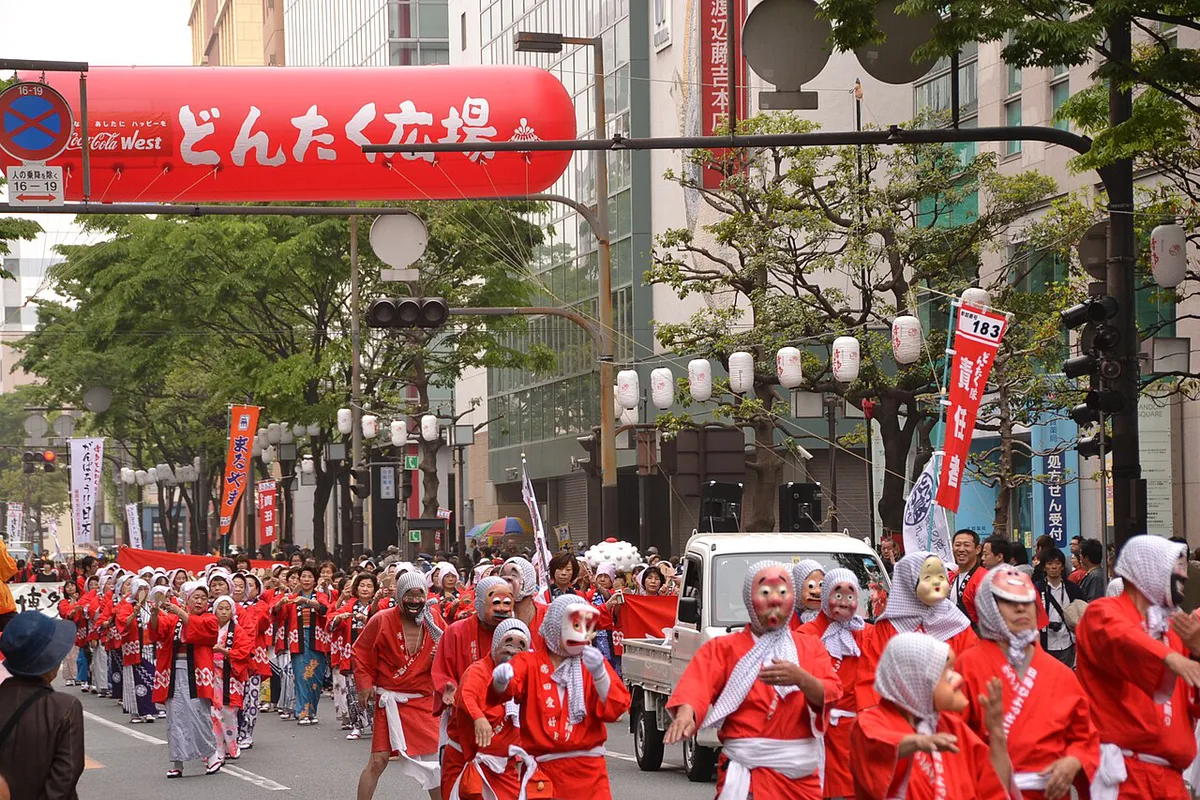
Hakata Dontaku traces back to Hakata Matsubayashi, a New Year ritual first recorded in 1179 during the Heian period. Performers welcomed local deities of good fortune with music and dance, a custom believed to have spread from Kyoto to Kyushu as groups visited feudal lords' residences. During the Edo period, the ritual grew into a formal procession called Tōrimon. Japan's official tourism guide credits the parade's three gods of fortune, Fukujin, Ebisu, and Daikoku, with leading it on horseback. Umbrella-shaped decorations called Kasaboko accompanied the procession, and local folklore held that walking beneath one brought good health. The Meiji government banned the parade in 1872 over concerns about public order. Citizens revived it in 1879 under a new name, Dontaku. The word comes from the Dutch zondag, meaning Sunday or holiday, a legacy of Dutch traders near Nagasaki during the Edo period.
From its 1179 origins as an intimate New Year ritual, Hakata Dontaku evolved into a festival drawing two million spectators annually.
- 1179: Hakata Matsubayashi begins as a New Year ritual
- 1872: The Meiji government bans the procession
- 1879: Citizens revive it as Hakata Dontaku
- 1941: Wartime restrictions suspend the festival
- 1946: The festival resumes after World War II
- 1949: May 3-4 becomes the fixed annual date
- 1962: Dontaku is formally named Fukuoka's Citizens' Festival
2026 Schedule: What Happens May 2-4
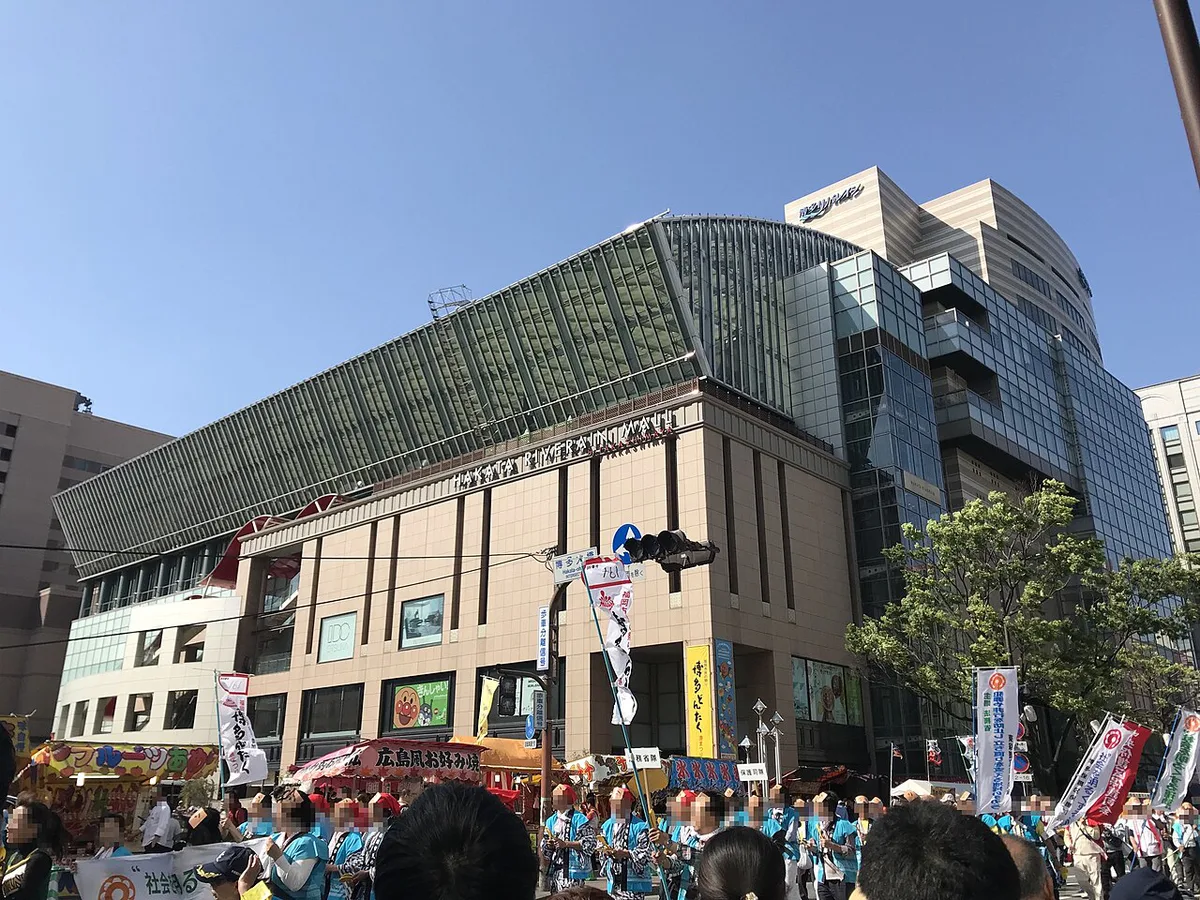
Hakata Dontaku 2026 runs Sunday, May 3, and Monday, May 4, both national holidays. An eve festival opens the event on Saturday, May 2. According to Fukuoka Prefecture's official event listing, that eve program runs from 5:00 PM to 8:30 PM. It is organised by RKB Mainichi Broadcasting on the main stage in front of Fukuoka City Hall, with invited Dontaku groups and a guest singer. Entry is free and no numbered tickets were issued in 2026, so check the official Hakata Dontaku site for the current-year arrangements. The Matsubayashi procession, led by the three gods of fortune on horseback alongside a children's dance troupe, tours the city on May 3 and 4 from 9:00 to 17:00 and opens the Meiji-dori parade at 13:06 on May 3. Meiji-dori then hosts the main Dontaku-tai parade through the afternoon, starting with a tape-cutting and fanfare at Dontaku Square at 13:05. Meiji-dori closes to traffic from 12:30 on May 3 and from 13:30 on May 4 until 19:00, so budget extra time to reach a viewing spot. May 4 repeats a full parade schedule from 14:05, and the festival closes with So-Odori, a mass public dance from 17:50 to 18:20 at Dontaku Square and three other points along the route. Everyone nearby is welcome to join, clapping wooden rice scoops as the music plays. Decorated Nishitetsu flower buses, called Hana Jidosha, circulate through the city from May 2 to 4 (three ran in 2026) and light up after dark. The floats began as fresh-flower displays before adding electronic lighting in later decades. In recent years, international performance groups have also joined the lineup. For the year's full festival lineup, see Fukuoka's year-round festival calendar.
The Shamoji Tradition: Why Rice Scoops?
Shamoji, wooden rice scoops, are Hakata Dontaku's most recognizable prop. According to Fukuoka City's official tourism guide, the custom began when a merchant's wife heard festival music passing her home. She grabbed her kitchen rice scoop and ran outside to dance along, and the gesture stuck as tradition. Dontaku-tai performers now clap shamoji together in unison while marching, producing the rhythmic clack that defines the parade's sound. A related custom is wearing haori coats inside-out, called surase, considered a stylish nod to the festival spirit. Visitors do not need a costume or shamoji to join in. Shamoji souvenirs are sold at stalls along the route for anyone who wants to clap along. Standing near the parade route and clapping during the So-Odori finale is enough to take part.
Where to Watch: Viewing Spots and Transit
Fureai Plaza, in front of Fukuoka City Hall, is confirmed as the festival's main venue by Fukuoka Prefecture's official tourism site. The core parade runs along Meiji-dori between Gofukumachi and Tenjin. The paid tourist viewing stands, called kanko sajiki, were not set up in Suijo Park in 2026; the organiser instead placed a smaller set of "Dontaku machi-aruki" viewing seats at the Dontaku Square headquarters. Seating is limited, so check the official site for the current year's arrangements. Standing-room viewing costs nothing, in line with many of Fukuoka's free things to do. Tenjin Station, on the Kuko (Airport) subway line, sits close to the route. Tenjin-minami Station, on the Nanakuma Line, is another walkable option. Avoid buses and taxis during parade hours. Meiji-dori's road closures back up surface traffic across central Fukuoka on both afternoons. The table below breaks down which part of the festival suits which kind of visitor.
| Feature | Best For | Location |
|---|---|---|
| Main Dontaku Parade | First-time visitors, photographers | Meiji-dori, between Gofukumachi and Tenjin |
| Matsubayashi Parade | History-focused visitors | Starts in the Hakata area |
| So-Odori (Grand Finale) | Visitors who want to dance | Dontaku Square |
| Hana Jidosha (Flower Buses) | Families, evening viewing | Various routes citywide |
Food and Nearby Sights in Hakata and Tenjin
Yatai food stalls cluster in Nakasu and Tenjin during the festival, serving alongside the parade route. For a fuller sense of the city's food scene, see the guide to Fukuoka's food and yatai culture. Two local specialties worth prioritizing are Hakata ramen, a tonkotsu pork-bone broth, and Hakata udon, a softer noodle than most regional styles. Kushida Shrine, the starting point for July's Hakata Gion Yamakasa floats, is a short walk away in Hakata Old Town. Nearby temples such as Tochoji and Jotenji make quick add-on stops for visitors extending the afternoon. Hakata Old Town's shrines and temples are walkable from the parade route, pairing easily with the festival schedule. The Hakata Traditional Craft and Design Museum relocated to Hakata Ekimae 1-chome in Hakata-ku in May 2025. Confirm its current hours before visiting, since relocations can shift opening schedules. For a broader list of nearby stops, check Fukuoka's attractions guide.
Golden Week Survival: Booking, Crowds, and Weather
Book accommodation at least six months ahead. Fukuoka hotels routinely sell out completely during Golden Week, and Fukuoka's neighborhood guide is worth reviewing before rates climb further. Deciding How Many Days in Fukuoka: 13 Essential Planning Tips to spend also helps with planning around the festival. If Meiji-dori feels too crowded, the roughly 30 smaller stage locations around the city offer performances with thinner crowds, especially in late morning before the afternoon parade peak. Save the main parade route and So-Odori finale for when a guaranteed view matters most. Arriving at a viewing spot well before a parade segment starts secures a clearer sightline without a long wait. Early May in Fukuoka can turn warm and humid by midafternoon, so carry water and sun protection for a full day outdoors. Fukuoka's seasonal guide compares Golden Week to quieter shoulder-season weeks. Golden Week congestion is not unique to Fukuoka. Hotel rates spike across Kyushu, so check Kumamoto's event calendar before adding extra nights nearby. The same applies heading toward Hiroshima's event calendar.
Hotels for the May 3 and 4 festival sell out completely each year, so book accommodation at least six months ahead.
Frequently Asked Questions
When is Hakata Dontaku 2026?
Hakata Dontaku runs May 3 and May 4, 2026, both national holidays. An eve festival takes place May 2 from 5:00 PM to 8:30 PM, according to Fukuoka Prefecture's official event listing.
Is Hakata Dontaku free to attend?
Yes, standing-room viewing along the parade route and at the roughly 30 stage locations is free. The paid kanko sajiki stands were not set up in 2026; a smaller set of machi-aruki viewing seats was offered instead, so check the official site for the current year.
What is the difference between Hakata Matsubayashi and Dontaku?
Hakata Matsubayashi is the original 1179 New Year ritual, performed on both festival days (9:00–17:00) as the three gods of fortune parade on horseback. Dontaku is the modern citywide festival that grew out of it after an 1879 revival, adding afternoon parades, stage shows, and Hana Jidosha flower buses.
Where is the best place to watch the parade?
Meiji-dori between Gofukumachi and Tenjin carries the main parade and draws the largest crowds. Fureai Plaza in front of Fukuoka City Hall hosts the main stage for a fixed view instead of walking the route.
How far ahead should travelers book Fukuoka hotels for Golden Week?
Book at least six months ahead. Fukuoka hotels routinely sell out completely during Golden Week, and rates climb well before the exact festival schedule is confirmed each year.
What does the shamoji clapping mean?
Shamoji are wooden rice scoops that Dontaku-tai performers clap together while marching. The custom traces to a merchant's wife who reportedly grabbed her kitchen scoop and joined a passing parade.
What are Hana Jidosha?
Hana Jidosha are decorated Nishitetsu buses, known as flower cars, that circulate through Fukuoka during the festival. Three ran from May 2 to 4 in 2026, lit up for visibility after dark.
Free: The Fukuoka Essentials guide
Top things to do, where to stay, a perfect day plan, getting around, and the best time to go — a Fukuoka mini-guide you can take offline.
You might also like


Continue reading
More guides you'll find useful