Zenkoji Temple Events: Ceremonies, Festivals, and the 2027 Gokaicho
Plan Zenkoji Temple events: the O-Asaji morning service, Tomyo Lantern Festival, and the rare 2027 Gokaicho, with timing, tickets, and access.
On this page
Last updated September 2026, this guide sorts Zenkoji Temple events into three tiers: a daily sunrise ritual, an annual festival calendar, and a rare Buddhist exhibition. Sunrise sets the clock for the O-Asaji morning service, which starts near 5:30am in July and drifts to 7:00am in January. The next Gokaicho exhibition runs April 4 to June 19, 2027, a rare public viewing of the Maedachi Honzon replica held every six to seven years.
Zenkoji Temple Events at a Glance
Zenkoji is officially non-sectarian, so its calendar mixes daily Buddhist ritual with festivals that any visitor can join. That openness means the daily service, annual festivals, and the Gokaicho are all open to visitors regardless of faith or nationality. Three categories structure this guide: the O-Asaji morning service held every day of the year, annual festivals tied to specific months, and the multi-week Gokaicho exhibition that appears only once every six to seven years. For a wider view of what else is running in the prefecture during a trip, the Nagano festivals calendar covers events beyond the temple grounds.
- O-Asaji: daily, year-round, free to watch
- Annual festivals: Tomyo Lantern Festival (Feb), Gion Festival (June), Binzuru (Aug), Joya no Kane (Dec 31)
- Gokaicho: April 4-June 19, 2027, once every six to seven years
O-Asaji: The Dawn Morning Service and Juzu Blessing
O-Asaji takes place in the Main Hall every day, timed to sunrise rather than a fixed clock. According to Zenkoji's official site, the start time shifts by the minute across the year. Arrive by roughly 5:30am in July and by 7:00am in January to be in place before chanting begins. Two consecutive 30-minute sessions make up the ritual, one led by Daikanjin monks and one by Daihongan monks. Both are conducted in Japanese chanting rather than a spoken program, so no language ability is needed to attend. Just before each session, the head priest or priestess walks a line of kneeling visitors and touches their heads with a Buddhist rosary, a blessing known as juzu-chodai. Standing to watch both the entrance and exit lines is free and open to anyone. Sitting inside the Naijin inner sanctuary during the chanting requires a ticket, priced from about 600 yen as part of the Zenkoji Naijin and Kaidan Meguri combination.
- Session structure: two 30-minute chanting sessions (Daikanjin, then Daihongan)
- Naijin ticket: from about 600 yen (Zenkoji Naijin and Kaidan Meguri combination)
- Free viewing: the juzu-chodai blessing line, no ticket needed
Annual Festival Calendar: Lanterns, Floats, and Bell Ringing
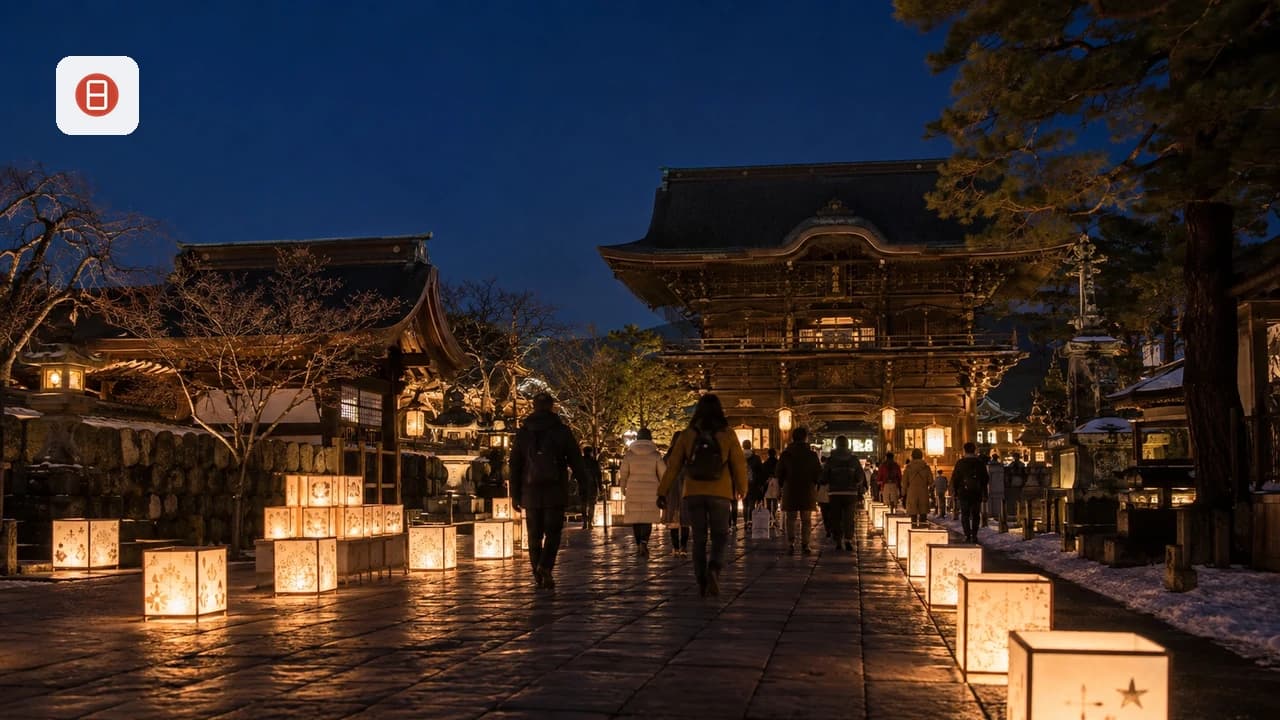
Zenkoji's festival calendar runs from a winter illumination through a summer dance festival to a New Year's Eve bell-ringing. Held in mid-to-late February, the Tomyo Lantern Festival commemorates the 1998 Nagano Winter Olympics. According to Go Nagano's tourism site, the temple is lit in Olympic colors while Joyama Park fills with lanterns. Recent editions have paired the lighting with an evening program at the Main Hall, so check current-year listings for exact dates and any add-on displays. Early February also brings Setsubun nationwide, a bean-throwing custom marking the seasonal turn from winter to spring. Zenkoji's own Setsubun observance, if any in a given year, is worth confirming through current listings before planning around it. Travelers visiting in mid-winter often pair the lantern festival with the Nozawa Onsen Fire Festival, held elsewhere in the prefecture. Since the Tomyo Lantern Festival falls in peak snow season, pair it with the Nagano snow season guide for road and transit conditions. First weekend of June brings the Nagano Gion Festival, with festival floats, geisha performances, and a sake-tasting stamp rally. August's Binzuru Summer Festival is Nagano City's largest dance festival, covered in full in the Binzuru festival guide. On December 31, the temple opens its bell for a public New Year's Eve ringing known as Joya no Kane. For exact dates across the full year, cross-check the month-by-month festival calendar.
| Festival | When | Highlight |
|---|---|---|
| Tomyo Lantern Festival | Mid-to-late February | Olympic-color illumination, lanterns in Joyama Park |
| Setsubun | Early February | Bean-throwing custom; confirm current-year timing |
| Nagano Gion Festival | First weekend of June | Floats, geisha performances, sake stamp rally |
| Binzuru Summer Festival | August | Nagano City's largest dance festival |
| Joya no Kane bell-ringing | December 31, late night | Public New Year's Eve bell at the Main Hall |
Zenkoji Gokaicho 2027: The Rare Great Disclosure
Zenkoji's hidden Buddha statue, believed to be the first Buddhist image brought to Japan, has not been shown to the public since 654, according to Zenkoji's official site. Roughly once every six to seven years, the temple reveals a stand-in instead: the Maedachi Honzon, a replica installed for public worship. Next, the Gokaicho runs April 4 to June 19, 2027, a 77-day event. A sacred pillar called the Eko-bashira stands in front of the Main Hall, connected to the Maedachi Honzon by a cord known as the Rope of Good Fortune. Worshippers touch the pillar to form a symbolic connection to the replica and, through it, to the hidden image itself. Previous Gokaicho cycles have drawn roughly 6 million visitors across the full multi-month run. Expect the grounds to be busiest on weekends, holidays, and during the opening and closing ceremonies. Given the crowds, book shukubo temple lodging six months or more ahead of any 2027 travel dates. Options are listed in the Nagano lodging guide, including temple stays near the grounds. Travelers pairing the trip with Matsumoto can cross-check the Matsumoto events calendar. Those continuing toward the Hokuriku coast can do the same with the Kanazawa festivals guide.
The 77-day Gokaicho draws millions over months, while the daily O-Asaji ritual requires mere minutes of early arrival—vastly different planning horizons for two of Zenkoji's major offerings.
Hands-On Spiritual Experiences
Beyond scheduled ceremonies, Zenkoji offers several experiences visitors can join on their own schedule. Kaidan Meguri sends visitors into a pitch-black corridor beneath the Main Hall, feeling along the wall for guidance. Somewhere along the path is a metal latch called the Key of Enlightenment, fixed directly under the hidden Buddha statue. Touching it is said to create a direct connection to the hidden image. At the Daikanjin sub-temple, guided Zazen seated meditation sessions include a shoulder tap from a wooden slat called a keisaku. Chair seating is available for those who prefer not to sit on the floor. Sutra copying at the same sub-temple starts with grinding your own ink and finishes with two completed sutras, one kept and one left at the temple. Mawarigoma is a short fire ceremony in which visitors write a wish on a wooden plaque, then place it into the fire to the sound of drumming and chanting.
Planning Your Visit: Access, Tickets, and Etiquette
JR Nagano Station is the transit hub for reaching Zenkoji. On foot, the walk north from the station takes about 30 minutes. By bus, route 1 runs from the Zenkoji Exit to the Zenkoji Daimon stop, then it is roughly an 8-minute walk to the Main Hall. A taxi from the station takes about 10 minutes, a middle option between walking and the bus. Drivers exiting the Joshin-etsu Expressway at Nagano IC face about a 30-minute drive into central Nagano. Parking near the temple runs around 500 yen for two hours. For city-wide transit options beyond this route, see the Nagano transit guide. As of 2026, ticket pricing is tiered rather than a single admission fee. Photography is not permitted inside the Main Hall, and shoes come off before stepping onto the tatami and wood floors of the inner halls. Budget at least one hour for the Main Hall, a Naijin ticket, and the Kaidan Meguri. Extending to a full day adds the Sanmon Gate climb, the Kyozo repository, and time on Nakamise-dori, plus a look at the wider 11 Best Things to Do in Nagano, Japan (2026 Guide) nearby. Building a Zenkoji stop into a wider Nagano trip works well alongside the Nagano itinerary guide. Cross-check seasonal timing first with the seasonal Nagano guide.
| Ticket | Adult Price | Covers |
|---|---|---|
| All Buildings combination | 1,200 yen | Naijin, Kaidan Meguri, Sanmon Gate, Kyozo |
| Zenkoji Naijin and Kaidan Meguri | 600 yen | Inner sanctuary seating plus the underground crawl |
| Sanmon Gate | 600 yen | Rooftop view over Nagano City |
| Kyozo sutra repository | 300 yen | One turn of the rotating sutra holder |
Not Zenkoji in Hokkaido: Usu Zenkoji Is a Different Temple
Search results sometimes mix up Nagano's Zenkoji with Usu Zenkoji, a separate temple near Lake Toya in Hokkaido. The two share a name but not a location, sect calendar, or set of events. Usu Zenkoji's spring highlight is a rock-breaking cherry tree that blooms from a crack in a large boulder, typically flowering in May. Its main summer event is the Jizoson ceremony on July 23-24, when paper lanterns are floated on Usu Bay after a memorial service, with fireworks to follow. Fees there run around 1,000 yen per person for the lantern-floating service and 700 yen for the stupa-offering service. None of these Hokkaido dates or prices apply to a Nagano Zenkoji visit.
Mistakes to Avoid
A few planning mistakes are easy to avoid with the right timing. Arriving after sunrise means missing the start of O-Asaji entirely, since the doors and blessing line form beforehand, not after. Skipping the Kyozo sutra repository skips part of the ritual too. Giving the roughly five-ton octagonal holder one full clockwise turn is said to carry the same merit as reading all 6,771 volumes of scripture inside it. Treating the 2027 Gokaicho as a same-week booking is another common error, given the lodging demand outlined above. Rounding out the visit with nearby stops keeps the day efficient. The Nagano attractions guide covers what else sits within walking distance.
- Arrive before sunrise, not after, to catch the full O-Asaji service
- Turn the Kyozo sutra holder once, clockwise, for its full symbolic merit
- Book Gokaicho-period lodging six months or more ahead, not the week of travel
- Remove shoes before inner halls and skip photos inside the Main Hall
Frequently Asked Questions
What time does the O-Asaji morning service start at Zenkoji?
Start time shifts daily with sunrise, from about 5:30am in July to 7:00am in January. Arrive at least 15 to 20 minutes early to find a spot in the blessing line or secure a Naijin ticket.
How much does it cost to visit Zenkoji Temple?
Watching O-Asaji and the juzu-chodai blessing outside is free. Paid tickets are tiered instead. Naijin and Kaidan Meguri access costs about 600 yen, and Sanmon Gate entry is a separate 600 yen. Kyozo repository entry runs 300 yen, and the All Buildings combination covering everything costs about 1,200 yen.
When is the next Zenkoji Gokaicho?
Next Gokaicho dates run April 4 to June 19, 2027, a 77-day event held roughly every six to seven years. It centers on the Maedachi Honzon, a replica of the temple's permanently hidden Buddha statue.
Is Zenkoji in Nagano the same temple as Usu Zenkoji in Hokkaido?
No, they are separate temples with separate event calendars. Nagano's Zenkoji holds the daily O-Asaji service and the Gokaicho exhibition, while Hokkaido's Usu Zenkoji runs its own festivals, including a July Jizoson lantern-floating ceremony on Usu Bay.
How long should a Zenkoji visit take?
A focused visit covering O-Asaji and the Kaidan Meguri fits into about an hour. Extending to a full day adds the Sanmon Gate climb, the Kyozo repository, and time on Nakamise-dori, plus a look at the wider 11 Best Things to Do in Nagano, Japan (2026 Guide) nearby.
What should visitors avoid doing inside Zenkoji's Main Hall?
Photography is not permitted inside the Main Hall, so keep cameras and phones away during services. Shoes also come off before stepping onto the tatami and wood floors in the inner halls.
Free guide: Japan's Hidden Gems
12 under-the-radar places beyond Tokyo & Kyoto — with the best season to visit each and a local tip you won't find in the guidebooks.
You might also like

Continue reading
More guides you'll find useful