
Jidai Matsuri Kyoto: A Complete Guide to the Parade of the Ages
Plan your Jidai Matsuri Kyoto visit for October 22, 2026: the parade route, best viewing spots, paid seating prices, and subway access, explained.
On this page
Last updated August 2026: the Jidai Matsuri Kyoto procession returns on October 22. Roughly 2,000 costumed participants and 70 horses cover a 5km route from the Kyoto Imperial Palace to Heian Shrine. This guide compares the three main viewing areas, weighs paid seats against free sidewalk spots, and covers subway access for the 12:00 PM start.
Jidai Matsuri Kyoto: Quick Facts at a Glance
These are the core numbers to plan around before diving into route strategy.
- Date: October 22 every year, with a rain date of October 23.
- Start time: 12:00 PM departure from Kyoto Imperial Palace.
- Finish time: around 2:30 PM arrival at Heian Shrine.
- Route length: about 5km, roughly 3 miles, from palace to shrine.
- Scale: around 2,000 participants and 70 horses across some 20 groups.
- Cost: free from sidewalks; regular 2026 reserved seats run ¥5,000 to ¥7,500.
What Is the Jidai Matsuri in Kyoto?
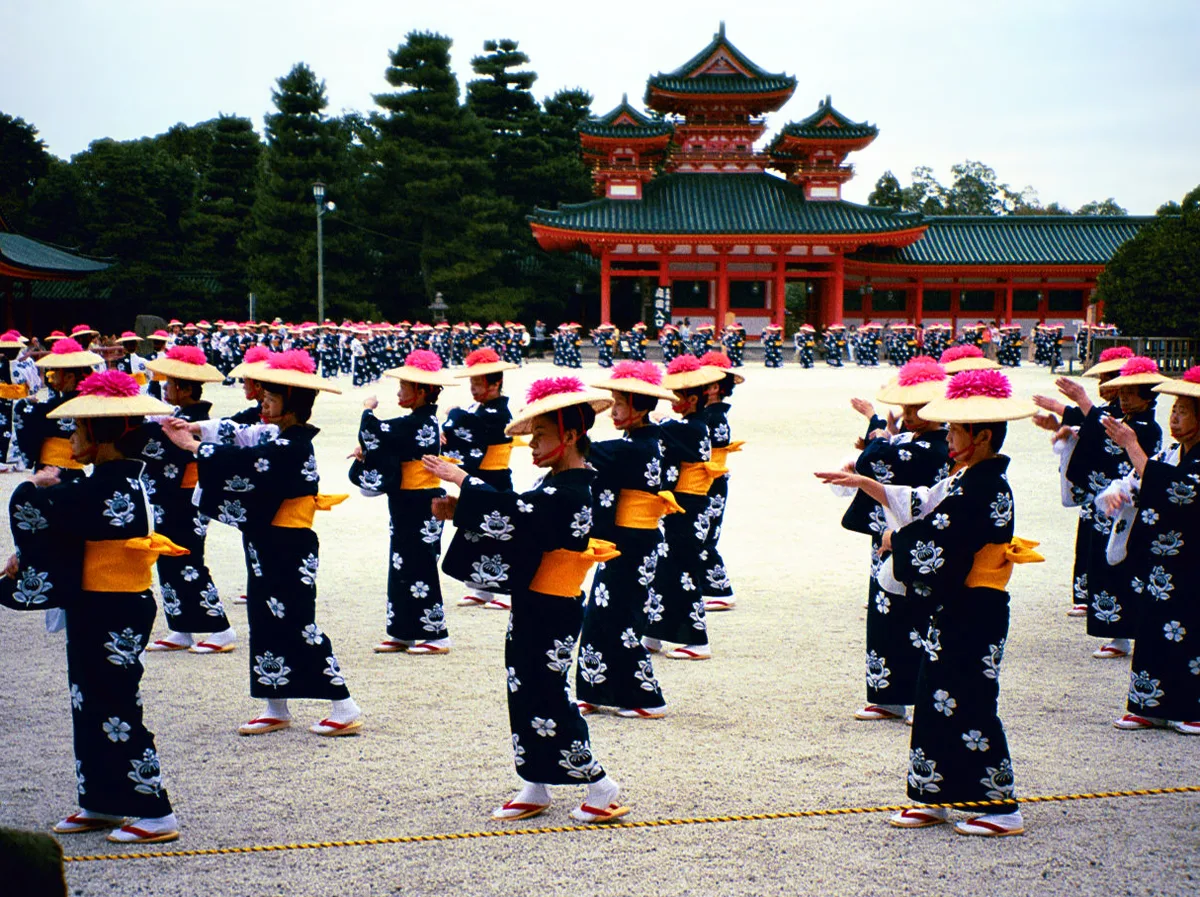
Jidai Matsuri, or Festival of the Ages, ranks among Kyoto's three major annual festivals. It runs alongside the Gion Matsuri parade in July. Aoi Matsuri's procession follows every May. Heian Shrine inaugurated the festival in 1895, marking 1,100 years since Kyoto's founding in 794. Two mikoshi carry the spirits of Emperor Kammu and Emperor Komei from the shrine through the city and back. Roughly 12,000 costumes and ceremonial items appear in the parade, each recreated with period-accurate dyeing and weaving techniques. Organizers describe the procession as a walking museum rather than a simple costume parade. That level of historical research is rare outside dedicated museum exhibits.
Why Kyoto Built a Festival Around Its Own History
Japan's capital moved from Kyoto to Tokyo in 1868 during the Meiji Restoration. The emperor, the imperial family, and most of the government moved with it. Kyoto's population and civic leaders worried the city would fade without its imperial role. Heian Shrine opened in 1895 as a direct response, staging the first Jidai Matsuri to reassert Kyoto's cultural identity. Commemorative events originally ran from October 22 to 24, organized by Heian Kosha, a citizens' group formed to manage the new shrine. Organizers shifted the procession to October 22 alone starting in 1896, the date it still uses today. That civic-morale motive is why the festival reenacts eras rather than simply displaying artifacts in a museum case. Kyoto's autumn calendar also includes the Kurama Fire Festival in late October, a different atmosphere from the Jidai Matsuri's daytime procession.
The Procession: A Parade That Walks Backward Through Time
The parade moves backward through Japanese history, opening with the Meiji Restoration of 1868 and closing with the Enryaku era of 782 to 806. About 2,000 participants and 70 horses fill roughly 20 groups across 8 historical periods, forming a procession about 2km, or a little over a mile, long. Each group marches in full era-specific dress, so the shift from Meiji uniforms to Heian robes happens in real time. Gion Matsuri centers on Yasaka Shrine's summer rites, while Jidai Matsuri unfolds as one continuous historical timeline.
- Meiji Restoration (around 1868): a marching band and soldiers of the imperial forces, including a figure representing Sakamoto Ryoma.
- Edo Period (1603-1868): the shogun's ceremonial deputies on horseback, footmen tossing spears and travel boxes, and a small group of famous women including a princess on a wheeled platform.
- Azuchi-Momoyama Period (1568-1603): Hideyoshi Toyotomi's retinue marking his son's coming-of-age ceremony, followed by the armor of Oda Nobunaga's commanders.
- Muromachi Period (1338-1573): Ashikaga shogunate magistrates, court nobles, and a reenactment of the Furyu-odori dance.
- Yoshino Period (1333-1392): the commander Kusunoki Masashige welcoming exiled Emperor Godaigo back to the capital in 1333.
- Procession of Women, Middle Ages (1185-1603): peddlers from Kyoto's Ohara and Katsura districts carrying firewood, charcoal, and baskets of sweetfish.
- Kamakura Period (1192-1333): warriors in hunting dress and deer-skin leggings, recalling former Emperor Gotoba's Yabusame archery gathering.
- Fujiwara Era through Enryaku Era (782-1185): Heian court nobles in evolving Japanese-style dress, closing with officials from Kyoto's founding as capital in 794.
The Procession of Women and the Two Mikoshi
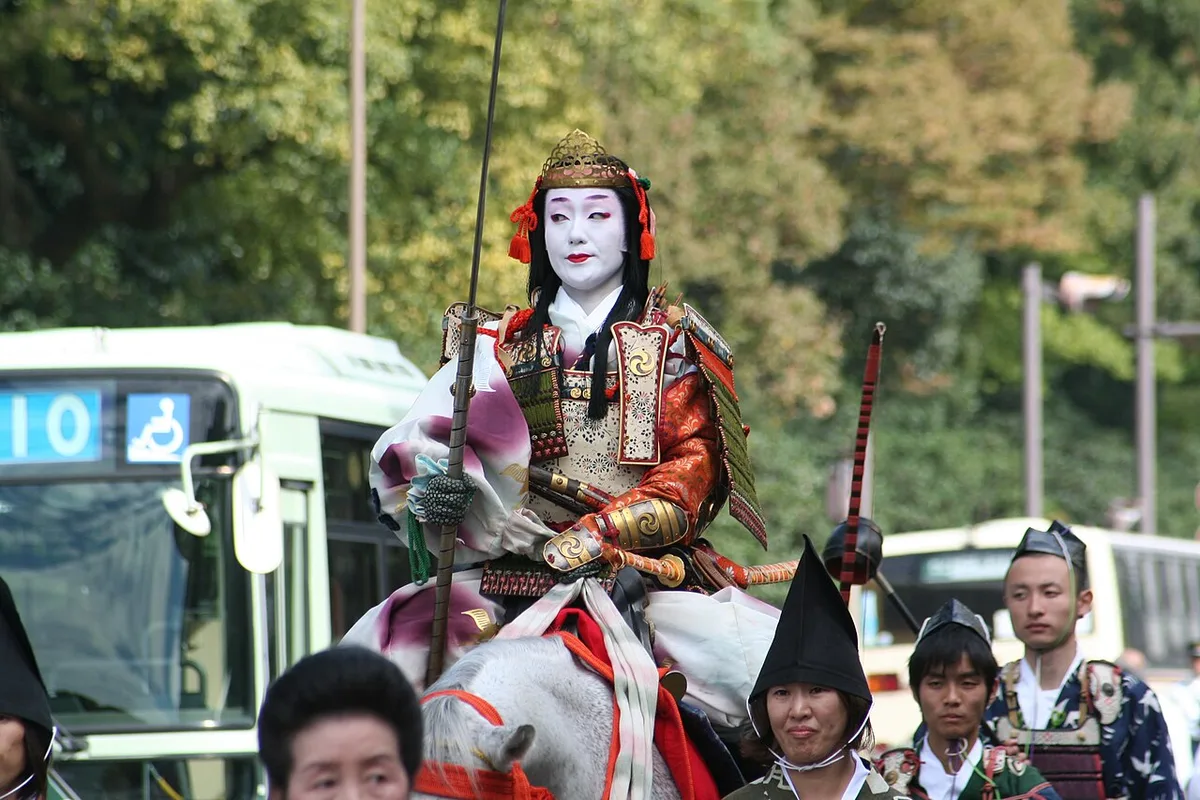
Most photographed of all is the Procession of Women, spanning outfits from the Heian court to the medieval era. Court women wear elaborate jūnihitoe robes, twelve-layered silk garments once reserved for Heian nobility. Earlier in the sequence, peddlers from Kyoto's Ohara and Katsura districts appear in shorter kimonos with white cloth tied over their hair. Two mikoshi close the parade, carrying the spirits of Emperor Kammu and Emperor Komei. A costumed military band playing gagaku music escorts the shrines through the city. These portable shrines normally stay inside Heian Shrine and travel through Kyoto only on this one day each year. Onlookers often single out the jūnihitoe robes and the mikoshi's arrival as the parade's two most memorable moments.
The festival opened in 1895 as a response to Kyoto losing its capital status. Yet visitors often remember the elaborate jūnihitoe robes and mikoshi arrival for visual impact rather than the historical reassertion they represented.
Where to Watch: Comparing the Three Main Viewing Areas
Three viewing areas dominate the route, and each trades off differently between crowd size, photo backdrop, and ease of access. Many visitors watch the start at Kyoto Gyoen, then take the subway ahead to Heian Shrine before the parade arrives. None of the three areas requires a ticket, since all sit along the free public route. Photographers favor the Imperial Palace start for uncluttered background shots, while the Heian Shrine finish rewards anyone chasing atmosphere over composition.
| Viewing Area | Approx. Arrival Time | Crowd Level | Best For | Getting There |
|---|---|---|---|---|
| Kyoto Imperial Palace (start) | 12:00 PM | Very high; arrive well ahead | Wide shots of the full lineup forming | Karasuma Line to Imadegawa Station, 5-min walk |
| Karasuma-Oike | 12:50 PM | Moderate | Wide boulevard sightlines over the crowd | Walkable from either subway hub on this route |
| Sanjo-dori | Around 1:30 PM | Moderate to high | Downtown shopping-district backdrop | Central Nakagyo-ku, near downtown hotels |
| Heian Shrine (finish) | 2:30 PM | Highest congestion of the day | Torii gate finale, highest energy | Tozai Line to Higashiyama Station, 10-min walk |
Paid Reserved Seats vs Free Sidewalk Viewing
Paid reserved seats guarantee a spot without a two-hour wait, and all individual tickets include the official guidebook and commemorative items. Free sidewalk viewing costs nothing and lines the entire 5km route, though the best spots fill up early. The official 2026 seating areas are Kyoto Gyoen, Oike-dori, and Jingu-michi. Regular seats cost ¥5,000 from the second row or ¥7,500 in the front row; learning and special seats cost more. The limited presale lottery ran July 10–17, and general sales are scheduled to start September 8 at 10:00. Check the official 2026 Jidai Matsuri seating page before booking because availability can change. Families with young children often prefer paid seats simply to avoid standing for two hours straight. Either choice works; the decision mostly comes down to budget and how much flexibility matters to you.
- Pro: a guaranteed sightline without staking out a spot two hours early.
- Pro: an English-language pamphlet explains each historical group as it passes.
- Con: seats fix you to one location for the entire two-hour procession.
- Con: at ¥5,000 to ¥7,500 for regular seats, paid viewing costs more than the free sidewalks lining the rest of the route.
Getting There: Subway Stations and Crossing the Route
Take the subway rather than a bus on festival day, since parade closures reroute bus lines unpredictably. Discover Kyoto's access notes point to Imadegawa Station on the Karasuma Line, a 5-minute walk to the Imperial Palace. Marutamachi Station is a second nearby option, though its Exit 1 tends to bottleneck as festival crowds converge. The Tozai Line's Higashiyama Station serves Heian Shrine, about a 10-minute walk from the exit. Once the procession begins, crossing the route on foot becomes difficult until a gap opens between groups. Reach a viewing spot well before the section you want to watch arrives, since gaps between costume groups are brief. Streets near the route close to general traffic for several hours, so factor that into any taxi plans. October afternoons suit a full day outdoors; the Best Time to Visit Kyoto: Monthly & Seasonal Guide (2026) guide covers seasonal planning beyond festival day. Sidewalk viewing costs nothing, and the 10 Best Free Things to Do in Kyoto (2026) guide lists other no-cost activities to pair with festival day.
Where to Stay and Where to Eat Near the Route
Nakagyo-ku, the central ward along Oike-dori, puts travelers within walking distance of the parade's midpoint. Higashiyama, near Heian Shrine, suits anyone prioritizing the festival's finale over its start. Both neighborhoods sit well within walking or short subway range of the rest of central Kyoto. Restaurants directly on Oike-dori and around Heian Shrine fill up on festival day, so reserve ahead or plan to eat elsewhere. Nishiki Market, a short subway ride from the route, stays a reliable backup for lunch before or after the parade. Booking a room in either neighborhood at least a few weeks ahead is wise, since October is peak season across Kyoto. Travelers staying multiple days can pair the festival with a day trip from Kyoto earlier or later in the same week.
Viewing at 12:50 PM (Karasuma-Oike) has moderate crowds compared to very high congestion at the start. Staying in central Nakagyo-ku near Oike-dori positions you at this moderate-crowd midpoint rather than near the start or finish.
Mistakes to Avoid: Rain, Timing, and Sun Exposure
If rain falls on October 22, the parade shifts to October 23. A second rainout on the 23rd cancels the event for the year. Scheduling can also shift for reasons beyond weather; in 2019 organizers moved the parade to October 26 to accommodate Emperor Naruhito's enthronement ceremony. Confirm the forecast a day ahead, and check the Kyoto festivals calendar for any last-minute notices. The parade starts at noon, but the full procession takes about 2 hours to pass any single point. Arriving right at 12:00 does not guarantee a quick viewing, so budget extra time before or after the front group passes. October afternoons in Kyoto can still run warm, and the parade route offers little shade along its open boulevards. Layer clothing you can remove, since mornings start cool but afternoons in direct sun can feel much warmer. Bring water and sun protection regardless of the forecast. Portable phone chargers are worth packing too, since photo-heavy afternoons drain batteries fast. None of these adjustments take much effort, and each one meaningfully improves the day.
Frequently Asked Questions
When is the Jidai Matsuri held in 2026?
The Jidai Matsuri takes place on October 22, 2026, with the procession departing Kyoto Imperial Palace at 12:00 PM. If rain falls that day, the event moves to October 23. A second rainout cancels it for the year.
Is the Jidai Matsuri free to watch?
Yes, sidewalks along the full 5km route are free, with no ticket required. Paid 2026 seats are also available at Kyoto Gyoen, Oike-dori, and Jingu-michi; regular seats cost ¥5,000 from the second row or ¥7,500 in the front row.
How long does the parade take to pass a viewing spot?
The full procession takes about 2 hours to pass any single viewing point, even though it starts precisely at noon. Plan to stay in place for the whole sequence, since crossing the route mid-parade is difficult.
Which subway station works best for the Jidai Matsuri?
Imadegawa Station on the Karasuma Line is a 5-minute walk to the Kyoto Imperial Palace start point. For the finish at Heian Shrine, take the Tozai Line to Higashiyama Station, about a 10-minute walk.
How does the Jidai Matsuri compare to the Gion Matsuri?
Gion Matsuri centers on large float processions tied to summer purification rites in July. Jidai Matsuri instead recreates roughly eight centuries of Kyoto history in reverse chronological order every October 22.
What should you bring to watch the Jidai Matsuri?
Wear comfortable shoes, since most viewing involves standing on pavement for extended periods. Bring water, sun protection, and a compact stool or mat if you plan to claim a spot early.
Free: The Kyoto Essentials guide
Top things to do, where to stay, a perfect day plan, getting around, and the best time to go — a Kyoto mini-guide you can take offline.
You might also like

Continue reading
More guides you'll find useful


