Shoro Nagashi Nagasaki: 2026 Spirit Boat Festival Guide
Shoro Nagashi fills Nagasaki's streets with spirit boats and firecrackers every August 15. Plan 2026 timing, viewing spots, and what to bring for this free Obon procession.
On this page
Last updated September 2026, this guide covers shoro nagashi in Nagasaki, the city's Obon rite for the recently deceased. Held every August 15, it fills Shianbashi, Kencho-zaka, and the Ohato waterfront with hand-built spirit boats, firecrackers, and chanting late into the night. Bereaved families lead the procession, so approach it as a mourning rite, not a fireworks show.
What Is Shoro Nagashi in Nagasaki?
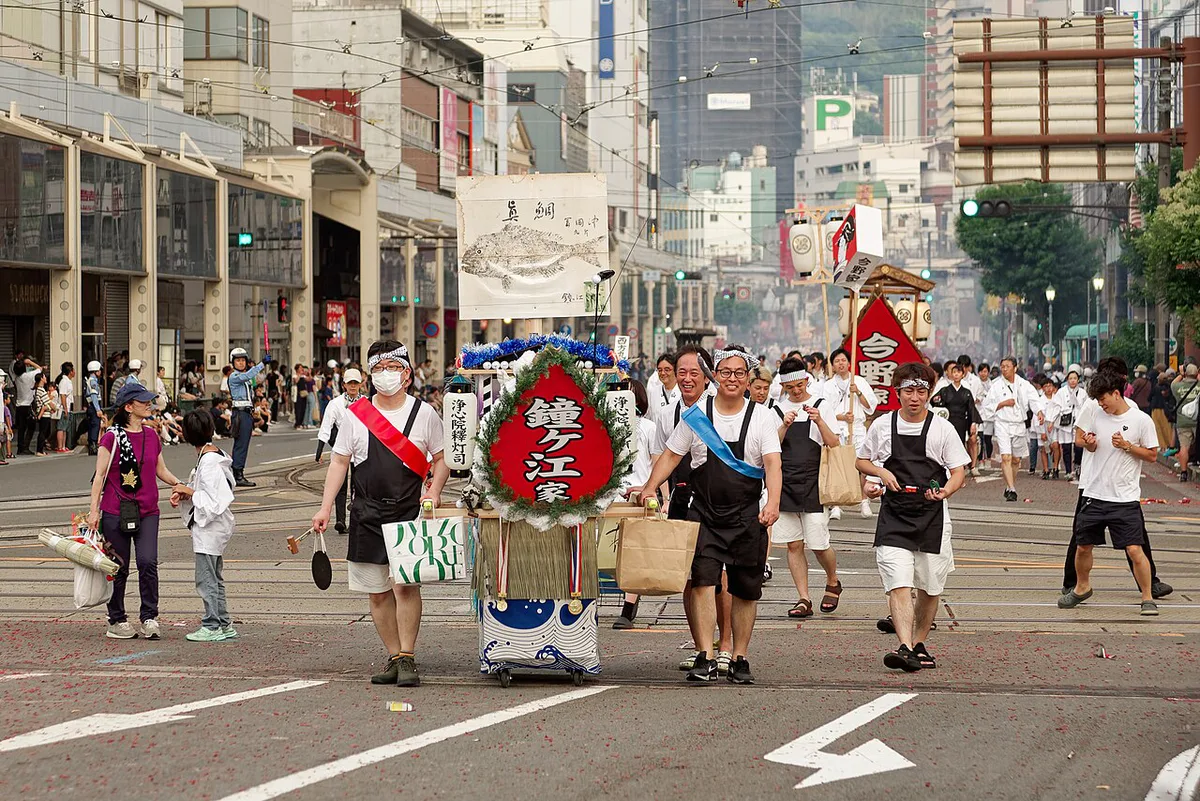
Shoro Nagashi marks the final night of Obon, Japan's festival for returning ancestral spirits, always falling on August 15. The three days leading up to it involve welcoming rituals: families light lanterns, burn incense, and prepare offerings before the final send-off. Nagasaki's version differs sharply from the quiet toro nagashi lantern-floating seen in other regions of Japan. Families who lost a relative in the past year build a shorobune, a spirit boat, and pull it through the streets toward the harbor. Firecrackers crack constantly along the route while gongs clang and marchers chant. Historical crowd counts have topped 180,000 spectators in a single year, making this one of Nagasaki's largest annual gatherings. For the fuller festival calendar around it, see the Nagasaki festivals overview. Check the month-by-month festival calendar for what else lands in August.
The Meaning Behind the Firecrackers and Chants
Spiritual intent sits underneath the noise. Mourners send the souls of the deceased to the Pure Land, the Buddhist realm known as Sukhavati. Firecrackers trace back to a Chinese custom for warding off evil spirits, brought to Nagasaki through the city's long trading ties with China. As each boat passes, participants set off strings of firecrackers meant to cleanse its path. Gong-beaters keep pace at the front of the larger boats. Marchers around them repeat the chant Doi, Doi throughout the procession. That call-and-response, layered over constant firecracker noise, explains why Nagasaki's Obon send-off feels frenzied rather than quiet. By the time the last boats reach the harbor, spent firecracker paper often blankets the pavement in a thick layer. Nagasaki-born singer Masashi Sada later wrote a well-known song about the festival, cementing its place in local culture.
Shorobune and Moyaibune: Anatomy of a Spirit Boat
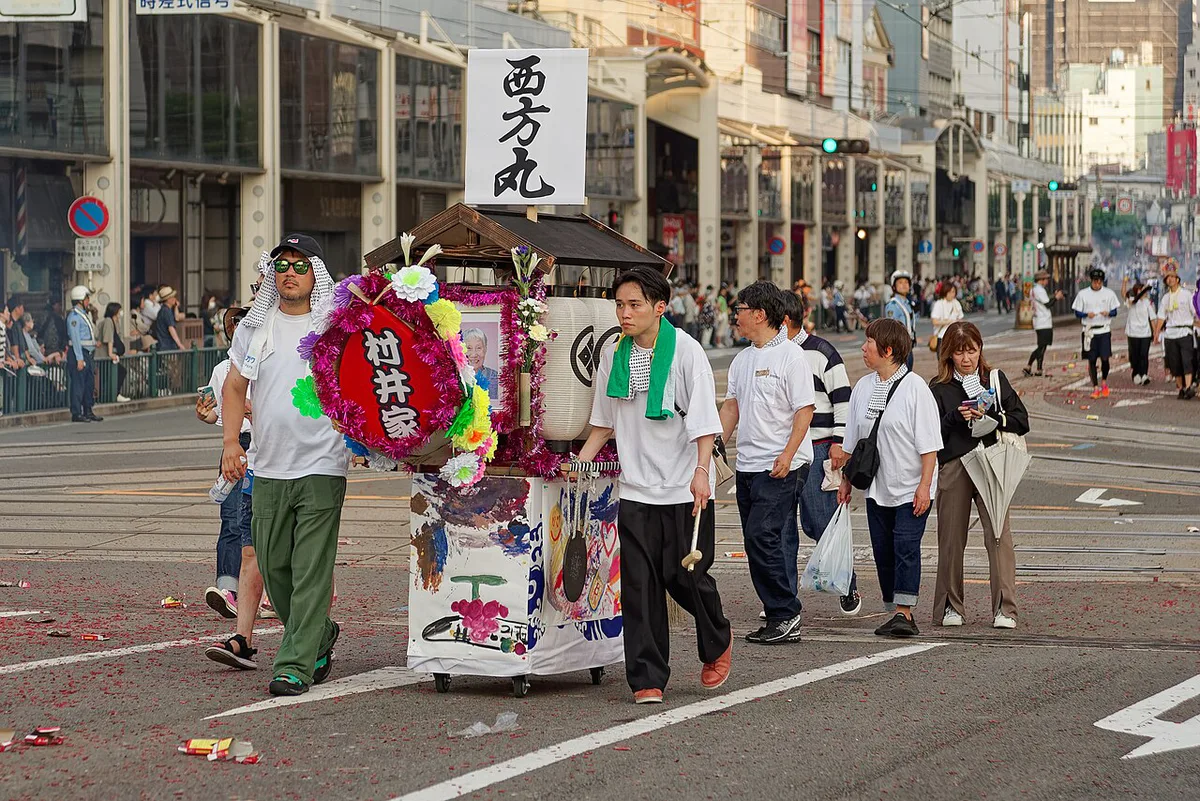
Two boat types make up the procession. A shorobune is an individual or family boat, typically built by households mourning a death from the past year. A moyaibune is a larger community boat, sponsored by a neighborhood association, workplace, or local group. Builders favor bamboo, straw, and wood for the frame, with cogongrass used in some outlying districts. Documented examples include a politician's boat built in the shape of Japan's Diet building and a soy sauce maker's boat carrying miniature casks, each reflecting the deceased's life and work. Costs scale with size and ambition. One well-documented example, a fifteen-meter boat built for a Buddhist monk's family, cost more than ¥2 million to construct, decorate, and outfit fifty helpers with matching festival attire. Individual family boats cost far less, built mostly from bamboo, straw, and grass gathered locally.
A boat costing ¥2 million to build, decorate, and outfit helpers receives the same crane dismantling as simpler family boats once keepsakes are removed.
- Shorobune (individual or family boats): roughly 1-2 meters long, decorated with a photo of the deceased, a family crest, and sometimes a keepsake tied to their hobbies.
- Moyaibune (community boats): built by neighborhood groups, reaching 20 meters or more, strung with dozens of paper lanterns marked with the group's crest.
- Kawari shorobune (custom-shaped boats): built to reflect the deceased's profession or passion, from a yacht shape for a sailor to a boat modeled on a workplace.
Shoro Nagashi Nagasaki 2026: Schedule and Route
Shoro Nagashi falls on August 15, 2026, a Saturday, following the same date every year. Road closures begin around 17:00 as processions assemble in neighborhoods across the city. Intensity builds through the evening, with the heaviest crowds and firecracker density typically between 19:00 and 21:00. Processions continue until roughly 22:00 to 23:00, when the last boats reach the harbor. Nagasaki's official tourism guide confirms the date and central route each year. Nagasaki's steep, curving downtown slopes channel multiple neighborhood processions into the same few streets, which is part of why Shianbashi and Ohato feel so packed. Traffic restrictions affect central Nagasaki from about 17:00 until each procession finishes for the night. Trams reroute around the closed streets, so budget extra walking time to any viewing point.
| Viewing spot | What to expect |
|---|---|
| Shianbashi | The most crowded stretch downtown, where multiple neighborhood processions converge; arrive by 17:00 for space. |
| Kencho-zaka | A sloped street below the Nagasaki Prefectural Office, giving an elevated view as boats descend. |
| Ohato | The final convergence point near Nagasaki Port Ohato Terminal, where processions merge before boats reach the Nagashiba collection site. |
Getting To and Away From the Procession
Plan transit before dark, since the closures reshape how you move through downtown. Nishihamanomachi tram stop sits closest to the Kencho-zaka viewing area. Ohato and Gotomachi stations serve the harbor-side convergence point instead. For regional access into the city, including the Kamome Shinkansen line into Nagasaki Station, see the guide to getting to Nagasaki. Leaving Nagasaki the same night is the hardest part to plan. Processions often run past 22:00, and some last trains toward Fukuoka's Hakata Station depart before the festival fully winds down. Check current JR Kyushu timetables in advance, and book a Nagasaki hotel rather than counting on a same-night departure. Nagasaki City's official tourism site also posts transit advisories during festival closures.
Boats don't reach the harbor until around 22:00 to 23:00, but the last trains to Fukuoka depart earlier, making a same-night return trip impossible.
What to Bring and How to Behave
Come prepared for sensory overload, not a quiet lantern ceremony. August in Nagasaki is hot and humid, and firecracker smoke lingers over the crowd for hours. Check the Best Time To Visit Nagasaki: Weather By Month & Guide guide for what August weather typically brings before you pack. The event continues rain or shine, so pack a light rain layer alongside earplugs if forecasts call for showers. Shoro Nagashi is a funeral rite before it is a spectacle. Skip intrusive flash photography directed at mourning families. Never step into a boat's path or block the pullers' route. Some marchers walk in silence or openly grieve, while others focus on lighting firecrackers. Give both groups room, and follow the lead of local spectators on when to stay back.
- Earplugs: firecracker volume runs constant and close-range for hours, one of the loudest matsuri soundscapes in Japan.
- Closed-toe shoes: spent firecracker paper and embers cover the pavement, and open-toe sandals leave feet exposed to burns.
- A damp towel or cooling wrap: August humidity plus smoke makes the multi-hour crowd conditions physically taxing.
- Cash and a portable phone charger: road closures can strand you away from convenience stores for stretches.
Where the Boats End Up: Nagashiba and the Modern Finish
Boats once drifted out to sea or burned at the water's edge, but environmental regulations ended both practices. Regulators cited ocean pollution from floating and burning debris as the reason for the change. Processions now end at designated Nagashiba collection points, concentrated near the Ohato waterfront. Cranes lift each boat and dismantle it mechanically once families remove photographs, mortuary tablets, and other keepsakes. The contrast is stark: a hand-built, deeply personal boat gives way to a crane in under a minute.
Where to Stay and What to Do the Next Day
Book Nagasaki accommodation four to six months ahead of Shoro Nagashi. Rooms near Nagasaki Station and the Hamamachi shopping arcade sell out fastest. Both sit within walking distance of the Shianbashi and Ohato viewing areas. See the where to stay in Nagasaki guide for neighborhood-by-neighborhood options. Spectating itself costs nothing, so pair the evening with other 10 Best Free Things to Do in Nagasaki: Budget Guide (2026) earlier that day. Nearby daytime sights include Dejima, Shinchi Chinatown, and the Megane-Bashi stone bridge, all within walking distance of the main route. Nagasaki also runs a quieter lantern event each winter. Compare the two in the Nagasaki Lantern Festival 2027: Dates, Venues, and Insider Tips. The city's other major festival, Kunchi, arrives in autumn with a different parade style. Its Nagasaki Kunchi Festival Guide: 9 Essential Planning Tips covers that October event. Build the morning after around Nagasaki's core attractions. Or follow a full Nagasaki Itinerary for First-Timers in 2026 that pairs the festival with sightseeing. If Obon week takes you further across Kyushu, check Kumamoto's event calendar for the same mid-August period. Or see the Kagoshima festival listings for the same week.
Frequently Asked Questions
When is Shoro Nagashi in Nagasaki in 2026?
Shoro Nagashi falls on August 15, 2026, a Saturday, matching its fixed annual date. Processions typically start around 17:00 and continue until roughly 22:00-23:00.
Is Shoro Nagashi free to attend?
Yes, spectating the procession costs nothing. Road closures begin around 17:00, and the best viewing spots along Shianbashi, Kencho-zaka, and Ohato fill up fast, so arrive early for space.
What is the difference between shorobune and moyaibune?
A shorobune is an individual or family boat, usually 1-2 meters long, built to honor a specific relative who died in the past year. A moyaibune is a larger community boat, sponsored by a neighborhood or organization, that can stretch 20 meters or more.
Do you need earplugs for Shoro Nagashi?
Earplugs are strongly recommended. Firecrackers fire constantly and at close range throughout the procession, making sustained noise a defining feature of the event rather than an occasional burst.
How do you get to and from the festival?
Nishihamanomachi tram stop and Ohato or Gotomachi stations sit closest to the main viewing areas. Because processions can run past 22:00 and some last trains toward Fukuoka depart earlier, booking a Nagasaki hotel is safer than planning a same-night departure.
What should you not wear to Shoro Nagashi?
Skip open-toe sandals and flip-flops. Firecracker embers and spent paper cover the streets for hours, and closed-toe shoes protect your feet from burns and debris.
Does Shoro Nagashi happen if it rains?
Yes. The procession continues rain or shine, so pack a light rain layer along with earplugs if the forecast calls for showers.
Can you photograph the procession?
Photography is welcome, but keep it respectful. Avoid pointing flash directly at grieving families, and prioritize wide shots over close-ups of individual mourners.
Free: The Nagasaki Essentials guide
Top things to do, where to stay, a perfect day plan, getting around, and the best time to go — a Nagasaki mini-guide you can take offline.
You might also like


Continue reading
More guides you'll find useful