
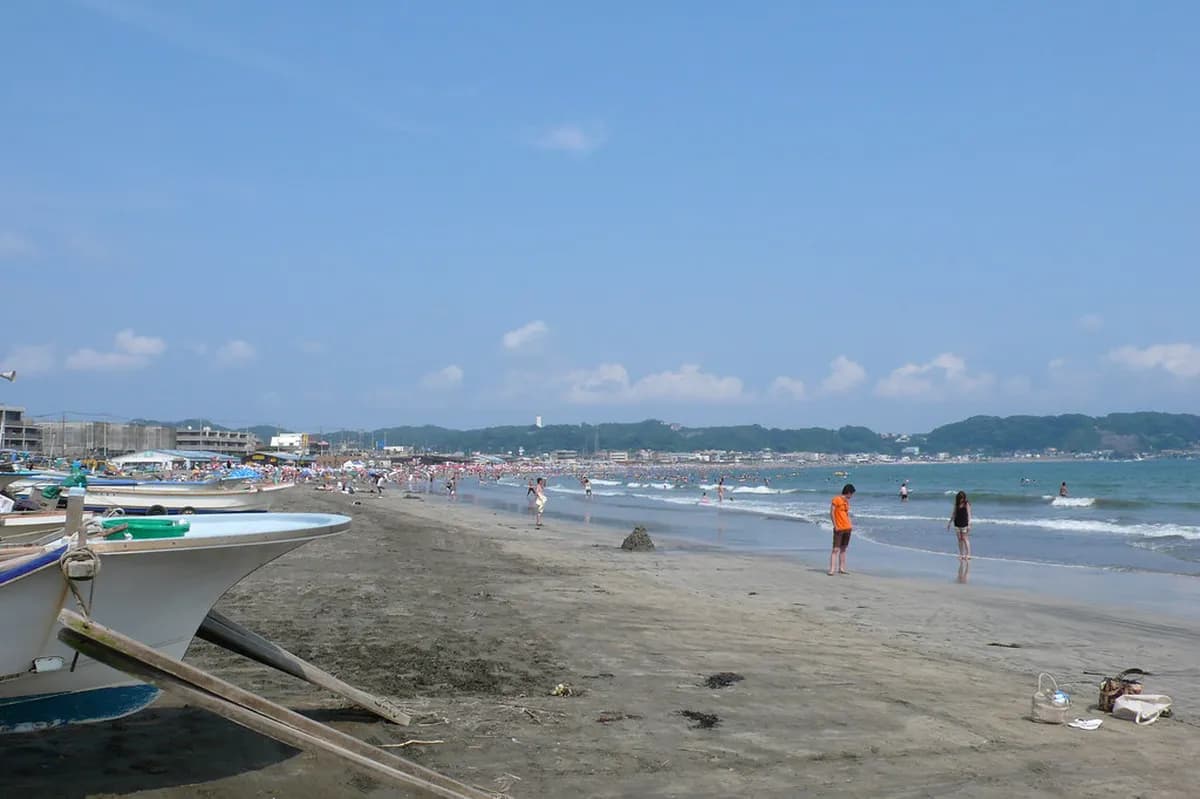
Yuigahama Beach is the most popular coastal escape in Kamakura, drawing Tokyo day-trippers, surfers, and families to its wide dark-sand shoreline on Sagami Bay. The beach runs roughly 900 metres east-west, entry is free year-round, and it pairs naturally with the Great Buddha and Hasedera Temple in a single day. Understanding the seasonal systems — swim zones, beach huts, festival crowds — will save you a lot of guesswork on arrival.
This guide covers transport from Tokyo, the 2026 swim season, beach hut prices, nearby sights, and the practical details that most English-language coverage misses. Explore the full range of things to do in Kamakura to plan the rest of your day around the beach.
Yuigahama Beach Kamakura Guide & Quick Facts
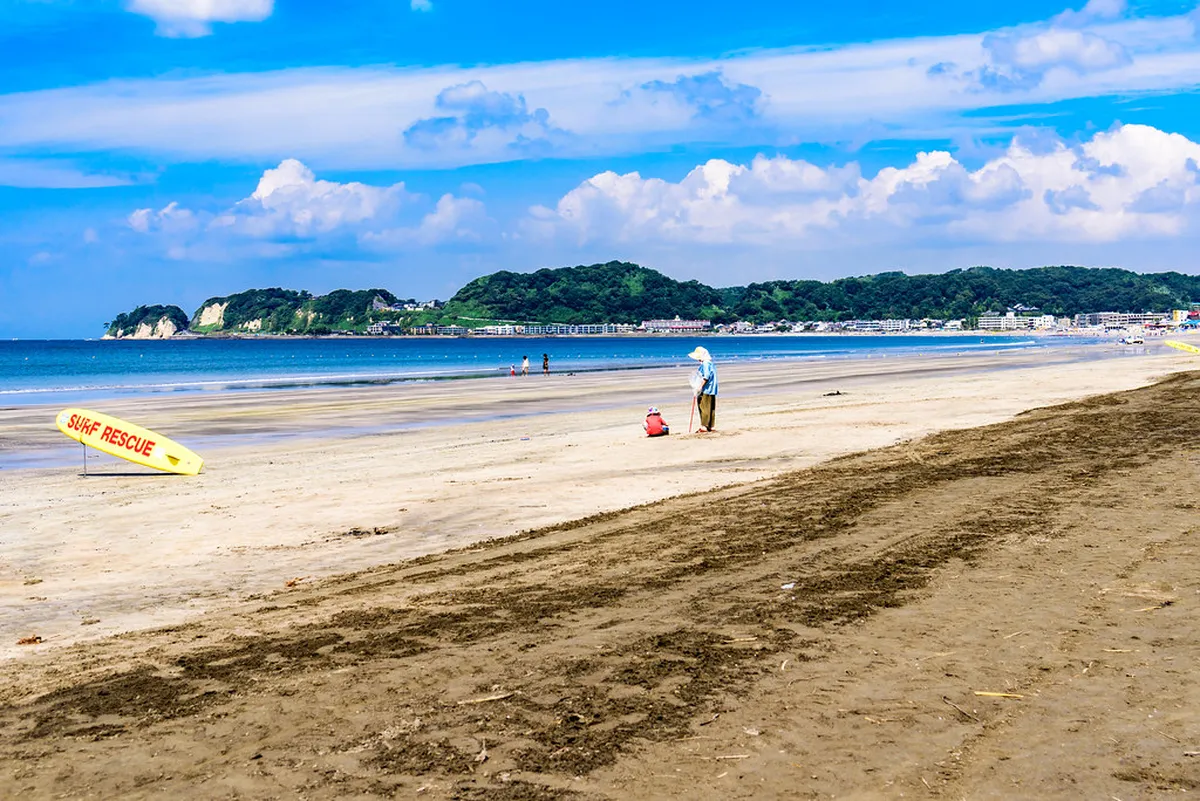
Yuigahama Beach faces due south into Sagami Bay, with the Inamuragasaki headland closing the western horizon and Zaimokuza Beach continuing east of the Nameri River mouth. The sand is dark grey to near-black, the result of high iron content washed down from the Miura Peninsula. That distinctive colour gives great photos but also means the surface temperature climbs fast in midsummer — locals routinely measure 55 to 60°C on the sand at 13:00 in August, so sandals are non-negotiable from late July through mid-September.
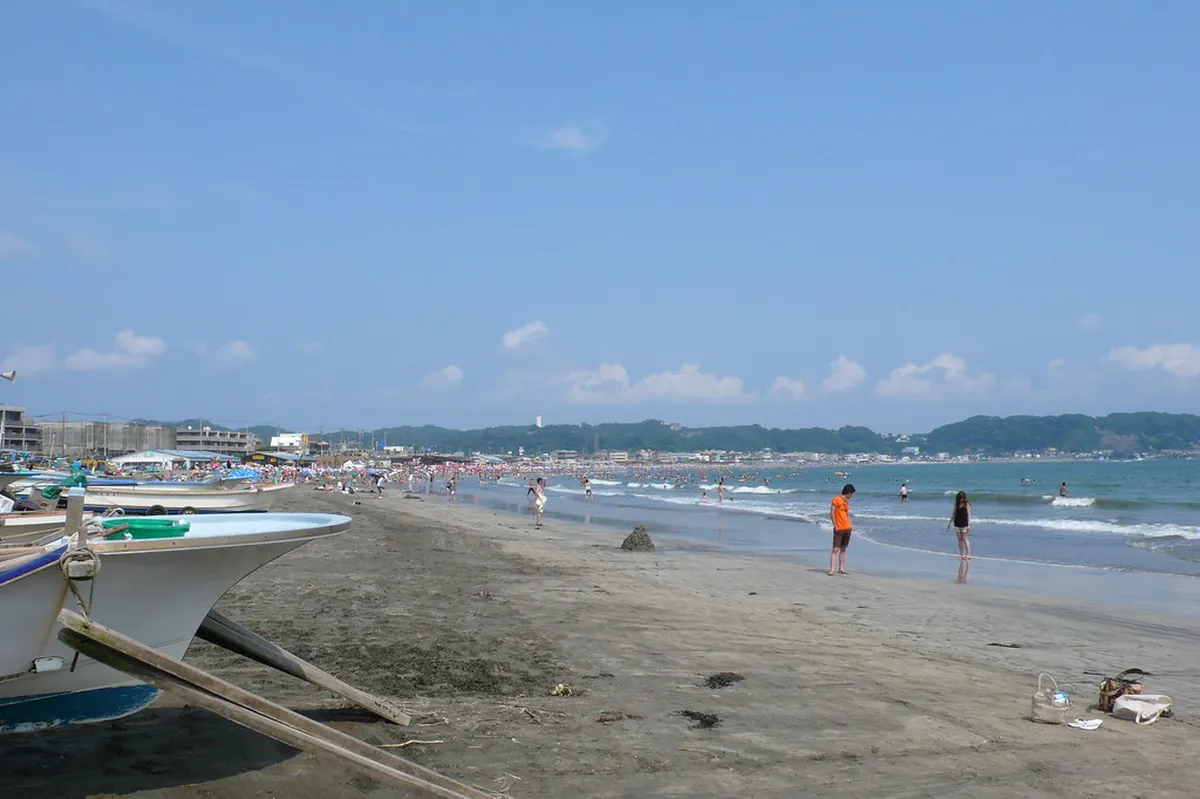
The beach holds Blue Flag certification for water quality and facilities. During the official swim season it is divided into colour-flagged zones: a central swim area, a body-boarding zone, and a surfing corridor. Outside the season the beach remains open 24 hours, but there are no lifeguards, no first aid, and no public showers at the seawall huts.
On clear winter days the view west along the coast toward Enoshima sometimes frames Mount Fuji above the horizon — one of the strongest free photo opportunities on the Kanagawa coast. Even in summer, the combination of ocean breezes and the green Enoden train rolling past the seawall every 12 minutes creates an atmosphere that is instantly recognisable from travel photography.
- Address: 4-4 Yuigahama, Kamakura-shi, Kanagawa 248-0014
- Beach length: approximately 900 metres (central Yuigahama section)
- Entry fee: free year-round
- Sand type: dark magnetite volcanic grain — heat-retaining, footwear required in summer
- Certification: Blue Flag for water quality and safety standards
- Nearest stations: Yuigahama Station (Enoden Line, 4-minute walk); JR Kamakura Station (15-minute walk)
How to Get to Yuigahama Beach: Trains and Rail Passes
From Tokyo Station take the JR Yokosuka Line direct to Kamakura Station — about 60 minutes and around 940 yen one way. From Shinjuku the JR Shonan-Shinjuku Line runs the same journey in roughly 65 minutes. Both routes are covered by IC cards (Suica or Pasmo) and by the Japan Rail Pass; no seat reservation is needed.
From Kamakura Station, transfer to the Enoden Line and ride one stop to Yuigahama Station (about 3 minutes, 200 yen). The beach is a 4-minute walk south through a quiet residential lane. You can also walk the full 15 minutes south from JR Kamakura Station along Wakamiya-oji if you want to see the approach avenue. Check Japan Guide Yuigahama for the latest fare tables before you travel.
If you plan to visit the Great Buddha, Hasedera, and Enoshima on the same day, the Enoshima-Kamakura Free Pass makes sense. From Shinjuku it costs around 1,640 yen and covers your round-trip on Odakyu plus unlimited Enoden rides for the day. A standard Japan Rail Pass does not cover the Enoden since it is a private railway — budget around 600 to 800 yen extra for local hops.
Driving is rarely the right call. Coin car parks near the beach charge 400 to 600 yen per hour and fill before 09:00 on summer weekends. Train plus Enoden is faster, cheaper, and lets everyone drink at a beach hut without assigning a designated driver.
Swimming, Surfing, and the Beach Hut (Umi-no-ie) System
The official 2026 swim season is expected to run from early July to late August; the Kamakura City beach office typically confirms exact dates in mid-June. During this window around 30 umi-no-ie (beach huts) appear on the sand, lifeguards staff three towers from 09:00 to 17:00, and the colour-flag swim zones are enforced. Check the Official Kamakura City Beach Page the week before you arrive for confirmed 2026 opening dates.
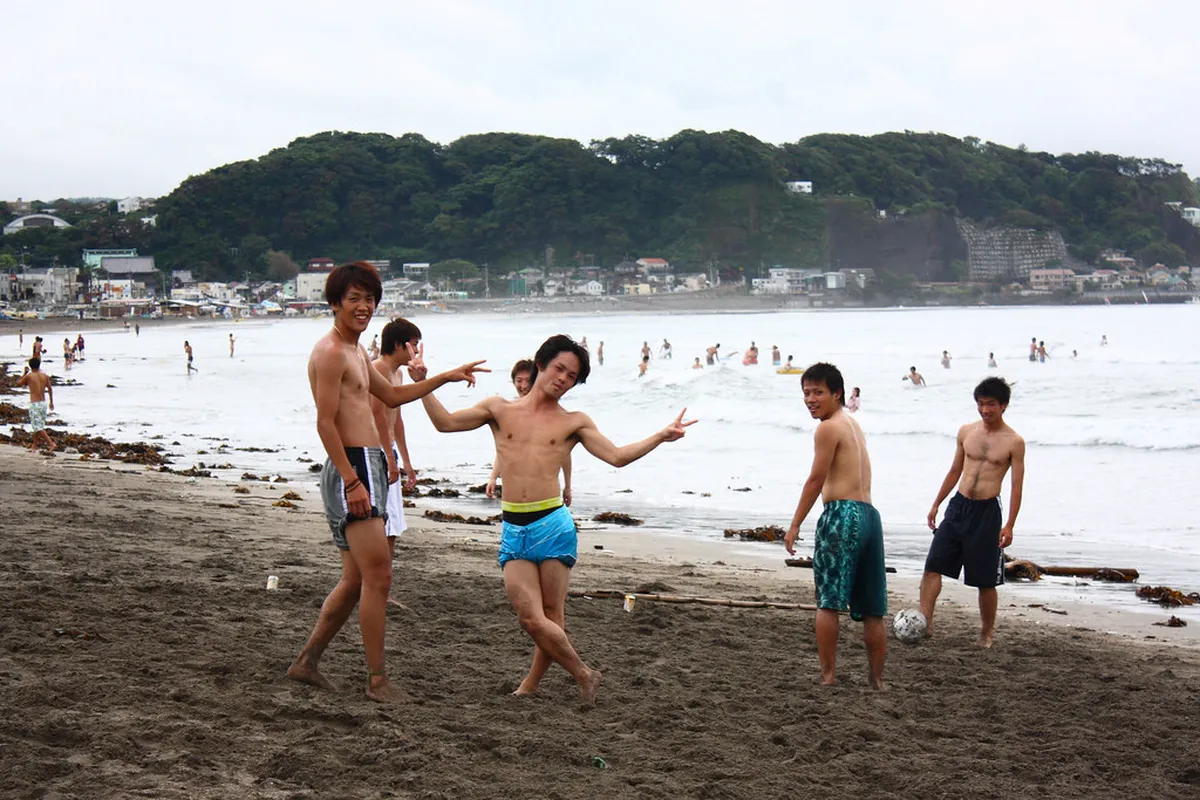
Each beach hut is privately run and has its own personality — some are vegan-friendly, a few run DJ sets at sunset, and several cater specifically to families with paddling areas for toddlers. A parasol-and-chair set typically costs 1,000 to 2,000 yen per group for a half-day base with shade, lockers, hot showers, and food. Showers inside the huts cost 200 to 500 yen for non-customers; outdoor cold-water seawall rinses are free. The huts dismantle within a week of the season ending, usually by early September — visitors arriving in mid-September often find bare sand with nothing open.
Surfing runs all year. The break is forgiving in summer (waist-high, mushy) and picks up energy from October through March when low pressure systems push in from the east. Surfboard and SUP rental sits at 3,000 to 5,000 yen per half day from the shops along Route 134 behind the seawall. Local etiquette is strict: do not drop in, do not paddle around the line-up, and take a lesson rather than a rental for your first session — group lessons cost 8,000 to 12,000 yen for two hours including board, wetsuit, and a beach safety briefing in English.
Seasonal Warnings: What Locals Know
The single most underrated risk is heat off the dark sand. Bare feet on the surface at midday in August are painful within 15 seconds — surface temperatures consistently reach 55 to 60°C on clear afternoons. Sandals stay on between the seawall and your towel, especially for children. Small children and pets are particularly vulnerable to these ground temperatures.
Jellyfish populations climb sharply after Obon week in mid-August and peak in the last ten days of the swim season. Moon jellies and, occasionally, Portuguese man-o'-war counts spike around 20 August even though the official season runs a further ten days. Ask the lifeguard for the day's jellyfish flag before entering the water in late August. A thin rash guard provides meaningful protection if you want to stay in the water regardless.
Yuigahama's dark sand reaches 55–60°C at midday in August — always keep sandals on between the seawall and your towel. Jellyfish counts spike around 20 August; ask the lifeguard about the jellyfish flag before entering the water. Typhoon swells can close swimming 24–48 hours before landfall and leave the water unsafe for three days after.
Typhoon swells are the third hazard. Yuigahama faces open Pacific southwest and any typhoon tracking up the Izu chain or Boso Peninsula will close swimming 24 to 48 hours before landfall. The water can remain unsafe for three days after a storm due to debris and rip currents — surfers love this window, but swimmers should not test it. Wind direction also matters on calm days: a south wind above 6 m/s creates uncomfortable blown-sand conditions and triggers yellow-flag swim restrictions. Check the Japan Meteorological Agency Kamakura forecast the morning of your visit.
Tide-Line Walks: Sea Glass and Fossil Hunting
Yuigahama is one of the better tide-line beaches in greater Tokyo for hunters of sea glass and small fossils. After winter storms the wrack line throws up frosted blue and brown glass. Less well known: small fossilised shark teeth from the Pliocene-era Zushi formation occasionally wash in from the cliffs east of Zaimokuza. Bring a small mesh bag and head out within an hour of low tide for the best pickings. The area near the Nameri River mouth, where Yuigahama transitions into Zaimokuza Beach, is the most productive stretch.
Tide tables are posted inside every Enoden station ticket office, or check Japan Meteorological Agency tide tables online the night before. Low tide also exposes the widest shell-hunting belt and the firmest walking surface along the full seawall promenade. The paved promenade runs flat and uninterrupted from Inamuragasaki all the way to Zaimokuza — a 4 km out-and-back walk with benches and shade trees every 200 metres.
Kamakura Kaihin Park sits at the eastern edge of the beach with shaded lawns, a preserved Enoden 100-series train car that children can board, a small playground, and public toilets. It is the easiest spot to assemble a picnic without paying for a beach hut. From the park's western corner you can follow the promenade for about 30 minutes to Inamuragasaki headland, with views back across the full Yuigahama curve on a clear day.
Festival and Events Calendar (2026 Dates)
The Kamakura Hanabi Taikai (Fireworks Festival) is the headline event on the beach itself. Around 2,500 to 4,000 shells are launched from boats anchored offshore in a roughly 50-minute show, including the signature underwater starmines that explode at sea level. It typically runs in the second week of July in 2026 — treat this as projected and confirm with the Visit Kamakura Official site once dates are posted, as weather cancellations are common and rescheduling is rare. Arrive on the sand by 17:00 for a usable spot; the seawall fills by 18:00 and trains back to Tokyo run at standing capacity until around 22:30.
Earlier in the year, Kamakura Matsuri runs across the second and third Sundays of April with historical processions and yabusame (mounted archery) on the beach itself, recalling Yuigahama's medieval role as a samurai training ground. In August, Bonbori Matsuri (7 to 9 August) lights hundreds of paper lanterns along the path from the beach to Tsurugaoka Hachimangu — a quieter, more atmospheric option than the fireworks. Reitai Matsuri (14 to 16 September) at the shrine is the other annual yabusame round and is generally considered the more authentic of the two.
For visitors who want a mix of culture and beach, Hase no Akari (19 to 25 August) illuminates Kotoku-in and Hasedera at night and pairs well with an early-evening beach session before the temples open for the light-up. All dates are subject to official confirmation; verify against the Kamakura city tourism office in the week of your visit.
Nearby Sights: Temples, Anime, and the Enoden Chain
Yuigahama sits at the centre of the most efficient temple-beach combination in greater Tokyo. The Great Buddha of Kamakura at Kotoku-in is a 12 to 15 minute walk inland (entry 300 yen, plus 50 yen to step inside the bronze figure). Five minutes beyond that, Hasedera Temple has a hillside observation terrace with the cleanest aerial view of the full Yuigahama curve — time it before noon, then descend to the beach for the afternoon. Both sites combined take about 90 minutes and cost under 600 yen.
Anime fans have a dedicated stop two Enoden stations west at Kamakurakoko-mae. The level crossing in front of the school there is the real-world location of the Slam Dunk opening sequence and now draws a steady queue of photographers most afternoons. Midweek mornings before 09:00 are the only realistic window for a clear shot; arriving any later means navigating around crowds. From there, one more stop west puts you on Enoshima Island — a half-day extension with sea caves, a botanical garden, and the Sea Candle observation tower.
Walking east from Yuigahama, you reach Zaimokuza Beach in about 15 minutes by crossing the Nameri River footbridge. Zaimokuza is quieter and more local in character, with a small fishing-boat harbour at its eastern end and cheaper fish-grill stalls than the Yuigahama beach huts. Combining both beaches on foot gives you the full coastal sweep without retracing steps and is worth the extra 30 minutes if you have a full day.
Near the central lifeguard tower, look for a small bronze monument marking the site of the 1333 battle that ended the Kamakura Shogunate. Most visitors walk past it without noticing. It is a rare free connection between the sand under your feet and 700 years of Japanese history — take 90 seconds to find it before you set up your towel.
Where to Stay: Best Hotels in Kamakura
Most international visitors do Yuigahama as a Tokyo day trip, and that is a perfectly reasonable choice. Staying overnight in Kamakura makes sense in three specific situations: you want the early-morning empty-beach photograph before 07:00, you are attending the Kamakura Hanabi Taikai (last train fills by 21:30 and Ubers are unavailable), or you want zazen at Engakuji at 06:00 on a Saturday morning.
Three areas work well as a base. Around Hase Station is the most beach-convenient option, putting you within walking distance of both the sand and the Great Buddha. Guesthouses on the Yuigahama and Hase side run 9,000 to 14,000 yen per night for two. Mid-range, boutique properties around Hase Station fall into the 18,000 to 28,000 yen range. For sunset sea views, look at properties along Route 134 between Yuigahama and Inamuragasaki. Around JR Kamakura Station has the best transport access — business hotels here tend to start around 12,000 yen — but it is a 15-minute walk to the beach.
Book at least 6 weeks ahead for any weekend in July or August, and especially for the fireworks weekend in mid-July when rooms sell out completely. Late September availability opens up as the swim season ends, with prices dropping 20 to 30 percent and the beach at its emptiest while still walkable in shorts. The Komachi Street area near the station is the best back-up for last-minute dining and souvenir hunting regardless of where you sleep.
Planning Like a Pro: Budget and Timing Tips
Arrive on the 08:30 train from Tokyo on summer weekends. Beach huts reach capacity by 11:00 in July and August, and the central lifeguard swim zone is rope-locked once it hits its 600-person cap. A weekday visit cuts crowds by roughly 70 percent and is the single most effective change you can make to your trip. A late June or early September weekday gives you swim-season facilities with roughly half the mid-August crowd density.
A full day at Yuigahama can cost almost nothing. The core experience — sand, sea, seawall promenade — is free. A family of four can spend the day for under 4,000 yen by packing convenience-store bento from the Lawson directly across from Yuigahama Station. Coin lockers at the station cost 400 yen for small bags; outdoor cold-water seawall showers are free. If you prefer a hut base, the 2,500 yen flat family rate at some huts (shaded floor area, lockers, unlimited showers) is often cheaper than buying individual drinks across an afternoon.
Local etiquette at Yuigahama is stricter than it looks. Glass bottles are forbidden in the swim zone. Drones are restricted near the beach huts and crowded sand. Portable speakers at any volume are socially unacceptable on weekends. Tattoos are tolerated on the beach itself but beach huts may ask you to cover up inside their dining areas — a rash guard is the simple solution and you will want one in the water anyway. The community runs morning beach cleans most weekends in July and August; visitors are welcome to join and free coffee is usually offered after.
A weekday in late June or early September gives you swim-season facilities at roughly half the mid-August crowd density. The Enoshima-Kamakura Free Pass (~¥1,640 from Shinjuku) covers your round trip plus unlimited Enoden rides — worth buying if you plan to add the Great Buddha, Hasedera, and Enoshima to the same day.
Frequently Asked Questions
How do I get to Yuigahama Beach from Kamakura Station?
You can reach the beach by walking south for 15 minutes or taking the Enoden train to Yuigahama Station. The train ride takes only five minutes and offers a scenic view. For more details on the area, check our guide to Kamakura attractions.
Is there an entrance fee for Yuigahama Beach?
Entrance to the beach itself is completely free for all visitors throughout the year. You only need to pay if you use the private beach hut facilities for showers or lockers. These services are optional but highly recommended for swimmers during the summer.
When is the best time for swimming at the beach?
The official swimming season runs from early July to late August when lifeguards are present. July is typically the best month for warm water and fewer jellyfish. Avoid the Obon holiday week in mid-August if you want to skip the largest crowds.
Are tattoos allowed at Yuigahama Beach?
Tattoos are allowed but local regulations request that you keep them covered with a shirt or rash guard. This policy helps maintain a comfortable environment for all visitors and families. Most beach huts will ask you to cover up before entering their dining areas.
Yuigahama Beach offers a rare combination of free Pacific-facing shoreline, accessible surf culture, and proximity to seven centuries of samurai history. The 2026 swim season runs early July to late August — target a weekday between 15 July and 25 August for the full umi-no-ie experience without peak weekend crowds. Keep sandals on the dark sand, check the jellyfish flag after mid-August, and use the Enoden Free Pass to chain the beach with Hase, the Great Buddha, and Enoshima in a single efficient day from Tokyo.
For more Kamakura planning, see our Things to do in Kamakura and Kamakura day trip itinerary 2026 guides.