

Isuien Garden is one of the most carefully composed landscape spaces in Nara — a strolling garden that pulls the mountains and temple gates of the surrounding city into its own visual frame. The name translates as "garden founded on water," a reference to the Yoshikigawa River that feeds its three ponds. At 13,481 square metres, it is the only promenade-style garden (kaiyushiki teien) in Nara city, making it a genuinely different experience from the moss and tea-ceremony gardens next door. This guide covers everything you need to visit confidently in 2026: tickets, timing, seasonal highlights, and the architectural details most visitors walk past without noticing.
Isuien Garden Quick Summary (Hours & Fees)
The garden opens at 09:30 and closes at 16:30, with last entry at 16:00. In April and May the closing time extends to 17:00. It is closed every Tuesday (or the following Wednesday if Tuesday falls on a public holiday), during the Obon holidays, over the New Year period (late December to mid-January), and for approximately the final ten days of September. Always confirm on the official Isuien Garden website before you go, since the September closure window can shift slightly year to year.
| Visitor | Admission |
|---|---|
| Adult | ¥1,200 (includes Neiraku Museum) |
| University / high school student | ¥500 |
| Child | ¥300 |
| Open hours (standard) | 09:30 – 16:30, last entry 16:00 |
| Open hours (April – May) | 09:30 – 17:00, last entry 16:30 |
| Closed | Tuesdays, late Dec – mid-Jan, last 10 days of September |
Adult admission is ¥1,200. University and high-school students pay ¥500, and children ¥300. All tickets include entry to both the front and rear garden sections and to the Neiraku Museum — there is no separate museum charge. Japan has a national Famous Scenic Spot designation (Meisho); Isuien holds this status, which is worth knowing if you are keeping a list of officially recognised landscape heritage sites.
The garden sits at 74 Suimon-cho, Nara City 630-8208, about a fifteen-minute walk east of Kintetsu Nara Station. Budget sixty to ninety minutes for the garden and museum combined; add thirty minutes if you plan to stop for tea.
The History of Isuien: Edo and Meiji Eras
The front garden dates to 1670, when a wealthy textile merchant named Michikiyo Kiyosumi (also recorded as Kiyosumi Dosei in some sources) bought the land during the Kanbun era of the Edo period. He redesigned it as a private villa retreat, drawing water from the Yoshikigawa River to fill the central pond and laying out the paths around the Sanshu-tei tea house that still stands today. The aesthetic is intimate and enclosed — the scale of a merchant's private world rather than an aristocratic estate.
The rear garden was added in 1899, during the Meiji era, by a different owner: Tojiro Seki, a prosperous Nara merchant. He commissioned the garden's design from Yumyosai, the head of the Urasenke tea school, who brought a more expansive naturalistic sensibility. The rear section is larger, more open, and calibrated to frame the temple skyline rather than turn inward. In 1939 Junsaku Nakamura purchased both properties and merged them into a single garden, simultaneously establishing the Neiraku Museum as the permanent home for his personal art collection.
The combined garden was designated an important Cultural Asset in 1975, cementing its status alongside Naramachi's historic streetscape as one of Nara's key preservation-listed sites. The two-part structure — one section built for quiet retreat, the other built for borrowed grandeur — is what gives Isuien its unusual range of atmosphere within a single ticket.
Exploring the Front Garden (Zen-en)
The front garden centres on a pond fed by the Yoshikigawa River, with the mountains of Wakakusa, Mikasa, and Takamado visible in the distance. The composition is tighter and more shaded than the rear section, with moss carpets, stepping stones, and dense planting that creates a sense of enclosure even on busy days. This is the section that rewards slow walking — rush through it and you miss the way each turn frames a new pocket of water and stone.
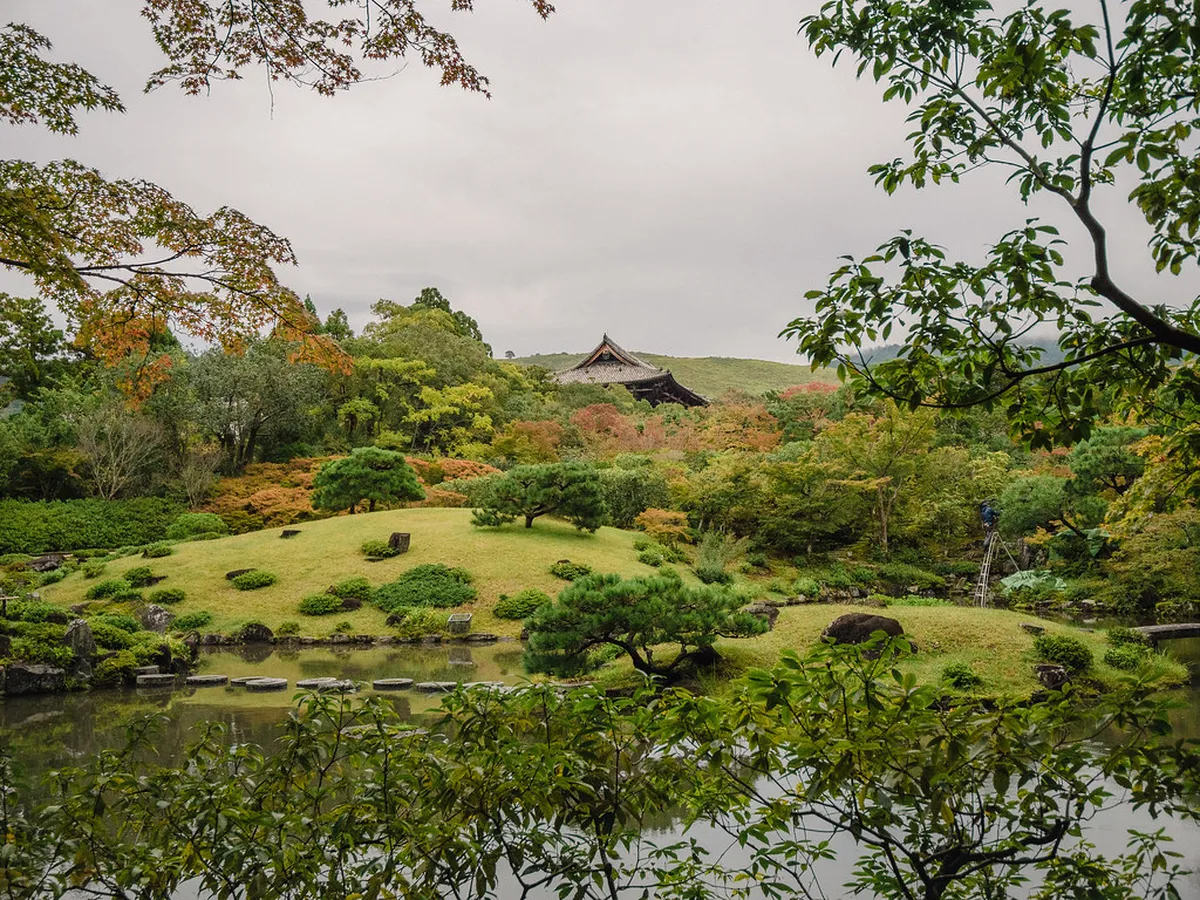
Four tea houses are distributed across the garden, each with a distinct history. Sanshu-tei was relocated to the garden in the 1670s by Kiyosumi Dosei and served as his secondary residence; it faces the main pond and today serves matcha and seasonal sweets. Seishuan is a precise replica of the famous Yuin tea house — an Important Cultural Property associated with the Urasenke school — built under the guidance of tea master Jikisho Genshitsu. Teishuken, also dating to the 1670s, is notable for a distinctive circular window in its alcove; Seki Tojiro added a terrace to it in the late 19th century. Hyoshintei was constructed in the early twentieth century and is notable for one architectural detail no other garden tea house in Nara can claim: some of its structural timber came from the original wooden boards of Shin-Yakushi-ji Buddhist temple. You can sit inside Hyoshintei and look out over the rear garden through the same wood that once formed part of a Nara temple.
A small Inari Shrine tucked near the garden perimeter is easy to miss. It receives little foot traffic and offers a quiet moment away from the main paths — worth a brief stop if you notice the red torii marker.
The Rear Garden (Ko-en) and Borrowed Scenery
Borrowed scenery — shakkei in Japanese — is a design technique that deliberately incorporates distant landscape features into the garden's composition, so that elements outside the boundary feel like part of the garden itself. Isuien's rear garden is one of the most cited examples of the technique in Japan. The designer positioned paths and sight-lines so that four separate background elements appear to belong to the garden: the Nandaimon (Great South Gate) of Todai-ji, Mount Wakakusayama to the east, Mount Kasugaokuyama, and Mount Mikasayama. From the main viewing terrace near Hyoshintei, these four elements form a continuous backdrop across the pond.
The effect only works because the garden walls and tree lines are precisely managed. Trees that have grown too tall get trimmed to maintain the frame; the pond's surface acts as a mirror that doubles the gate and the mountains. If you arrive mid-morning, the Nandaimon sits in direct light against a clear sky — this is the clearest view of the borrowed scenery. By early afternoon the light shifts and the mountains behind pick up more shadow, which some photographers prefer for the added depth.
The adjacent Yoshikien Garden across the Yoshikigawa River waives its entry fee for foreign tourists. Visiting both in sequence — Isuien first at 09:30, then Yoshikien — lets you compare two distinct garden styles in the same morning for the price of one ticket.
For the best autumn photograph, stand at the far edge of the rear pond with the maples in the foreground and the Nandaimon centred in the background. In late November the red canopy and the grey gate create a composition that requires almost no cropping. Spring cherry blossoms in March and April frame the same view in white and pale pink against the stone.
Neiraku Museum: Art and Artifacts
Your admission ticket covers entry to the Neiraku Art Museum, which sits immediately adjacent to the garden entrance. The collection was assembled by Junsaku Nakamura and consists primarily of ancient Chinese bronzes, Korean ceramics, seals, and mirrors — objects spanning several dynasties and periods. It is a specialist collection rather than a broad survey, and the quality of individual pieces is high. Expect to spend twenty to thirty minutes inside if you look at everything properly.
Photography is not permitted inside the galleries. The restriction applies to all rooms and all devices, including phones. The garden itself has no photography restrictions — you can photograph freely outdoors. If you forget and reach for your phone inside, staff will remind you politely but firmly. The museum is small enough that the no-photography rule does not feel punitive; the artifacts are close enough to examine carefully without needing a record shot.
Photography is strictly prohibited inside the Neiraku Museum — all rooms, all devices. Staff will remind you if you reach for a phone near the cases. Photograph freely in the garden itself, but put your camera away before stepping through the museum entrance.
The museum is open during the same hours as the garden. On days when the garden is closed — Tuesdays, Obon, New Year — the museum is also closed. There is no way to visit the museum without entering the garden, and no museum-only ticket.
The Tea Houses: Sanshu-tei and Hyoshin-tei
Sanshu-tei operates as a working tea house and light restaurant. It serves matcha with seasonal wagashi (Japanese sweets), and on certain days a mugitoro-meshi set — grated yam over barley rice, a traditional Nara dish — is available at lunch. The terrace overlooks the front garden pond directly. Reservations are not required for tea; the restaurant portion can fill up around midday. If you plan to eat here, arrive before 12:00 or after 13:30.
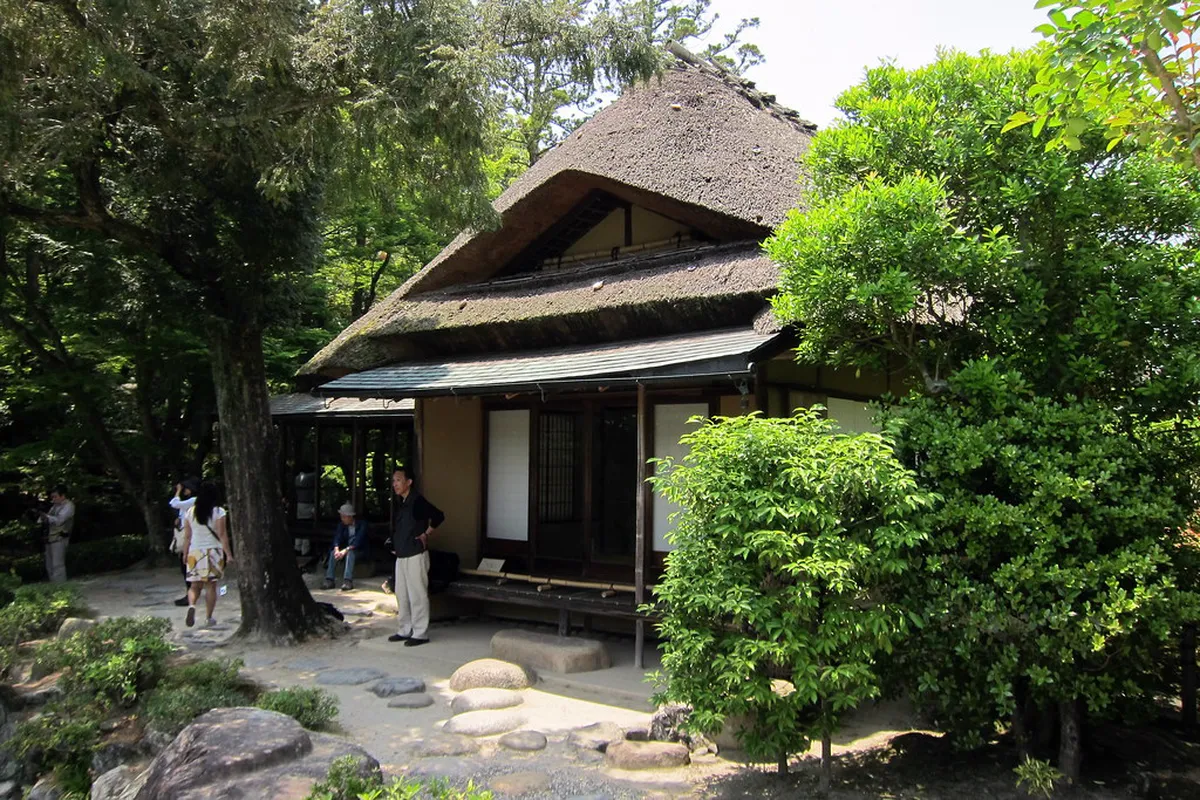
Hyoshintei has the better view of the rear garden and the borrowed scenery. It is a thatched-roof structure and visually the most photographed interior space in the garden. Both tea houses were originally built for private use by wealthy owners; sitting in either of them now for the price of a matcha is one of the more straightforward ways to experience historic Japanese domestic architecture without visiting a museum recreation.
How to Get to Isuien Garden
From Kintetsu Nara Station (served by the Kintetsu Nara Line and Kyoto Line), the garden is about a fifteen-minute walk east through the edge of Nara Park. From JR Nara Station, take a bus to the Oshiagecho stop, which puts you about five minutes away on foot. From Todai-ji's main gate (Nandaimon), the garden is a ten-minute walk west — a logical sequence if you are combining both sites in one morning.
The address is 74 Suimon-cho, Nara City 630-8208. Use Google Maps: Isuien Garden and Neiraku Museum to navigate directly to the entrance gate, which faces a small side street rather than a main road and can be easy to miss on a first visit. Yoshikien Garden sits immediately across the Yoshikigawa River, so the two are walkable back-to-back within an afternoon.
Best Time to Visit: Seasonal Highlights
Late November is the peak season for Isuien. The Japanese maples in the rear garden turn deep red and frame the borrowed scenery of Todai-ji and the mountains at their most dramatic. Visitor numbers are high but manageable on weekdays; weekends in late November can be crowded. The garden stays open on its standard Tuesday closure rule even during peak autumn — confirm the specific calendar for November on the official site each year.
Spring from late March through April brings cherry blossoms, and the April–May extended opening hours (until 17:00) allow for an early-evening visit when day-trippers from Kyoto and Osaka have largely left. Summer is the least visited season; the dense tree cover in the front garden provides genuine shade, and the moss looks its deepest green after the June rains.
Winter visits, particularly after light snowfall, reveal the structural geometry of the garden most clearly. Stone lanterns, the wooden water mill, and the tea house eaves carry snow in ways that make the garden look like a monochrome woodblock print. The garden is closed over the New Year period, but open through December and from mid-January onward. The Toka-ye Lantern Festival in August (5th–14th) lights candles throughout Nara Park each evening from 19:00 to 21:45; the festival does not extend into the garden itself but creates an atmospheric backdrop if you are staying in the area overnight.
Isuien vs. Yoshikien Garden
Yoshikien, directly across the Yoshikigawa River, waives its entry fee for foreign tourists — a policy that has been in place for several years and remains current in 2026. It contains three distinct garden styles within its boundary: a pond garden, a moss garden, and a tea ceremony garden. The moss garden in particular is exceptional and worth seeing even if you plan to pay for Isuien.
Isuien costs ¥1,200 but offers substantially more. The garden is larger (13,481 square metres versus Yoshikien's more compact layout), the borrowed scenery of Todai-ji's gate is architecturally significant in a way that Yoshikien's views are not, and the Neiraku Museum collection is included. If your priority is garden design technique and cultural depth, Isuien is the better choice. If you are on a strict budget or have limited time, Yoshikien's free admission makes it the rational starting point — and many visitors do both in sequence, spending forty minutes in Yoshikien and ninety in Isuien.
The two gardens are best visited in the same half-day block. From Isuien's exit, Yoshikien is a two-minute walk across the river. Start with Isuien when it opens at 09:30 to get the rear garden in the best morning light, then cross to Yoshikien before the day-trip crowds arrive from Kyoto.
Nearby Attractions in Nara Park
The garden sits at the edge of central Nara Park, which means three of Japan's major heritage sites are within easy walking distance. Todai-ji and its Great Buddha Hall are five minutes north on foot — the Nandaimon gate you see as borrowed scenery from inside Isuien is the same gate you pass through to reach the temple. Kasuga Taisha shrine is a fifteen-minute walk east along forest paths through the park's deer-grazing area. The Nara National Museum is five minutes west, making it a logical pre- or post-garden stop for anyone interested in Buddhist art.
A practical itinerary for a single day: start at Isuien and Yoshikien at 09:30, move to Todai-ji by late morning, have lunch near Nandaimon, then walk to Kasuga Taisha through the park in the afternoon. This covers the park's core sites without backtracking and keeps walking distances short. The deer throughout the park are accustomed to visitors; they will approach if you have food, so hold any snacks inside your bag.
Frequently Asked Questions
How much is the entrance fee for Isuien Garden?
The standard adult admission fee for Isuien Garden is 1200 yen per person. This price covers entry to both the front and rear gardens as well as the Neiraku Museum. Students and children can enter at a reduced rate of 500 yen and 300 yen respectively.
Is Isuien Garden worth visiting compared to Yoshikien?
Isuien is generally worth the fee for those who appreciate larger landscapes and historical art. While Yoshikien is free for foreign tourists, Isuien provides a more expansive experience and the 'borrowed scenery' view. If you are near the Nara National Museum, visiting both is very convenient.
How long does it take to walk through Isuien Garden?
Most visitors find that sixty to ninety minutes is enough time to see the entire garden and museum. This allows for a leisurely pace through the walking paths and time to admire the museum artifacts. If you plan to have tea at the Sanshu-tei house, add an extra thirty minutes.
Can you take photos inside the Neiraku Museum?
No, photography is strictly prohibited inside the Neiraku Museum to protect the ancient artifacts from flash damage. However, you are free to take as many photos as you like within the outdoor garden areas. Be sure to capture the famous views of the Todai-ji gate from the rear garden.
Isuien Garden rewards visitors who slow down. The borrowed scenery technique only reveals itself when you stand in the right spot; the tea house timber from Shin-Yakushi-ji only means something if you know to look for it; the small Inari Shrine only appears if you leave the main path. Most of what makes this garden exceptional is invisible to a twenty-minute circuit. Give it ninety minutes, go early, and bring the Neiraku Museum into the itinerary rather than treating it as an afterthought.
For more Nara planning, see our 20 Best Nara Attractions, and Nara Itinerary for First-Timers guide.


