How to Visit Sakurajima: Complete Kagoshima Ferry Guide & Ash Survival Tips 2026
Complete 2026 guide to visiting Sakurajima from Kagoshima. Ferry fares (250 yen), 24-hour schedule, IC card tips, ash survival protocols, best observatories, and day-trip itinerary. Updated May 2026.
On this page
- Ferry runs 24 hours, every 15–20 minutes during the day; 15-minute crossing
- Adult fare: 250 yen (pay on Sakurajima side); children 130 yen
- Car ferry: 1,700–2,350 yen one-way depending on vehicle length
- CUTE Day Pass: 1,200 yen — unlimited ferry + Island View Bus + city trams
- Alert Level: 3 (restricted within 2 km of craters) — check JMA before you go
- Payment: cash or Iwasaki/RapiCa IC card at Sakurajima port (no Suica, no credit cards there)
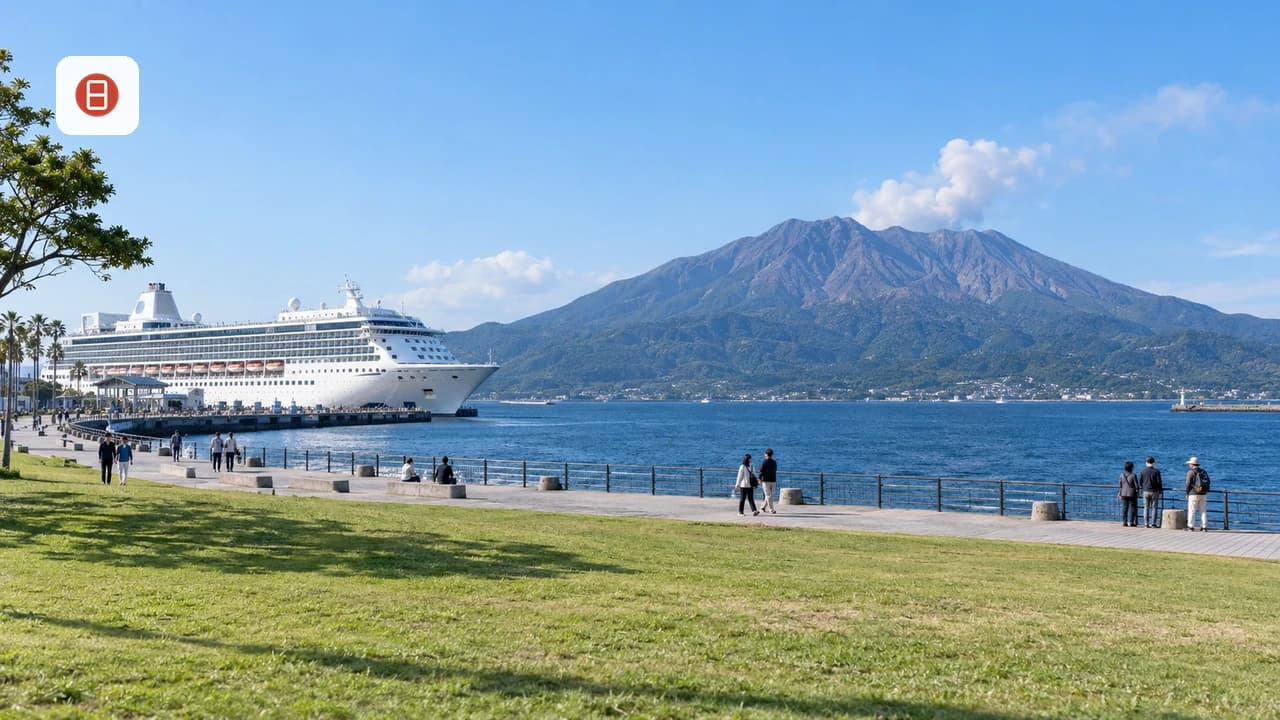
Sakurajima is one of Japan's most active volcanoes and Kagoshima's most iconic landmark — a brooding, ash-dusting peak that rises from the bay just fifteen minutes from the city centre by ferry. In 2026 the volcano remains at Japan Meteorological Agency Alert Level 3, which means it is open to visitors outside the 2 km exclusion zone around the craters. Knowing exactly how the Sakurajima ferry works, what to pay, and how to handle the near-daily ash fall is what separates a confident day trip from a frustrating one.
This guide covers the full journey: getting to Kagoshima, boarding the ferry, buying the right pass, moving around the island by bus or bike, reaching the top observatories, eating the region's famous black pork, and packing the right kit to survive an ash shower. Whether you have two hours or a full day, you will leave with a clear plan.
The CUTE One-Day Sightseeing Pass (¥1,200) covers unlimited rides on city trams, the City View Bus, the Sakurajima Ferry, and the Island View Bus — making it far better value than paying individual fares if you plan to visit two or more island sites.
1. Reaching Kagoshima: Air, Train, and Bus Logistics
Kagoshima Airport receives domestic flights from Tokyo (Haneda and Narita), Osaka, Nagoya, and Okinawa several times daily. The airport limousine bus to Kagoshima-Chuo Station takes around 40 minutes and runs every 20–30 minutes. From the station, the city tram (streetcar) Line 2 reaches the Suizokukan-guchi stop — a five-minute walk from the ferry terminal — in about 15 minutes.
By Shinkansen, the Kyushu line connects Hakata (Fukuoka) to Kagoshima-Chuo in around 80 minutes on the fastest Mizuho services. From Kagoshima-Chuo Station it is a ten-minute walk to Kagoshima Port main terminal, or take the tram. Drivers on the Kyushu Expressway arrive via the Kagoshima-Kita or Taniyama interchanges; pay parking is available at the ferry terminal itself.
Budget travelers can use Nishitetsu or Ibusuki highway buses, which terminate at or near Tenmonkan, Kagoshima's central shopping district. From there the tram reaches the ferry terminal in about eight minutes. The ferry terminal is also a stop on the Kagoshima City View Bus loop, so you can combine the ferry trip with other city sightseeing on one pass.
2. Sakurajima Ferry 2026: Fares, Schedule, and Payment Rules
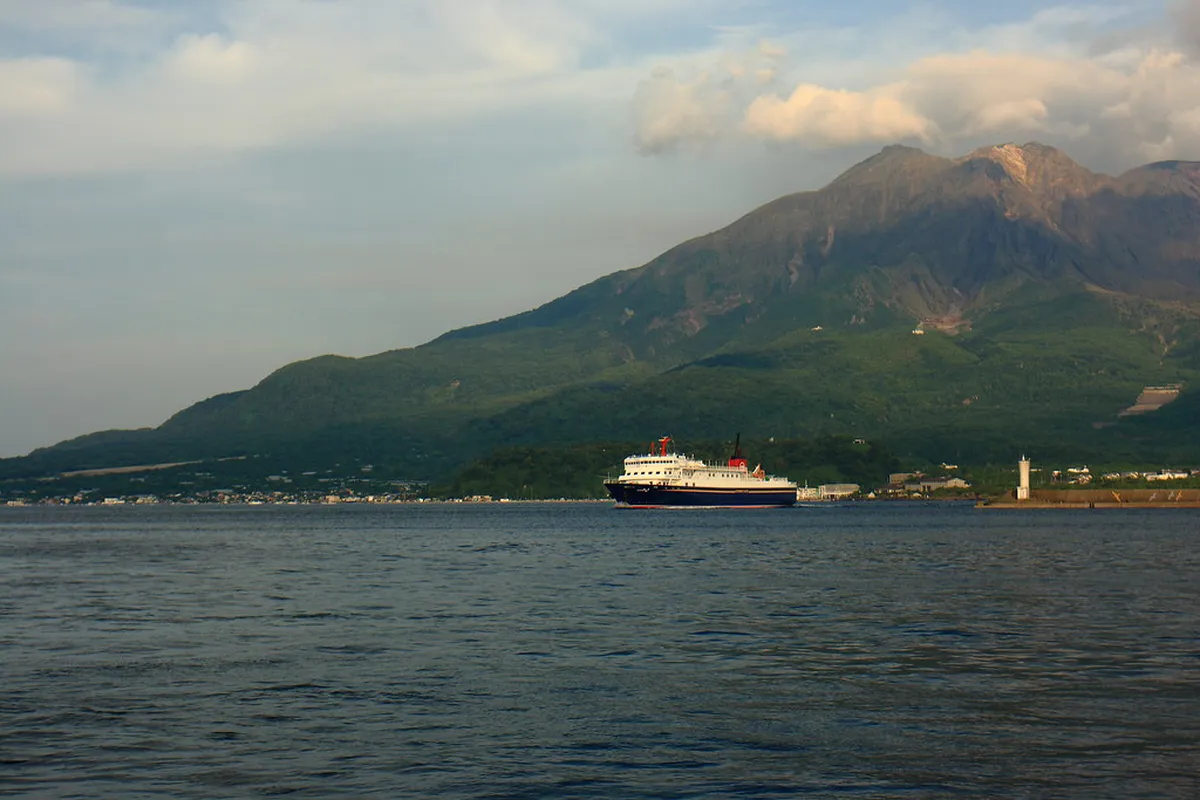
The Sakurajima Ferry is operated by Kagoshima City and runs 24 hours a day, year-round. During the day departures leave every 15–20 minutes from both Kagoshima Port (main terminal) and Sakurajima Port. Late-night and early-morning services run less frequently; check the official timetable at the terminal or the city's ferry page before planning a late return.
2026 Fares at a Glance
| Passenger / Vehicle | One-Way Fare |
|---|---|
| Adult (12+) | 250 yen |
| Child (primary school age) | 130 yen |
| Car (3–4 m body length) | 1,700 yen |
| Car (4–5 m body length) | 2,350 yen |
| Bicycle | Nominal additional fee |
Payment quirks you must know: When boarding at Kagoshima Port you do NOT pay. You pay the passenger fare on arrival at Sakurajima Port. At Sakurajima Port, only cash (yen) or the Iwasaki/RapiCa IC card are accepted — Suica, PASMO, credit cards, and foreign currency are all refused. At Kagoshima Port (return leg) cash, credit card, and IC cards are accepted. Load yen cash or a local IC card before you board if you want a friction-free return.
The onboard udon stand is a Kagoshima institution — a steaming bowl of Kagoshima-style noodles costs around 370–400 yen and is ready well before the 15-minute crossing ends. It is one of Japan's shortest, most satisfying culinary detours.
3. CUTE Pass, Island View Bus, and Bike Rentals
If you plan to visit more than one or two spots on the island, the CUTE One-Day Sightseeing Pass (1,200 yen) is the best-value ticket in Kagoshima. It covers unlimited rides on city trams, the City View Bus, the Sakurajima Ferry, and the Island View Bus on the island itself. You can also buy a digital version through the Visit Kagoshima City app, which skips the ticket-desk queue entirely.
The Sakurajima Island View Bus runs a loop from the ferry terminal clockwise around the island, stopping at all major observatories and visitor sites. It departs roughly every 35–50 minutes; the full loop takes about one hour. Buying a day pass from the driver saves money versus single-ride fares if you plan three or more stops.
Electric bicycle rental is available at the Sakurajima Visitor Center, near the ferry terminal. The daily fee is around 2,500 yen. The island's perimeter road is 36 km and hilly in sections — the electric assist is genuinely necessary unless you are an experienced cyclist. Cycling lets you stop spontaneously at viewpoints the bus skips and suits photographers who want to work at their own pace.
- CUTE Day Pass — 1,200 yen; covers ferry, Island View Bus, trams, City View Bus
- Island View Bus day pass — lower cost; island only, no mainland coverage
- Electric bicycle — ~2,500 yen/day; self-paced; available at Visitor Center
- Rental car — pay per vehicle on ferry (1,700–2,350 yen); explore at will; parking available at all major sites
4. Best Observatories and Lava Trails for Your Sakurajima Visit
The island has two tiers of viewpoints: those accessible by bus or car, and a short hiking trail system for those who want to get closer to the volcanic terrain. The craters themselves are off-limits within 2 km under the current Alert Level 3 restriction.
Yunohira Observatory (Altitude 373 m)
This is the highest point publicly accessible on Sakurajima and the closest legal approach to the summit. On a clear day you get a 360-degree panorama: the rugged slopes of Kitadake, the vast Taisho Lava Field spreading below, and the cityscape of Kagoshima shimmering across Kinko Bay. The Island View Bus stops here; the viewpoint has a small covered shelter and a coin-operated telescope. Ash can reduce visibility on eruption days — come early in the morning when the air is typically clearest.
Arimura Lava Observatory
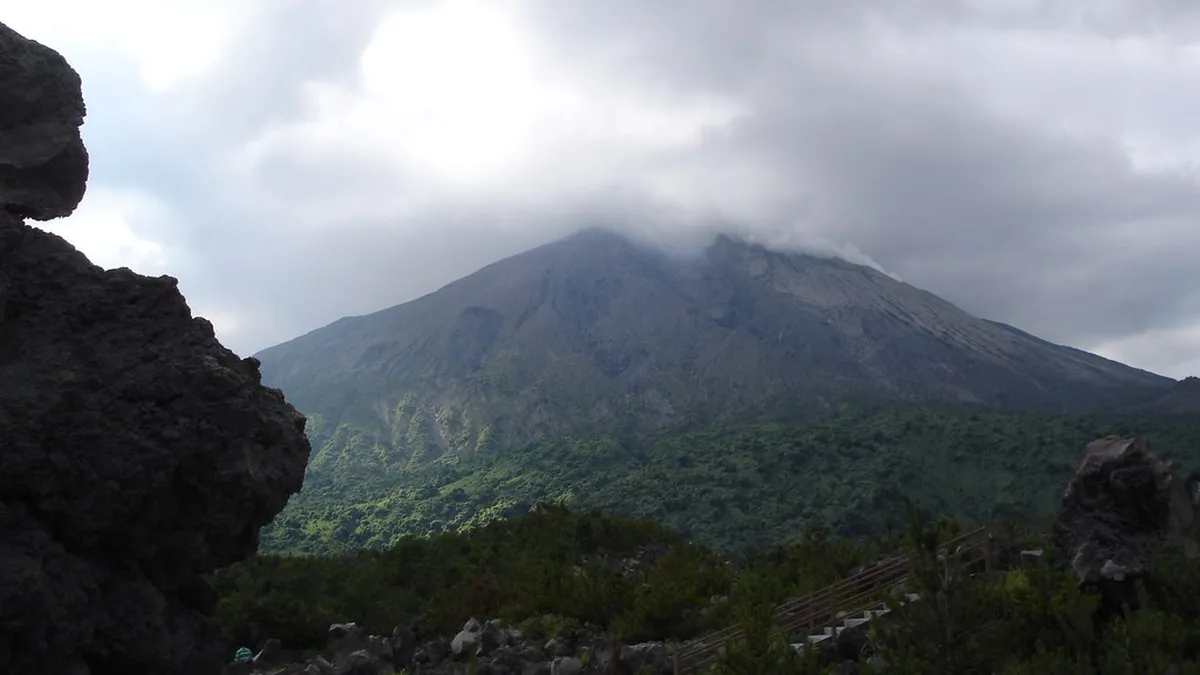
Set on the Taisho Lava Field at the foot of Minamidake, this observatory offers a ground-level encounter with the 1914 eruption's legacy. A 1 km walking trail weaves across the black pine-dotted lava, with excellent sight lines to the active crater. This is the best spot for eruption photographs because the lava field creates a stark foreground. The bus stops here on the loop; allow 20–30 minutes to walk the trail.
Karasujima Observatory and Nagisa Lava Trail
A 3 km paved walking path connects Lava Nagisa Park to the Karasujima Observatory, built on the 1914 lava field and listed as one of Japan's 100 Best Walking Trails. The path is flat and wheelchair-accessible in most sections. Over a century after the eruption, black pines and coastal shrubs have reclaimed stretches of the lava — a vivid demonstration of ecological recovery. The trail ends at the Nagisa Park Footbath, one of the longest outdoor footbaths in Japan at 100 metres. Soaking is free; bring a small towel.
Sakurajima Visitor Center
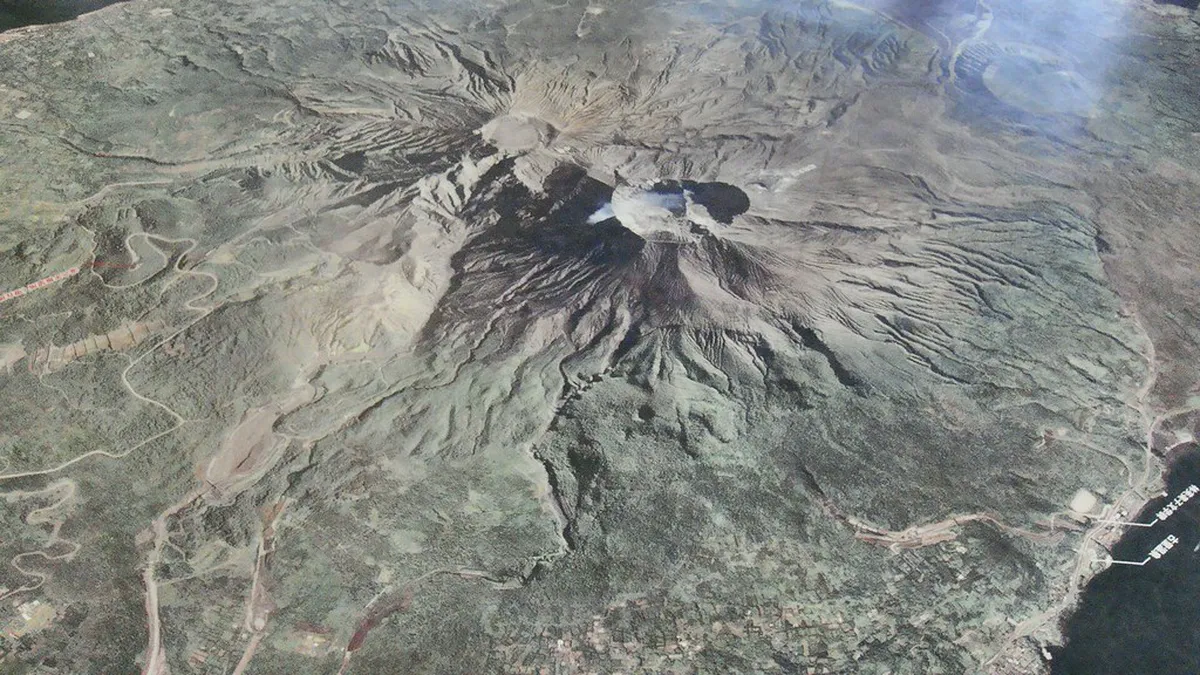
Located a short walk from the ferry terminal, the Visitor Center is free to enter and gives context to everything you will see on the island: eruption history, geological exhibits, real-time monitoring data, and a relief model of the volcano. It is the best first stop before heading to the observatories. A gift shop sells volcanic salt, Sakurajima daikon preserves, and lava-stone souvenirs.
5. Ash Survival 2026: Complete Safety Protocol
Sakurajima erupts regularly — multiple times per week in active periods. The Japan Meteorological Agency issued volcanic ash advisories on at least five separate occasions between April and May 2026, with ash plumes reaching FL080–FL110 (roughly 2,400–3,300 m above the crater) and drifting east, west, or toward the city depending on the prevailing wind. Knowing how to handle ash fall is not optional; it is part of visiting this volcano.
Before You Leave Kagoshima
- Check the JMA Sakurajima activity page or the Yahoo Japan Weather volcanic alert dashboard for the current alert level and wind direction forecast.
- If the forecast wind blows toward Sakurajima from the west, the island is likely to receive ash that day. Consider timing your trip for morning when winds are typically lighter.
- Alert Level 3 (current as of May 2026) prohibits entry within 2 km of the craters but keeps all tourist sites, observatories, and trails open.
What to Pack
- Dust mask or N95 respirator — ash particles are microscopic glass shards that irritate the lungs and sinuses. A standard surgical mask offers partial protection; an N95 or KN95 is better during heavy falls.
- Goggles or wraparound sunglasses — contact lens wearers should switch to spectacles. Ash can lodge behind lenses and scratch the cornea.
- Compact umbrella — locals use them as ash shields. Doubles as sun protection. Avoid dark colours that make ash accumulation more obvious.
- Sealed plastic bags — protect camera bodies, charging ports, and lens mounts from fine dust. Ash inside a USB-C port can cause corrosion over weeks.
- Small towel — for wiping down at footbaths and brushing ash from clothing before re-entering the ferry.
If Ash Starts Falling on the Island
- Immediately put on your mask and eye protection.
- Seek shelter in the Visitor Center, a bus shelter, or any reinforced concrete building. Concrete shelters (volcanic eruption shelters) are marked with bright orange signs at every bus stop and along major roads.
- If driving, keep windows fully closed and the air recirculation switch on.
- Do not run — running kicks up settled ash from the ground.
At Sakurajima Port only cash (yen) or the Iwasaki/RapiCa IC card are accepted — Suica, PASMO, credit cards, and foreign currency are all refused. Load yen cash or a local IC card before you board to avoid a frustrating situation at the payment gate.
If a Larger Eruption is Signalled
Emergency sirens and text alerts (via Japan's J-Alert system) will activate. Follow directions from island staff and Kagoshima City officials immediately. Move away from the crater direction — for Minamidake, that means moving toward the western or northern coast. Do not wait for the next scheduled bus; flag down any vehicle or move on foot toward the ferry terminal. The ferry will prioritise evacuation over the regular schedule during emergencies.
6. What to Eat: Kagoshima Black Pork, Shochu, and Volcanic Daikon
Kagoshima's food identity revolves around three products raised and grown in the shadow of Sakurajima.
Kurobuta (Berkshire black pork) is the centrepiece. Kagoshima's black pigs are raised on sweet potatoes, producing meat with fine fat marbling that melts at very low temperatures. Tonkatsu (breaded cutlet) restaurants near the Tenmonkan district and around the ferry terminal serve it at lunch and dinner. A kurobuta tonkatsu set meal typically costs 1,500–2,500 yen and includes miso soup, rice, and shredded cabbage. Shabu-shabu restaurants offer an alternative preparation — thin slices swirled briefly in dashi broth.
Shochu is Kagoshima's signature spirit, distilled from sweet potatoes rather than grain. The region produces hundreds of varieties. Light and floral styles suit meal pairing; earthy, full-bodied styles are for sipping after dinner. Most izakaya offer a short tasting flight (sanpuro) for around 600–900 yen — a good way to learn your preference without committing to a full bottle.
Sakurajima daikon is the world's largest radish, grown in the mineral-rich volcanic soil of the island. Individual vegetables can weigh over 30 kg. The flesh is mild, sweet, and slightly less peppery than standard daikon. You will find it pickled in brine at souvenir shops near both ferry terminals, or simmered in hearty winter stews (oden) at local restaurants from October to March.
On the island itself, the Visitor Center gift shop stocks daikon pickles, volcanic salt ramen kits, and Sakurajima citrus products. Food options on the island are limited, so eat a full meal in Kagoshima before boarding the ferry.
7. Kagoshima City Highlights to Pair with Your Sakurajima Visit
For the best Kagoshima experience, combine the volcano with the city's historic sites. The two complement each other because the same eruption history that shaped Sakurajima also defined the city's samurai culture and industrial revolution heritage.
Sengan-en (Iso Garden) is a seventeenth-century feudal estate garden that uses Sakurajima as its "borrowed scenery" — the volcano forms the natural backdrop across the bay. The garden costs 1,000 yen entry and takes around 60–90 minutes to walk fully. The adjacent Shoko Shuseikan is Japan's first Western-style factory, now a UNESCO-listed museum tracing the Shimazu clan's industrialisation. Allow a half-day for both.
Shiroyama Observatory is the most photographed Sakurajima viewpoint from the city side. A 20-minute trail through cedar forest leads to the hilltop where the last stand of the Satsuma Rebellion occurred in 1877. Sunrise and sunset views are exceptional; come 30 minutes before golden hour for the best light on the volcano.
The Kagoshima City Aquarium (Ioworld) sits immediately beside the Sakurajima Ferry Terminal, making it an easy add-on at either end of your day. Its centrepiece is a massive 4,500-cubic-metre tank housing whale sharks — the largest fish in the world — alongside manta rays and open-ocean pelagic species. Entry is 1,500 yen for adults.
For more ideas on what to see in the city, read our full guide to Kagoshima attractions and our Kagoshima itinerary and transport guide.
8. Sample One-Day Sakurajima Itinerary
This schedule assumes you are staying in Kagoshima City and using the CUTE Day Pass. Adjust timing based on the Island View Bus schedule on the day of your visit — collect the current timetable from the ferry terminal information desk.
- 07:30 — Breakfast in Kagoshima; pick up a CUTE Day Pass at the ferry terminal or download the digital version.
- 08:00 — Board the first morning ferry; ride upstairs for volcano views; try the onboard udon stand.
- 08:15 — Arrive Sakurajima Port; visit the Visitor Center for a 15-minute orientation and to check current ash/wind conditions.
- 09:00 — Island View Bus to Yunohira Observatory; 20 minutes; panoramic 360-degree crater view.
- 10:00 — Continue bus loop to Arimura Lava Observatory; walk the 1 km lava trail (30 minutes).
- 11:00 — Bus or cycle to Karasujima Observatory via the 3 km Nagisa Lava Trail on foot.
- 12:00 — Foot soak at Nagisa Park Footbath (free, 100 m long); pick up a daikon pickle snack from a nearby stall.
- 13:00 — Return ferry to Kagoshima; brush ash from clothes before boarding.
- 14:00 — Lunch of kurobuta tonkatsu near the Tenmonkan district.
- 15:30 — Visit Sengan-en garden and Shoko Shuseikan museum (allow 90 minutes).
- 17:30 — Shiroyama Observatory for sunset views of Sakurajima from the city side.
For a deeper two-day Kagoshima plan that incorporates Ibusuki sand baths and the Chiran Samurai District, see our complete Sakurajima day trip itinerary.
9. Regional Extensions: Ibusuki Sand Baths and Chiran Samurai Village
If you have an extra day in southern Kyushu, two destinations within 60–90 minutes of Kagoshima are worth the detour. Both offer experiences that exist nowhere else in Japan.
Ibusuki, on the southern tip of Satsuma Peninsula, is famous for its natural steam sand baths (sunamushi onsen). Attendants bury you up to the neck in hot volcanic sand on the beach; the geothermal heat penetrates the muscles in about 10–15 minutes in a way that regular hot springs cannot replicate. The experience costs around 1,600 yen at the public Sunamushi Kaikan facility. The scenic Ibusuki no Tamatebako limited-express train from Kagoshima-Chuo makes the 50-minute journey in style, with half-black half-white carriages and large panoramic windows.
Chiran Samurai District is a preserved Edo-period streetscape in the city of Minamikyushu, about 45 minutes by bus from central Kagoshima. Seven historic samurai residences with immaculate stone-walled gardens are open to visitors on a single combined ticket (530 yen). The district also houses the Chiran Peace Museum, dedicated to the tokkotai (kamikaze) pilots stationed here during WWII — a sobering and thoughtfully curated memorial that draws visitors from across Japan.
Frequently Asked Questions
Is it safe to visit Sakurajima in 2026?
Yes, Sakurajima is open to visitors in 2026 under JMA Alert Level 3. The alert means entry within 2 km of the craters is prohibited, but all observatories, the Visitor Center, lava trails, and the footbath remain fully accessible. The Japan Meteorological Agency monitors the volcano around the clock and issues immediate warnings if conditions change. Check the JMA website or Yahoo Japan Weather volcanic page for the current status before you board the ferry.
How much does the Sakurajima ferry cost in 2026?
The standard adult fare is 250 yen one-way (children 130 yen). You pay this fee at the Sakurajima Port terminal after crossing, not when you board in Kagoshima. Only cash (yen) or the Iwasaki/RapiCa IC card are accepted at the Sakurajima payment gate — Suica, PASMO, and credit cards are not valid there. For a full day of sightseeing the CUTE Day Pass at 1,200 yen covers unlimited ferry rides plus the Island View Bus and city trams.
What should I do if the volcano erupts while I am on the island?
Stay calm and immediately move to the nearest reinforced concrete shelter — these are marked with orange signs at every bus stop and at all major tourist sites. Put on your dust mask and eye protection. Japan's J-Alert system will push emergency notifications to mobile phones; Kagoshima City officials and island staff will give evacuation directions. Move away from the crater direction and toward the ferry terminal on the western coast. The ferry will prioritise evacuees over the regular schedule during declared emergencies.
Can you drive a rental car onto the Sakurajima ferry?
Yes. Cars drive directly onto the lower vehicle deck. The fee is 1,700 yen one-way for cars with a body length of 3–4 m, or 2,350 yen for 4–5 m vehicles. Taking a car gives you complete freedom to stop at viewpoints on your own schedule and is particularly useful for visiting Yunohira Observatory, which is a steep climb from the bus stop. Parking is available at all major island sites.
How long is the ferry ride from Kagoshima to Sakurajima?
The crossing takes approximately 15 minutes from Kagoshima Port to Sakurajima Port. Ferries run every 15–20 minutes during daytime hours, so you rarely wait more than 20 minutes for the next departure. The 24-hour service makes it easy to return on a late-night ferry after dinner in Kagoshima.
What is the best time of day to visit Sakurajima?
Early morning (07:30–10:00) offers the clearest air before daily volcanic activity typically increases and before tour groups arrive. Winds are usually lighter in the morning, reducing the chance of ash fall on the island. Sunset from Yunohira Observatory is spectacular but check the Island View Bus last-return time carefully so you do not miss the final loop back to the ferry terminal. Avoid midday in summer (July–August) when heat and humidity on the lava fields are intense.
Do I need to book the Sakurajima ferry in advance?
No advance booking is needed for passenger tickets. Walk-up boarding is the norm; you pay the 250 yen fare on arrival at Sakurajima Port. If you are bringing a car during a peak holiday period (Golden Week, Obon, New Year) there may be a short vehicle queue — arrive 30 minutes before your target departure to be safe. Foot passengers board without queuing in almost all conditions.
Visiting Sakurajima in 2026 is straightforward once you understand the ferry payment system, the IC card rules, and the ash protocol. The 15-minute crossing from Kagoshima is one of the best-value excursions in Japan: 250 yen delivers you face-to-face with one of the world's most active volcanoes, a hundred-metre foot soak, lava fields that stretch to the waterline, and summit observatories where you can watch the crater vent in real time.
Pack a mask, a towel, a sealed bag for your camera, and a CUTE Day Pass. Check the JMA wind forecast, take the early ferry, and give yourself a full day. Kagoshima's black pork and shochu will be waiting when you return. For more Kagoshima planning, see our complete guide to Kagoshima attractions, our Kagoshima transport and itinerary guide, and our dedicated Sakurajima day trip itinerary.
Free: The Kagoshima Essentials guide
Top things to do, where to stay, a perfect day plan, getting around, and the best time to go — a Kagoshima mini-guide you can take offline.
You might also like

Continue reading
More guides you'll find useful