1 Day in Kanazawa: Perfect One-Day Itinerary (2026)
One day in Kanazawa: a complete hourly itinerary for 2026 covering Kenrokuen Garden, Kanazawa Castle, Higashi Chaya geisha district, Omicho Market, and the Nagamachi Samurai District — plus day-trip logistics from Tokyo and Osaka.
On this page
Kanazawa packs an extraordinary amount of history, culture, and food into a compact, walkable city — which is exactly why a one-day visit works so well. Often called "Little Kyoto," it escaped World War II bombing and retains intact geisha districts, samurai neighborhoods, and one of Japan's three great landscape gardens. You do not need two or three days to feel satisfied here; a single well-planned day gives you the city's soul. This guide is deliberately built around the 1-day intent — tight, efficient, and honest about what you can realistically see. If you have more time, our 2-day Kanazawa itinerary adds Ninja Temple, Myoryuji, crafts workshops, and deeper cultural immersion.
For a full overview of everything the city offers, see our Kanazawa attractions guide.
Getting to Kanazawa for a Day Trip (2026 Shinkansen Times)
Kanazawa sits on the Hokuriku Shinkansen line, making it genuinely practical as a day trip from Tokyo or Osaka. Check JR West schedules for the latest train times and fares.
- From Tokyo: JR Hokuriku Shinkansen (Kagayaki or Hakutaka service) from Tokyo Station to Kanazawa takes approximately 2 hours 30 minutes. First Kagayaki departs around 8:00 am, arriving ~10:30 am. Standard unreserved fare is around ¥14,000 one way; covered by JR Pass.
- From Osaka/Kyoto: Take the Thunderbird Limited Express from Shin-Osaka or Kyoto to Kanazawa — about 2 hours 15–30 minutes, approximately ¥8,000 one way. The earliest trains arrive in Kanazawa before 9 am if you depart by 6:30 am from Osaka.
- Left luggage: Kanazawa Station has coin lockers on the east (Kenroku-en) exit side. Small lockers ¥400, large ¥700 per day. Arrive, drop your bag immediately, and head out light.
For full transport options within the city, see our Kanazawa transport guide.
8:00 am — Arrival at JR Kanazawa Station
Kanazawa Station's iconic wooden Tsuzumi-mon drum gate is a landmark in its own right. If arriving from Tokyo on the first Kagayaki (depart 6:00 am Tokyo, arrive 8:32 am Kanazawa), you have a full day ahead. From Osaka, aim to arrive no later than 9:30 am to make this schedule work.
First stop: Drop luggage in a coin locker (east exit, ground floor), then rent a Machi-nori electric bike. Docking stations are located just outside the east exit. The 1-day pass costs ¥1,650 (available at the Machi-nori main office or via the app); this covers unlimited 30-minute rides all day — more than enough for hopping between attractions. Rides under 30 min are ¥165; the day cap is ¥2,200 without the pass. Electric bikes make the slight uphill to Kenrokuen easy.
9:00 am — Kenrokuen Garden (allow 90 minutes)
Kenrokuen is considered one of Japan's Three Great Gardens alongside Kairaku-en in Mito and Koraku-en in Okayama. Its name means "garden of six sublimities" — spaciousness, seclusion, artifice, antiquity, waterways, and panoramas — and it genuinely delivers all six. Visit the official Kanazawa guide for seasonal details, then enter through the Kenroku-en-shita gate near the Ishikawa Gate.
2026 admission: Adults ¥320, under 18 free. Open 7:00 am–6:00 pm (March–October), 8:00 am–5:00 pm (November–February).
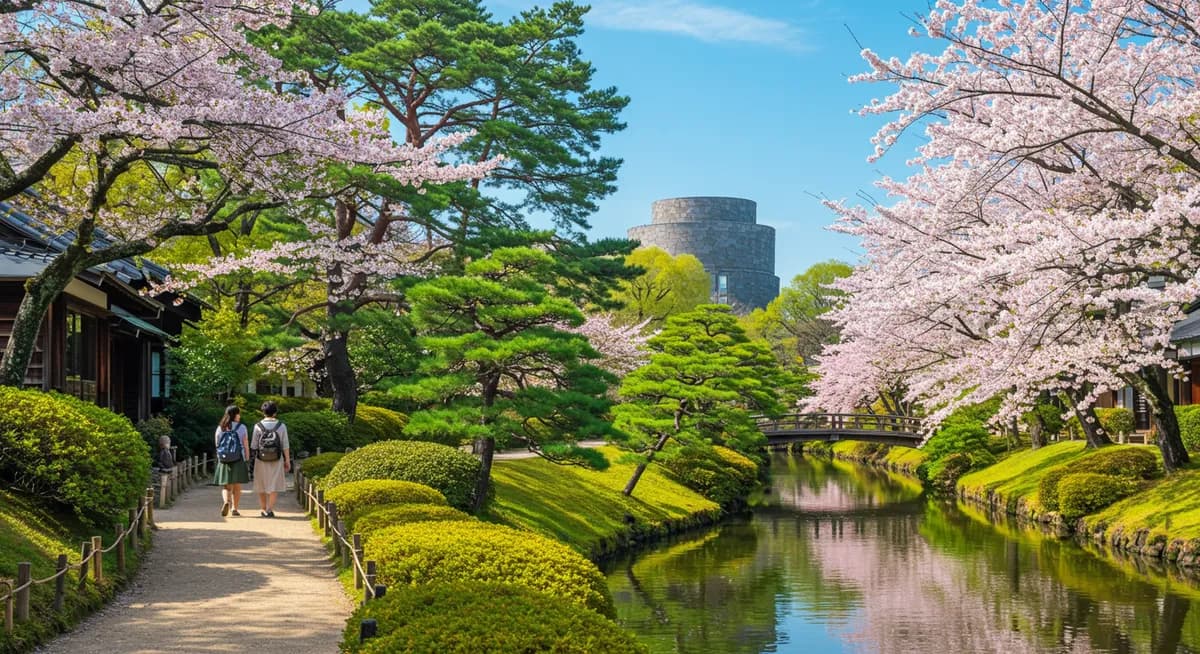
Walk the main circuit counter-clockwise: Kotoji Toro stone lantern (the most photographed spot in Kanazawa) → Kaiseki Waterfall → Yugao-tei teahouse → Hisago Pond. In spring (late March–early April), the weeping cherry tree near Neagari-matsu pine explodes in pink. In autumn (mid-November), maples flame red against moss. Allow 90 minutes; 60 minutes if you need to cut time.
See our dedicated Kenrokuen Garden guide for opening hours, seasonal highlights, and insider tips.
11:00 am — Kanazawa Castle Park (allow 45–60 minutes)
Walk directly from Kenrokuen's south exit through Ishikawa Gate (free to enter the grounds) into Kanazawa Castle Park. The castle was the seat of the powerful Maeda clan, the largest feudal domain outside the Tokugawa shogunate. The Ishikawa-mon gate (1788) survived fires and is the original structure; the Hishi Yagura turret and Gojukken Nagaya storehouse were authentically reconstructed in 2001.
2026 admission: Castle grounds free; Gyokusen'inmaru Garden ¥310. Open 9:00 am–4:30 pm.
Go inside the reconstructed turret to see the timber joinery — the wood is traditionally worked with no metal fasteners. Views from the upper floor look back across Kenrokuen and out to the city. Allow 45–60 minutes. Our full Kanazawa Castle Park visiting guide has everything you need.
12:30 pm — Lunch at Omicho Market (allow 60 minutes)
From the castle, it is a flat 10-minute walk north to Omicho Market — Kanazawa's covered fresh food market operating since 1721. With 170+ stalls, it is Japan's largest "kitchen market" outside Tokyo's Tsukiji. The specialty is fresh seafood from the Sea of Japan: buri (yellowtail), nodoguro (blackthroat seaperch), crab in season (November–March), and the city's famous fresh oysters.
Best lunch option: Order a kaisendon (scattered sashimi rice bowl) at one of the dozen lunch counters on the market's upper level. Expect to pay ¥1,500–¥2,800 depending on what's fresh. Arrive by 12:30 pm to beat the 1:00 pm lunch rush. Street-level stalls sell tamagoyaki (sweet egg rolls), skewered seafood, and Kanazawa's gold-leaf soft-serve ice cream (¥500–¥700) — perfect for a walking dessert.
Our Omicho Market food guide covers the best stalls and what to order in each season.
2:00 pm — Higashi Chaya Geisha District (allow 60–75 minutes)
Higashi Chaya-gai (East Teahouse District) is the largest and best-preserved of Kanazawa's three geisha districts, and one of the few such districts outside Kyoto that still hosts active geisha performances. The main street is lined with two-story wooden ochaya (teahouse) buildings dating from 1820, their latticed facades largely unchanged.
Walk slowly down the main lane (Higashiyama Higashi). Step inside Shima Ochaya (admission ¥700), a former working teahouse where you can see the banquet rooms, lacquered instruments, and private guest quarters. Kaikaro Teahouse (¥750) is also open to visitors and offers matcha tea inside the historic rooms.
Gold-leaf products are the district's signature souvenir — look for Hakuichi and Sakuda shops where you can watch artisans apply Kanazawa's famous gold leaf (the city produces 99% of Japan's gold leaf). Our Higashi Chaya District guide has the full walking route and opening hours.
4:00 pm — Nagamachi Samurai District (allow 45 minutes)
From Higashi Chaya, take a Machi-nori bike or 15-minute walk west to Nagamachi, the preserved samurai residential quarter. Unlike the theatrical reconstructions at many castle towns, Nagamachi's earthen-walled lanes (dobu-bei walls) and compact machiya townhouses are the genuine article — samurai families lived here through the Meiji era and their descendants' homes still line the narrow paths.
The Nomura Samurai House (admission ¥550; 8:30 am–5:30 pm) is the stand-out: a preserved interior with tatami rooms, a shoin-zukuri study, and a miniature garden incorporating a stream from Kenrokuen's waterway system. Allow 30 minutes inside; the garden alone is worth it. The surrounding lanes are free to walk and pleasant in late afternoon light.
5:30 pm — Gold Leaf Workshop or 21st Century Museum (pick one)
You now have 60–90 minutes before dinner. Two options depending on your interests:
Option A — Gold leaf workshop: Kanazawa is the only place in Japan where you can do a hands-on gold leaf application experience. Hakukokan in Higashi Chaya (10-min walk back) and the Kanazawa Gold Leaf Experience Centre near Nagamachi both offer 60-minute sessions applying gold leaf to lacquerware, chopsticks, or a mirror — prices from ¥2,200. Book in advance on their websites; popular slots fill by early afternoon.
Option B — 21st Century Museum of Contemporary Art: A 5-minute walk south of Kenrokuen, this circular building by SANAA architects is free to enter the public zone and ¥460 for ticketed galleries. The permanent "Swimming Pool" installation by Leandro Erlich (visitors appear submerged from outside) is worth the ticket. Open until 6:00 pm Tuesday–Sunday; closed Monday.
7:00 pm — Dinner (allow 75 minutes)
Kanazawa's dinner scene is concentrated in Katamachi (the bar district) and around the Korinbo department store area — both a 10-minute walk or quick Machi-nori ride from Nagamachi.
Best choices for a one-night first visit:
- Kaga kaiseki: Try Kanazawa's refined multi-course cuisine at Tsuruko or Kakuzan (book ahead; ¥8,000–¥15,000 per person). Kaga cuisine uses local buri, duck jibu-ni stew, and mountain vegetables in elaborate seasonal arrangements.
- Sushi: Kanazawa is one of Japan's premier sushi cities. Counter restaurants near Omicho Market serve 10-piece omakase sets for ¥5,000–¥9,000. The fish — especially winter buri and nodoguro — is exceptional.
- Izakaya: For a casual dinner, Katamachi's izakaya alleys offer excellent grilled seafood and local Tedorigawa or Fukumitsuya sake for ¥2,000–¥4,000 per person. See our best restaurants in Kanazawa guide for specific recommendations by cuisine and budget.
9:00 pm — Departure or Overnight Onsen Stay
The last Hokuriku Shinkansen back to Tokyo departs Kanazawa around 9:00–9:30 pm, arriving Tokyo around midnight. Check the JR schedule the morning of your visit as times vary by season. From Osaka, the last Thunderbird departs around 9:30 pm.
If you decide to stay overnight — strongly recommended if the day has made you want more — Kanazawa has excellent ryokan options with private onsen baths. The Dormy Inn Kanazawa near the station has a rooftop onsen and is excellent value. Staying means you can visit a geisha dinner performance in Higashi Chaya or explore the quieter evening atmosphere of Kenrokuen's illumination events (seasonal, check visitkanazawa.jp). Our day trips from Kanazawa guide also covers how to use the city as a base for Shirakawa-go and Noto Peninsula.
Practical 1-Day Kanazawa Route Summary
| Time | Stop | Duration | Cost (2026) |
|---|---|---|---|
| 8:00 am | JR Kanazawa Station — bag drop + Machi-nori bike | 30 min | ¥1,650 (day pass) |
| 9:00 am | Kenrokuen Garden | 90 min | ¥320 |
| 11:00 am | Kanazawa Castle Park | 60 min | Free (grounds) |
| 12:30 pm | Omicho Market — lunch | 60 min | ¥1,500–2,800 |
| 2:00 pm | Higashi Chaya Geisha District | 75 min | ¥700 (Shima) |
| 4:00 pm | Nagamachi Samurai District | 45 min | ¥550 (Nomura House) |
| 5:30 pm | Gold leaf workshop or 21st Century Museum | 60–75 min | ¥460–2,200 |
| 7:00 pm | Dinner (Katamachi or Korinbo area) | 75 min | ¥2,000–9,000 |
| 9:00 pm | Departure (Shinkansen) or overnight | — | — |
Frequently Asked Questions — 1-Day Kanazawa Itinerary
Can you visit Kanazawa in one day?
Yes. Kanazawa's top five attractions — Kenrokuen Garden, Kanazawa Castle Park, Omicho Market, Higashi Chaya District, and Nagamachi Samurai District — are all within 2 km of each other. A 1-day visit starting by 9:00 am comfortably covers all five with time for lunch, a workshop, and dinner before the last Shinkansen. The city is compact enough that even walking the full loop takes under 90 minutes of total transit time.
Is one day in Kanazawa enough?
One day is enough to see the highlights and leave satisfied. It is not enough to take the Ninja Temple (Myoryuji) tour, do a serious Kaga cuisine kaiseki, visit Kenrokuen at dawn, or explore the Teramachi Temple District on the west bank. If you have any flexibility, one night makes a meaningful difference — you gain a Shinkansen-friendly morning, unhurried access before the day-trip crowds arrive (Kenrokuen is quietest before 9:00 am), and the city's evening atmosphere around Higashi Chaya, which is entirely different from daytime. See our 2-day itinerary if you can stay.
What is the best transport for a Kanazawa day trip?
The Machi-nori electric bike share (¥1,650 day pass) is the best option for a one-day visit. It eliminates bus wait times, covers the distances between attractions in 5–15 minutes, and the electric assist makes uphill stretches to Kenrokuen and the castle area easy. The Kanazawa Loop Bus (¥200 per ride, ¥500 day pass) is a good alternative if cycling is not your preference — it stops at all major sights. Regular taxis are plentiful but expensive for multi-stop touring.
Where do I leave my luggage on a Kanazawa day trip?
Kanazawa Station (east/Kenroku-en exit, ground floor) has coin lockers: small ¥400, medium ¥500, large ¥700 per day. They are generally available even on busy weekends. Drop luggage the moment you arrive and retrieve it before your departure Shinkansen. There is also a staffed luggage service counter (TC Ticket Counter) in the station for oversized items.
Should I stay overnight in Kanazawa instead of doing a day trip?
If your schedule allows even one night, stay. Kanazawa has excellent onsen ryokan, the morning light at Kenrokuen is magical before the crowds, and a geisha dinner performance at Higashi Chaya teahouse is only possible in the evening. The cost difference between a day trip and an overnight stay is roughly ¥8,000–¥15,000 for accommodation — worth it for the experience. That said, for travelers on a tight Japan Rail Pass schedule with limited days, the one-day itinerary above delivers real value. Kanazawa is not a city you need three days to appreciate on a first visit.
What season is best for a one-day Kanazawa visit?
Spring (late March to early May) for cherry blossoms at Kenrokuen; autumn (mid-October to mid-November) for maple foliage. Both seasons are peak-crowd periods — arrive early (first Shinkansen possible). Summer is hot but uncrowded. Winter gives you snow-covered Kenrokuen (stunning) but shorter days — you lose the 9 pm departure window as darkness falls by 5 pm.
For a deeper exploration, discover more of the city's best sites in our Kanazawa attractions pillar guide, find the top places to eat in our best restaurants in Kanazawa roundup, or plan a longer trip with our 2-day Kanazawa itinerary for authentic cultural experiences.
 8 Essential Restaurants in Kanazawa (2026)May 11, 2026