
Best Hiroshima Activities 2026
Best Hiroshima activities in 2026: Peace Memorial Park, Miyajima Island, okonomiyaki, cycling routes, cultural workshops, and seasonal festivals. Plan your trip with practical tips.
On this page
Hiroshima rewards travelers who treat it as more than a half-day stop on the bullet train. The city pairs one of the most moving historical sites in Japan with a UNESCO island shrine, a distinctive food culture, and easy access to lesser-known day trips most itineraries skip. This guide covers the activities worth your time in 2026, with practical notes on tickets, timing, and rule changes you will not see in most listicles.
Use this as a working shortlist. For a broader trip plan, cross-reference things to do in Hiroshima, browse immersive Hiroshima experiences, or scout active Hiroshima adventures. Travelers leaning into heritage can dig into Hiroshima culture and the city's landmarks; evening visitors should check Hiroshima nightlife; and anyone matching a trip to a festival can scan upcoming Hiroshima events. Once your dates are set, structure the days with a tested Hiroshima itinerary that hits the major highlights.
1. Peace Memorial Park, Museum, and the A-Bomb Dome
The Peace Memorial Park is the emotional and geographic anchor of any Hiroshima visit, and most travelers should plan at least three to four hours here. The Peace Memorial Museum's main building reopened in 2019 with redesigned exhibits that emphasize personal artifacts — burned uniforms, melted lunchboxes, handwritten letters — over abstract statistics. Tickets cost 200 yen for adults in 2026, and lines move fastest if you arrive at 08:30 opening. The museum gets crowded by 10:30, and English audio guides are available for an extra 400 yen.
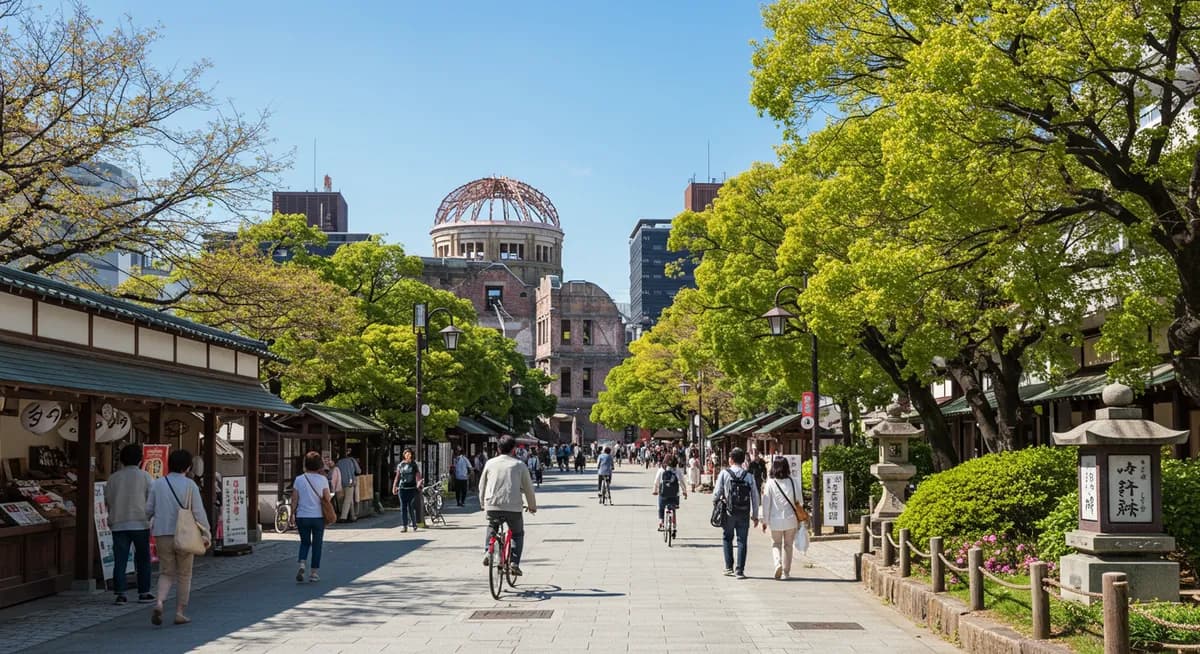
Outside, walk the Cenotaph, the Children's Peace Monument (where Sadako Sasaki's paper cranes are displayed), and the A-Bomb Dome (Genbaku Dome), a UNESCO World Heritage site preserved as it stood after August 6, 1945. The dome is best photographed from across the Motoyasu River in late afternoon when the western light hits the skeletal frame. Volunteer guides — many are descendants of survivors — offer free 90-minute walking tours; reserve through the Hiroshima Peace Volunteers website at least 48 hours ahead.
2. Itsukushima Shrine and the Floating Torii on Miyajima
The vermilion torii gate of Itsukushima Shrine emerged from a long restoration in late 2022 and now stands fully repainted — the colors are notably brighter than in pre-2020 photos. Time your visit by tide table, not by clock: the gate "floats" only at high tide, while low tide lets you walk out across the mudflats to touch its base. Both versions are worth seeing, and ideally you experience both on the same day. The Hiroshima Tourism site publishes daily Miyajima tide charts; bookmark them before you go.
Reach the island via the JR ferry from Miyajimaguchi (covered by the JR Pass) — the 10-minute crossing takes a slight detour past the torii on the morning runs. Stay overnight at a ryokan if you can; the island after the last 17:30 ferry empties out, and Itsukushima Shrine illuminated against a black tide is one of the quieter scenes in Japan. Mount Misen, the island's 535-meter peak, is reachable by ropeway plus a 30-minute hike, with views as far as Shikoku on clear days.
3. The Miyajima Visitor Tax and Deer-Feeding Ban (2026 Rules)
Two recent rule changes catch first-time visitors off guard, and almost no English listicle covers them. Since October 2023, every non-resident visitor to Miyajima pays a 100-yen Miyajima Visitor Tax (the "Itsukushima Visit Tax"), collected at the ferry terminal alongside your ferry ticket. A one-year pass costs 500 yen and is worth it only for repeat visitors. The fee funds island infrastructure and crowd management, and you cannot board the ferry without paying it — keep small change on hand.
The second surprise: feeding Miyajima's free-roaming deer is prohibited and has been since 2008, but enforcement tightened in 2023 after several visitor injuries. Deer will absolutely steal maps, ferry tickets, and ice cream from unsuspecting hands; tuck papers deep in zipped bags and eat snacks indoors. There are no deer crackers sold on the island (unlike Nara), and giving any human food can incur a fine. The deer are wild — admire from arm's length and they will mostly ignore you.
4. Hiroshima-Style Okonomiyaki at Okonomimura
Hiroshima okonomiyaki is built in distinct layers — crepe batter, mounded cabbage, bean sprouts, pork belly, yakisoba noodles, and a folded egg — rather than the mixed Osaka-style batter most travelers know. Watching it assembled on the teppan in front of you is half the experience. Okonomimura, a four-floor building near Chuo-dori, packs around 24 specialist stalls under one roof and is the easiest single destination if you cannot decide between shops. Expect to pay 900 to 1,400 yen per pancake.
For a more refined version, locals recommend Nagata-ya (near the A-Bomb Dome) or Hassei in Hatchobori; both routinely have 30-minute queues at peak lunch and dinner. Order it with oysters in winter (kaki okonomiyaki) — Hiroshima Bay produces about 60% of Japan's farmed oysters, and the seasonal variant is exceptional from November through February. This kind of regional eating is a core part of Hiroshima culture.
5. Hiroshima Castle and Shukkeien Garden
Hiroshima Castle — nicknamed "Carp Castle" for the river fish in its moat — is a 1958 reconstruction, since the original was destroyed in the 1945 bombing, but the museum inside the keep is genuinely informative on samurai history and the Mori clan that built it. The grounds are free; entry to the keep is 370 yen. The five floors are not air-conditioned, so plan around the heat in summer.
Pair the castle with Shukkeien Garden, a 10-minute walk east. The 17th-century strolling garden was largely destroyed in 1945 and replanted; the current trees and koi-filled central pond date mostly from the 1950s, which gives it a slightly different feel from older Edo gardens elsewhere. Entry is 260 yen, and the seasonal lighting events in early April (cherry blossoms) and mid-November (autumn leaves) are worth scheduling around if your dates line up.
6. Mazda Museum (and Why You Need to Book Now)
The Mazda Museum at the company headquarters in Fuchu is one of the few corporate museums in Japan that genuinely earns the trip — exhibits cover the rotary engine, Le Mans-winning prototypes, and a working assembly line you watch through observation windows. The 90-minute tour is free, but it is reservation-only and books out four to six weeks ahead in 2026. Reserve through the Mazda website the moment your dates firm up; same-week walk-ins are not possible.
The tour is conducted in English at 10:00 on weekdays only (no weekend tours), and you must bring photo ID matching your reservation. Reach the museum on the JR Sanyo Line to Mukainada Station, then a free Mazda shuttle. If you cannot get a slot, the smaller Mazda Zoom-Zoom Stadium tour or the Hiroshima City Transportation Museum cover similar industrial-history ground without the booking pain.
7. Day Trip to Kure and the Yamato Museum
Kure, a 35-minute JR Kure Line ride from Hiroshima Station, was the largest naval shipyard in the Imperial Japanese Navy and built the battleship Yamato — the largest battleship ever constructed. The Yamato Museum centers on a 26.3-meter, 1:10 scale model of the ship and complements it with the actual Type Zero fighter, kaiten manned torpedoes, and contextual exhibits on Kure's wartime industry. Adult admission is 500 yen, and the museum opens at 09:00 daily except Tuesdays.
Across the plaza, the JMSDF Kure Museum (the "Iron Whale") lets you walk through the decommissioned Akishio submarine — free entry, and the only place in Japan where civilians can board a real submarine interior. The pairing makes for a half-day add-on and balances the pacifist focus of central Hiroshima with a more complicated naval-history perspective. Pack a 6.5-hour buffer including the train ride.
8. Cycle the City and the Setouchi Shimanami Kaido
Hiroshima's compact center along the Motoyasu and Ota rivers is genuinely flat, and a rental bike (around 1,000 yen per day from Peace Cycle near the station) covers more ground than the streetcar in less time. Pedal between Peace Memorial Park, Hiroshima Castle, and Shukkeien in a single morning loop. For something more ambitious, the Setouchi Shimanami Kaido — a 70-kilometer cycling route across six islands of the Seto Inland Sea — starts from Onomichi (90 minutes east by JR) and is one of the most scenic long-distance bike routes in Asia. Day trippers ride the first 25 kilometers and return by bus.
9. Sake Tasting in Saijo
Saijo, a 40-minute local train east of Hiroshima, is one of Japan's three great sake-brewing towns alongside Nada and Fushimi. Seven active breweries cluster within a 10-minute walk of Saijo Station, and most run small tasting flights for 500 to 1,000 yen. Kamoizumi and Hakubotan are the easiest English-friendly stops. The annual Sake Matsuri in early October fills the streets with a 1,000-brewery tasting tent — book accommodation months ahead if you want to attend.
10. Orizuru Tower and Cultural Workshops
The Orizuru Tower's open-air rooftop gives the best public-access view over Peace Memorial Park, and the interactive paper-crane folding station on the way down — where you fold an orizuru and drop it into a 50-meter glass tube — is a quiet, meaningful close to a museum visit. Adult admission is 2,200 yen. For a deeper cultural layer, book a calligraphy or kimono workshop in the Hondori shopping arcade, or a tea ceremony at Shukkeien's tea house. These small group sessions usually accept same-day reservations and run 1,500 to 4,000 yen.
How Long to Spend and How to Get Around
Two full days is the realistic minimum: one for central Hiroshima (Peace Park, castle, Shukkeien, okonomiyaki dinner) and one for Miyajima. Three days lets you add Kure or Saijo. Four days unlocks Onomichi and the Shimanami Kaido. The city's streetcar (Hiroden) is the cheapest hop between sights at 240 yen flat, but the one-day pass at 700 yen pays off after three rides. JR Pass holders can use the JR ferry to Miyajima for free.
If you arrive from Tokyo or Osaka, see this guide to reaching Hiroshima from Tokyo and Osaka; for in-city transit, this Hiroshima streetcar and bus guide walks through fares and routes. Travelers stretching budgets should read this Hiroshima budget travel guide covering free sights and cheap eats.
Related Guides for Planning Hiroshima
For a broader shortlist, start with 15 best things to do in Hiroshima in 2026. Travelers combining city and island can use this Hiroshima and Miyajima 2 day itinerary map for an efficient route. Spring visitors should check these Hiroshima cherry blossom season ideas.
For the full 2026 events calendar — from the August 6 Peace Memorial Ceremony to Miyajima festivals — see our Hiroshima 2026 events and seasonal guide. Summer visitors should review Hiroshima summer festivals and Bentenjima fireworks 2026. For a hands-on activity at the Peace Memorial, read how to fold orizuru paper cranes. Craft enthusiasts will enjoy these 7 traditional Hiroshima arts and crafts.
Hiroshima rewards travelers who slow down. The Peace Memorial deserves more than a quick photo, Miyajima deserves an overnight, and the lesser-known stops — Kure, Saijo, the Mazda factory — turn a one-night stopover into a memorable three-day base. Plan tickets early, watch the tides for Miyajima, and budget 100 yen per person for the island tax.
 Kagoshima Culture GuideFebruary 17, 2025
 Matsumoto Nights: Nightlife GuideFebruary 17, 2025
 Top Things To Do in HiroshimaFebruary 17, 2025