

Yoshino Cherry Blossoms: 2026 Viewing Guide
Yoshino cherry blossoms 2026 guide: the four staggered bloom tiers (Shimo, Naka, Kami, Oku Senbon), the best viewpoints, the sacred history of the sakura, crowd timing, and how to plan a visit.
On this page
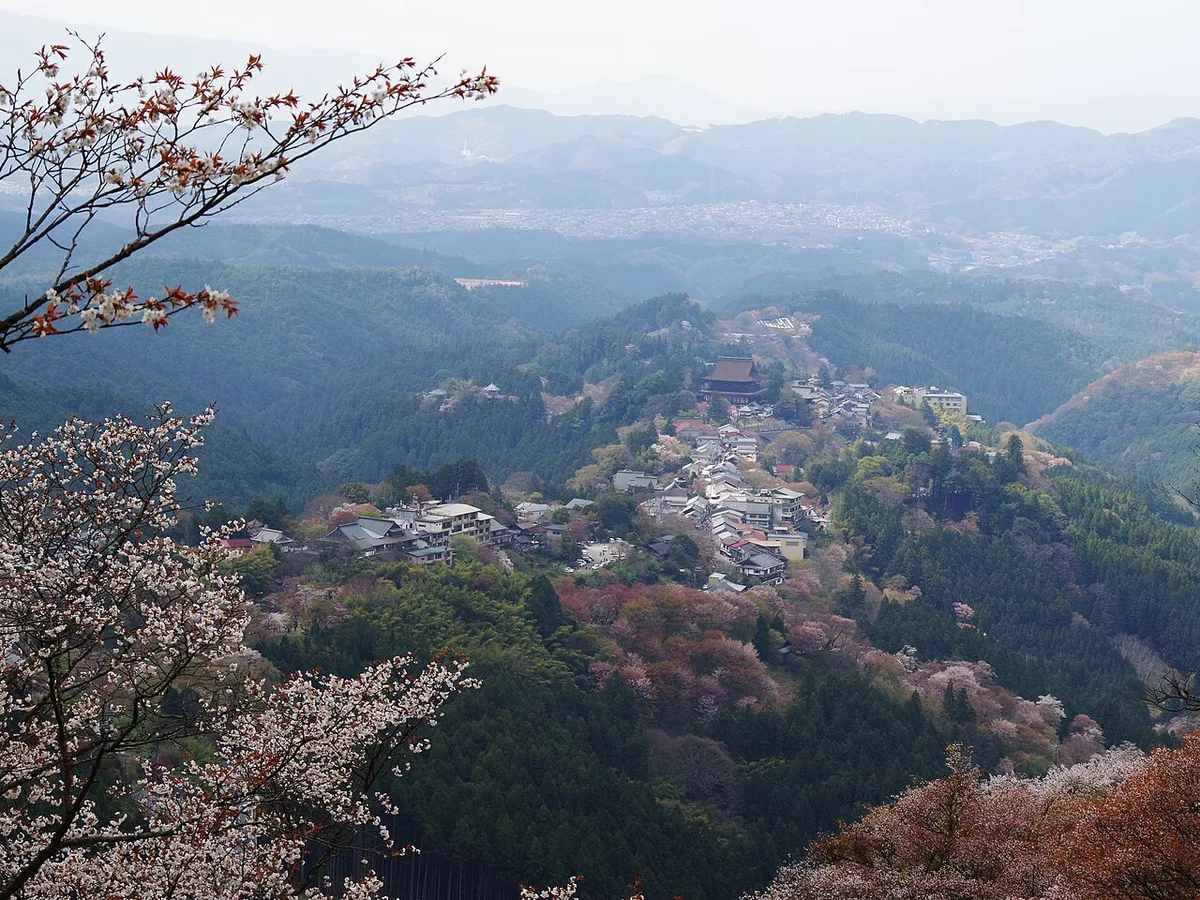
Mount Yoshino, in the mountains south of Nara, is widely regarded as Japan's single greatest cherry blossom destination — and the reason has less to do with the number of trees than with how they are arranged. Roughly 30,000 trees, the overwhelming majority of them Yoshino-zakura (the very cultivar named after this mountain), blanket the slope across four distinct elevation tiers. Because the mountain rises from around 350 to 750 meters, those tiers do not bloom together: they bloom in sequence, over two to three weeks, turning a single mountainside into a rolling, elevation-driven wave of pink rather than a one-week spectacle.
That staggering is what sets Yoshino apart from Japan's park-planted cherry destinations. A visitor arriving even a week "too late" for the lower tier can often still catch peak bloom higher up the mountain — a forgiving quality no ordinary sakura park can offer. Layered onto the natural spectacle is over a thousand years of religious history: these trees were planted by Shugendo mountain ascetics as offerings to the mountain deity Zao Gongen, giving Yoshino's blossoms a devotional weight that most hanami spots simply don't carry.
This 2026 guide covers the four-tier bloom sequence and how to time a visit around it, the best viewpoints, the mountain's sacred history, and practical notes on crowds, shuttle buses, and viewing costs.
Bloom timing shifts year to year with spring temperatures, so treat any fixed calendar date as a rough guide only. Check the Yoshino tourism association's real-time bloom tracker in the weeks before your trip rather than planning off a generic "early April" assumption.
Key Takeaways
- Mount Yoshino's roughly 30,000 cherry trees bloom in four elevation tiers — Shimo Senbon (lower), Naka Senbon, Kami Senbon, and Oku Senbon (upper) — in sequence over two to three weeks, not all at once.
- Because the tiers bloom in order from low to high, a visit timed to a specific tier can still catch peak bloom even if the lower slopes have already finished.
- The Hanayagura observation deck near Yoshimizu Shrine offers the classic sweeping view across multiple tiers in a single frame — the postcard shot most visitors come for.
- The sakura were originally planted by Shugendo mountain ascetics as sacred offerings to the deity Zao Gongen, giving Yoshino a religious history that sets it apart from ordinary park-planted cherry destinations.
- Peak week, typically early-to-mid April, draws heavy crowds and shuttle bus queues; visiting on a weekday or focusing on the lower tiers eases the crush considerably.
The Staggered Bloom: Four Tiers Across Three Weeks
The defining feature of Yoshino's cherry blossoms is elevation. Mount Yoshino climbs from roughly 350 meters at its base to about 750 meters near its upper slopes, and that vertical range is enough to shift bloom timing meaningfully from bottom to top. The mountain is divided into four traditional viewing tiers, each blooming in turn as spring warmth climbs the slope.
| Tier | Elevation | Typical Bloom Window (2026 estimate) |
|---|---|---|
| Shimo Senbon (lower) | ~350m | Early April, first to bloom |
| Naka Senbon (middle) | ~400-500m | Early-to-mid April |
| Kami Senbon (upper-middle) | ~500-600m | Mid April |
| Oku Senbon (uppermost) | ~600-750m | Mid-to-late April, last to bloom |
This sequencing is precisely what makes Yoshino more forgiving than a typical single-location cherry spot. If travel dates fall a week later than planned, the lower tiers may have already scattered their petals, but Kami Senbon or Oku Senbon further up the mountain can still be at or approaching peak. The reverse also holds: an early-April arrival that misses the upper tiers can still catch Shimo Senbon in full bloom near the base. Because timing shifts with each year's weather, the best time to visit Yoshino guide is worth checking closer to your travel dates rather than relying on a fixed calendar window.

The Best Views: Where to See the Full Sweep
The single most rewarding vantage point on the mountain is the Hanayagura observation deck, positioned near Yoshimizu Shrine on the Naka Senbon tier. From here, thousands of trees are visible across multiple elevation bands in one uninterrupted sweep — the classic wide shot that appears in nearly every photograph of Yoshino's blossoms. Because it sits roughly mid-mountain, Hanayagura captures blooms from the tier it sits on plus glimpses of the tiers above and below, making it a strong single stop for visitors who cannot walk the whole mountain in one day.
Yoshimizu Shrine itself, just below the deck, is worth building time around — its grounds and approach path are framed by cherry trees on several sides, and the shrine's own history is tied closely to the mountain's sacred status. For a fuller sense of the shrine's setting and how it fits into a walking route up the mountain, see the Yoshimizu Shrine guide. Kinpusen-ji, the mountain's other major temple complex, offers a different kind of framing — its main hall rises above the Shimo Senbon tier, and cherry trees line the approach; details on visiting are in the Kinpusenji Temple guide.
Because the four tiers are spread across a genuine elevation gain, most visitors do not attempt to walk the entire mountain on foot in a single day. Combining walking with the mountain's cable transport is the practical approach for covering more than one or two tiers, and pairing that with an honest sense of how the tiers compare against each other in scale and atmosphere helps set expectations before arrival — see the guide to Yoshino's four tiers for a tier-by-tier breakdown.
A Sacred Mountain: The History Behind the Sakura
Yoshino's cherry trees were not planted for scenery. Their origin lies with Shugendo, a syncretic mountain-ascetic tradition, whose practitioners planted sakura on the slopes over the course of more than a thousand years as devotional offerings to Zao Gongen, the mountain's guardian deity. The tree is considered sacred to Zao Gongen in Shugendo practice, which is why the sakura here are concentrated on a mountain that has functioned as a site of religious pilgrimage and ascetic training for centuries, rather than in a designed public park.
This origin story is what separates Yoshino from Japan's other famous cherry blossom destinations, most of which were planted deliberately as ornamental gardens or urban parks in more recent centuries. Walking the mountain during bloom season means passing through a landscape that carries genuine devotional weight — shrine gates, mountain trails, and ascetic training grounds woven directly into the same slopes covered in blossoms. That layered history is part of what draws repeat visitors back to Yoshino rather than a closer, more convenient cherry-viewing spot nearer a major city.

Crowds, Timing, and Getting Around
Yoshino's reputation means peak week — typically falling somewhere in early-to-mid April, though the exact dates shift with each year's spring temperatures — draws very large crowds, particularly on weekends. Shuttle buses running up the mountain during peak season can develop long queues, and cars are restricted on the upper approach roads during the busiest days to manage traffic. Visiting on a weekday, arriving early in the morning, or deliberately timing a trip to a specific tier rather than chasing "full mountain" peak bloom all meaningfully reduce the crowding.
Viewing the mountain itself is free, though some individual viewpoints and temple grounds — including sections of Kinpusen-ji — apply their normal admission fee (2026 estimate; verify current pricing before visiting, as temple fees are adjusted periodically). Because bloom dates genuinely move year to year, checking the Yoshino tourism association's real-time bloom tracker in the weeks immediately before travel is far more reliable than planning around a fixed date from a previous year's calendar.
Most visitors reach Yoshino as a day trip from Osaka or Kyoto by rail, connecting to the mountain's cable car for the steepest section of the ascent. The guide to getting to Yoshino from Osaka and Kyoto covers train routes, approximate travel time, and the cable-car connection in detail.
Planning Your Visit
Because the four tiers are spread across real elevation and distance, a single day covers the mountain comfortably only with some planning around which tiers to prioritize. Visitors chasing the widest possible sweep of blossoms should anchor their day around the Hanayagura deck and Yoshimizu Shrine on the Naka Senbon tier, then extend upward or downward depending on which tier is closest to peak that week. A full walking-and-cable-car day plan, including realistic timing between the tiers and the two major temple stops, is laid out in the Yoshino one-day itinerary.
Outside of peak bloom weeks, Yoshino's slopes are quieter but still worth visiting for the temple architecture, the mountain scenery, and the historical weight of the Shugendo sites — the cherry trees are the headline attraction, but not the only reason to make the trip.
Frequently Asked Questions
When do Yoshino's cherry blossoms bloom?
Yoshino's roughly 30,000 cherry trees bloom in a staggered sequence across four elevation tiers, generally spanning early April to mid/late April as a 2026 estimate. The lower Shimo Senbon tier blooms first, followed by Naka Senbon, then Kami Senbon, with the uppermost Oku Senbon tier blooming last. Because bloom timing shifts with each year's spring weather, checking the Yoshino tourism association's real-time bloom tracker closer to your travel dates is more reliable than planning around a fixed calendar window.
What is the best viewpoint for Yoshino's cherry blossoms?
The Hanayagura observation deck, near Yoshimizu Shrine on the Naka Senbon tier, offers the classic sweeping view across multiple elevation bands in a single frame — the widely photographed postcard shot of the mountain. Its mid-mountain position also gives partial views of the tiers above and below, making it a strong single stop for visitors who cannot walk the entire mountain in one day.
Why is Mount Yoshino considered Japan's best cherry blossom destination?
Two things set Yoshino apart from other cherry blossom destinations in Japan. First, its roughly 30,000 trees bloom in four staggered elevation tiers over two to three weeks rather than all at once, so a visit can be timed to catch peak bloom at a specific tier even if others have finished. Second, the trees carry genuine religious history — they were planted by Shugendo mountain ascetics as sacred offerings to the deity Zao Gongen over more than a thousand years, giving Yoshino a devotional weight that park-planted cherry destinations don't have.
Is it free to view the cherry blossoms at Yoshino?
Viewing the mountain and walking between its tiers is free. Some individual viewpoints and temple grounds, including sections of Kinpusen-ji, apply their normal admission fee (2026 estimate; verify current pricing before visiting). During peak bloom weeks, shuttle buses run up the mountain and cars are restricted on the upper approach roads to manage traffic, so budget time for queues if visiting on a weekend in early-to-mid April.
Yoshino earns its reputation as Japan's premier cherry blossom destination through a combination that no other single location matches: a genuine elevation gradient that stretches peak bloom across two to three weeks instead of one, a sweeping single-frame view from the Hanayagura deck that has become the mountain's signature image, and over a thousand years of Shugendo religious history woven directly into the slopes. Timing a visit around a specific tier — rather than chasing an ideal "whole mountain" moment that rarely aligns perfectly — is the most reliable way to see Yoshino at its best.
Build a Yoshino day around the Hanayagura deck and Yoshimizu Shrine, then extend to whichever tier is closest to peak that week, and round out the trip with Kinpusen-ji's temple architecture lower on the mountain. For the full picture of what else the area offers beyond the blossoms, see the Yoshino attractions guide.
For reference information on the mountain and its cherry blossoms, see Mount Yoshino on Wikipedia.
Free guide: Japan's Hidden Gems
12 under-the-radar places beyond Tokyo & Kyoto — with the best season to visit each and a local tip you won't find in the guidebooks.
You might also like


Continue reading
More guides you'll find useful


