

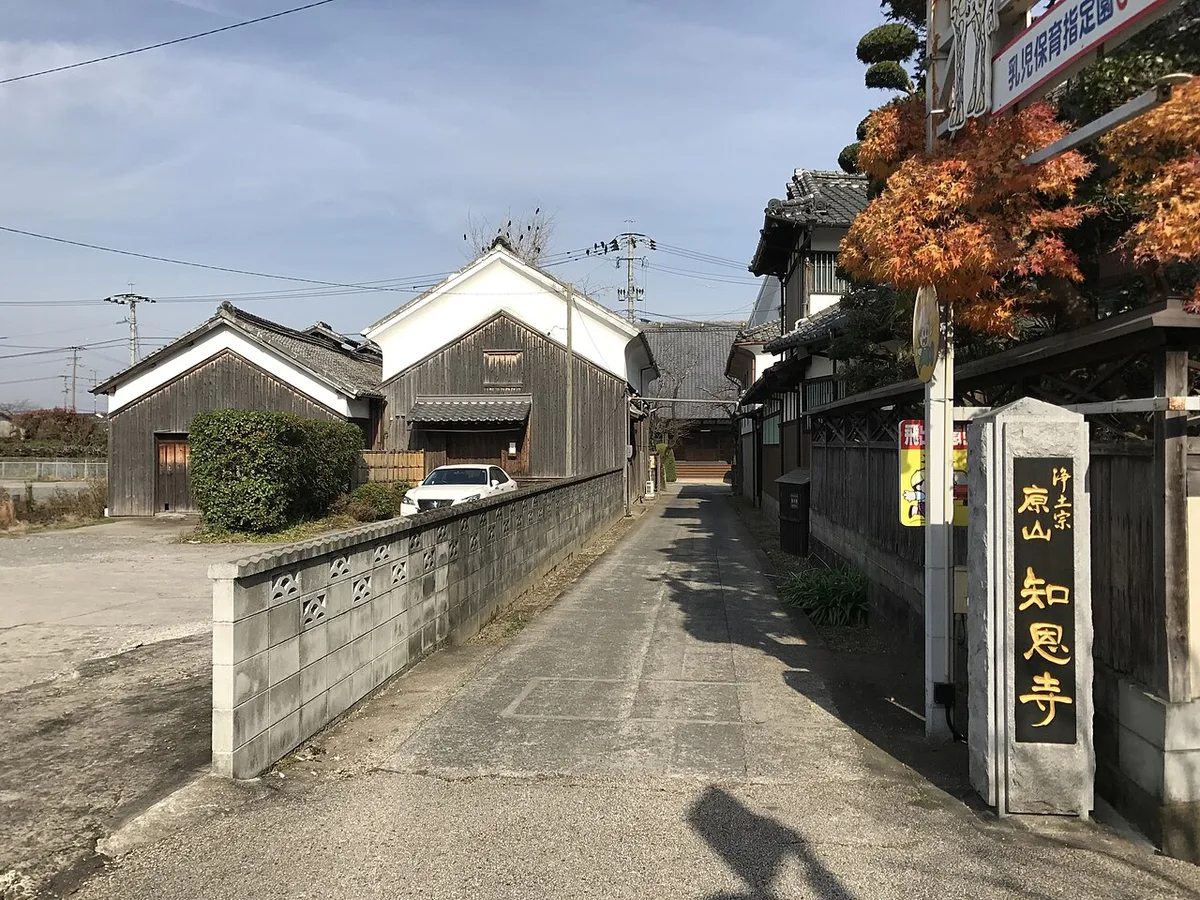
Chion-ji is a Rinzai Zen temple standing at the southern tip of Amanohashidate, right beside the station and at the foot of View Land — the first sacred landmark most visitors encounter on the famous sandbar peninsula. Dedicated to Monju Bosatsu (Manjushri), the bodhisattva of wisdom, it is counted among the Nihon San Monju: Japan's three great Monju temples, a distinction shared with Monjuji in Hyogo and Zenmyoji in Oita.
The grounds are immediately recognisable by their pine trees strung with hundreds of Suehiro omikuji — fan-shaped fortune slips that visitors tie to the branches, giving the temple a fluttering, festive appearance unlike anywhere else in Japan. At the heart of the compound stands the Chie-no-wa, a circular stone lantern whose ring pilgrims pass through seeking wisdom and clarity.
Entry to the temple grounds is free, and the entire complex is compact enough to explore in under an hour, making it an effortless pairing with the Amanohashidate sandbar walk or a cable-car trip to View Land.
This guide covers everything you need to plan a visit in 2026, from the Tahoto pagoda and Yamamon gate to transport links and practical timing tips.
Why Visit Chion-ji Temple? Amanohashidate's Temple of Wisdom
Chion-ji occupies a rare and distinguished position in Japanese Buddhism. As one of the three pilgrimage sites collectively known as the Nihon San Monju, it draws devotees who believe that praying to Monju Bosatsu — the deity governing wisdom, study, and intellectual endeavour — can sharpen the mind and guide important decisions. Students facing university entrance examinations, parents seeking blessings for their children's studies, and travellers simply hoping for clarity in uncertain times all find their way through the Yamamon gate.
The Chie-no-wa wisdom-ring lantern is the symbolic centrepiece of the visit. This distinctive circular stone lantern is said to bestow wisdom upon those who pass beneath or through its ring. The ritual is quiet and unhurried, in keeping with the temple's contemplative atmosphere. In a place as visually dramatic as Amanohashidate, Chion-ji offers a grounding counterpoint — a space for stillness amid the scenery.
The fan-shaped Suehiro omikuji are another feature found nowhere else quite like this. Suehiro means "widening toward the tips" — a metaphor for expanding fortune — and seeing the pine trees layered with hundreds of paper fans in various colours is one of Amanohashidate's most singular sights. Even visitors with no intention of drawing a fortune slip often pause to take in the effect. For the full picture of what else awaits in the area, the things to do in Amanohashidate guide covers the sandbar, viewpoints, and bay experiences alongside Chion-ji.
History and Significance of Chion-ji Temple
Chion-ji's origins are linked to the wider religious heritage of Amanohashidate, which has been a site of spiritual significance since at least the Heian period (794–1185). The temple's association with Monju Bosatsu — one of the most important bodhisattvas in Mahayana Buddhism, depicted riding a lion and holding a flaming sword of wisdom — gave it an elevated status among pilgrimage circuits that reached across Japan.
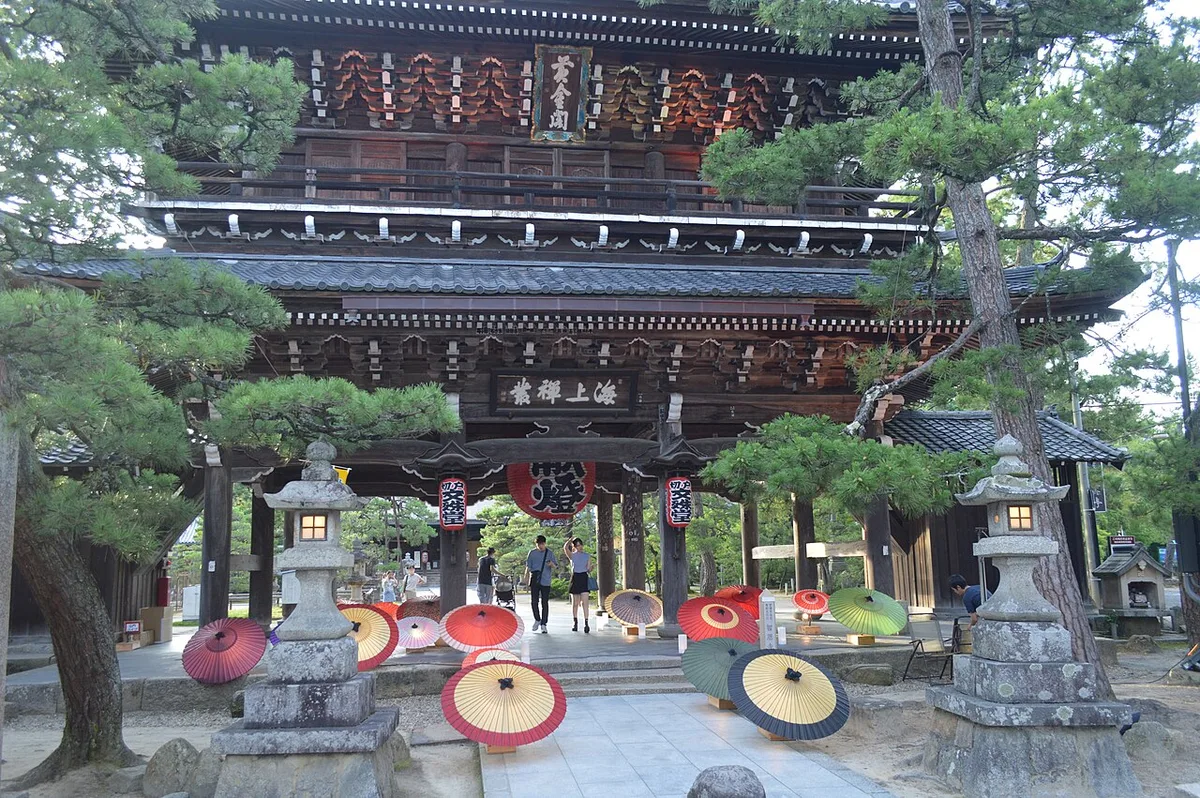
The main hall, known as the Monju-do, enshrines the temple's principal image of Monju Bosatsu and forms the ceremonial focus of the compound. Its architectural lines reflect the refined yet restrained aesthetic of Rinzai Zen temple design: clean proportions, dark timber, and minimal ornament that directs attention inward.
The Tahoto pagoda is the temple's most architecturally significant structure and has been designated an Important Cultural Property by the Japanese government. The Tahoto, or "multi-treasure pagoda," is a distinctive two-storey form particular to Esoteric Buddhist traditions: a cylindrical lower storey topped by a square upper storey beneath a pyramidal roof. The example at Chion-ji is a well-preserved specimen of the type, its weathered timbers speaking to centuries of exposure to the sea air of Miyazu Bay. The Yamamon gate, the formal entrance to the inner precinct, frames the approach to the Monju-do and gives the compound its sense of processional depth.
Together, these structures make Chion-ji one of the more architecturally layered temple complexes in the Kinki region north of Kyoto — modest in footprint, but rich in what it contains. For the broader religious and landscape heritage of the area, our guide to the full Chion-ji & Nariai-ji temples guide covers both Amanohashidate temples in depth.
Getting to Chion-ji Temple: Access and Transport
Chion-ji Temple is located immediately adjacent to Amanohashidate Station, the southern gateway to the sandbar. The station is served by the Kitakinki Tango Railway (KTR, colloquially called Tangotetsu), which connects with JR lines at Nishi-Maizuru and Fukuchiyama. From Kyoto Station, the most straightforward route is the Hashidate limited express, which runs the journey in approximately two hours without transfer. Seats are bookable and recommended at weekends and during peak autumn and spring seasons.
From Osaka, travellers can take the Kounotori limited express to Fukuchiyama and transfer to the Tango Explorer or a local KTR service to Amanohashidate. Allow around two and a half hours from Osaka Sannomiya. From the station forecourt, Chion-ji Temple is visible and reachable on foot in under two minutes — exit the station and turn left; the Yamamon gate will be immediately in front of you.
Visitors arriving by car will find pay car parks along the southern approach to the sandbar, near the station and the View Land base terminal. The area around the temple itself is pedestrian-only, so park at the perimeter and walk in. Chion-ji's central position means it naturally falls at the start or end of any sandbar walk or View Land excursion, with no additional transit required between the three.
Highlights of Chion-ji Temple: What to See and Do
The Chie-no-wa is the first thing most visitors seek out — a stone lantern with a circular aperture through which pilgrims step or reach, invoking the wisdom of Monju Bosatsu. The ritual is simple and open to all, regardless of religious background, and the worn stone of the ring testifies to centuries of hands and feet following the same passage. Mornings, before tour groups arrive, are the best time to engage with it quietly.
The Suehiro omikuji occupy a world of their own. Unlike the scrolled paper tubes of a standard omikuji, these fortune slips arrive pre-folded into the shape of an open fan. Visitors draw a slip, read their fortune, and tie the fan to one of the designated pine trees if they wish to leave a prayer. The cumulative effect — hundreds of paper fans fluttering in the sea breeze against a backdrop of ancient pines — is one of the most visually memorable sights in the Tango Peninsula. Even outside the omikuji ritual, the grove is worth pausing in.
The Tahoto pagoda stands within the inner compound and can be viewed at close range during opening hours. Its double-storey form, with the cylindrical base giving way to a square upper chamber, is distinct from the more common five-storey pagodas seen at larger temple complexes. The designation as an Important Cultural Property reflects both its age and its architectural integrity — it has survived the sea-salt air and seasonal typhoons of the Tango coast largely unaltered.
The Monju-do main hall and the Yamamon gate complete the compound's principal points of interest. The Monju-do Hall — the inner sanctuary dedicated to Monju Bosatsu — is the spiritual heart of the site, while the gate frames the arrival sequence in a way that signals the transition from the busy approach street to the quieter precinct within. After exploring Chion-ji, consider heading up to the View Land cable-car complex by chairlift for the famous matanozoki (between-the-legs) view across the sandbar.
Planning Your Visit: Hours, Access, and Tips
The temple grounds are open roughly 08:00–17:00 daily, though these hours are subject to change and should be confirmed before your visit, particularly outside the main tourist season. Entry to the grounds themselves is free of charge. The Suehiro omikuji and access to certain inner halls carry a small additional cost — budget a few hundred yen per person for these if you plan to participate.
Chion-ji is one of the most accessible temple sites in the Tango region. The compound is largely flat and paved, making it navigable for visitors with pushchairs or mobility considerations. The Yamamon gate entrance has no steps on approach from the station side, and the inner pathways between the key structures are gentle underfoot.
The temple can become busy during peak pilgrimage periods — particularly around university entrance examination season (January–February), when students and families come to pray for academic success — and during the autumn foliage season (October–November) when Amanohashidate draws its largest tourist crowds. Weekday mornings throughout spring and autumn offer the most comfortable balance of atmosphere and manageable visitor numbers.
Allow 30–45 minutes for a thorough visit to Chion-ji, including time to draw an omikuji and view the Tahoto pagoda. The temple pairs well with the sandbar walk and a ride up to the viewpoints — our guide to the Amanohashidate viewpoints covers exactly how to sequence the day for maximum impact. The Amanohashidate attractions hub is the best starting point for building a full itinerary around the area.
Frequently Asked Questions
Is Chion-ji Temple free to enter?
Yes, the temple grounds are free to enter. There is no admission charge for walking the compound and viewing the Tahoto pagoda, Yamamon gate, and Chie-no-wa lantern. The Suehiro omikuji fortune slips and access to certain special inner halls carry a small additional fee of a few hundred yen, but the core visit costs nothing.
What are Chion-ji Temple's opening hours?
The grounds are open roughly 08:00–17:00 daily as of 2026, though hours can vary by season and should be confirmed before your visit. The temple is right beside Amanohashidate Station, so it is easy to check on arrival. Special ceremonies or maintenance closures occasionally affect access to specific inner structures — the main grounds remain accessible in most circumstances.
What is the Chie-no-wa at Chion-ji Temple?
The Chie-no-wa (智恵の輪) is a circular stone lantern whose ring is believed to bestow wisdom upon those who pass through or touch it. "Chie" means wisdom and "wa" means ring or circle. It is one of the defining ritual objects at Chion-ji and reflects the temple's dedication to Monju Bosatsu, the bodhisattva of wisdom. The ritual is open to all visitors, regardless of religious background.
What is the Nihon San Monju?
The Nihon San Monju (日本三文殊) are the three great Monju Bosatsu temples in Japan: Chion-ji in Amanohashidate (Kyoto Prefecture), Monjuji in Naruto City, and Zenmyoji (also called Kokuzo Monjuin) in Oita Prefecture. Monju Bosatsu is the bodhisattva of wisdom and learning in Mahayana Buddhism. The three temples are collectively revered as pilgrimage destinations for students, scholars, and those seeking intellectual blessings.
How do I get to Chion-ji Temple from Kyoto?
From Kyoto Station, take the Hashidate limited express on the JR San'in Main Line and Miyazu Line to Amanohashidate Station — the journey takes approximately two hours. Chion-ji Temple is immediately adjacent to the station exit, reachable in under two minutes on foot. Seats on the Hashidate express are bookable and recommended during weekends and peak seasons. From Osaka, transfer at Fukuchiyama to the Kitakinki Tango Railway, allowing around two and a half hours total.
Can I visit Chion-ji Temple and Amanohashidate View Land in the same trip?
Yes — combining both is straightforward and strongly recommended. Chion-ji Temple sits at the base of View Land, right beside the chairlift and cable-car terminals. A logical sequence is to visit Chion-ji first (30–45 minutes), then ride up to View Land for the matanozoki viewpoint (allow 1–2 hours at the top), before walking out across the Amanohashidate sandbar on your return. The entire circuit can be completed comfortably in a half day.
Chion-ji Temple rewards the curiosity of visitors who make time for it beyond the sandbar and the scenic viewpoint. As one of Japan's three great Monju temples, it carries a significance disproportionate to its modest footprint — a place where centuries of pilgrims have come seeking clarity, and where the fan-strewn pine trees and the worn ring of the Chie-no-wa lantern speak to a still-living devotional tradition.
The temple is free, central, and requiring no special preparation to visit, yet it offers a depth of cultural and architectural interest that repays unhurried attention. Allow yourself the time to stand in the pine grove, draw a Suehiro fan, and sit with the quiet of the Monju-do before the next cable car arrives.
For a complete itinerary combining all the highlights of the area, see our guide to things to do in Amanohashidate and the detailed two-temple walkthrough at the full Chion-ji & Nariai-ji temples guide.