
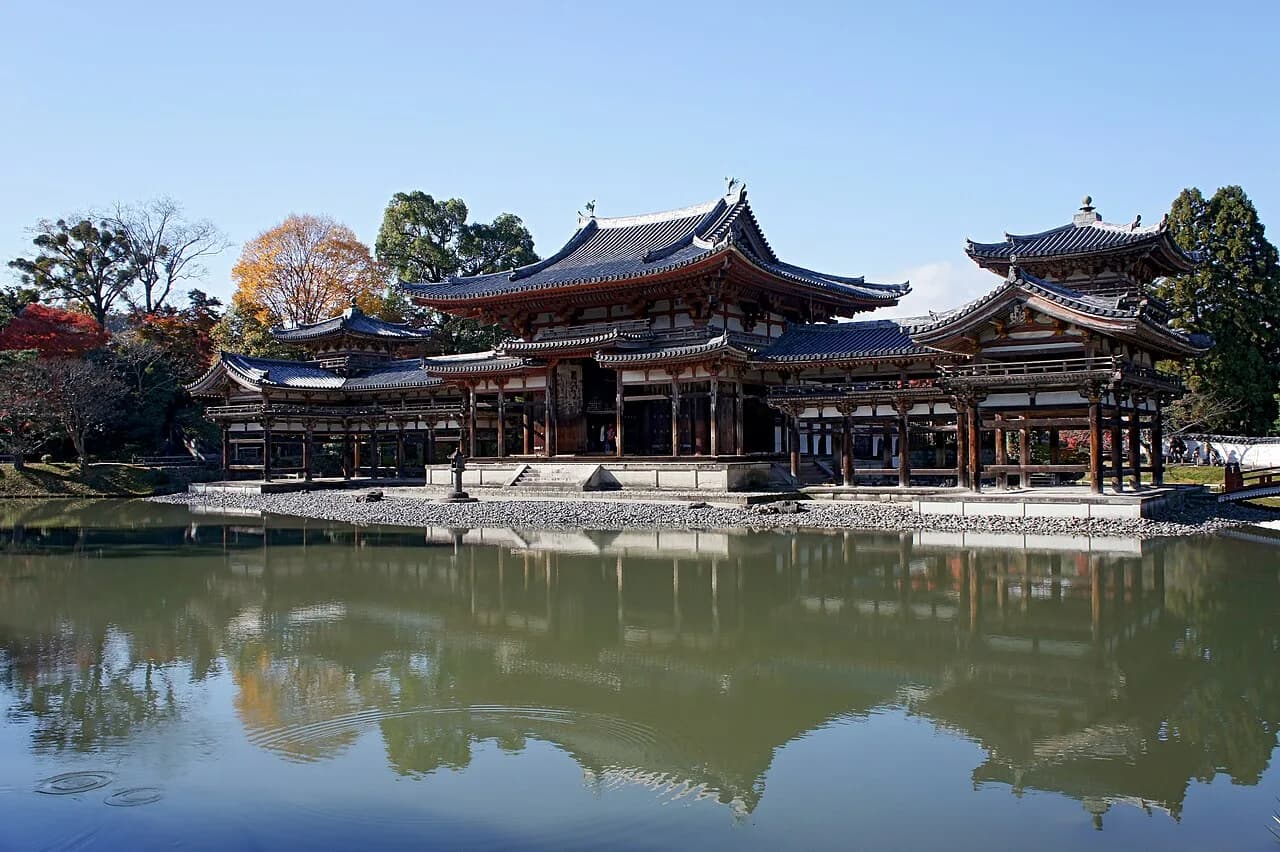
Byodo-in is one of Japan's most recognisable landmarks, and yet the real thing invariably surpasses the photograph. Set on the eastern bank of the Uji River in southern Kyoto Prefecture, this UNESCO World Heritage Site houses the Phoenix Hall — a Heian-era temple pavilion so iconic that it has appeared on Japan's 10-yen copper coin for over sixty years.
Built in 1053, the Phoenix Hall was designed to evoke the Western Paradise of Amida Buddha on earth. Its crimson-and-gold pavilion, mirrored in the still Aji-ike pond below, is among the finest surviving examples of Pure Land Buddhist architecture in the world.
Inside, the gilded Amida Nyorai — carved by master sculptor Jocho and designated a National Treasure — occupies the central dais, surrounded by 52 cloud-riding bodhisattvas. The adjoining Hoshokan museum preserves the original bronze phoenixes from the rooftop, the ancient temple bell, and the carved bodhisattva panels.
This guide covers everything you need to plan a visit in 2026: opening hours, ticket prices, how to secure a timed Phoenix Hall interior slot, and how to reach Byodo-in from Kyoto in under 20 minutes.
Why Visit Byodo-in? The Heian Masterpiece on Japan's 10-Yen Coin
Byodo-in holds a unique place in Japanese cultural life that few historic sites can match. Every time someone reaches into their pocket, they handle a small portrait of the Phoenix Hall — the 10-yen copper coin has carried an image of Hoodo's southern facade since 1959. Look closely at Japan's 10,000-yen banknote and you will find the gilt phoenix that crowns the rooftop there too, a quiet testament to how deeply this single building is woven into national identity.
Beyond the numismatic fame, Byodo-in rewards visitors with a genuinely moving experience. The UNESCO inscription as part of the Historic Monuments of Ancient Kyoto recognises its extraordinary preservation and its status as a benchmark of Heian-period artistic achievement. The complex sits within a carefully tended landscape garden on the river's edge, just minutes from the riverside promenade where Uji's matcha tea houses on nearby Byobugaura cluster along the water.
Few sights in Japan reward the early visitor more reliably. Morning light catches the Phoenix Hall's crimson eaves and gold fittings while the reflection trembles in the pond below — an image that justifies the journey from Kyoto all on its own. For a broader view of the city's highlights, from Ujigami Shrine to the famous tea culture, see our overview of things to do in Uji.
History and Significance of Byodo-in
The land on which Byodo-in stands was originally a riverside villa, passing through aristocratic hands until Fujiwara no Michinaga — the most powerful statesman of the Heian court — acquired it in the early 11th century. In 1052, Michinaga's son Fujiwara no Yorimichi converted the estate into a Buddhist temple. The following year he commissioned the Phoenix Hall, known in Japanese as Hoodo, as an earthly representation of the Western Paradise described in Pure Land Buddhist scripture. The hall's twin wings and central pavilion were intended to evoke a phoenix in flight, though the name stuck only in later centuries.
The central figure enshrined inside is the Amida Nyorai, sculpted by Jocho, the preeminent Buddhist sculptor of the Heian period. Jocho developed a technique called yosegi-zukuri — joined woodblock construction — that allowed large, refined statues to be produced with consistent precision and naturalistic grace. The Byodo-in Amida is his only confirmed surviving work, making it a singular object in Japanese art history. Surrounding the central dais, 52 apsaras — cloud-riding bodhisattvas carved in hinoki cypress — line the walls, each in a subtly different pose: playing instruments, holding lotuses, performing mudras. The original ninth-century wall paintings depicting the Western Paradise survive in fragmentary form on the interior walls.
The temple's survival across nearly a millennium owes much to Uji's protected valley setting and to the continuous stewardship of the temple community. The Hoshokan treasure museum, opened in 2001, moved the most vulnerable original artefacts — the roof phoenixes, the ancient bronze bell (one of Japan's three celebrated ancient bells), and the wood-carved bodhisattva panels — indoors for long-term preservation, replacing them with faithful reproductions inside the hall.
Getting to Byodo-in: Access and Transport
Byodo-in is located in Uji City, southern Kyoto Prefecture, approximately 10 minutes' walk from both JR Uji Station (JR Nara Line) and Keihan Uji Station (Keihan Uji Line). The most scenic approach follows Byobugaura, the shaded riverside promenade lined with matcha shops and teahouses — worth taking slowly in its own right.
From Kyoto Station, the fastest access is the JR Nara Line direct to JR Uji Station, which takes approximately 17 minutes on a Miyakoji Rapid service. Local trains take around 30 minutes. From Osaka or Nara, JR services connect via the Yamatoji Line and Nara Line junction at Kizu. Visitors using the Kintetsu network can take the Kintetsu Kyoto Line to a transfer point and connect toward Keihan Uji, though this adds journey time and is less direct than the JR option from central Kyoto.
There is no dedicated large car park adjacent to the temple; rail is by far the more convenient choice. The walk from either station is flat and clearly signposted. Plan to arrive before 09:30 to join the first Phoenix Hall interior slot of the day without queuing, and to photograph the pond reflection before tour groups arrive.
Highlights of Byodo-in: What to See
The Aji-ike pond and Phoenix Hall south facade is the defining view. The crimson central pavilion and its two flanking corridor wings reflect almost perfectly in the still water below. Autumn — mid-November in particular — turns the surrounding maples red-orange, amplifying an already spectacular composition. Even in a modest morning light, the scene is striking enough to understand why it has been reproduced on millions of coins.
The Phoenix Hall interior is a separate timed experience, limited to around 50 visitors per slot and running from 09:30 to 16:10. Each viewing lasts approximately 15–20 minutes. These timed interior tickets cost ¥300 per person on top of the garden admission, and they sell out by midday on busy days — purchase yours from the ticketing booth immediately after entering the grounds. Inside, Jocho's Amida Nyorai sits on a lotus platform beneath a gilded canopy, the 52 cloud-riding bodhisattvas arranged in relief around the walls, and the fragmentary ancient wall paintings visible under soft lighting.
The Hoshokan museum, included in the base garden admission, is essential. The pair of original bronze phoenixes that once crowned the rooftop ridge are displayed here at eye level — far more impressive in person than the coin suggests. The ancient bell and the original cloud-bodhisattva panels round out a collection that reads as the complete artistic programme of the Phoenix Hall. Allow 30 minutes inside the museum. For a deeper dive into the Byodo-in experience within the broader Uji itinerary, see the full Byodo-in & Phoenix Hall guide.
Planning Your Visit: Hours, Access, and Tips
The garden and Hoshokan museum are open daily from 08:30 to 17:30, with the last entry at 17:15. The Hoshokan museum closes slightly earlier at 17:00. The Phoenix Hall interior operates timed entry sessions from 09:30 to 16:10. There are no regular closing days; check the official site before travelling in case of special closures.
Admission is ¥600 per adult for the garden and Hoshokan museum combined (2026 estimate; verify on byodoin.or.jp/en/). Entry to the Phoenix Hall interior requires an additional timed ticket at ¥300 per person, purchased on-site on the day. Byodo-in is not free to enter. As of 2026, there is no online advance booking for interior slots — the only strategy is to arrive early and buy the timed ticket at the gate booth before they sell out.
Budget 1.5 to 2 hours for a thorough visit: garden circuit (20 minutes), Hoshokan museum (30–40 minutes), Phoenix Hall interior slot (20 minutes, plus any queue). Arriving before 09:30 is the single most effective planning move — it positions you for the first interior slot, the quietest pond-reflection photographs, and the museum before tour groups arrive.
The main paved paths around the Aji-ike pond are accessible for visitors with pushchairs and wheelchairs. The Hoshokan museum entrance is step-free. The Phoenix Hall interior involves a wooden gangway; check with staff on arrival if accessibility is a concern. Combine your visit with a stop at Nakamura Tōkichi Honten — Uji's most celebrated matcha house, a short walk along Byobugaura — and cross the historic the Uji Bridge en route. Start trip planning at the Uji attractions hub for the full city overview.
Frequently Asked Questions
How much does Byodo-in cost to visit?
Garden and Hoshokan museum admission is ¥600 per adult (2026 estimate). Entry to the Phoenix Hall interior requires a separate timed ticket at an additional ¥300 per person, purchased on-site on the day. Byodo-in is not free — budget ¥900 per adult for the full experience including the interior visit.
What are Byodo-in's opening hours?
The garden is open 08:30–17:30 (last entry 17:15). The Hoshokan museum is open 09:00–17:00. The Phoenix Hall interior operates timed entry sessions from 09:30 to 16:10. The complex is generally open daily; check byodoin.or.jp/en/ before your visit for any special closures in 2026.
How do I get to Byodo-in from Kyoto?
Take the JR Nara Line from Kyoto Station to JR Uji Station — approximately 17 minutes on the Miyakoji Rapid service. From the station, Byodo-in is a 10-minute walk following the riverside Byobugaura promenade. The Keihan Uji Line also serves Keihan Uji Station, similarly 10 minutes' walk from the temple. Rail is strongly recommended over driving as parking near the temple is limited.
What is special about the Phoenix Hall?
The Phoenix Hall (Hoodo) was built in 1053 as part of Byodo-in and is the finest surviving example of Heian-era Pure Land Buddhist architecture. Its iconic crimson facade reflected in the Aji-ike pond is reproduced on Japan's 10-yen coin and the gilt phoenix on the rooftop appears on the 10,000-yen note. Inside stands the gilded Amida Nyorai by master sculptor Jocho — his only confirmed surviving work and a National Treasure — surrounded by 52 cloud-riding bodhisattvas.
Do Phoenix Hall interior tickets sell out?
Yes. The timed Phoenix Hall interior tickets (¥300, separate from garden admission) are sold on-site on the day and routinely sell out by midday on weekends and busy periods. There is no advance online booking as of 2026. The most reliable strategy is to arrive before 09:30 and purchase your interior ticket from the booth immediately after entering the garden grounds.
What is the Hoshokan museum at Byodo-in?
The Hoshokan is Byodo-in's treasure museum, opened in 2001 to house the temple's most fragile original artefacts. It displays the pair of original bronze phoenixes that once crowned the rooftop ridge, the ancient temple bell (one of Japan's celebrated trio of ancient bells), and the original wood-carved cloud-riding bodhisattva panels now replaced by reproductions inside the hall. Admission is included with the ¥600 garden ticket.
Byodo-in repays the modest journey from Kyoto many times over. The Phoenix Hall's reflection in the Aji-ike pond, the gilded Amida inside its dim interior, and the quietly manicured garden surrounding them combine into one of Japan's most complete cultural half-days. Whether you come for the UNESCO heritage, the numismatic curiosity, or simply the beauty of a Heian pavilion unchanged in nearly a thousand years, Byodo-in belongs on any serious itinerary of the Kyoto region in 2026. Arrive early, secure your timed interior ticket first, and let the rest of the morning unfold at a slow pace — the temple rewards it.