
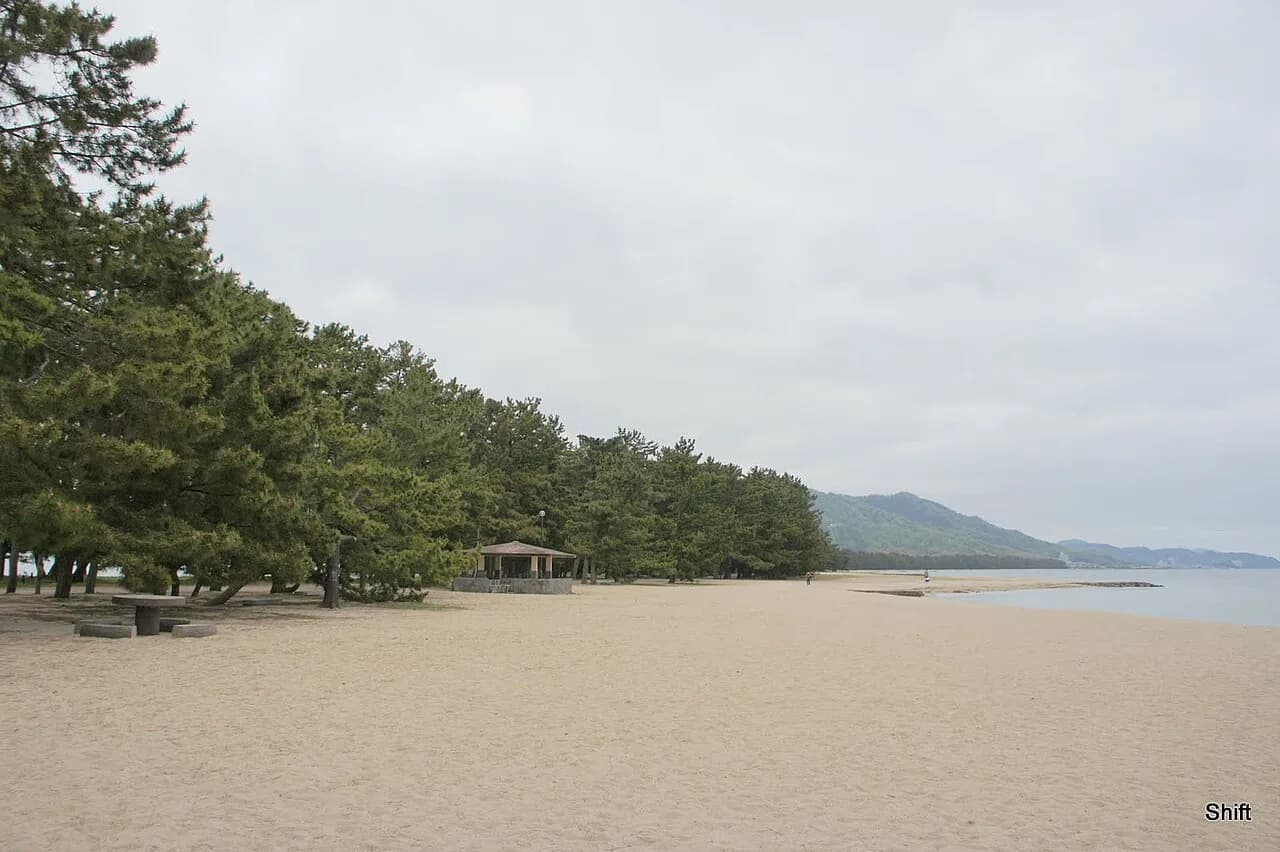
Stretching 3.6 kilometres across the mouth of Miyazu Bay on the Sea of Japan coast of northern Kyoto Prefecture, Amanohashidate — literally 'bridge to heaven' — is one of the most celebrated natural landscapes in all of Japan.
Mantled by roughly 8,000 pine trees, some centuries old and individually named, the sandbar separates the open bay from the sheltered Aso Sea lagoon behind it, creating an ethereal green ribbon of land suspended between two bodies of water.
Recognised as one of Japan's Three Scenic Views (Nihon Sankei), the sandbar is entirely free to enter and rewards visitors whether they choose to walk its full length, cycle it on a rental bike, or glide across by sightseeing boat. A sacred freshwater spring, small Shinto shrines, and a summer swimming beach add further texture to the experience.
This guide covers everything you need to plan a 2026 visit — from train connections to the best ways to traverse the sandbar and take in the famous matanozoki upside-down hilltop view.
Why Visit Amanohashidate Sandbar?
Very few landscapes in Japan earn the distinction of Nihon Sankei — the Three Scenic Views — alongside Matsushima in Miyagi and Itsukushima in Hiroshima Prefecture. Amanohashidate has held that honour for centuries, celebrated in classical poetry, ink paintings, and pilgrim diaries long before the railways made it accessible to ordinary travellers.
What sets the sandbar apart is its combination of scale, natural beauty, and genuine accessibility. Unlike many of Japan's great scenic spots, the centrepiece is entirely free to enter and can be explored under your own power at any pace you choose. The pine canopy is dense enough to feel immersive — not a manicured park, but a living coastal forest threaded with a footpath and cycling lane running side by side for the full 3.6 km.
There is also the irresistible tradition of matanozoki: visitors bend forward at the waist and view the sandbar upside-down from the hillside viewpoints, so that the pale pine-covered arc appears to float in the sky like a true bridge to heaven. The effect is disorienting and genuinely arresting. For the full range of experiences available in the area, see our guide to things to do in Amanohashidate and explore the Amanohashidate attractions hub for viewpoints, temples, and linked sites.
History and Significance of the Sandbar
Amanohashidate was formed over many thousands of years by longshore drift, as sediment carried by the Noda River accumulated into a narrow bar dividing Miyazu Bay from the Aso Sea lagoon behind it. The geological process that shaped it is still active — the sandbar shifts subtly with each season and storm, and its exact form is never permanently fixed.
Its cultural significance runs equally deep. The pine trees now mantling it were planted and replanted over centuries through the stewardship of local lords, shrine communities, and later the Meiji-era forestry service. Of the roughly 8,000 pines standing today, the oldest are individually named. Several are bound with shimenawa — the sacred straw rope used to mark divine objects — as a reminder that this is not merely a scenic landscape but a spiritually charged one.
Along the sandbar path lies Isoshimizu, a freshwater spring listed among Japan's 100 Famous Waters (Nihon Hyakumei-sui). Remarkably, the spring produces entirely fresh water despite the sea lapping on both sides of the sandbar — a phenomenon venerated as sacred since at least the Heian period. Small Shinto shrines and stone lanterns stand at intervals along the path as testimony to centuries of pilgrimage and continuing reverence for this improbable strip of coastal land.
Getting to Amanohashidate: Access and Transport
Amanohashidate is served by its own station — Amanohashidate Station — on the Kyoto Tango Railway (KTR) Miyafuku Line. The most direct approach from Kyoto is the KTR limited express service "Hashidate" from Kyoto Station, running via Fukuchiyama; the journey takes approximately two hours. Trains run several times daily and the ride through the Tamba highlands is scenic in its own right.
From Osaka, travellers typically take the JR Fukuchiyama Line to Fukuchiyama, then transfer to the Kyoto Tango Railway for the final leg; allow around two and a half to three hours in total. Check the KTR website for the current timetable and any advance seat-reservation requirements before your 2026 visit, as limited express services can sell out on peak weekends.
Amanohashidate Station sits at the southern (Monju) end of the sandbar, where bike-rental outlets, the sightseeing boat terminal, and most refreshment stalls are concentrated. The northern end at Fuchu can be reached by sightseeing boat in roughly 12 minutes, by cycling the pine corridor in about 20 minutes, or on foot in 45–50 minutes. Hilltop viewpoints for the matanozoki tradition are found at the Kasamatsu Park in the north — reached by cable car from the Fuchu shore — and at the Amanohashidate View Land in the south, served by chair-lift near the station.
Highlights of Amanohashidate Sandbar: What to See and Do
Walking or cycling the pine corridor is the essential experience. The path is largely flat and well-surfaced, and the light through the canopy shifts dramatically across the day — gold in early morning, silver at midday, amber in late afternoon. Rental bikes are available near the Monju end for approximately ¥400–¥600 per hour (2026 estimate), and the full crossing takes about 20 minutes at a comfortable pace. For a detailed walk-through of the route, timing, and what to bring, see the full walking and cycling guide.
Midway along the sandbar, a wooden signpost marks Isoshimizu — the freshwater spring of Japan's 100 Famous Waters — where water wells up cold and clear from beneath the sand despite the sea on both sides. A small stone shrine marks the site and drinking from the spring is considered auspicious. Further small Shinto shrines and torii gates are scattered along the path, framing glimpses of the water through the pine trunks.
At the southern end a sandy swimming beach opens each summer (July–August), when the calm, shallow bay waters attract families from across the Kansai region. Outside summer the beach is deserted and peaceful. At the northern end, Chionji Temple — a venerable Muromachi-period temple dedicated to Monju Bosatsu, the bodhisattva of wisdom — anchors the Fuchu shore and is well worth a short detour before or after taking the cable car up to Kasamatsu Park.
Those who prefer water to land can cross by sightseeing boat between the south and north ends throughout the day. Fares are approximately ¥800–¥1,200 per person (2026 estimate); collect tickets at the waterside office near the station and check current schedules on arrival, as frequency varies by season.
Planning Your Visit: Hours, Access, and Tips
The sandbar itself is a public path accessible at all hours with no admission charge — there is no ticket booth or gate at either end. Bike rental and sightseeing boat services operate from approximately 09:00 to 17:00 with seasonal variation; the chair-lift to Amanohashidate View Land and the cable car to Kasamatsu Park have their own posted hours and separate fares. Confirm timings locally in 2026, as schedules shift between tourist season and the quieter winter months.
The pine corridor is at its most atmospheric in the early morning before tour coaches arrive, and in the late afternoon when the sun falls at an angle through the canopy. Weekday mornings in spring (late March to April) and autumn (October to November) offer the finest balance of colour, comfortable temperatures, and manageable crowds. Summer weekends attract significant numbers of domestic visitors, particularly families heading for the swimming beach.
Footwear suitable for a woodland path is recommended — the route is surfaced for most of its length but includes sandy sections near the south-end beach. The path is largely flat and accessible for most fitness levels, though the viewpoint chair-lifts and cable cars involve short uphill walks at each terminus. A combined visit to the sandbar, one hilltop viewpoint, and Chionji Temple takes roughly four to five hours. For full logistics, meal stops, and timing advice, our one-day Amanohashidate itinerary lays out the whole day in detail.
Frequently Asked Questions
Is the Amanohashidate Sandbar free to visit?
Yes, the sandbar path is entirely free to enter and open at all hours. There are no admission charges for walking it. Optional extras carry separate costs: bike rental is approximately ¥400–¥600 per hour (2026 estimate), sightseeing boat crossings are approximately ¥800–¥1,200 per person (2026 estimate), and the chair-lift and cable car to the hilltop viewpoints charge their own fares. Simply walking the sandbar costs nothing at all.
How long does it take to walk the full length of the sandbar?
Walking the full 3.6 km length of Amanohashidate takes approximately 45–50 minutes at a relaxed pace without stopping. Add extra time for the Isoshimizu spring, shrine detours, and photography beneath the pines. Most visitors allow at least two hours to cross the sandbar, visit Chionji Temple at the north end, and return — either on foot again or by sightseeing boat back to the south (Monju) end.
Can you cycle across Amanohashidate?
Yes, cycling is one of the most popular ways to traverse the sandbar. A dedicated cycling lane runs its full length alongside the pedestrian footpath, and the crossing takes roughly 20 minutes at a comfortable pace. Rental bikes are available near the station at the south (Monju) end for approximately ¥400–¥600 per hour (2026 estimate). Ride considerately near the midpoint, where foot traffic is heaviest on busy days.
What is the matanozoki tradition at Amanohashidate?
Matanozoki means 'looking through your legs' — visitors bend forward at the waist and view the sandbar upside-down from the hilltop viewpoints. When the scene is inverted, Amanohashidate appears to float in the sky like a bridge to heaven, giving the sandbar its name. The classic spots for matanozoki are Kasamatsu Park at the north end (reached by cable car) and Amanohashidate View Land at the south end (reached by chair-lift near the station).
What is Isoshimizu and why is it significant?
Isoshimizu is a freshwater spring on the sandbar listed among Japan's 100 Famous Waters (Nihon Hyakumei-sui). What makes it remarkable is that the spring produces entirely fresh, clear water despite the sea surrounding the sandbar on both sides — a phenomenon treated as sacred since at least the Heian period. A small stone shrine marks the site along the sandbar path, and drinking from the spring is considered auspicious.
What are Japan's Three Scenic Views?
Japan's Three Scenic Views (Nihon Sankei) are Amanohashidate in Kyoto Prefecture, Matsushima in Miyagi Prefecture, and Itsukushima (Miyajima) in Hiroshima Prefecture. The designation dates to a classical ranking first formalised in the Edo period and has shaped Japanese aesthetics and travel culture for centuries. Amanohashidate's pine-mantled sandbar is uniquely the only one of the three that can be traversed freely on foot or by bicycle.
Amanohashidate Sandbar stands apart from almost everything else in Japan's vast catalogue of scenic destinations — a place where an entirely natural formation has been venerated, tended, and celebrated for more than a thousand years without losing any of its essential wildness. The pines are as dense and immersive as they appear in the ink paintings of the Edo masters; the freshwater spring still wells up cold and clear through sea-flanked sand; the matanozoki view from the hilltops is as disorienting and beautiful as any landscape effect in the country.
Whether you walk slowly beneath the canopy, cycle briskly end to end, or glide across by sightseeing boat, the sandbar rewards the time you give it. Plan at least a half-day, bring layers for the sea breeze, and aim for morning or late-afternoon light for the finest atmosphere along the pine corridor.