
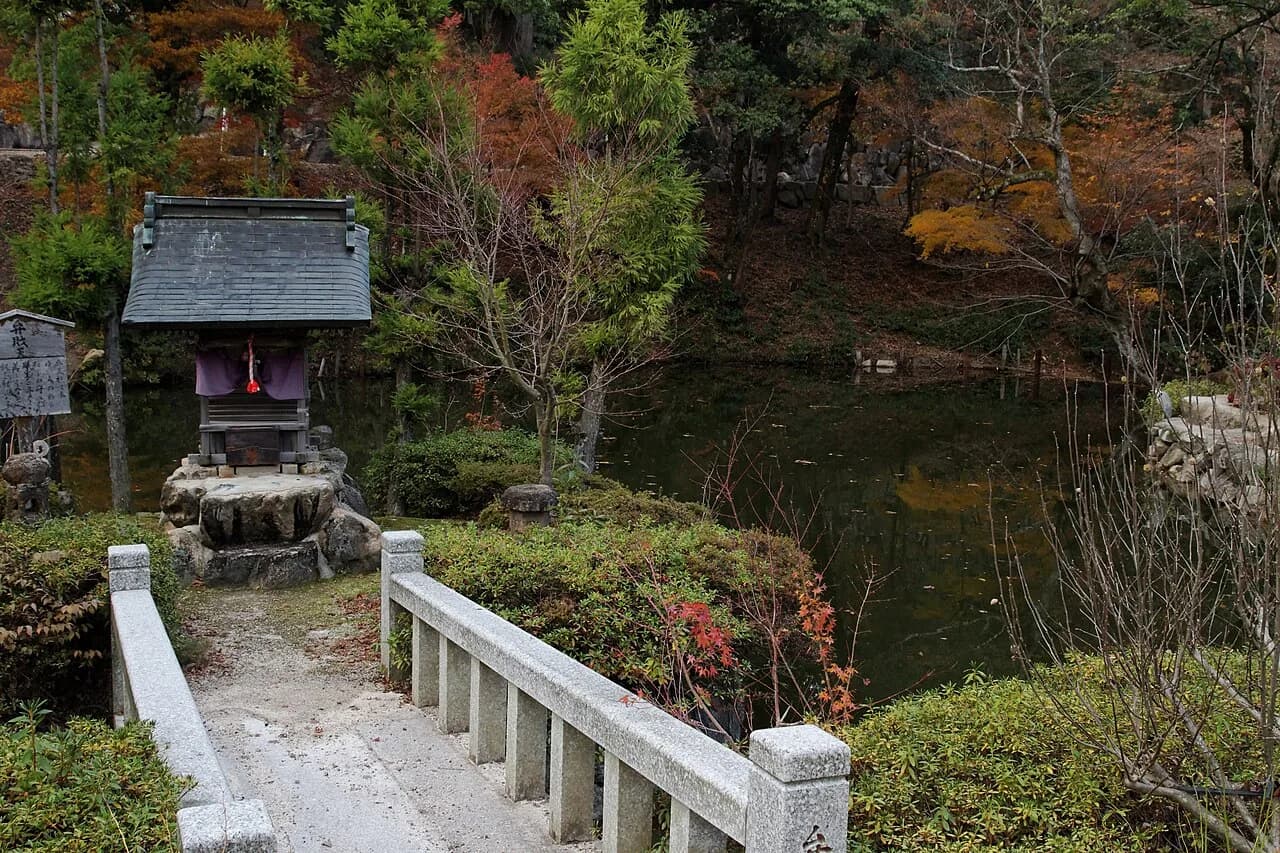
Nariai-ji is a Shingon Buddhist mountain temple perched high on the forested ridge above Amanohashidate — one of Japan's Three Views — where it has served pilgrims of the Saigoku Kannon circuit for over a millennium.
As the 28th of the 33 Kannon temples of western Japan, Nariai-ji draws both devoted pilgrims completing the ancient circuit and travellers seeking the highest vantage over Miyazu Bay and the celebrated pine-covered sandbar stretching across the water below.
Beyond its pilgrimage credentials, the temple holds a vivid five-storied pagoda, a legendary bell with a bittersweet tale, an enigmatic dragon carving, and the Nariaisan Panorama Observation Deck — positioned well above the standard viewpoint at Kasamatsu Park beneath it.
This guide covers everything you need for your 2026 visit: temple bus access, admission, the key highlights, and how to combine Nariai-ji with the wider offerings of the area.
Why Visit Nariai-ji? A Pilgrimage Above the Sandbar
Few temples in the Kansai region combine spiritual depth with landscape drama the way Nariai-ji does. Positioned high on the northern ridge above Kasamatsu Park, the temple commands panoramic views that the famous matanozoki (upside-down viewing) at the park below simply cannot match for altitude and breadth. From the Nariaisan Panorama Observation Deck, the full sweep of Miyazu Bay opens beneath you, with Amanohashidate's pine-clad sandbar laid out like a brushstroke across the water.
The pilgrimage dimension adds a layer of meaning that rewards even visitors with no formal connection to the Saigoku circuit. Nariai-ji is the 28th of the 33 temples dedicated to Kannon across western Japan — a circuit that has drawn pilgrims since the Heian period. Standing here, stamp book in hand or simply in spirit, connects you to more than a thousand years of devotional practice.
For the full range of day-trip options across the bay and town, things to do in Amanohashidate covers how Nariai-ji fits into a well-paced itinerary alongside the sandbar walk and the waterfront temples.
History and Significance of Nariai-ji Temple
Nariai-ji is traditionally said to have been founded in the late 7th century, enshrining the Juichimen Senju Kannon — an eleven-faced, thousand-armed form of Kannon central to the temple's identity as a site of compassionate prayer. The temple's Shingon affiliation places it within the esoteric Buddhist tradition that flourished across Japan's mountain sanctuaries, where altitude itself carried spiritual weight.
Among the temple's most evocative treasures is the Nakichi-no-Kane — the Bell of a Crying Woman. According to legend, a woman in grief donated her bronze mirror to be cast into the bell after the death of someone dear. The bell's resonance is said to carry her sorrow, lending the whole precinct a quietly melancholic atmosphere long after the prayers are done.
Equally compelling is the left-facing dragon carving within the temple grounds, attributed by tradition to Hidari Jingoro — the near-mythical Edo-period sculptor credited with remarkable carvings at shrines and temples across Japan. Whether the attribution holds, the carving's unusual leftward orientation (most dragons in Buddhist iconography face right) makes it a focal point for attentive visitors.
For the combined historical narrative of both ridge temples, the full Chion-ji & Nariai-ji temples guide traces each in the context of Amanohashidate's sacred landscape.
Getting to Nariai-ji Temple: Access from Amanohashidate
The journey to Nariai-ji is a layered ascent that forms part of the experience itself. From Amanohashidate Station (Kyoto Tango Railway), cross the bay by ferry or walk the sandbar, then take the ropeway or chairlift at Amanohashidate View Land up to the Kasamatsu Park. From Kasamatsu Park, a dedicated temple bus covers the remaining steep climb to Nariai-ji — budget for this fare as a separate cost on top of the temple admission.
Driving is possible on the narrow mountain road and limited parking exists near the temple gate, but the bus is the more reliable option for independent travellers. The address is Nariaiji 339, Miyazu, Kyoto Prefecture; searching for 成相寺 alongside "Miyazu" in navigation apps is the most reliable method. Total travel time from Amanohashidate Station to the temple — ferry plus ropeway plus bus — is approximately 40–50 minutes.
For a fuller picture of the ascent options and the viewpoint sequence on the northern ridge, see our guide to the Amanohashidate viewpoints.
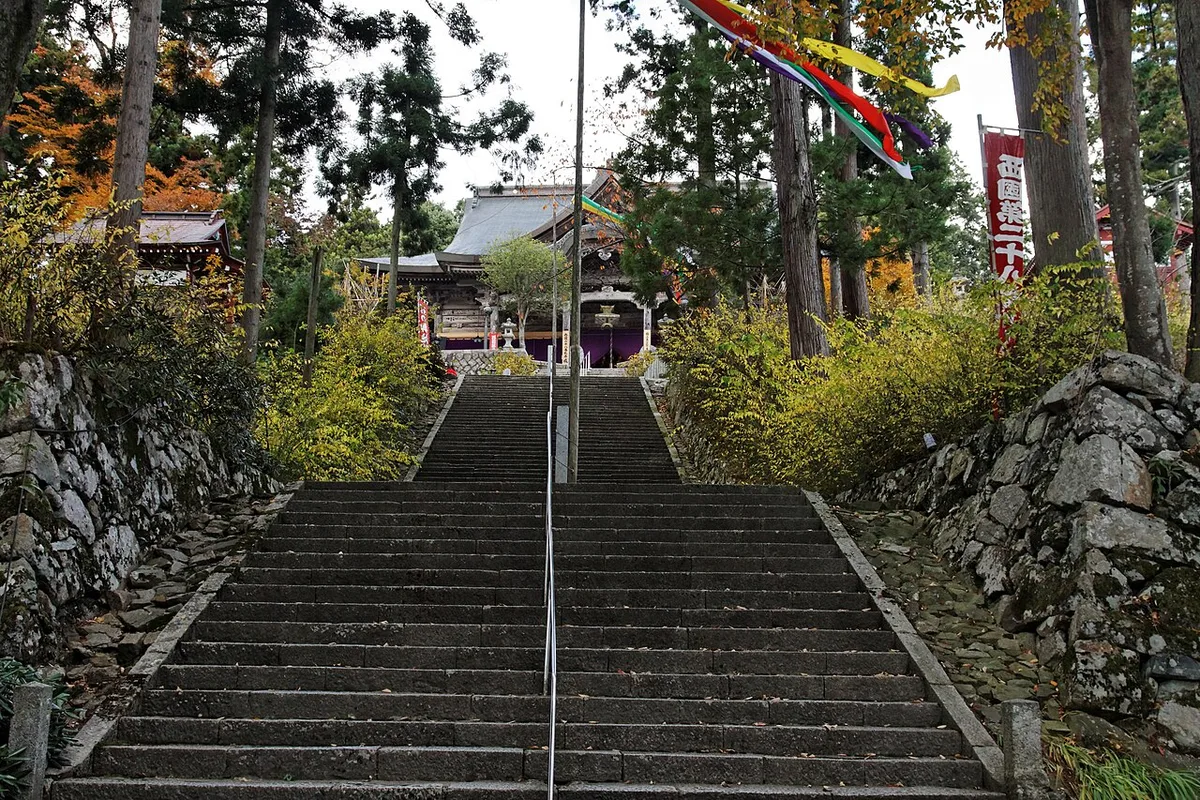
Highlights of Nariai-ji: What to See
The five-storied pagoda is the visual centrepiece of the complex. Vivid in lacquered vermilion and black, it rises above the mountain cedar in a composition that is particularly striking in early-morning mist. It is among the finest examples of multi-storied temple architecture in the Kinki region.
The Nakichi-no-Kane (Bell of a Crying Woman) hangs in the bell tower beside the main hall. Visitors may ring it — a deeply atmospheric act in this setting, where the sound rolls across the valley. The legend gives weight to what might otherwise be a routine encounter with a temple bell.
Seek out the left-facing dragon carving attributed to Hidari Jingoro near the main hall. Its rightward convention-defying orientation is immediately noticeable, and the dynamism of the carving rewards close attention. The nearby nokyocho (stamp office) is open during regular hours for Saigoku pilgrims to receive their calligraphy seal — non-pilgrims are equally welcome throughout.
A short walk above the main buildings leads to the Nariaisan Panorama Observation Deck, the highest publicly accessible viewpoint in the Amanohashidate area. The deck delivers an unobstructed panorama over the full breadth of Miyazu Bay, with the sandbar visible in its entirety and the Tango Peninsula mountains closing the horizon — arguably the finest elevated view in the Kansai region.
Nearby on the Amanohashidate town side, Monju-do Hall makes a rewarding cultural counterpart before or after the ridge ascent, and all major sites are listed in the Amanohashidate attractions hub.
Planning Your Visit: Hours, Access, and Tips
Nariai-ji is roughly open from 08:00 to 16:30 — these are 2026 estimates; always confirm current hours directly with the temple before visiting, as mountain temples may adjust seasonally or for religious observances.
Admission is approximately ¥500 per adult (2026 estimate), with reductions for children. The temple bus from Kasamatsu Park and the ropeway or chairlift at the base are both ticketed separately. A sensible per-person budget for the full round trip including all transport is ¥2,000–¥3,000.
Wear comfortable footwear — the path within the precincts includes stone steps and uneven surfaces. The terrain is manageable for most visitors of moderate fitness despite the mountain setting.
The best time to visit is weekday mornings in spring (late March–May) or autumn (October–November), when light on the pagoda and foliage is at its finest and tour groups are fewest. Summer visits offer lush green canopy but humidity; winter brings contemplative quiet and occasional snow on the upper ridge.
On the descent, make time for the Kasamatsu Park — the matanozoki viewpoint there pairs naturally with the panorama deck above. For a complete Amanohashidate day, begin at the waterfront and Chion-ji in the morning before heading up to Kasamatsu Park and Nariai-ji in the afternoon.
Frequently Asked Questions
How do I get to Nariai-ji Temple from Amanohashidate Station?
From Amanohashidate Station, cross the bay by ferry (or walk the sandbar) and take the ropeway or chairlift up to Kasamatsu Park. From there, a temple bus runs the remaining steep climb up to Nariai-ji. The full journey takes approximately 40–50 minutes. Driving the mountain road and parking near the gate is also possible, though the bus is more straightforward for most visitors.
What are the opening hours and admission fee for Nariai-ji?
Nariai-ji is roughly open 08:00–16:30 (2026 estimate — confirm with the temple before visiting). Admission is approximately ¥500 per adult. The temple bus from Kasamatsu Park and the ropeway or chairlift from the base are ticketed separately, so budget around ¥2,000–¥3,000 per person for the full ascent and temple visit combined.
Is Nariai-ji part of the Saigoku Kannon pilgrimage?
Yes. Nariai-ji is the 28th temple of the Saigoku Kannon pilgrimage — a circuit of 33 Kannon temples across western Japan dating to the Heian period and one of the oldest pilgrimages in the country. Pilgrims may receive a calligraphy stamp at the nokyocho during opening hours. Non-pilgrims are equally welcome at the temple and observation deck.
What is the legend of the Bell of a Crying Woman (Nakichi-no-Kane)?
According to legend, a grieving woman donated her bronze mirror to be melted down and cast into the bell at Nariai-ji after losing someone dear. The bell's resonance is said to carry her sorrow. Visitors may ring the Nakichi-no-Kane during their visit — the sound rolling across the forested ridge adds a memorable, melancholic note to any temple walk.
What is the Nariaisan Panorama Observation Deck?
The Nariaisan Panorama Observation Deck is a viewpoint above Nariai-ji's main buildings, reached by a short walk through the precincts. It is the highest publicly accessible viewpoint in the Amanohashidate area, offering an unobstructed panorama over the full breadth of Miyazu Bay and the pine-covered sandbar. It surpasses Kasamatsu Park below in both altitude and field of view.
Can I visit Kasamatsu Park and Nariai-ji on the same trip?
Yes — most visitors combine both in a single afternoon. Take the ropeway or chairlift to Kasamatsu Park for the matanozoki viewpoint, then board the temple bus for the final ascent to Nariai-ji. Allow roughly 1.5–2.5 hours for the whole ridge excursion, including travel, the temple circuit, and the panorama deck. Return buses to Kasamatsu Park run regularly during temple opening hours.
Nariai-ji sits at the intersection of two things Japan does extraordinarily well — mountain pilgrimage and landscape drama. Whether you are drawn by the Saigoku Kannon circuit, the legend of the Nakichi-no-Kane, the enigmatic left-facing dragon, or simply the prospect of the highest view over Miyazu Bay, the temple rewards the extra effort of the temple bus ride above Kasamatsu Park.
Because few travellers make the full ascent, Nariai-ji retains an atmosphere of genuine quiet and devotion even during the busier seasons. That alone makes it worth the climb.
For a complete Amanohashidate day combining the sandbar walk, the viewpoints, and the pilgrimage temples, see things to do in Amanohashidate and the detailed account of both ridge temples in the full Chion-ji & Nariai-ji temples guide.