
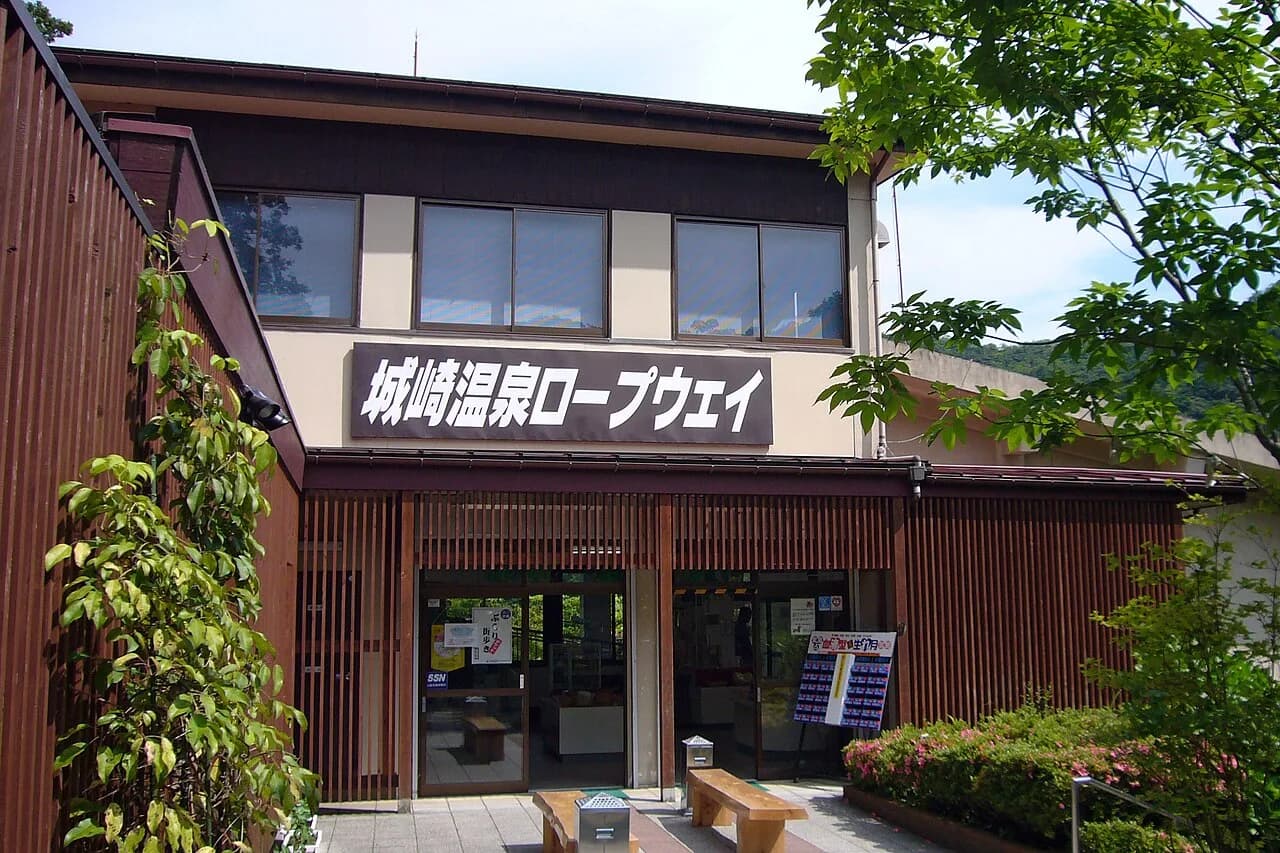
Rising from the north-western edge of Kinosaki Onsen, the Kinosaki Onsen Ropeway carries passengers in two stages up the forested flank of Mt Daishi (Daishiyama) — past the town's 8th-century guardian temple and on to an observation deck where the willow-lined streets and tile-roofed ryokan unfurl in miniature below.
The mid-station stop at Onsenji gives the journey its cultural weight: the Yakushido hall enshrines Yakushi Nyorai, the healing Buddha, and for centuries pilgrims climbed this mountain to seek divine blessing before descending to bathe in Kinosaki's seven public sotoyu bathhouses. That tradition still lends any ropeway visit a sense of ritual that sets it apart from an ordinary cable-car ride.
At the summit, a broad observation deck, a café known for drip-filter coffee, and a kawarake-nage disc-throwing spot make the top station well worth lingering at before the seven-minute ride back down. On clear days the view stretches beyond the Maruyama River plain to the blue arc of the Sea of Japan.
This guide covers the history, highlights of each stop, how to reach the base station, and everything you need to plan a smooth 2026 visit — for the full town context, see our overview of things to do in Kinosaki Onsen.
Why Visit the Kinosaki Onsen Ropeway?
Kinosaki Onsen is celebrated for its seven bathhouses, which guests visit in sequence wearing yukata and wooden geta — an experience that unfolds entirely at street level, along canal banks and beneath weeping willows. The ropeway offers the only practical way to step outside that intimate ground-level world and see it whole: the compact grid of rooftops, the canal threading through the centre, and the mountain backdrop enclosing the town on three sides all resolve into a single satisfying panorama from the summit deck.
The ropeway also adds a cultural and spiritual layer that the sotoyu circuit alone cannot provide. Onsenji predates the modern resort town by more than a millennium, and a half-hour at its Yakushido hall — where incense drifts through old timber and stone lanterns line mossy paths — sets the senses before an evening of bathing in a way that simply beginning at the nearest bathhouse does not.
Even on a tight schedule, the full ropeway round trip with a stop at Onsenji takes barely 90 minutes, making it one of the most time-efficient ways to deepen a stay. Our 1-night Kinosaki itinerary recommends riding up in the late afternoon, as the warm light gilds the rooftops and the sotoyu lanterns are just beginning to glow.
History and Significance of Onsenji
Onsenji is traditionally said to have been founded in the early 8th century by the monk Dochi, who spent a thousand days in ascetic practice on Mt Daishi praying for the benefit of all living creatures. Legend holds that it was Dochi's devotion that drew forth Kinosaki's healing waters — the founding image of a heron nursing a wounded leg in a thermal stream remains the town's most recognisable symbol, reproduced on manhole covers, yukata, and shop signs throughout the streets below.
The Yakushido hall at Onsenji enshrines Yakushi Nyorai, the Buddha of Medicine and Healing, whose compassion is held to be the spiritual source of Kinosaki's curative waters. In the pre-modern era, pilgrims who arrived in Kinosaki for its baths would first climb the mountain on the stone-paved pilgrim path — which still runs alongside the ropeway route — making their petition at the Yakushido before descending to bathe. This sequence of prayer before water places Onsenji above the seven sotoyu in Kinosaki's deeper cosmology of healing.
The ropeway itself was installed in the 20th century to open the mountain to visitors who could not manage the steep pilgrim ascent. The old stone path remains walkable today and is used by confident walkers who prefer to hike one way and ride the other — a satisfying combination that the terrain generously accommodates.
Getting to the Ropeway Base Station
The ropeway base station sits at the north-western end of the main onsen street, a short uphill walk from Kono-yu, one of the seven bathhouses. From the Kinosaki Onsen Station, the walk along the willow-canal street heading north-west takes roughly 10–15 minutes; follow signs marked ロープウェイ (ropeway) or ask at your ryokan for the most direct route.
By rail, Kinosaki Onsen is served by JR limited express trains. From Kyoto, take the Kinosaki or Hashidate service (approximately 2 hours 20 minutes); from Osaka, travel via Fukuchiyama (approximately 2 hours 30 minutes); from Tottori, the San'in Main Line runs westward in around 80 minutes. Check the JR West timetable for current 2026 services and seat reservations, particularly at weekends when trains fill quickly.
Visitors arriving by car will find public car parks near the station end of the canal street; there is no parking directly at the ropeway base. The 10–15 minute walk from those car parks passes several sotoyu bathhouses, making it a pleasant introduction to the town layout before the mountain excursion.
Highlights of the Ropeway Journey
The gondola departs the base station on the first of its two stages, climbing through cedar forest to the mid-station at Onsenji. Disembarking here is strongly recommended: the Yakushido hall is open to visitors, and a short wander through the temple precincts — stone lanterns, gnarled pines, the hush of the mountain above — provides a contemplative counterpoint to the busy streets below. Walkers who prefer the pilgrim path may choose to descend on foot from this point and take the ropeway only for the second, upper stage.
Back in the gondola, the second stage continues to the Mt Daishi summit station. The observation deck at the top commands an unobstructed view in three directions: Kinosaki's rooftops and canal directly below, the broad floodplain of the Maruyama River stretching inland, and — on days of good visibility — the slate-blue expanse of the Sea of Japan along the northern horizon.
A small café at the summit station serves drip-filter coffee and light snacks on a terrace sharing the same panorama, making it an agreeable pause before the return ride. Before boarding the gondola down, look for the kawarake-nage spot: small unglazed clay discs are sold at the station to be thrown from a designated ledge toward a torii gate below, each carrying a wish. The practice is quick, good-spirited, and unexpectedly memorable. For the full walk-through of the temple history and summit experience, see the full ropeway & Onsenji guide.
Planning Your Visit: Hours, Tickets, and Tips
The ropeway operates approximately from 09:10 to 16:30 in 2026, with gondolas departing roughly every 20–30 minutes. These are estimated figures — confirm current timetables on the official website (kinosaki-ropeway.jp) or at your accommodation before visiting, as seasonal adjustments apply. The ticket office closes before the final departure, so aim to reach the base station by 16:00 at the latest. A round-trip ticket is approximately ¥1,200 per adult; a one-way (single) journey costs around ¥900.
The most common trip-planning pitfall is the closure schedule: the ropeway shuts on the 2nd and 4th Thursday of each month for routine maintenance. Always check the calendar before building your day around a ropeway visit. Operations may also be suspended in poor weather — heavy rain, strong winds, or snow — so it is worth telephoning the station or checking the official site on the morning of your visit if the forecast looks doubtful.
Wear comfortable, sturdy shoes if you plan to use any portion of the pilgrim path. The mountain can be several degrees cooler than the town below, even in midsummer, so carry an extra layer. Morning visits offer the quietest conditions; late afternoon — roughly two hours before closing — rewards with warm light on the valley and is the slot recommended in our 1-night Kinosaki itinerary.
Frequently Asked Questions
How much does the Kinosaki Onsen Ropeway cost?
A round-trip ticket costs approximately ¥1,200 per adult in 2026 (estimate — verify on site). A one-way single ticket is around ¥900. Children's fares are typically reduced; check the official website at kinosaki-ropeway.jp for current pricing and any seasonal changes before your visit.
What are the ropeway's opening hours and which days is it closed?
The ropeway runs roughly from 09:10 to 16:30, with gondolas departing approximately every 20–30 minutes (2026 estimates). It closes on the 2nd and 4th Thursday of each month for maintenance, and may also suspend operations during heavy rain, strong winds, or snow. Always confirm hours and closures before planning your visit around the ropeway.
What is Onsenji Temple and why is it important to Kinosaki Onsen?
Onsenji is an 8th-century Buddhist temple on the slope of Mt Daishi, regarded as the guardian temple of Kinosaki's hot springs. Its Yakushido hall enshrines Yakushi Nyorai, the healing Buddha, believed to be the spiritual source of the town's curative waters. For centuries, pilgrims climbed the mountain to seek the Buddha's blessing before bathing — a tradition that gives the ropeway journey its cultural and historical depth.
How long does the ropeway ride take?
Each stage of the two-stage ropeway takes roughly three to four minutes; the full base-to-summit journey is approximately seven minutes. Allow 60–90 minutes in total for the return trip with time to explore Onsenji at the mid-station and the observation deck at the summit.
Can I walk up to Onsenji instead of taking the ropeway?
Yes — a stone-paved pilgrim path runs alongside the ropeway route and connects the town to Onsenji on foot. Many visitors choose to walk one way and ride the gondola the other. The path is steeper than the cable-car ride suggests, so comfortable footwear is essential; allow 20–30 minutes for the ascent at a steady pace.
What can I see from the Mt Daishi summit observation deck?
The summit deck offers an unobstructed panorama over the rooftops and willow-canal of Kinosaki Onsen, the wider Maruyama River plain, and on clear days the Sea of Japan to the north. The deck also has a café and a kawarake-nage disc-throwing spot where visitors toss small clay discs toward a torii gate below as a good-luck gesture.
The Kinosaki Onsen Ropeway packs a lot into a 90-minute round trip: a mountain temple with more than twelve centuries of healing pilgrimage behind it, a panorama that reframes the compact spa town as something extraordinary, and a summit café where the coffee tastes better for the altitude. Whether you go for the Yakushi Nyorai blessing, the view to the sea, or simply the novelty of rising above the yukata-clad crowds below, the ropeway earns its place at the top of any Kinosaki itinerary.
For further planning, visit the Kinosaki Onsen attractions hub and browse our complete guide to things to do in Kinosaki Onsen. the Kinosaki Onsen Station precinct — the natural starting point for any sotoyu circuit — is a short walk back down the canal from the ropeway base.