Tucked away on the slopes of Mount Kinpo, this reigando cave (unganzenji temple) visitor guide reveals a hidden world of samurai history.
This sacred site served as the final sanctuary for the legendary swordsman Miyamoto Musashi during his later years in Kumamoto.
Visitors today can walk the same paths where he meditated and crafted his most famous literary work on strategy.
The journey through the temple grounds offers a rare blend of spiritual serenity and historical depth for every traveler.
History of Reigando Cave and Unganzenji Temple
Unganzenji Temple was founded in 1351 by the Chinese-born Zen monk Toryo Eiyo, who recognized the spiritual power of the surrounding rock formations and established a place of worship around the cave. The temple belongs to the Soto sect of Zen Buddhism and has remained on this mountain site continuously for nearly seven centuries.
The cave itself, known as Reigando (霊巌洞), translates as "spirit rock cave" — a name that reflects the local belief that the ancient volcanic formations carry a sacred energy. Since ancient times, monks, poets, and warriors came here for ascetic practice and meditation, long before Musashi made the site internationally famous.
Unganzenji is also officially listed as the 14th stop on the Kyushu 33 Kannon pilgrimage (九州西国三十三箇所), which draws spiritual seekers from across Kyushu. The site forms part of Japan's Important Cultural Properties, and the temple is also known locally as Iwato Kannon, after the Kannon bodhisattva enshrined inside the cave. Many travelers combine this spiritual journey with a visit to Kumamoto Castle to understand the local samurai heritage.
Miyamoto Musashi and the Book of Five Rings
Born in 1584, Miyamoto Musashi is considered the greatest swordsman in Japanese history. Between the ages of 13 and 29 he fought and won 60 duels without defeat. Later in life he founded his own school of swordsmanship, the Niten Ichiryu style, which emphasized using two swords simultaneously.
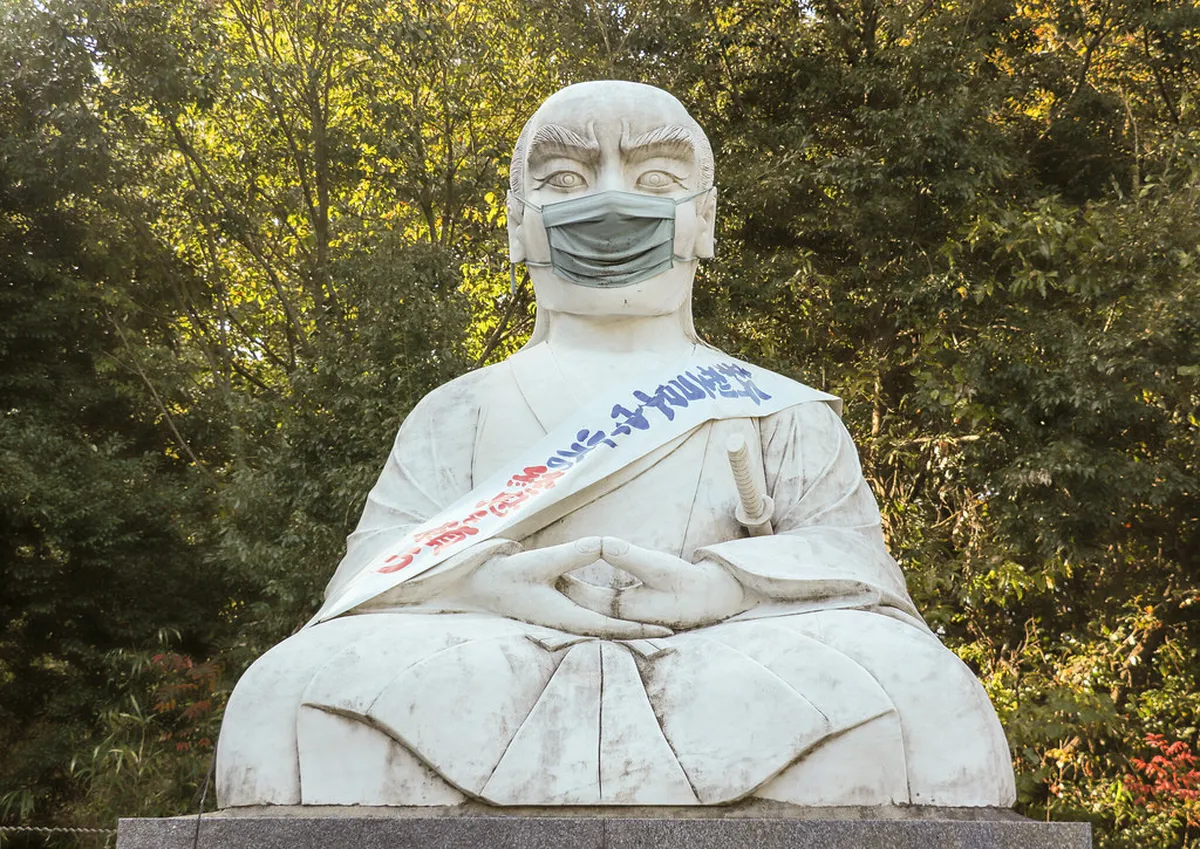
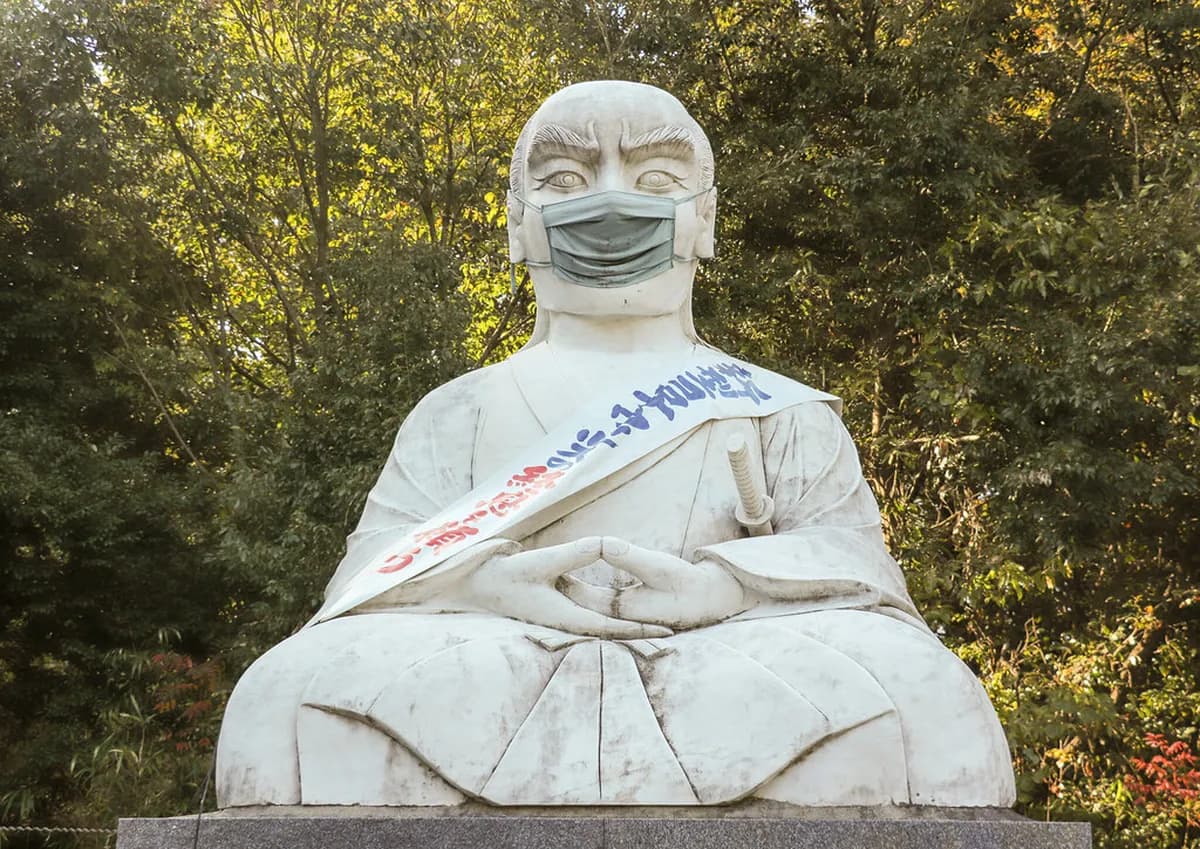
In 1640, invited by the feudal lord Hosokawa Tadatoshi, Musashi came to Kumamoto to serve as a senior advisor and teacher. Three years later, in 1643, he retreated to this mountain cave to spend his final months in deep meditation. It was here, away from the noise of the castle town, that he composed The Book of Five Rings (五輪書, Gorin no Sho) — a treatise on military strategy divided into five chapters named after the elements: Earth, Water, Fire, Wind, and Void.
The book remains a cornerstone of martial arts philosophy and is still widely read in business, military, and strategic planning contexts around the world. Musashi died of disease shortly after completing it, around the age of 62. Standing inside the cave today, it is easy to understand why this silent, elevated space gave him the clarity he sought.
Passing 500 Statues of Buddha's Disciples (Gohyakurakan)
After paying admission at the temple entrance, the path winds downhill through a forested hillside covered in mossy stone statues. These are the Gohyakurakan — the 500 disciples of Buddha who have reached nirvana. A devoted local merchant named Fuchitaya Gihei spent 24 years carving them between 1779 and 1802. Each statue wears different clothing and carries a unique facial expression; some appear contemplative, others almost comical.
Many of the statues are now headless. The damage has two causes: earthquake damage over the centuries, and the deliberate destruction of Buddhist icons during the anti-Buddhist movement of the Meiji Restoration in the late 1800s, when government policy temporarily enforced the separation of Shinto and Buddhism. The missing heads give the path an eerie, atmospheric quality that visitors tend to remember as one of the most striking parts of the entire visit.
At the end of the statue-lined path, steep stone stairs rise to the cave entrance. The cave is shallow but wide, opening like a large mouth in the cliff face. Look up at the ceiling near the back: the three Chinese characters of the name Reigando (霊巌洞) are carved into the stone, written right to left, and have remained there since the temple's founding. In the center of the cave floor, a massive boulder of volcanic tuff protrudes upward — this is the stone where Musashi is said to have meditated.
The Obstructed Sea View: What Musashi Saw That You Won't
One practical detail that most visitors discover only after they arrive: the cave entrance no longer offers a view to the Ariake Sea. Historical evidence shows that when Musashi meditated here in 1643, the cliff face was open to the west and he could look out over the water. Today, large trees have grown — and been planted — directly in front of the cave mouth, blocking that view entirely.
This is not a restoration failure; it is simply how the site has evolved over centuries. Managing your expectations before you arrive prevents disappointment. The cave itself, the meditation stone, the enshrined Kannon statue, and the engraved characters on the ceiling remain fully intact and powerful. The experience of standing inside the rock is the real draw, not the panorama.
For genuine views over the Ariake Sea and the Shimabara Peninsula, drive to the summit of Mount Kinpo after your visit. The road winds almost to the top, and the viewpoint there delivers the sweeping westward perspective that the cave no longer provides.
Quick Facts: Admission, Hours, and Fees
Planning your visit requires knowing the basic logistics to ensure the temple gates are open when you arrive. The site is open every day and is accessible year-round, though morning visits offer the best light for photographing the rakan statues in the forest.
Keep small change ready for the entrance fee — the small temple office does not accept credit cards or IC cards. Children's admission applies to ages 6 to 15.
| Detail | Information |
|---|---|
| Adult admission | ¥200 (some recent visitors report ¥300 — verify on arrival) |
| Children (ages 6–15) | ¥100 |
| Payment | Cash only |
| Opening hours | 08:00–17:00 daily |
| Parking | Free — approx. 30 car spaces, 5 bus spaces |
| Phone | 096-329-8854 (Japanese only) |
- Adults: ¥200 (some recent visitors report ¥300 — verify on arrival as fees may have changed)
- Children ages 6–15: ¥100
- Payment: Cash only
- Opening hours: 08:00 to 17:00 daily
- Free parking with approximately 30 car spaces and 5 bus spaces, plus a toilet
- Phone: 096-329-8854 (Japanese only)
Note: group discounts of 10–30% are available for parties of 20 or more. Check for local updates on the Japan Times - Reigando Cave Coverage before you depart.
Only six buses run per day between Sakuramachi Bus Terminal and Iwato Kannon Iriguchi. Save the return timetable to your phone before leaving the city — there is no reliable mobile signal on the mountain road.
How to Get to Reigando Cave (Transport Guide)
Reaching Reigando requires planning because it sits deep in the mountains roughly 10 kilometers west of central Kumamoto. There is no station nearby. Your main options in 2026 are bus, car, taxi, bike, or on foot. Each suits a different traveler profile.
By bus: Take the Sanko Bus (産交バス) from Sakuramachi Bus Terminal (桜町バスターミナル), route U3-1 direction Kawachi Onsen Center, and get off at Iwato Kannon Iriguchi (岩戸観音入口). The ride takes about 30–40 minutes and costs around 550 yen one way (pay cash when you exit the bus). Only six buses run per day, so check the current timetable before departing — departures from Kumamoto are around 07:55, 10:30, 13:10, 14:20, 16:20, and 18:20. From the bus stop, walk uphill for 15–20 minutes through mikan (mandarin orange) orchards until you see a large seated statue of Musashi in a car park; the temple is a short walk below. Return buses from Iwato Kannon Iriguchi depart at roughly 07:01, 09:16, 11:41, 14:21, 15:21, and 17:36.
By car or rental car: This is the most practical option for families and groups. The drive from JR Kumamoto Station or Sakuramachi Bus Terminal takes about 30 minutes on winding mountain roads. Free parking with about 30 spaces is available at the Musashi statue lot at the top, with another smaller lot near the main temple entrance. Roads are narrow on the mountain section; drive carefully. You can find more details on regional transit in our guide to Kumamoto transportation for international visitors.
By taxi: From the city center expect to pay approximately 3,500 yen one way for the 30-minute trip. If you want the taxi to wait while you visit, hiring for a two-to-three-hour block typically costs 10,000–15,000 yen. Ask your hotel to call Kumamoto Taxi (Tel. 0120-012-086) as some city cabs are reluctant to travel this far out.
By bike: The Mt. Kinpo area is a popular cycling route. Reaching the cave from downtown Kumamoto takes about two hours on a road bike with proper gear — avoid mama-chari city bikes on these slopes.
On foot: The walk from downtown Kumamoto takes approximately 2.5 hours each way along hiking trails that wind through mikan fields and rice farms. Best suited for travelers with a full day and a love of the Japanese countryside.
Planning Like a Pro: What to Bring and Digital Prep
Cellular signals often drop out in the deep valleys surrounding the temple and the cave entrance. Download your maps for offline use and save the bus timetable on your phone before leaving the city — you cannot rely on live navigation once you're on the mountain road.
The stone steps leading to the cave are exceptionally slippery when wet due to heavy moss growth. Wear shoes with strong rubber lug treads — hiking boots or sturdy trail runners — rather than smooth-soled sneakers or sandals. The path does have handrails in some sections, but they do not extend the full length.
The stone steps and path to the cave are heavily mossy and become dangerously slippery in rain. The route is not wheelchair or pushchair accessible due to steep, uneven sections without full handrail coverage.
There are no convenience stores near the temple. Bring your own food and water, or plan to eat at Café Kokopelli (see below) immediately after your visit. A small coin purse is essential: you'll need cash for the entrance fee plus coins for offerings at the small shrine inside the cave. Note that access is not wheelchair or pushchair friendly due to the steep, uneven stone path and steps.
- Hiking boots or trail runners with rubber lug soles
- Offline maps and bus schedules downloaded before leaving the city
- Reusable water bottle (no vending machines on the path to the cave)
- Coin purse for admission, bus fare, and cave offerings
At the temple entrance, look left before descending to the cave: a small display case in a building to the left shows relics associated with Musashi. These include a wooden sword attributed to him (reportedly the one he used in his famous duel on Ganryujima Island), historical portraits, and copies of manuscripts. Seeing these before entering the cave gives the meditation stone and interior shrine meaningful context.
Is There Anything Else Near Reigando? (Café Kokopelli & Mt. Kinpo)
After exploring the cave, most visitors stop at Café Kokopelli (Cafe+Antiques Kokopelli), located right next to the temple entrance. This is a converted old farmhouse operating as both a café and an antiques shop, with a relaxed European-inspired interior. They offer vegan and vegetarian options, English is spoken, and their curry sets are particularly good. Seating is very limited, so arrive early or expect to wait — weekend lunch sets sell out fast.
The surrounding Mount Kinpo area offers more than just the cave. Yuhoen Fruits Land, a pick-your-own orchard on the road to Reigando, lets you harvest seasonal fruits including oranges, grapes, and strawberries depending on the time of year. About 20 minutes' drive from the cave is Kusamakura Onsen Tensui (草枕温泉てんすい), a hot spring facility with outdoor baths overlooking the Ariake Sea — an ideal way to unwind after the hike. The drive to the summit of Mt. Kinpo from the temple takes only a few minutes and rewards you with panoramic views of Kumamoto City to the east and the Ariake Sea to the west, including the Shimabara Peninsula in Nagasaki Prefecture.
For those interested in Miyamoto Musashi beyond the cave, the Shimada Museum of Art in Kumamoto City holds a private collection of samurai memorabilia and Musashi-related artwork assembled by collector Matomi Shimada — a smaller but well-curated complement to the cave visit.
Nohyaki: Visiting During the Aso Grassland Burning
Travelers visiting in late February or early March should be aware of the traditional Nohyaki grassland burning events in the Aso region. While these fires take place roughly 50 kilometers to the east, the smoke and haze can drift westward toward Mount Kinpo on certain wind days, reducing visibility across the valley.
For most visitors the impact is minimal — the cave, temple, and rakan path are all enclosed in forest and unaffected. However, if you are specifically planning to drive to the Mt. Kinpo summit for the sea views after your cave visit, check local air quality and wind forecasts before you go. Clear winter days outside the burning window (typically late March onward) offer the sharpest mountain vistas.
Frequently Asked Questions
Is Reigando Cave accessible for travelers with limited mobility?
The path to Reigando Cave involves several steep and uneven stone steps that are often covered in slippery moss. This makes the site difficult for those using wheelchairs or those with significant mobility challenges. Visitors should check our general Kumamoto travel tips for more accessible local attractions.
How long does it take to tour the temple and the cave?
Most visitors spend between 60 and 90 minutes exploring the temple grounds, the statue path, and the cave itself. This allows enough time for photography and quiet reflection at the meditation site. If you plan to hike further up Mount Kinpo, allow for at least three hours total.
Can I see the original Book of Five Rings at the cave?
The original manuscript is not kept at the cave for preservation reasons, but the temple museum displays several important relics. You can see a wooden sword attributed to Musashi and historical portraits of the swordsman. These items provide excellent context before you enter the actual meditation space.
A visit to Reigando Cave offers more than just a history lesson on Japan's most famous samurai.
It provides a rare opportunity to stand in the very spot where legendary philosophy was born.
By following this guide, you can navigate the mountain paths with confidence and enjoy the spiritual silence.
The memory of the mossy statues and the quiet cave will stay with you long after you leave Kumamoto.
For the latest official information, see the Reigando Cave (Unganzenji Temple) official site.
For more Kumamoto trip planning, see our Kumamoto Attractions, Reigando Cave Guide guides.