

The Port of Nagoya Public Aquarium is one of the largest marine facilities in Japan, housing over 500 species and more than 50,000 individual creatures. Visitors come here specifically to see rare orcas and beluga whales — species that exist in only a handful of Japanese facilities. The complex splits across two buildings, each following a distinct theme, and the surrounding Garden Pier adds three more attractions worth your time. This guide gives you everything you need to plan a focused, rewarding visit in 2026.
Getting the most from a day here requires some advance planning. The dolphin and orca shows run on a fixed rotation, and the sardine feeding event at the Kuroshio Tank fills up fast along the viewing glass. Knowing which ticket to buy, which entry time to target, and where to stand for the best spectacles makes the difference between a rushed visit and a genuinely memorable one.
Essential Visitor Information: Tickets and Hours
Standard adult admission is 2,030 yen, and elementary and junior high school students pay 1,010 yen. Preschool children aged four and older pay 500 yen, and children under four enter free. You can check current pricing and purchase tickets in advance through the official Nagoya Aquarium site. Buying at a nearby convenience store (konbini) before you arrive lets you skip the entrance queue entirely.
| Visitor type | Aquarium only | 4-facility combo |
|---|---|---|
| Adults | ¥2,030 | ¥2,440 |
| Elementary / junior high students | ¥1,010 | — |
| Preschool (aged 4+) | ¥500 | — |
| Under 4 years old | Free | Free |
| Evening rate (after 17:00, summer) | ¥1,600 | — |
The 4-facility Garden Pier combo ticket is the key value decision. At 2,440 yen for adults, it adds the Fuji Antarctic Museum, the Maritime Museum, and the Observation Deck for just 410 yen more than the aquarium alone. If you were to buy those three additional attractions separately, you would spend significantly more. For a full-day visit, the combo is clearly the better choice; for a two- to three-hour stop focused only on the aquarium, the standard ticket is fine.
Operating hours run from 09:30 to 17:30 during the regular season (late March through November). Summer holidays and Golden Week see extended hours until 20:00, with a discounted nighttime admission rate of 1,600 yen for adults after 17:00. Winter hours (December through mid-March) close at 17:00. Last entry is always one hour before closing. The aquarium is closed on Mondays; if a public holiday falls on a Monday, Tuesday closes instead. Always confirm seasonal hours and show times on the official aquarium website before visiting during holiday periods.
The aquarium is closed on Mondays. If a public holiday falls on Monday, it stays open that day and closes Tuesday instead. During school trip season (September through November), large groups arrive on weekday mornings — visit at opening (09:30) or after 14:00 for more space.
How to Get to Nagoya Port Public Aquarium
The simplest route from Nagoya Station is the Higashiyama Line to Sakae Station, then a transfer to the Meiko Line. Ride the Meiko Line to its final stop, Nagoyako Station — the entire journey takes around 30 minutes. Use Exit 3 for the shortest walk, which is a flat five-minute stroll through the Garden Pier area. The route is fully accessible for strollers and wheelchairs. Consult the Nagoya Subway System Guide for up-to-date timetables.
If you are coming from Chubu Centrair International Airport, take the Meitetsu Tokoname Line to Kanayama Station, then switch to the Meiko subway line toward Nagoyako. The transfer at Kanayama is straightforward and the total journey is under one hour. Travelers arriving at Meitetsu or JR Kanayama Station can also board the Meiko Line there directly, skipping a transfer entirely.
Weekend visitors should consider the Donichi Eco Kippu (Weekend Eco Ticket), a day pass sold by the Nagoya Transportation Bureau that covers all subway lines for a flat fee. This pass often costs less than a return Meiko Line fare from the city center, so it pays for itself on the outbound journey alone. Drivers can use the Garden Futo Parking Lot or the Garden Futo Nishi (West) Parking Lot, both priced at 100 yen per 30 minutes and capped at 1,000 yen per 24 hours.
North Building Highlights: Marine Mammals and Performances
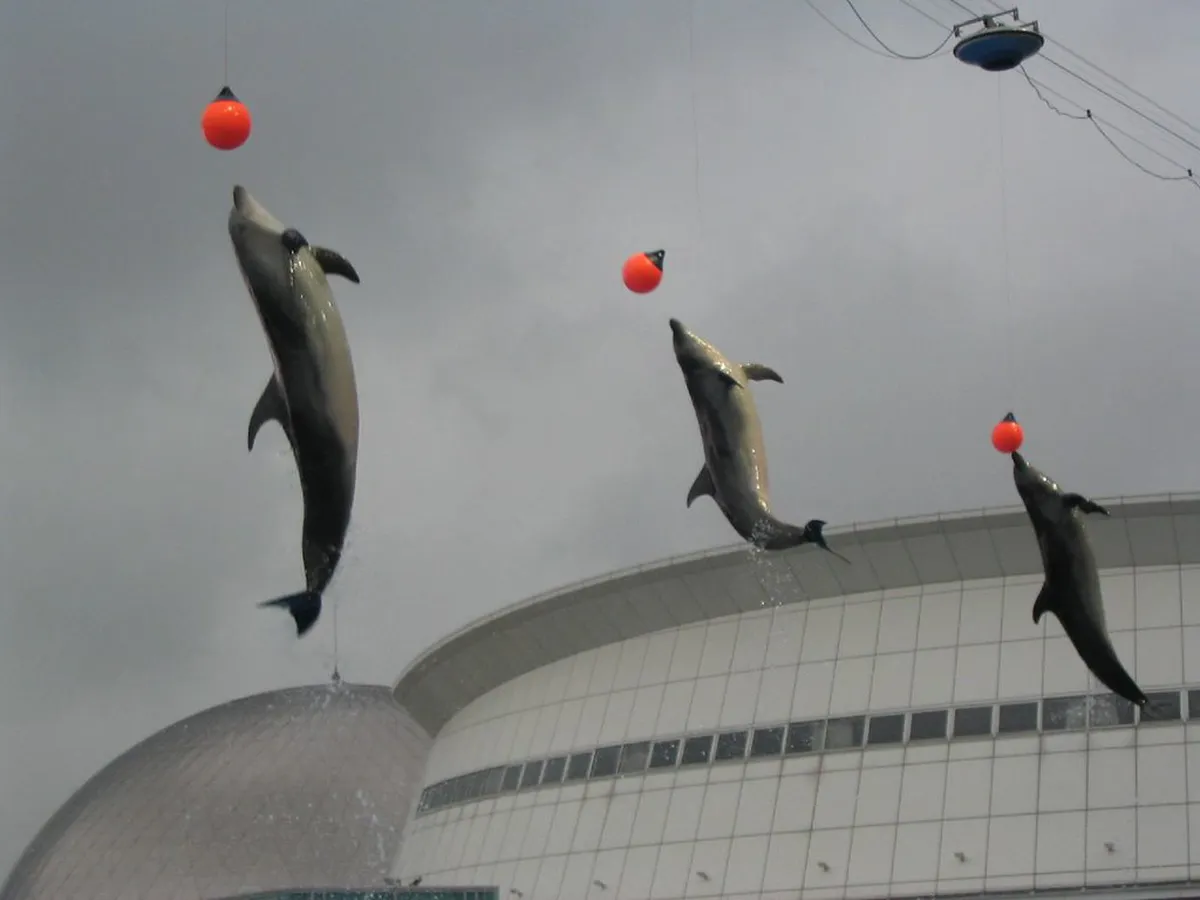
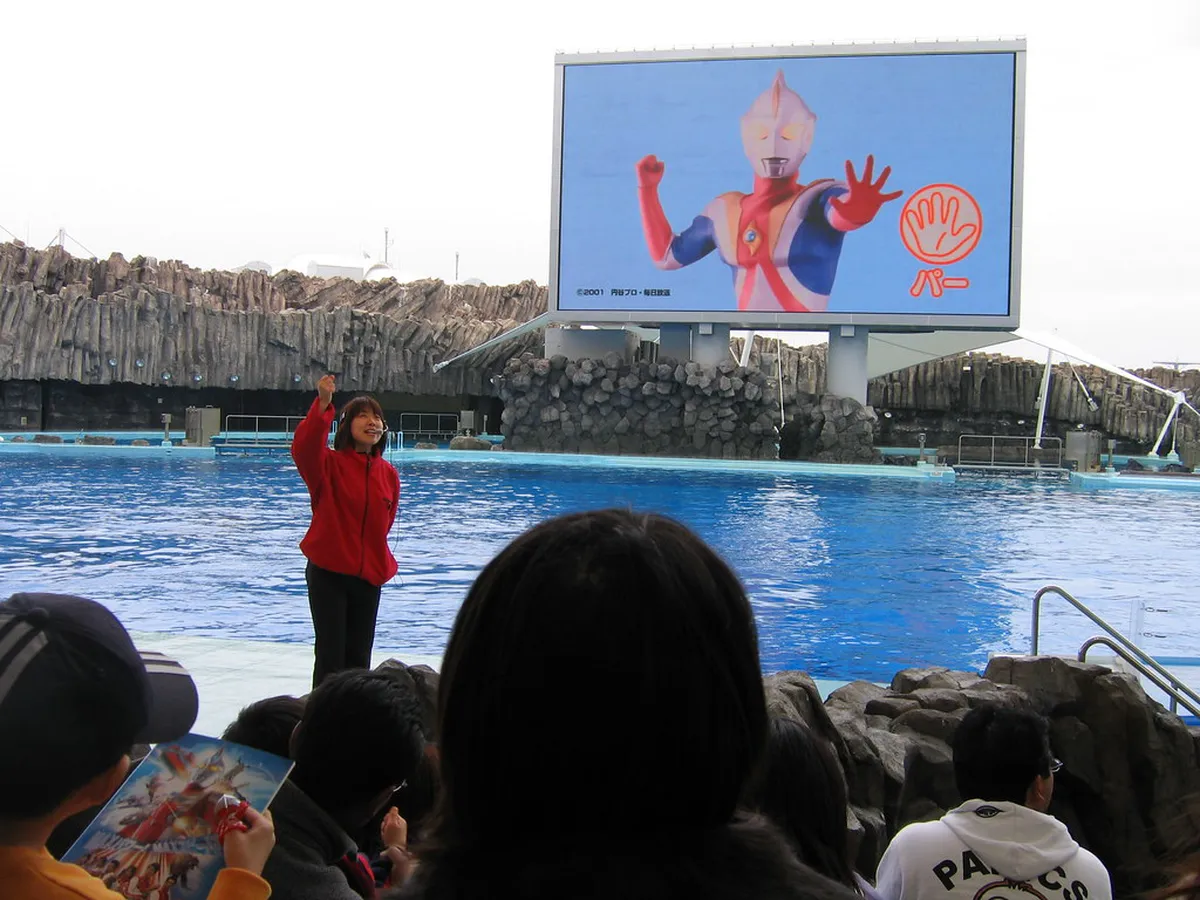
The North Building is organized around the theme of "A Journey Over 3.5 Billion Years" and holds the aquarium's most famous residents. The Main Pool is a 60 x 30 x 12 meter outdoor tank with stadium seating for 3,000 spectators. A giant HD screen at the center lets the entire audience see close-up footage of the animals even from the far rows. Underground viewing windows give a completely different perspective on how fast dolphins move through water.
Nagoya is one of only a handful of facilities in Japan that successfully houses and breeds orcas (Orcinus orca). The killer whale tanks are separated from the dolphin pool and offer both above-water and underwater viewing. The breeding program here is considered among the most successful in the country, and staff commentary during public training sessions — usually 15 minutes, three times per day — explains the animals' intelligence and social bonds in accessible terms.
Beluga whales (Delphinapterus leucas) are found in just five facilities across all of Japan, and Nagoya is one of them. Known as "canaries of the sea" for their complex vocalizations, belugas are highly social and visible through large glass viewing panels in the North Building. The Whale Room nearby displays genuine skeletal models of orcas and whales alongside three-dimensional stereoscopic imagery that documents their evolutionary history from land mammals. The touchscreen informational panels here are available in English and well worth ten minutes of your time.
South Building Highlights: The Journey to Antarctica
The South Building follows a geographic narrative, starting with the Sea of Japan and progressing southward through tropical waters to the Antarctic. Each zone recreates the lighting, temperature, and species profile of that region. The path is intuitive to follow and typically less crowded than the North Building's performance areas, making it a good starting point if you arrive early.
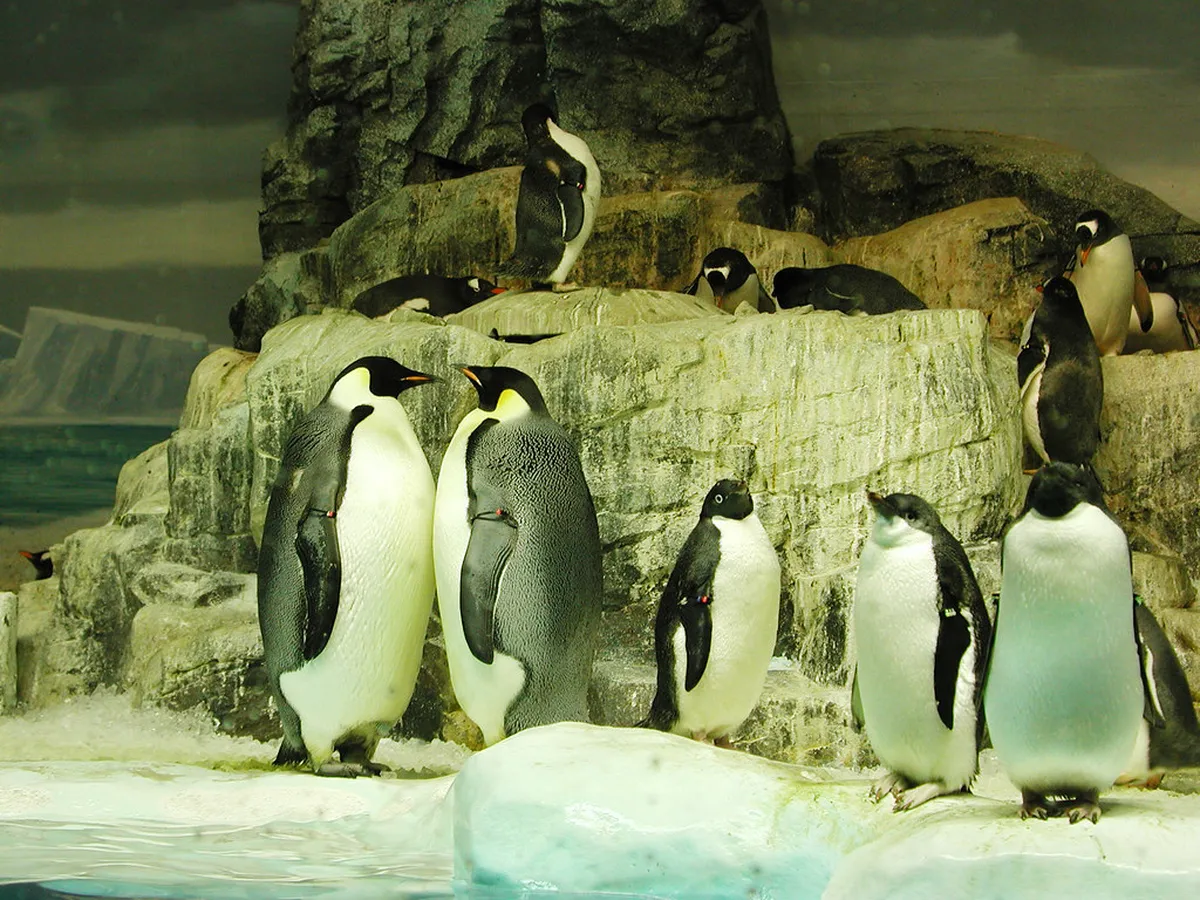
The Penguin Tank is a consistent crowd favorite, housing Emperor and Adelie penguins in a habitat with real snow and near-freezing water. Watching them launch from the ice shelf and reach full swimming speed within seconds is striking even for visitors who have seen penguins before. The Antarctic Marine Life gallery nearby adds context with exhibits on the ecosystem that supports these birds in the wild.
The Gallery of Deep Sea Life on the lower floors displays creatures from high-pressure, low-light environments rarely exhibited anywhere: giant isopods, rare deep-sea crabs, and species that produce their own bioluminescence. This section provides a sharp contrast to the bright tropical reef tanks earlier in the route. The South Building also contains a Movie Theater showing nature documentaries about Antarctic exploration, a worthwhile 20-minute stop if you want to rest your feet.
One standout exhibit that visitors often overlook is the Coral Tunnel Tank. Its ceiling is open to natural sunlight, which streams directly into the water and creates shifting patterns of light across living coral — something almost impossible to replicate artificially. Real living coral is notoriously difficult to maintain in captivity, and seeing a healthy colony at this scale is unusual even by international aquarium standards. Budget extra time here for photography.
Must-See Events: Dolphin Shows and Sardine Tornadoes
The Dolphin Show runs three times per day during standard season, with additional performances during Golden Week and summer holidays. Arrive at the Main Pool stadium at least 20 minutes before showtime to get a good seat with a clear view of the screen. The front three rows are "splash zones" — bring a rain jacket or be prepared to get wet. The show runs approximately 25 minutes and includes commentary from aquarists.
Public training sessions for orcas and belugas run separately from the dolphin show, usually three times per day for 15 minutes each. These sessions are less theatrical but more educational, with aquarists explaining behavioral conditioning methods and the animals' natural habits in detail. Check the daily schedule board near the North Building entrance as soon as you arrive and build your day around these fixed times.
The Sardine Tornado in the Kuroshio Tank happens during scheduled feeding times — twice per day on weekdays and up to six times per day on weekends and holidays. Over 35,000 sardines move in synchronized waves when food enters the tank, forming a shimmering spiral that lasts about five minutes. For the best view, position yourself on the right side of the central viewing glass. This angle catches the light as the school rotates and gives you a clear sightline to the full spiral. Avoid the far left end of the tank during feeding, where the sardines concentrate but the viewing angle compresses the effect.
For the Sardine Tornado, position yourself on the right side of the central viewing glass — that angle catches the light as the school rotates and gives a clear sightline to the full spiral. Use burst mode and a wide-angle lens setting as the school shifts direction rapidly during feeding.
Spotted seal feeding at the Goma-chan Deck is another event worth catching. There is only a low fence between visitors and the seals — no glass — which makes this unusually intimate by aquarium standards. The penguin feeding event includes live commentary and a brief Q&A session with staff that families with children particularly enjoy.
Visitor Tips: Best Time to Visit and Avoiding Crowds
The most significant crowd pattern to plan around is the school trip season, which runs from September through November. Large groups of elementary and junior high students typically arrive on weekday mornings and fill the dolphin stadium and North Building viewing areas by 10:00. If you visit during these months, arriving at opening (09:30) or after 14:00 on a weekday gives you notably more space. Weekends are consistently busier regardless of season, and the summer break period (late July through September) combines family crowds with school groups.
Dining options at the port are more limited than anywhere near central Nagoya, so plan accordingly. The in-aquarium restaurant offers water views but a short menu. For more variety, the Jetty food court in the Garden Pier area is the better option, with stalls serving local Nagoya specialties including miso-katsu, shrimp tempura, and ramen at reasonable prices. If you are visiting on a full-day combo ticket, you may want to pack a light lunch to eat in the open spaces of Garden Pier People's Park to save time.
Photography in the darker exhibit areas — particularly the jellyfish section and the Gallery of Deep Sea Life — is challenging because flash reflects off the glass and disturbs the animals. Press your camera or phone lens directly against the glass to eliminate reflections and stabilize the shot. In the Coral Tunnel Tank, natural sunlight does the work for you; midday visits produce the brightest light through the open ceiling. For the Sardine Tornado, use burst mode and a wide-angle lens setting if possible, as the school shifts direction rapidly during feeding.
Beyond the Aquarium: Exploring the Garden Pier Area
The Fuji Antarctic Research Ship is docked immediately adjacent to the aquarium and operates as a floating museum. You can walk through the original crew quarters, visit the ship's bridge, and see the Sikorsky Sea King helicopter still mounted on deck. The Fuji traveled to Antarctica from 1965 to 1983, and the exhibits recreate daily life onboard through dioramas, video quizzes, and equipment displays. In the small park in front of the ship, the Fuji's massive propeller and anchor are displayed alongside a snow vehicle and a statue of two Antarctic sled dogs, Taro and Jiro.
The Nagoya Port Building houses the Maritime Museum and the Observation Deck. The museum covers the commercial history of Nagoya Port — Japan's largest container port by export volume — with interactive exhibits including a crane simulator and a collection of ships in bottles. The Observation Deck on the 7th floor gives a 360-degree view over Ise Bay and back toward Nagoya Station's skyline. On clear days the Suzuka mountain range is visible to the east.
Sea Train Land rounds out the port area with a ferris wheel that offers 15-minute rides and excellent views of the harbor at dusk. The Jetty complex at the entry point to the pier hosts souvenir shops and a game center alongside the food court. If you are planning a broader Nagoya itinerary, the Nagoya Castle district and the Nagoya City Science Museum are both under 40 minutes by subway and make natural follow-up stops on a second day.
Frequently Asked Questions
How much does it cost to go to the Nagoya Public Aquarium?
Standard adult tickets cost 2,030 yen for a single day of access. Children and students receive significant discounts, with elementary students paying 1,010 yen. You can also purchase a combo ticket for 2,440 yen that includes three other nearby port attractions.
How do I get to Nagoya Port Aquarium from Nagoya Station?
Take the Higashiyama Line to Sakae Station and then transfer to the Meiko Line. Ride the train to the final stop, Nagoyako Station, which takes about 30 minutes. Use the Nagoya Subway System Guide to check for the latest transit times.
Is the Port of Nagoya Public Aquarium worth it?
Yes, it is widely considered one of the best aquariums in Japan due to its massive size and rare species. The orca and beluga exhibits are world-class and offer educational value for all ages. It is a must-visit for families and nature lovers.
Can you see orcas at the Nagoya Aquarium?
Nagoya is one of the only facilities in Japan that successfully houses and breeds orcas (killer whales). You can see them in the North Building's massive outdoor tanks and through underwater viewing windows. They are a primary highlight for most international visitors.
How long should I spend at the Port of Nagoya Public Aquarium?
You should plan to spend at least 3 to 5 hours to see all the exhibits and shows. This allows enough time to watch the dolphin performance and the sardine feeding show. If you use the combo pass, plan for a full 8-hour day at the port.
The Port of Nagoya Public Aquarium rewards visitors who plan ahead. Arriving at opening avoids school trip crowds in peak season, choosing the 4-facility combo ticket unlocks a full day at the port for minimal extra cost, and positioning yourself correctly at the Kuroshio Tank makes the Sardine Tornado far more spectacular. Use this port of nagoya public aquarium visitor guide to navigate both buildings efficiently and catch the shows that matter most to you.
The surrounding Garden Pier adds genuine depth to the day — the Fuji Antarctic Research Ship and the Maritime Museum are not filler attractions. Consider the Legoland Japan or the Sky Promenade for a second Nagoya day. The port district is one of the city's most underrated half-days, and the aquarium is its best reason to make the Meiko Line journey south.
For more Nagoya planning, see our Nagoya itinerary, things to do in Nagoya, and Nagoya day trips guide.


