10 Best Sapporo Neighborhoods & Districts: A Local Guide (2026)
Explore the best Sapporo neighborhoods with our local guide. Discover Susukino nightlife, Odori Park, and hidden gems for food and culture in 2026.
On this page
Sapporo is built on a logical grid, which makes it easy to navigate but harder to know which area actually suits your trip. Each district has a distinct vibe — the neon energy of Susukino is completely different from the forest-shrine calm of Maruyama, and both feel miles away from the mountain-valley seclusion of Jozankei. Getting the neighborhood right is the single biggest factor in how good your visit feels.
This guide breaks down each major district by character, what to do there, and who it suits best. It is updated for 2026 to reflect current transit connections and seasonal tips. Whether you are planning top things to do in Sapporo around a food itinerary or a winter festival, the neighborhood you base yourself in shapes everything else.
Most visitors only see the central core, but the outer wards reward the curious. Read this before you book accommodation, because where you stay in Hokkaido's capital matters more than in most Japanese cities. Knowing the Best Time to Visit Sapporo: Complete Seasonal Travel Guide will also help you choose which neighborhood shines brightest in each season.
Odori Park and the Central District
Odori is the green spine of Sapporo, a 1.5-kilometre boulevard that splits the city into north and south and serves as the civic heart. The park itself is free to enter at any hour. It transforms completely by season: in February it hosts the world-famous Sapporo Snow Festival guide, in July it fills with beer gardens and corn-on-the-cob stalls, and in autumn the ginkgo trees turn it gold.
The Sapporo TV Tower anchors the eastern end and costs around 1,000 yen (roughly €6) for the observation deck. From the top you can see the entire grid layout of the city stretching to the mountains. The Sapporo Art Museum and the former Hokkaido Government Building — a red-brick landmark known locally as Akarenga — are both within a five-minute walk and free to enter.
Odori suits first-time visitors and those who want to be at the centre of seasonal events. It is also the transfer hub of the subway system: Odori Station sits at the intersection of all three subway lines, making every other district reachable in under 20 minutes. If you want one neighbourhood to cover all bases, this is it.
Susukino: Nightlife and Ramen Alley
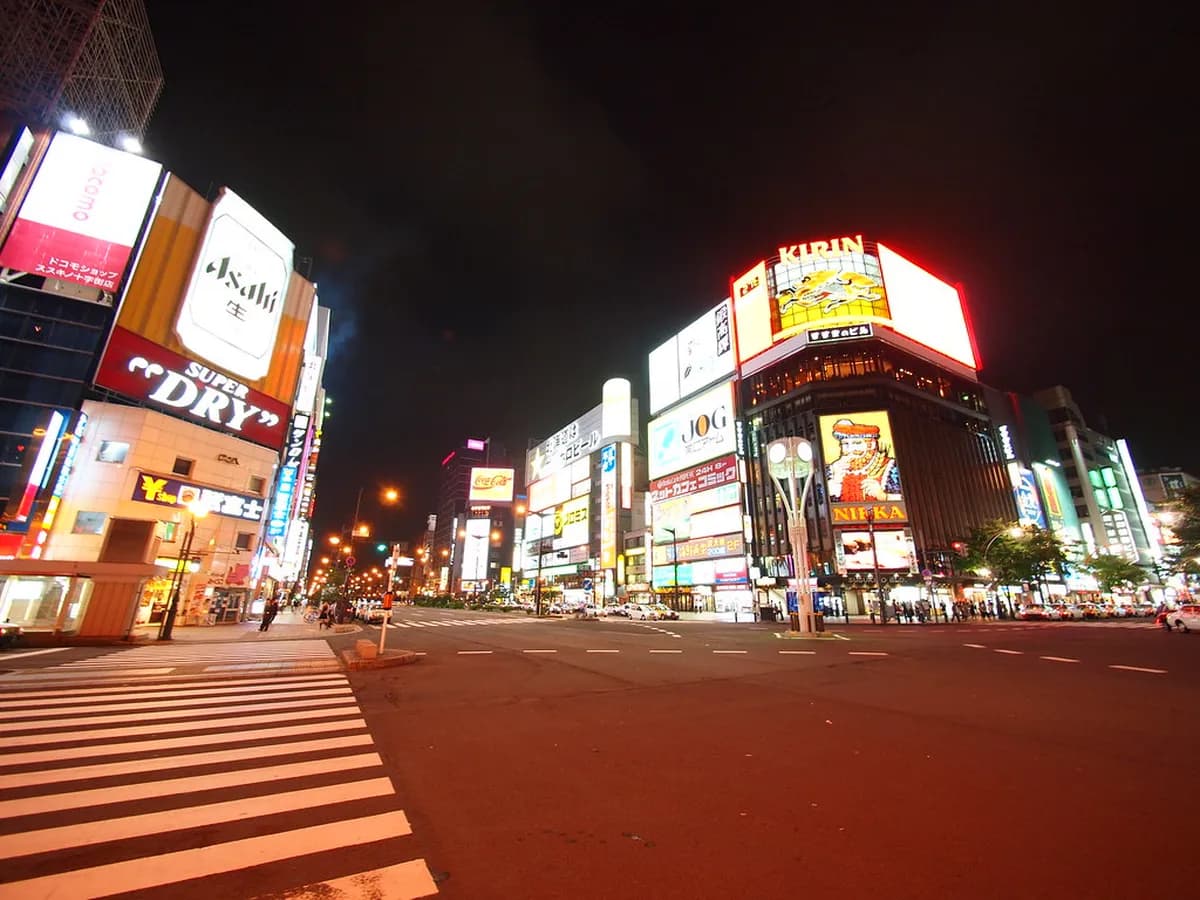
Susukino is the largest entertainment district north of Tokyo, and it earns the title. After dark, thousands of neon signs illuminate a compact grid of izakayas, karaoke bars, jazz clubs, and late-night ramen shops. The iconic Nikka Whisky sign above the main crossing is the unofficial meeting point of the city's night owls. Bars typically open from 18:00 and many run until 03:00 or later.
The must-visit spot within Susukino is Ramen Yokocho, a narrow alleyway packed with about a dozen tiny ramen stalls that have been operating since the 1950s. Each shop seats only eight to twelve people and specialises in Sapporo-style miso ramen with a rich pork-bone broth. Expect a short queue on weekends; most stalls open from 17:00. A bowl costs 900–1,200 yen (about €5–€7).
Solo travelers and couples visiting for the food and nightlife scene will feel most at home here. Susukino is also very safe by global standards — Japan's low crime rate applies fully here, though you should walk past aggressive touts near the main crossing without making eye contact. The Susukino subway station connects directly to Odori and Sapporo Station in two and four minutes respectively.
Where to Eat in Sapporo, Neighbourhood by Neighbourhood
Food is the main reason many visitors pick one district over another, and Sapporo's best-known dishes cluster in predictable places. Use this as a quick map before you choose where to stay or where to spend an evening.
- Miso ramen: Ramen Yokocho in Susukino is the classic stop. Outside the alley, the arcade counters in Tanukikoji serve bowls for roughly 800–1,000 yen with far shorter queues.
- Fresh seafood: Nijo Market sits a short walk from the eastern end of Odori Park. Stalls open early, from around 7:00. A seafood rice bowl (kaisendon) with crab, sea urchin or salmon roe usually runs 2,000–3,500 yen (about €12–€21), depending on the season and the catch.
- Soup curry: This Sapporo speciality is a thin, spiced broth packed with vegetables and chicken or pork. Shops are spread across the Odori and Susukino area, and a bowl costs around 1,300–1,800 yen (about €8–€11).
- Genghis Khan lamb barbecue: Grilled mutton on a domed pan is a Hokkaido staple. Susukino has the highest concentration of grill houses, and an evening meal with a drink typically costs 3,000–4,500 yen (about €18–€27) per person.
- Beer: The Sapporo Beer Museum is in the Higashi (East) Ward, a short ride from Sapporo Station. Entry to the museum is free, and the tasting counter charges per glass.
- Cafes and bakeries: Maruyama has the densest concentration of independent coffee shops, as covered above, and it suits a slow morning rather than a big dinner.
A practical pattern is seafood at Nijo Market for breakfast, soup curry for lunch, then a lamb grill or ramen in Susukino at night. All three stops fall within the central core, so you can follow this routine from a base near Odori without taking a taxi.
Sapporo Station and Kita Ward
Kita Ward around the main station is the city's gateway and the most practical base for transit-heavy itineraries. The station building itself houses several interconnected shopping malls — JR Tower, Esta, and Stellar Place — open daily from 10:00 to 21:00, with restaurants staying open until 22:00. Direct trains run to New Chitose Airport (37 minutes, 1,150 yen) and to other Hokkaido cities including Hakodate and Asahikawa.
The area is dense with business hotels at every price point, which makes it the easiest area to find last-minute accommodation. Nishi 1 Chome and the blocks immediately north and west of the station hold dozens of options within a three-minute walk of platform access. It is the least atmospheric neighbourhood for slow-travel exploration, but the convenience is unmatched for anyone doing day trips around Hokkaido.
First-time visitors on tight schedules should base themselves here. Families with heavy luggage benefit most, since coin lockers and luggage-forwarding services are clustered near the station exits. Connect quickly to Odori (two stops on the Namboku Line, 200 yen) and from Odori to Susukino (one more stop) without needing a map.
Nakajima Koen: Culture and Calm
Nakajima Koen is a large landscaped park sitting just two subway stops south of Odori, and it is one of Sapporo's most underrated districts. The park is free to enter 24 hours a day and contains a Japanese-style garden, a scenic pond popular for summer rowing, and the Hohei-kan — a late-19th-century wooden hotel with a powder-blue facade that has been designated a national cultural property. A short guided tour of the Hohei-kan costs around 200–400 yen.
The residential streets surrounding the park are quiet and lined with older apartment buildings and independent cafes that cater to locals rather than tourists. Prices in this area — for both accommodation and food — are noticeably lower than in the central core. It is a pleasant 20-minute walk north through Susukino to reach the main nightlife strip if you want evening activity without staying in the thick of it.
Families with young children and travellers who prefer green space over city buzz will find this area genuinely relaxing. The paths inside the park are flat and pushchair-friendly. Nakajima Koen station on the Namboku Line puts you three minutes from Susukino and six minutes from Odori, so you lose very little in terms of access.
Maruyama: Upscale Cafes and the Hokkaido Shrine
Maruyama is Sapporo's most affluent residential neighbourhood, located about 15 minutes west of the city centre on the Tozai subway line. It is built around Maruyama Park and the Hokkaido Shrine — a major Shinto shrine established in 1869 and dedicated to the development of Hokkaido. The shrine grounds are free to enter from sunrise to sunset, and the forested approach lined with ancient elm trees is one of the most atmospheric walks in the city. Historical context on Hokkaido's development is available through Sapporo's historical overview.
The commercial streets around Maruyama-Koen station have a distinctly European cafe culture feel, with a high density of independent coffee shops, bakeries, and wine bars. It is the best neighbourhood in Sapporo for a slow morning with a proper espresso and a pastry. The Maruyama Zoo, immediately adjacent to the park, charges around 800 yen (€5) for adults and is popular with families — it houses a notable Hokkaido brown bear enclosure. For travel planning tips, consult Japan's official tourism site.
Couples, slow travelers, and anyone who wants a quieter base with genuine neighbourhood character will enjoy Maruyama. It is also a practical base for visiting Hokkaido Shrine during cherry blossom season in late April or early May, when the grounds see one of the most beautiful hanami (blossom-viewing) events in northern Japan.
Tanukikoji: The Covered Arcade Between Odori and Susukino
Tanukikoji is a 900-metre covered shopping arcade that runs parallel to and just north of the Susukino district, connecting the Odori area to the entertainment quarter. It is one of the oldest shopping streets in Hokkaido, with records dating to the 1870s, and today it blends electronics shops, 100-yen stores, local izakayas, pharmacies, and souvenir stalls under a single continuous roof. Entry is free; shops generally open from 10:00 to 20:00.
For travellers, the arcade's biggest practical value is all-weather coverage. Sapporo receives heavy snow from December through March and frequent summer rain in July, and Tanukikoji lets you walk, browse, and eat without touching the elements. It connects naturally to Susukino's covered pedestrian zone, creating a continuous indoor route from the Odori subway exit to the Susukino crossing. The arcade is not primarily a tourist trap — most of the clientele on weekday mornings are elderly locals and neighbourhood residents.
Within Tanukikoji, look for the older blocks (particularly blocks 4 and 5 at the western end) for the most characterful shops: vintage record stores, a long-running toy shop, and local ramen counters that predate the tourist wave. A ramen bowl here will cost 800–1,000 yen and will involve none of the queue you face at Ramen Yokocho.
Minami Ward: Local Sapporo Beyond the Tourist Core
Minami (South) Ward is the least tourist-facing of the central districts and the most genuinely residential. It stretches south from the Susukino area toward the Jozankei valley and includes a mix of older shopping streets, local supermarkets, and neighbourhood izakayas that charge roughly half the price of the central core. If you want to eat and drink the way Sapporo residents do, this is the area to explore.
The southern end of Minami Ward bleeds into the Jozankei Onsen valley, about 50 minutes by bus from Sapporo Station (Jotetsu Bus runs hourly from platform 12, costing around 1,100 yen one way). Jozankei itself is technically within the city limits but feels entirely separate — a mountain hot-spring resort town with riverside ryokan, day-use onsen facilities (typically 1,000–2,000 yen), and dramatic autumn foliage from mid-October. It is Sapporo's best half-day escape and works as a standalone trip from any central neighbourhood.
Minami Ward suits independent travellers who want to eat local without price premiums and those planning an onsen day trip to Jozankei. Accommodation here is sparse but cheap. The Namboku subway line runs north through the ward, giving easy access to Susukino and Odori without backtracking.
Sapporo's Underground City: The Winter Connector Most Visitors Miss
Between November and March, Sapporo receives some of the heaviest snowfall of any major city in the world — routinely 5–6 metres across the season. The city's response is an underground pedestrian network called the Chikaho (officially Aurora Town and Pole Town) that connects Sapporo Station, Odori, and Susukino in a continuous 510-metre corridor without a single outdoor step. This is not just a transit shortcut — the Chikaho is lined with independent shops, food counters, art installations, and free heated seating areas.
What makes this particularly useful for neighbourhood planning: if you base yourself anywhere along this corridor — Kita Ward, Odori, or Susukino — you can reach all three districts in winter without a coat, boots, or an umbrella. The walk from Sapporo Station to Susukino takes about 12 minutes underground. The system operates from 06:00 to 24:00 daily, costs nothing to use, and is fully accessible with ramps and elevators at all major exits.
This changes the calculus of where to stay in winter. First-timers often over-weight proximity to Susukino for nightlife when in reality any hotel within the Chikaho corridor gives you the same effective access. The underground connection also extends east via the Tozai line platforms at Odori to reach Maruyama and west toward the convention centre at Sapporo Business Park — though those branches are covered but not climate-controlled in the same way.
Outer Districts Worth a Half-Day
Miyanomori and the Okurayama Ski Jump Stadium sit in the western hills about 20 minutes from the city centre by bus. The Olympic ski jump built for the 1972 Winter Games still operates and offers a chairlift to the jump deck — a genuinely vertiginous viewpoint over the entire city grid. Lift tickets are around 500–800 yen. The stadium museum is compact but well-curated.
Atsubetsu Ward on the eastern fringe holds the Historical Village of Hokkaido, an open-air museum with over 60 historic buildings transplanted from across the island. In summer, a horse-drawn trolley runs between sections. Admission is around 800 yen, and the village is best reached via Shin-Sapporo Station on the Tozai line (then a short bus). Allow three hours minimum.
Shiroishi Ward, directly east of the centre, is the city's best neighbourhood for budget ramen without tourist markup. The ward follows an old railway trail converted into a cycling and walking path, and a dozen small ramen shops operate on the streets flanking it. A bowl costs 700–900 yen and involves a local clientele of shift workers and students rather than camera-holding tourists.
Which Neighbourhood to Choose: A Quick Decision Guide
First-timers doing a short trip of two to three nights should base at Sapporo Station or Odori. Transit access is maximum, the airport connection is direct, and the underground walkway connects you to every evening attraction without winter exposure. This is the default recommendation for most visitors.
Nightlife-focused travellers can stay in Susukino itself — dozens of business hotels cluster within a three-minute walk of the main crossing — but this is only marginally more convenient than Odori, which is one subway stop or a 10-minute walk north. Check out the 8 Best Areas Where to Stay in Sapporo guide for specific hotel picks across all price bands.
Couples on a slow trip and those visiting in shoulder season (April–May or September–October) will enjoy Maruyama most — it has the best independent cafe scene and the most aesthetically pleasing walks. Families wanting green space and lower prices should look at Nakajima Koen, which is quiet, flat, and still well-connected. Budget travellers who want authentic local meals should look at guesthouses in Shiroishi or Minami Ward, where they can eat nightly for 800–1,200 yen per dish without the tourist premium.
Best Sapporo Neighbourhood for Each Season
Sapporo's character changes more between seasons than most Japanese cities, and the same district can feel lively in one month and dormant in another. If your dates are fixed, match the neighbourhood to the season first.
Winter (December to March)
Odori and Susukino are the places to be. The Snow Festival fills Odori Park in early February, and Susukino hosts its own ice sculpture event around the same time. Stay near Odori or Sapporo Station so the covered Underground City and Tanukikoji keep your walks short in deep snow.
Spring (April to May)
Maruyama is the pick. Cherry blossoms at Hokkaido Shrine and Maruyama Park usually peak in late April or early May, later than Tokyo or Kyoto. Pair a morning at the shrine with a cafe stop on the commercial streets near the station.
Summer (June to August)
Odori Park and Nakajima Koen work best. Odori hosts beer gardens through July and August, while Nakajima's pond and shaded paths are cooler and quieter. Summer is also the best time to use Sapporo as a base for outer-district half-days and day trips.
Autumn (September to November)
Ginkgo trees turn Odori gold in October, and the Hokkaido Shrine approach is at its best under the elms. Kita Ward near Sapporo Station is convenient in this season because the walk to the Hokkaido University campus, known for its tree-lined avenues, is short.
If you are still deciding where to sleep, the breakdown in best area to stay in Sapporo compares the central options by budget and transit access.
Getting Between Districts
Three subway lines — Namboku (north-south), Tozai (east-west), and Toho (northeast) — all intersect at Odori Station, making it the city's transfer hub. A single journey costs 200–380 yen depending on distance. Day passes (800 yen on weekdays, 500 yen on weekends and holidays) make sense if you plan more than three or four rides. Machines at every station have full English menus. Read the Getting Around Sapporo: 10 Essential Transport Tips guide for full fare zone details and tram coverage.
The Sapporo City Tram (streetcar loop) runs a scenic 8.9-kilometre circuit through the southwestern districts including Susukino and the western residential areas. A flat fare of 200 yen covers any single journey. It is slower than the subway but more atmospheric and useful for reaching parts of Nakajima Koen and the blocks south of Susukino that the subway misses.
In winter, the underground Chikaho corridor (Sapporo Station to Susukino, 510 metres, free) is the most practical route between the three central districts. In summer, the same journey above ground is pleasant and passes several covered shopping arcades including Tanukikoji. Cycling is viable in summer months via the river-path system, with rental stations near Odori and Maruyama.
Use our Sapporo attractions hub to plan your whole visit.
Frequently Asked Questions
What is the best neighborhood to stay in Sapporo for first-timers?
Kita Ward near Sapporo Station is the best choice for first-time visitors due to its central location. You will have immediate access to trains, shopping, and the underground walkway system. This area simplifies navigation and airport transfers significantly.
Which Sapporo neighborhoods are best for nightlife?
Susukino is the undisputed heart of Sapporo's nightlife and entertainment scene. It features thousands of bars, clubs, and late-night ramen shops within a compact area. Most of the city's evening energy is concentrated in this neon-lit district.
Is Susukino safe for solo travelers at night?
Susukino is generally very safe for solo travelers compared to many global nightlife districts. You should still remain aware of your surroundings and avoid overly aggressive street touts near the main crossings. Most bars and restaurants are welcoming and well-lit.
Sapporo's grid makes the city easy to read on a map, but the character differences between its districts are real and worth understanding before you book. Odori and the station area offer maximum transit efficiency; Susukino delivers the nightlife and food density; Maruyama gives you the city's best slow-morning cafe culture; Tanukikoji bridges them all under cover. Pick the neighbourhood that matches your pace and the season you are travelling in, and you will find Hokkaido's capital considerably more rewarding than a single central hotel can suggest.
Free: The Sapporo Essentials guide
Top things to do, where to stay, a perfect day plan, getting around, and the best time to go — a Sapporo mini-guide you can take offline.
You might also like


Continue reading
More guides you'll find useful