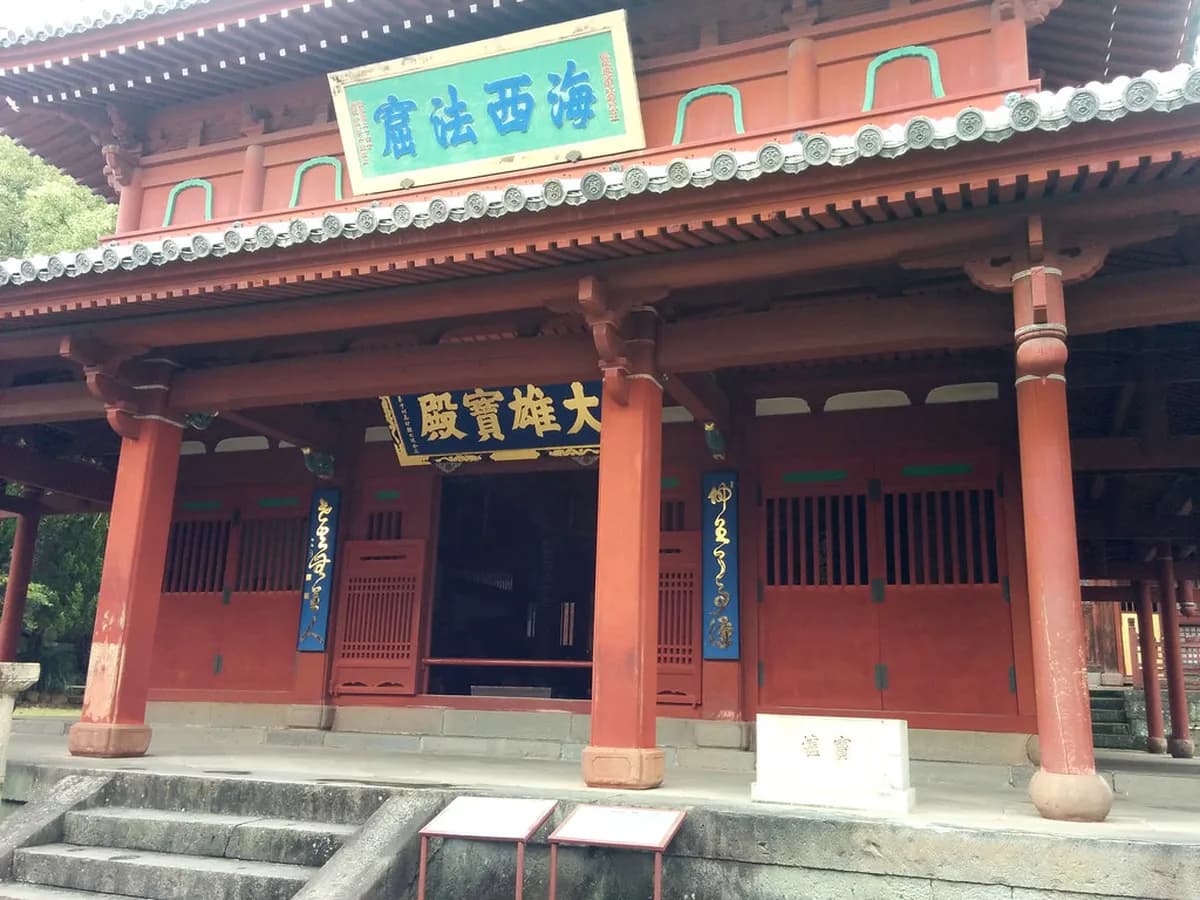
Sofukuji Temple stands as a vibrant testament to the deep historical ties between Nagasaki and China. Founded in 1629, this striking red complex is one of the few places in Japan where you can stand inside architecture that was physically built in China and shipped across the sea. Many travelers visit this landmark to see its rare Ming Dynasty gates and two designated National Treasures.
The temple offers a peaceful escape from the busy city streets while providing a unique cultural experience you won't find anywhere else in Kyushu. You will find it tucked away on a hillside in the historic Teramachi district, just three minutes on foot from the tram terminus. Explore other Nagasaki attractions to fully understand the city's diverse and layered past.
The Unique Chinese History of Sofukuji
The temple was founded in 1629 by the Chinese monk Chaoran, primarily for the community of merchants and traders from Fuzhou in Fujian Province who had settled in Nagasaki. During Japan's period of national isolation (sakoku), Chinese residents were permitted to build places of worship partly as proof to the authorities that they were not Christians, who faced severe persecution at the time. The result is one of the purest surviving expressions of continental Chinese temple culture on Japanese soil. The adjacent Nagasaki Chinatown preserves the same cultural heritage through its food traditions and merchant history.
Sofukuji belongs to the Obaku Zen sect, a branch of Buddhism that arrived from China in the mid-17th century and retained far stronger ties to Chinese ritual and chanting traditions than older Japanese Zen schools. This distinction matters visually: the bright colors, curved rooflines, and decorative motifs at Sofukuji bear far more resemblance to temples in Fujian Province than to the austere wood-and-stone aesthetic of most Japanese Zen temples. The city's multicultural heritage is nowhere more concentrated than here.
The Ningbo connection is one of the most remarkable footnotes in Japanese architectural history. The structural timbers for the main buildings were pre-cut by craftsmen in Ningbo, China, then loaded onto junks and transported across the East China Sea to Nagasaki, where they were reassembled piece by piece on the hillside. No equivalent feat of prefabricated cross-sea construction survives anywhere else in Japan, which is a key reason the buildings hold National Treasure status in 2026.
Must-See Architectural Highlights and National Treasures
The first structure you will encounter is the Ryugumon outer gate, rebuilt in the 19th century with its distinctive arched stone base and bright vermilion lacquer. This style is unmistakably Chinese and gives the temple its popular nickname, the Red Temple of Nagasaki. Compare this to the Dutch-colonial architecture at Dejima and the difference between the two foreign influences that shaped this city becomes immediately clear.
Beyond it stands the Daiippomon inner gate, a National Treasure built in China in 1644 and reassembled here in 1695. The intricate bracket work (tokyou) supporting its heavy tiled roof is the defining feature — no nails were used, and each interlocking timber component was carved to absorb the load of the roof's considerable weight. Visitors regularly pause here for several minutes working out how it holds together.
The Daiyuhoden main hall, the second National Treasure, was completed in Nagasaki in 1646 using timber sections shipped from China. Its double-roof silhouette and the elaborately painted interior ceiling are the visual high point of the grounds. Inside, you will find several statues including a figure of Mazu, the sea goddess, whom Chinese sailors prayed to before departing on the long passage back to Fujian. The grounds also contain a massive bronze cauldron that tells its own story — see the section below.
The Great Cauldron and the 1697 Famine Relief
Near the main hall you will notice an enormous cast-iron cauldron, roughly the size of a small car. Most visitors photograph it without knowing what it was used for. In 1697, a severe famine struck the Nagasaki region, and the abbot of Sofukuji organized a mass feeding effort using this cauldron to cook rice porridge (kayu) for an estimated 3,000 people per day over several weeks. It is one of the earliest documented examples of organized disaster relief in Japanese history and it happened in a temple courtyard.
The cauldron remained in active use for community cooking during subsequent food shortages and is now preserved as a cultural artifact on the temple grounds. No English placard explains its significance, which means the vast majority of visitors leave without knowing the story. If you have a translation app, point it at the nearby stone marker — the inscription is worth reading in full.
Practical Visitor Info: Admission and Opening Hours
Admission (¥300) is paid via a wooden honesty box at the gate — no staff, no ticket, bring exact coins. English signage is almost entirely absent; download a translation app before you arrive to read the carved stone markers near the main hall.
Admission is JPY 300 per person, paid using a wooden honesty box (saisenbako) positioned at the gate entrance. The gate is often unstaffed, particularly on weekday mornings. You drop the coins in yourself and walk through — no ticket is issued and no receipt is given. Check the (Official City Info) for any updates to opening hours before your visit.
Bring the exact amount in coins. There is no change available and no card reader anywhere on the premises. The grounds are open daily from 08:00 to 17:00. Use (Google Maps) to locate the entrance, which sits on a narrow residential lane that can be easy to miss from the main road.
The grounds rise steeply via several flights of stone steps with uneven paving on the upper terraces. Wear shoes with good grip. No cards accepted anywhere on site — cash coins only.
Physical preparation matters here. The path through the grounds rises steeply via several flights of stone steps, and some of the upper terraces require careful footing on uneven paving. Wear shoes with grip. English signage is almost entirely absent, so download a translation app before you arrive — pointing it at the carved stone markers near the main hall reveals details you will not find in any guidebook. Allow at least one hour, more if you want to linger at the upper terrace and look out over the Teramachi rooftops.
Transportation: How to Reach Sofukuji Temple
The simplest route from Nagasaki Station is tram line 1, which terminates at the Sofukuji stop — the last stop on the line, so there is no risk of missing it. The fare is JPY 140 per ride. The walk from the tram stop to the temple gate takes about three minutes along a gently sloping lane. Walk toward the iconic Megane Bridge after your visit to add another heritage stop to the day.
If you are using an IC card (Nimoca, Suica, Pasmo, or ICOCA), tap in and out at the tram door — the system is the same across all Nagasaki trams. Day passes for unlimited tram travel are available for JPY 600 and make financial sense if you plan to visit multiple Teramachi temples plus Dejima or the Atomic Bomb Museum in a single day.
Walkers coming from the Hamamachi shopping arcade reach Sofukuji in about fifteen minutes heading south along Teramachi-dori. This direction is recommended as it means you arrive at the temple feeling fresh rather than finishing the walk here after a full day on your feet. The route is flat and well-signposted in both Japanese and English.
Walking the Nagasaki Temple Street (Teramachi)
Sofukuji sits at the southern end of Teramachi-dori, a 3km pedestrian-friendly street that connects a chain of Buddhist temples and Shinto shrines across the eastern flank of Nagasaki's city center. The route is almost entirely flat until you turn off to enter individual temple compounds. This walking route pairs perfectly with a broader Nagasaki itinerary. Visit the grand Suwa Shrine for a contrasting style of sacred architecture later in the day.
The four Fortune Temples of Nagasaki (Nagasaki Shifukuji) are the organizational anchor of the walk. Two of them — Kofukuji and Sofukuji — are on Teramachi-dori itself. Kofukuji at the northern end was also founded by a Chinese monk in 1620 and also charges JPY 300 entry. If you visit both in one morning you will have seen the full range of Chinese-influenced Obaku Zen architecture that Nagasaki is known for.
The street is remarkably uncrowded even on weekends. A good rhythm is to start at Kofukuji around 09:00, work south through the smaller shrines and temples at a relaxed pace, stop for lunch in the Hamamachi arcade area around 12:00, then finish at Sofukuji by 14:00 before the afternoon heat peaks. The entire walk including temple entry time takes three to four hours. Stop at a local cafe along the route to try Nagasaki's famous castella sponge cake before catching tram line 1 back to the center.
Frequently Asked Questions
What is the best time to visit Sofukuji Temple?
The best time to visit is early morning or late afternoon when the light hits the red gates beautifully. These hours also offer the most peaceful atmosphere for exploring the National Treasures. You can easily combine this with a trip to Oura Church later.
How much is the admission fee for Sofukuji?
The admission fee is JPY 300 per person and must be paid in cash. There is an honesty box at the entrance because the gate is often unstaffed. Please bring the exact change in coins to ensure you can enter the grounds without any issues.
Is Sofukuji Temple part of the Nagasaki Temple Street?
Yes, Sofukuji is one of the most famous stops along the Teramachi-dori walking route. It is located at the southern end of the street near the tram terminal. Most visitors start their walking tour here before heading north toward the other historic temples in the area.
Why is Sofukuji called the Red Temple?
It is called the Red Temple because of the bright vermilion lacquer used on its main gates and buildings. This color is a classic feature of Chinese Ming Dynasty architecture. The vibrant red stands out sharply against the green trees and stone paths of the hillside.
Sofukuji Temple rewards visitors who arrive prepared. Bring JPY 300 in coins for the honesty box, wear shoes with grip for the stone steps, and download a translation app to unlock details the English placards do not cover — including the story of the great cauldron. The architecture alone justifies the visit, but the history behind it is even more compelling.
Combining Sofukuji with a walk north along Teramachi-dori turns a single attraction into a half-day itinerary. Consider staying at (Hotel Forza Nagasaki) for easy tram access to the Teramachi district and the rest of the city. In 2026 this remains one of Nagasaki's most undervisited cultural sites, which means you can almost always experience the National Treasure gates in near-total peace.
For more Nagasaki planning, see our Nagasaki attractions guide, Nagasaki itinerary, and Nagasaki Chinatown food guide.