Megane Bridge is one of the most photographed landmarks in Nagasaki — a double-arched stone structure built in 1634 that reflects in the Nakashima River to form the shape of a pair of spectacles. It is free to visit, open 24 hours, and sits at the centre of one of the best half-day walking routes in Nagasaki. This guide covers the photo spots, the heart-stone hunt, how to get there by tram, the best seasons to visit, and how to link the bridge into a full day around central Nagasaki.
The bridge is officially designated an Important Cultural Property and is considered the oldest stone arch bridge of its kind in Japan. It is not a grand monument; its appeal is its modest scale and the way it sits so naturally in the daily life of the city. Locals walk across it, students cycle past, and elderly residents pause on the embankment below. That quality — alive and ordinary despite being almost 400 years old — is what makes it worth a visit in 2026.
What to See and Do at Megane Bridge
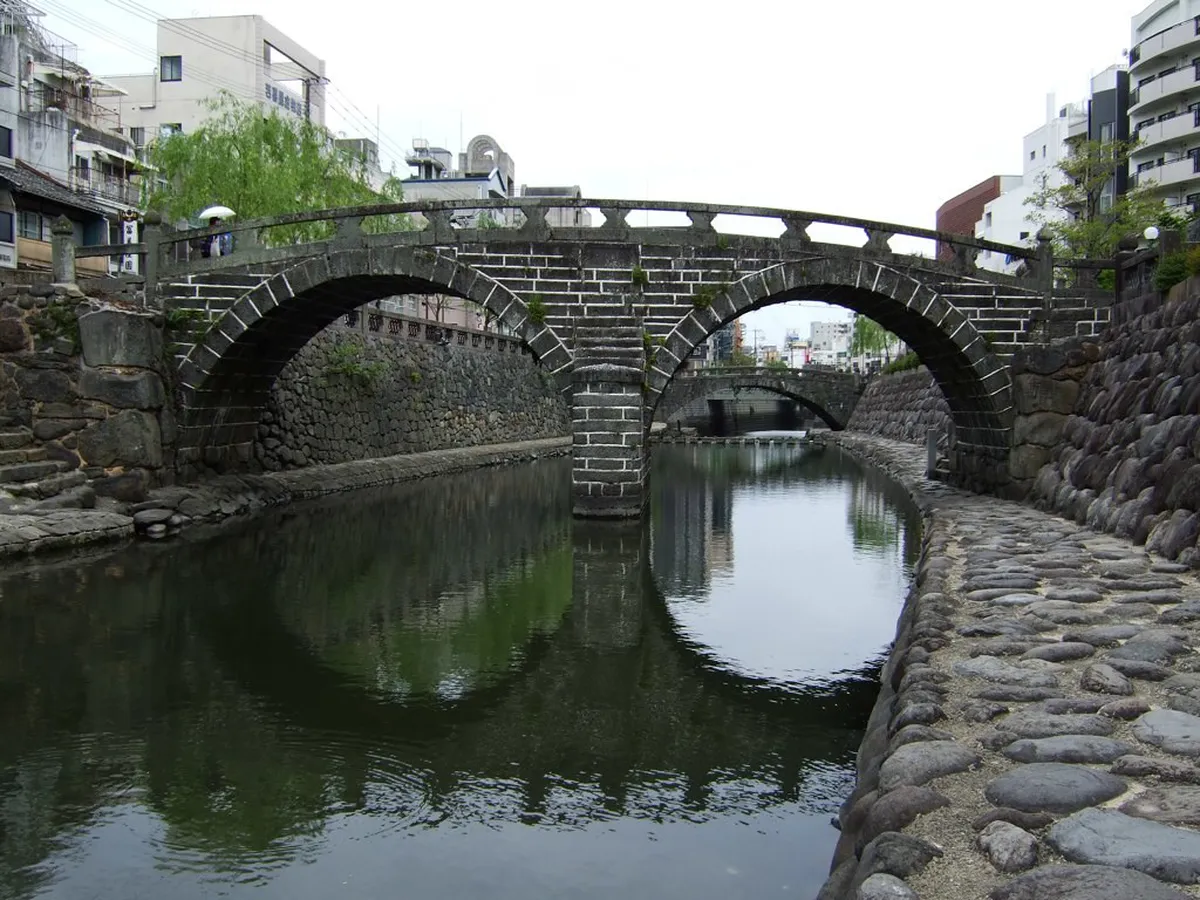
The primary draw is the spectacles reflection. When the Nakashima River is calm and the light is right, the two stone arches and their mirror images join into a perfect oval pair of glasses. The classic viewpoint is from the stepped embankment slightly downstream, crouching low so the camera is nearly level with the water surface. Early morning — before 08:00 — gives the calmest water and the softest light. Check the official Discover-Nagasaki.com page for event listings that may affect crowds around the riverbank.
Walking across the bridge itself is essential. The surface is worn stone, slightly uneven, with low railings softened by moss. From the centre, look upstream and downstream to see the other historic stone bridges that line this stretch of the Nakashima River. Each one is slightly different in scale and construction, and you can stroll between several of them without backtracking.
The heart-stone hunt is a genuinely fun activity, especially for couples and families. Around 20 heart-shaped stones are set into the embankment walls near the bridge. Local lore says finding them brings good luck in love. Walk slowly along the lower river path and scan the stone masonry carefully — they are not marked on any sign. After heavy rain the walls are easier to read because the contrast between the heart-shaped stones and the surrounding rock becomes sharper.
- Spectacles reflection: best before 08:00 from the downstream embankment, camera low and level with the water. Free. Open 24 hours.
- Heart stones: roughly 20 embedded in the retaining walls along the riverbank. No map provided — the search is the activity.
- Evening illumination: the bridge is lit until around 22:00. Good for long-exposure shots from a tripod; the arch curves and stone texture read well against dark water.
- Other stone bridges: walk upstream to find Fukurobashi, Higashiyamatebashi, and several smaller spans. Allow 45 minutes for a full river stroll.
Best Time to Visit
Autumn (September to November) is the most comfortable season. Temperatures drop to a pleasant range, the air is clearer than summer, and foliage along the riverbanks turns warm yellow and red in October and November. Evening walks in this period are particularly atmospheric.
Spring (late March to early April) brings cherry blossoms near the river and mild temperatures. The soft pink against grey stone makes for strong photos. Summer is hot and humid — visit before 09:00 or after 18:00 to avoid the worst heat. Heavy summer rain raises the river level and can blur the spectacles reflection. Winter is mild by Japanese standards; clear January and February days produce sharp light and nearly empty riverbanks, which suits photographers who want clean compositions.
One date worth planning around for 2026 is the Nagasaki Lantern Festival, held during the Lunar New Year period (typically late January to mid-February). The Nakashima River and surrounding streets fill with thousands of red lanterns, and the bridge itself becomes a centrepiece of the illuminations. The atmosphere is unlike any other time of year. Book accommodation well in advance if you plan to visit during the festival.
How to Get to Megane Bridge
The most direct route from Nagasaki Station is tram line 4 (bound for Shokakuji-shita) or tram line 5, alighting at the Meganebashi stop. The bridge is about one minute on foot from the stop. A single tram ride costs 140 yen (2026 adult fare); a day pass costs 600 yen and covers unlimited rides on all lines, which is worth buying if you plan to visit Glover Garden or the Peace Park on the same day.
On foot from Nagasaki Station the walk takes roughly 20 to 25 minutes along the shopping streets and then along the river. Signs in English and Japanese point to the bridge in the downtown area. If you are coming from Dejima or the Hamano-machi arcade, the bridge is only a five to ten minute walk east along the river. Parking in central Nagasaki is limited and expensive; the tram is the better option for most visitors.
Photography Tips for the Spectacles Reflection
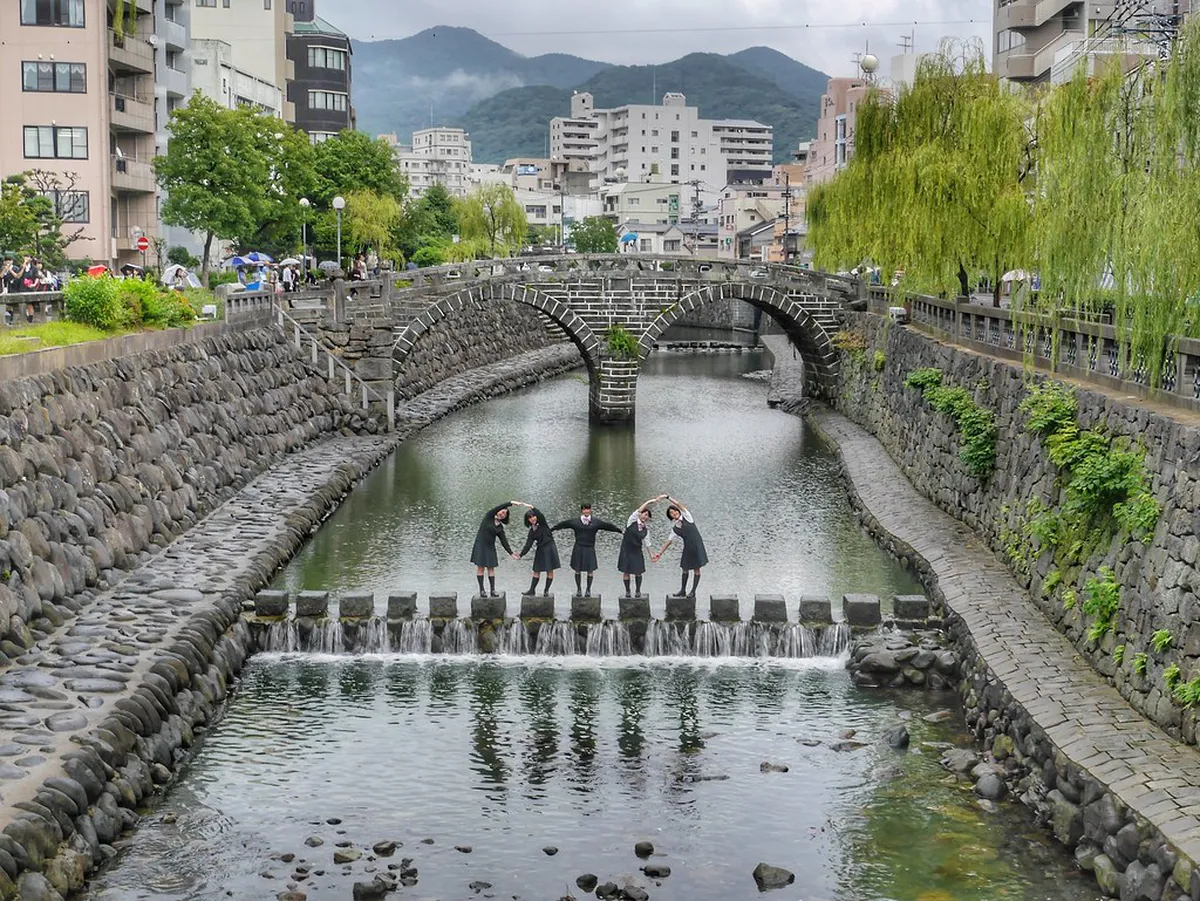
Arrive before 08:00 for the calmest water and the softest morning light. The classic shot is taken from the downstream embankment with your camera nearly level with the river surface. Avoid the hour after heavy rain — the river runs brown and the reflection disappears.
Arrive before 08:00 for still water, soft shadows, and minimal foot traffic on the bridge. Position yourself on the stepped embankment downstream from the bridge rather than on the bridge itself. Crouch or sit to get your lens close to water level — a higher angle breaks the oval shape of the reflection. A wide-angle lens at roughly 24 mm captures both arches and a sliver of the sky above the parapet.
In the evening, the bridge is illuminated in warm amber until approximately 22:00. The light emphasises the stone texture and the curves of the arches, and the reflections shimmer rather than mirror-image clearly. This is the right time for long-exposure shots (three to eight seconds on a tripod) that turn the water surface into a smooth canvas. Avoid shooting in the hour after heavy rainfall: the river runs brown and the reflection disappears entirely.
For a less common angle, walk upstream past the adjacent bridges and shoot Megane Bridge with one of the smaller spans in the foreground. This composition shows the river system as a whole rather than just the single landmark, and it appears far less often on travel feeds. Small changes in position along the bank — even two or three metres — dramatically alter the shape of the reflection, so move around rather than staying fixed at one spot.
Museums and Cultural Sites Near Megane Bridge
Kofukuji Temple is the most historically linked site to the bridge. The monk who designed the bridge in 1634, Mokusunyoujo, was the head priest here. The temple is a short walk from the riverbank and reflects the deep Chinese influence on Nagasaki's architecture. Visiting it after the bridge closes the cultural loop between the river crossing and the religious community that built it.
The Nagasaki Atomic Bomb Museum is reachable by tram from the Meganebashi stop. It provides a thorough account of August 1945 and the city's subsequent peace efforts. Allow two hours minimum. The Nagasaki Museum of History and Culture is also within walking distance and covers the city's trade history with the Dutch and Chinese, which adds context to the Chinese-designed bridge you have just visited.
Small galleries and craft shops line the side streets between the river and Hamano-machi arcade. Many sell pottery and calligraphy that reflect Nagasaki's multicultural heritage. These are locally owned rather than chain outlets, and browsing them briefly gives a different read on the neighbourhood than the major museums do.
Parks, Gardens, and Outdoor Spots to Pair with the Bridge
The Nakashima River embankment is itself the most immediate outdoor space. It functions as a linear park: benches along the lower path, low stone walls to sit on, and a calm atmosphere that contrasts with the busier streets above. The riverbank is pleasant for 30 to 60 minutes of slow walking even on a hot day because the water keeps the temperature slightly cooler.
Glover Garden sits on a hillside above the harbour and is a 15-minute tram ride from Meganebashi. The outdoor museum contains a cluster of Western-style Meiji-era buildings and offers panoramic views of the port. It is a strong half-day pairing with the bridge — one shows Chinese influence from 1634, the other shows European influence from the 1860s and 1870s, giving a complete picture of Nagasaki attractions and trading history.
The Nagasaki Peace Park is further north and requires a separate tram trip. The park features the large Peace Statue and the Fountain of Peace, and the grounds are quiet and spacious. Families with children typically spend around an hour here. If you are combining the bridge, Kofukuji Temple, Dejima, and the Peace Park in a single day, start at the bridge before 09:00 to keep the pace comfortable.
Budget and Family Visitor Advice
Megane Bridge costs nothing to visit. There is no gate, no ticket booth, and no timed entry system. You can walk across it and spend as long as you like on the riverbanks without any charge. The heart-stone hunt keeps children occupied for 20 to 30 minutes at zero cost and requires no special equipment — just sharp eyes.
Street food near the bridge and in Hamano-machi arcade is affordable. Look for Castella cake shops, a Portuguese-influenced sponge cake that Nagasaki is famous for, available in small individual portions from around 200 to 400 yen. Champon noodles — Nagasaki's signature dish — cost 800 to 1,200 yen at most restaurants near the river and are filling enough to serve as a full lunch. Rose-shaped Chirichirin ice cream is a popular treat with children and costs a few hundred yen per serving.
Accessibility note: the bridge surface is stone steps that can be challenging for pushchairs and wheelchairs. The surrounding riverbank paths are generally flat and paved, though some sections narrow. The tram system has low-floor cars on most lines and is the recommended transport for visitors with mobility considerations.
How to Plan Your Megane Bridge Day
A focused bridge visit — photo from the embankment, walk across, heart-stone hunt, riverbank stroll to two or three adjacent bridges — takes 45 to 60 minutes. If you include Kofukuji Temple and a coffee stop at a nearby kissaten, allow 90 minutes. A full half-day loop adding Dejima and lunch in Chinatown runs about four hours and covers the most important cultural sites in lower Nagasaki. For a structured Nagasaki itinerary, we recommend building your day around the bridge as a central waypoint.
The water is calmest in the early morning before wind picks up in the afternoon. If the spectacles reflection is your priority, arrive by 08:00 and head to the embankment immediately before other visitors arrive and disturb the water surface by crossing the bridge. Rainy days flatten the reflection but give the stone walls a richer, darker colour that can work well for photography in overcast light. If you are planning a 1-day itinerary, begin here before 09:00 to maximise time for other nearby attractions.
The bridge surface is uneven stone that becomes slippery when wet. The Nagasaki rainy season runs June–July — carry a compact umbrella and note that river levels rise quickly after heavy rain, temporarily restricting access to the lowest embankment paths.
Wear shoes with grip. The stone steps on the bridge and the riverbank walls are uneven and become slippery when wet. The rainy season in Nagasaki runs through June and July; carry a compact umbrella and note that river levels rise quickly after heavy rain, which can temporarily restrict access to the lowest embankment paths.
Suggested Walking Route from Megane Bridge
Start at the bridge before 09:00 for the best reflection and fewest people. Walk upstream along the river to see the other historic stone bridges, then cut into the Teramachi district to visit Sofukuji Temple, roughly ten minutes from the river. Sofukuji is one of the most ornate Chinese temples in Japan and shows clearly how the same cultural influences that produced the bridge extended into religious architecture.
From Sofukuji, head south toward central Nagasaki and walk to Dejima, the restored Dutch trading post. The contrast between the Chinese-built bridge and the Dutch-built island, separated by about 15 minutes on foot, summarises Nagasaki's unique position in Japanese history. The Dejima admission fee is modest and the exhibits are detailed without being overwhelming.
Finish in Nagasaki Chinatown (Shinchi Chinatown), one of the three oldest in Japan, for lunch or an early dinner. The walk from Dejima takes under ten minutes. Champon noodles and sara udon (fried noodles with vegetables and seafood) are the dishes to order. The red entrance gates make a strong closing photo for the day as afternoon light falls across them.
History and Cultural Background
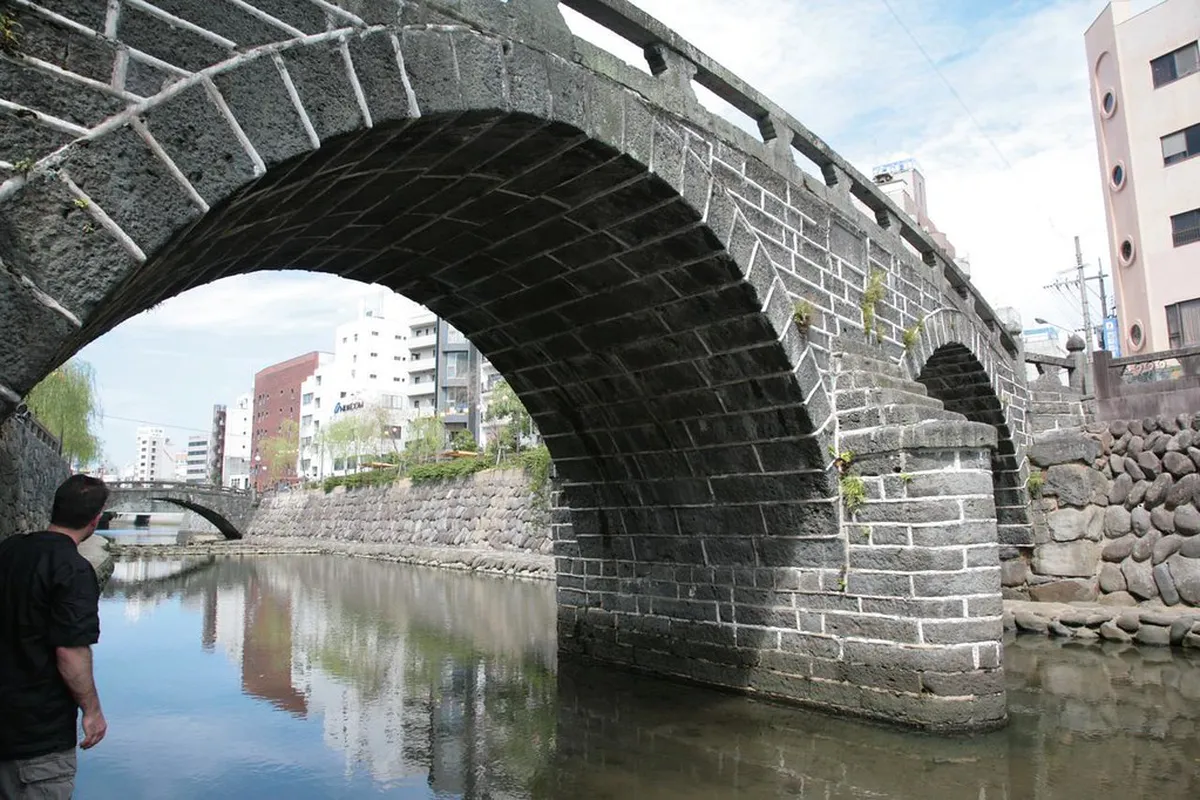
Megane Bridge was built in 1634 during the early Edo period, when Nagasaki was Japan's only officially sanctioned window to the outside world. The design is credited to Mokusunyoujo, a Chinese Zen monk who served as head priest of the nearby Kofukuji Temple. Stone arch bridges were rare and technically difficult in 17th-century Japan; wooden bridges were the norm. Constructing a double-arch stone bridge reflected both advanced Chinese craftsmanship and the practical need for a flood-resistant crossing in a river city prone to typhoons.
A major flood in 1982 damaged the bridge and displaced many of its original stones. The city recovered and catalogued as many stones as possible and used them in a careful restoration that preserved the bridge's historical profile. The result is designated an Important Cultural Property by the Japanese national government — the same designation given to structures of major architectural or historical significance. It is frequently ranked alongside Nihonbashi in Tokyo and Kintaikyo in Iwakuni as one of Japan's most celebrated bridges.
The bridge's Chinese origins connect it directly to Nagasaki's position as a centre of trade with China throughout the Edo period. The same community that built Kofukuji Temple, Sofukuji Temple, and the Confucian Shrine also shaped the riverscape that visitors walk through today. That continuity — a 17th-century monk's engineering decision still structuring a 21st-century city neighbourhood — is what gives the bridge its depth beyond the spectacles photograph.
Day Trips from Nagasaki: Huis Ten Bosch and Beyond
If you have an extra day after the bridge and central Nagasaki, Huis Ten Bosch is the most popular day trip from the city. The theme park recreates a Dutch town with canals, windmills, and flower gardens. It is located about 90 minutes from Nagasaki by direct limited-express train toward Sasebo. Entry fees vary by season and access zone; check the official park website for 2026 pricing before you go. The park connects directly to Nagasaki's Dutch trading history, making it a thematic follow-on to a Dejima visit.
Unzen, a hot spring town on the Shimabara Peninsula, is a second option. The journey takes about 90 minutes by bus via Obama Onsen. Unzen Jigoku (the volcanic hell vents) are a dramatic contrast to the river tranquillity of Megane Bridge and are suitable for a half-day or full day. Shimabara Castle, also on the peninsula, can be added to the same trip. Both Huis Ten Bosch and Unzen are reachable as day trips from a Nagasaki city base without needing to change accommodation.
Frequently Asked Questions
What Is Megane Bridge?
Megane Bridge is a historic stone arch bridge in Nagasaki, built in 1634. It is known as the Spectacles Bridge because its two arches reflect in the water to look like glasses. It is the oldest stone bridge in Japan and a popular photo spot. You can visit it for free while exploring the city of Nagasaki.
Why Visit Megane Bridge?
You should visit to see a masterpiece of early Edo-period engineering and find hidden heart-shaped stones. It offers a peaceful atmosphere and a glimpse into the city's multicultural history. The bridge is a perfect central point for a walking tour of nearby temples and museums. It is one of the most photographed landmarks in Kyushu.
How Long Should You Spend at Megane Bridge?
Most visitors spend 30 to 45 minutes exploring the bridge and the riverbanks. This gives you enough time to take photos and look for the lucky heart stones. If you plan to walk to nearby temples or Chinatown, allow for a total of two to three hours. It is an easy stop to include in any Nagasaki itinerary.
Which megane bridge visitor guide options fit first-time visitors?
First-time visitors should focus on the morning photo walk and the heart stone hunt. Combining the bridge with a trip to Dejima and Chinatown is the most efficient route. Using the local streetcar is the best way to reach the area quickly. This allows you to see the main highlights without feeling rushed.
Megane Bridge remains a timeless symbol of Nagasaki's beauty and historical depth. Whether you are hunting for heart stones or capturing the perfect reflection, it never disappoints. We hope this megane bridge visitor guide helps you plan an unforgettable trip to Kyushu. Enjoy the unique charm and quiet elegance of this ancient stone masterpiece.