10 Best Free Things to Do in Kamakura (2026)
Discover the best free things to do in Kamakura, from ancient hiking trails and hidden cave tombs to iconic shrines and scenic beaches. Plan your 2026 trip now!
On this page
Kamakura sits about an hour south of Tokyo on the Shonan Coast, and it is one of the most budget-friendly day trips you can make from the capital. The town was Japan's political center under Minamoto no Yoritomo in the 12th century, and it still carries that historical weight in every cedar-lined valley and stone staircase. You do not need to pay temple entry fees to feel it. The free hiking trails, open shrine grounds, and public beaches give you the full picture without the crowds that gather at the ticketed sites.
This guide covers the ten best free experiences in Kamakura for 2026, plus the practical transport decisions that affect how much money you actually spend before you even leave the train station. Most of these spots cluster within walking distance of Kamakura Station or Kita-Kamakura Station, so you can build an efficient route without spending much on local transit at all.
Getting to Kamakura from Tokyo
The two main routes from Tokyo both take roughly 55–60 minutes. The JR Yokosuka Line runs direct from Tokyo Station to Kamakura Station for approximately ¥945 one-way. The JR Shonan-Shinjuku Line departs from Shinjuku Station and also arrives direct at Kamakura for the same fare. Both lines accept IC cards (Suica, Pasmo) — tap in and tap out, no need to buy a paper ticket.
If you are starting from Shibuya, a small saving is possible: take the Tokyu Toyoko Line to Yokohama, then transfer to the JR Yokosuka Line toward Kamakura. The combined fare runs slightly below the direct Shinjuku route. It adds a transfer but saves around ¥100–¥150 depending on your origin station — worth considering if you are already in that part of the city.
The Odakyu Enoshima-Kamakura Freepass covers a round-trip from Shinjuku on Odakyu lines plus unlimited rides on the Enoden tram between Fujisawa and Kamakura. It costs ¥1,640 from Shinjuku in 2026. The math only works in your favor if you plan to use the Enoden four or more times and are combining Kamakura with Enoshima in the same day. For a Kamakura-only visit where you walk most of the route, an IC card and a single Enoden ride or two will cost less.
Navigating Kamakura: Walking vs. the Enoden Line
Once you arrive, walking is the most cost-effective and enjoyable way to get around. The main cluster of shrines, the Komachi-dori shopping street, and the Tsurugaoka Hachimangu shrine all sit within 15 minutes of the East Exit of Kamakura Station. From there you can reach the beaches in 20 minutes on foot via the Wakamiya-oji avenue.
The Enoden Line is a vintage single-car tram that hugs the coast between Kamakura and Fujisawa. A single ride costs ¥220–¥260 depending on the stop. It is genuinely useful for reaching Hase Station (near the Great Buddha) and Kamakura-kokomae Station (the Slam Dunk crossing). If you plan to use it more than three times in a day, the Enoden hop-on, hop-off day ticket at ¥800 becomes cost-effective. Accept IC cards.
For the northern temples and Kita-Kamakura area, simply ride one stop north from Kamakura Station on the JR Yokosuka Line — the fare is just ¥150. The walk between the two stations along the Kamakura kaido road takes about 25 minutes and passes several free outdoor temple areas along the way. Buses serve the eastern neighborhoods and cost ¥220 per ride, payable by IC card.
Tsurugaoka Hachimangu: Kamakura's Most Iconic Free Shrine
Tsurugaoka Hachimangu is the spiritual and geographical center of Kamakura. Minamoto no Yoritomo founded it in 1063 and moved it to its current site in 1180 when he established the Kamakura shogunate. The vast majority of the grounds are free to explore daily from 06:00 to 20:00. Only the small treasure museum requires a separate admission.
The main approach, the Dankazura, is a raised cherry-tree-lined path that cuts through the city center from the coast all the way to the shrine gate. In late March and early April this becomes a tunnel of pale pink blossoms that costs nothing to walk through. Two lotus-filled ponds flank the entrance — the left pond with three islands represents the Minamoto clan and the right pond with four islands represents their rivals, the Taira clan. The symbolism matters: four sounds like death in Japanese.
Peak blossom season (late March–early April) draws massive crowds after 10:00 AM. Arrive before 08:30 to experience the Dankazura tunnel of cherry blossoms with minimal tour groups — this is when the morning light and the peaceful atmosphere are at their best.
The main shrine building sits atop a grand stone staircase that gives a clear view across the city toward the sea. Arrive before 09:00 to beat the tour buses from Tokyo. The shrine hosts major free festivals throughout the year, including the Kamakura Festival in April with horseback archery (yabusame), making the timing of your visit worth checking against the Official Kamakura Tourism Website. The East Exit of Kamakura Station is a 10-minute walk away.
Hiking the Ancient Trails: Daibutsu, Tenen, and Gionyama
Kamakura is enclosed on three sides by wooded hills, and a network of free hiking trails crosses them. These are the same ridge passes — called kirisushi — that the medieval shogunate used as natural defense. The Daibutsu Hiking Course is the most popular, running from Kita-Kamakura through cedar and bamboo forest to emerge near the Great Buddha in Hase. It takes 60–90 minutes and is well-marked throughout. The Buddha itself costs ¥300, but you can view the head over the compound wall for free from the trail exit before you decide.
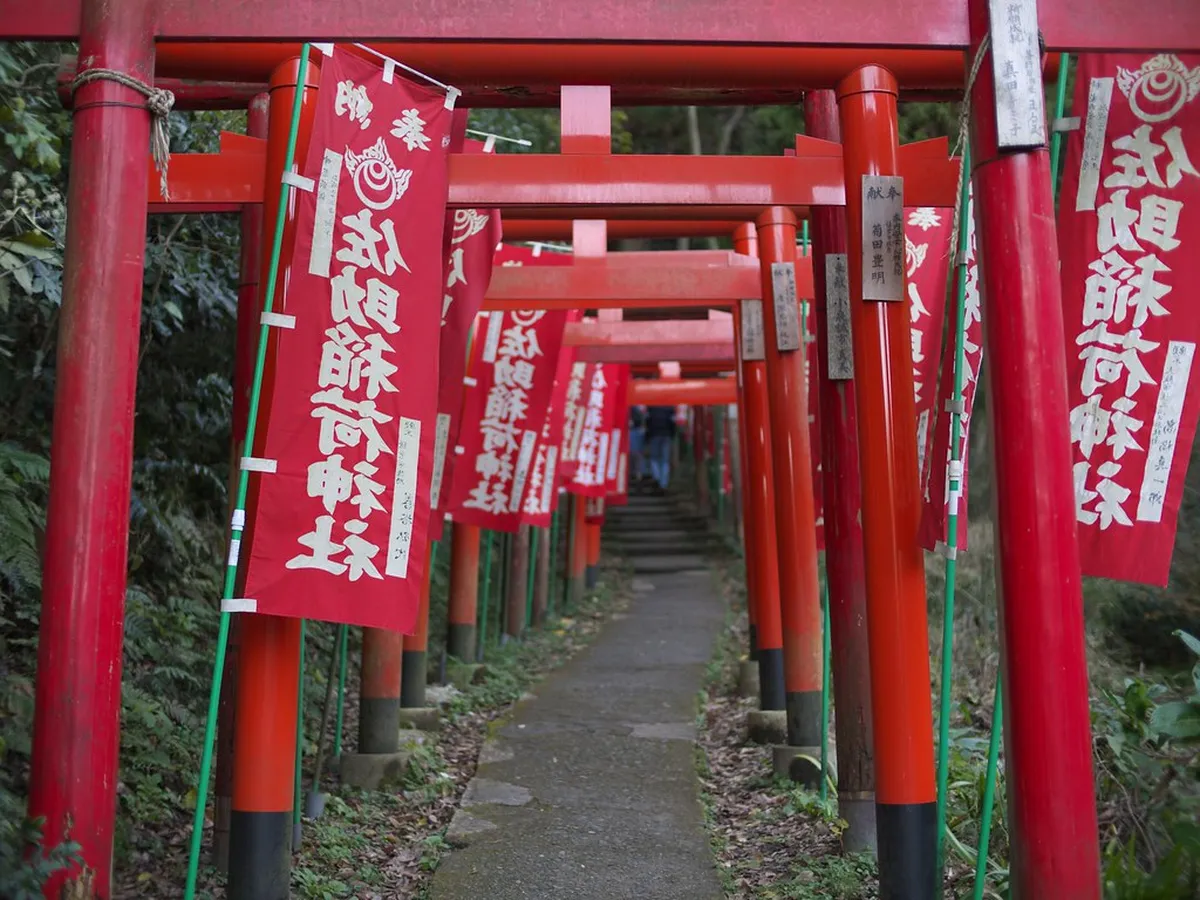
The Tenen Hiking Course branches east from near Zuisenji Temple and provides the longest ridge walk with the most elevation change. It connects to the Yagura cave tomb area and eventually reaches Kamakura-gu Shrine, all for free. The Gionyama trail is the shortest option — the entrance sits behind Myohonji Temple and the summit viewpoint takes about 30 minutes. From the top you see the full arc of Yuigahama beach and Sagami Bay below. It is often quiet even when the town center is crowded. For detailed route maps and station-exit starting points, the hiking trail guide covers each path.
All three trails are free during daylight hours. Wear shoes with grip — the clay paths become slippery after rain. Autumn (late November to early December) is the most photogenic season, with red maples framing the stone Buddhas along the lower sections. Spring offers free flower viewing too: the trails pass wild hydrangeas in late June that rival the famous paid hydrangea path at Hasedera.
The Daibutsu Hiking Course is the most popular trail, running 60–90 minutes from Kita-Kamakura through cedar and bamboo forest. You can view the Great Buddha's head over the compound wall for free from the trail exit before deciding to pay ¥300 entry to the temple grounds.
Free Temple Grounds and Hidden Statues in Kita-Kamakura
Kita-Kamakura Station sits one JR stop north of the main station and drops you into a quiet valley of major Zen temples. The famous ones — Engakuji (¥500) and Tōkeiji (¥200) — charge entry to their inner gardens. But a useful budget move almost no guide mentions: the outer approach to Engakuji, including the enormous wooden Sanmon gate and the cedar-forested perimeter walk, is visible and accessible without buying a ticket. You get the scale and atmosphere of one of Japan's great Zen complexes for free.
Jōmyōji Temple is a smaller Rinzai temple in the eastern Kamakura hills with free outer grounds and a rock garden viewable from the path. The road between Kita-Kamakura Station and Kamakura Station along the old kaido passes several small wayside Jizo statues and moss-covered stone lanterns set directly into the hillside — these are accessible to anyone walking past and give a sense of the layered religious geography that paid temple grounds often abstract away behind manicured paths.
This stretch is best walked in the morning before the heat builds. It takes around 25 minutes at a relaxed pace, and the stone-paved sections near Engakuji are among the most atmospheric in the entire town. Combine it with the start of the Daibutsu hiking trail for a half-day loop that costs nothing but the ¥150 train fare from Kamakura Station.
Zeniarai Benzaiten: The Free Money-Washing Shrine
Zeniarai Benzaiten Ugafuku Shrine is one of the strangest and most memorable sites in Kamakura. It sits hidden inside a hollow in the western hills, accessed through a low rock tunnel. The grounds are free to enter daily from 08:00 to 16:30. The ritual involves washing coins (or banknotes if you are feeling ambitious) in a spring inside a small cave — local belief holds that this multiplies the money over time. Bamboo baskets and incense are available inside for a small voluntary offering.
The walk from Kamakura Station takes about 20 minutes uphill through a residential neighborhood. Follow the hand-painted signs after the Zeniarai Benzaiten bus stop. The site becomes crowded on weekends but is genuinely quiet on weekday mornings. The approach tunnel — carved directly through rock — adds a theatrical quality you won't find at any of the larger, more photogenic temples.
The "Slam Dunk" Railroad Crossing at Kamakura-kokomae
The level crossing outside Kamakura-kokomae Station on the Enoden Line became globally famous as the opening scene backdrop of the manga and anime series Slam Dunk. The Enoden tram passes every 10–15 minutes with the Pacific Ocean visible behind it — on clear days, the horizon line sits perfectly level with the track. The spot is free to visit at any hour.
One practical note for 2026: photography from the center of the road is prohibited. Local residents have petitioned for this restriction because fans were stopping traffic for extended shots. Stand on the footpath beside the crossing and use the fence as a foreground element — it actually produces a better compositional frame than standing in the road anyway. The beach directly below the station is Shichirigahama, and on a clear winter or spring morning you can see the snow cap of Mount Fuji floating above the water from the shorefront path.
The Enoden ride from Kamakura Station to Kamakura-kokomae costs ¥260 by IC card. If you are planning to also visit Hase Station for the Great Buddha area and return to Kamakura Station by tram, three rides total comes to ¥700–¥780 — at that point the ¥800 Enoden day ticket covers the whole loop for a marginal saving.
Beach Hopping: Sun and Surf at Yuigahama and Zaimokuza
Yuigahama Beach is the most accessible of Kamakura's beaches — a 15-minute walk from the West Exit of Kamakura Station along a broad boulevard lined with surf shops. The 1-km stretch of sand is free to use year-round and faces directly southwest over Sagami Bay. In summer (July–August) the beach operates with lifeguards, beach shacks, and rental equipment, but simply sitting on the sand or swimming costs nothing. The bay produces long, mellow waves that attract surfers even outside the peak season.
Zaimokuza Beach extends east from Yuigahama and is slightly less crowded because it requires a 25-minute walk or a short bus ride from the station. It is a better choice for a quiet morning swim or picnic. The waters here are part of the Shonan Coast, and on a clear day the view across the bay extends to the Izu Peninsula. Both beaches are free to access at all hours.
For the best coastal views with almost no other visitors, walk the path that runs along the top of the seawall between Yuigahama and the mouth of the Namerigawa river at dawn. The light hits the water at a low angle, the fishing boats are returning, and the town is still quiet. It is a version of Kamakura that most day-trippers never see because they arrive after 10:00.
Window Shopping and People-Watching on Komachi-dori Street
Komachi-dori is a 600-meter pedestrian street running north from Kamakura Station directly to Tsurugaoka Hachimangu Shrine. It is lined with local craft shops, snack stalls, and specialty food sellers — walking the length of it costs nothing. The street is free to browse and operates roughly 10:00 to 18:00 daily, though snack vendors open earlier.
The best free activity here is eating cheaply rather than spending on sit-down meals. Street-food formats — skewered grilled squid, freshly made monaka wafers, shirasu (whitebait) rice crackers — run ¥200–¥400 per item and are eaten standing. This is the kind of eating the locals do, not expensive restaurant sets. Look for the Toshimaya Honten confectionery shop selling Hato Saburo, the dove-shaped butter biscuit that has been Kamakura's signature souvenir since 1897 — a small bag costs around ¥800 and makes an excellent picnic item for the beach.
Weekday mornings are significantly calmer than weekend afternoons when the crowds from Tokyo are thickest. The side alleys off the main street often hide small artisan workshops where you can watch craftspeople at work without any obligation to buy. It is worth arriving here before 09:30 to walk the full length without stopping every few meters.
Exploring the Mysterious Yagura Cave Tombs
The yagura are medieval rock-cut cave tombs unique to Kamakura, carved directly into the soft tuff cliffs throughout the eastern hills. They were used by samurai families to inter remains and were considered a high-status burial method during the Kamakura period. You encounter them throughout the hiking trails — small alcoves holding stone stupas and Buddhist carvings weathered by centuries of moisture. Access to the publicly accessible yagura around Zuisenji and the Nikaido neighborhood is free during daylight hours.
The largest accessible cluster sits near the approach path to Zuisenji Temple. The temple's inner garden charges ¥200 but the yagura carved into the cliffs lining the outer approach are viewable from the path for free. These tombs don't appear in most travel guides at all — they look like cave recesses in the cliff face and most first-time visitors walk past them without noticing. The combination of dripping ferns, carved stone stupas, and the silence of the narrow valley gives you a more direct encounter with Kamakura's samurai history than any museum exhibit. Combine the yagura walk with the Gionyama trail for a half-day free loop through the eastern hills using the Kamakura itinerary as a routing reference.
The Pass-and-IC-Card Decision That Changes Your Budget
Every budget guide mentions the Odakyu Freepass but very few work through the actual numbers. Here is the comparison for 2026. A round-trip from Shinjuku by JR costs approximately ¥1,890 (¥945 each way). The Odakyu Enoshima-Kamakura Freepass costs ¥1,640 from Shinjuku — that is ¥250 cheaper on the round-trip alone, and it includes unlimited Enoden rides. If you use the Enoden even once, the pass pays for itself versus separate IC card rides.
The catch: the Odakyu Freepass does not cover local buses, and the Enoden section of the pass only runs between Fujisawa and Kamakura — not Tokyo to Fujisawa. You must travel to Fujisawa on Odakyu lines to activate the tram portion. If your hotel is in Shibuya or anywhere not near a Shinjuku Odakyu connection, the math changes. There is also the Kamakura Free Environment Bill pass (¥900), which covers unlimited Enoden rides plus Enoden Bus and Keikyu Bus routes around Kamakura — useful if you are staying locally or want to hit the eastern neighborhoods not reachable on foot.
For most day-trippers doing the walking-heavy free itinerary in this guide, an IC card plus one or two individual Enoden rides (¥220–¥260 each) will come to less than the pass. The Odakyu Freepass makes the most sense when you are combining Kamakura with Enoshima in the same day — it was designed for exactly that routing. Run the numbers against your own departure point and planned stops before buying. Check the current pricing on the Odakyu Freepass page as fares update annually.
Essential Tips for Planning Your Free Kamakura Itinerary
Arrive by 08:30 to beat the tour groups. Most organized tours depart Tokyo after 09:00, so the first 90 minutes in Kamakura are noticeably calmer. This is when the shrine grounds, the Dankazura approach, and the Kita-Kamakura temple paths are at their best — uncrowded, morning light, no noise from the vendors who open at 10:00.
For free seasonal flower viewing, late March to early April brings cherry blossoms along the Dankazura without any ticket required. Late June brings wild hydrangeas along the hiking trails, which are genuinely comparable to the famous paid hydrangea path at Hasedera. November to early December is the maple leaf season, when the trails through the temple forest areas turn red and gold — also entirely free. The 2026 day trip guide maps these seasonal windows into half-day and full-day routing options.
Pack a convenience store lunch from Tokyo rather than eating at the tourist-facing restaurants on Komachi-dori. A onigiri, a sandwhich, and a drink from a 7-Eleven before you board the train saves ¥1,000–¥1,500 versus a sit-down lunch in Kamakura. Eat it at Yuigahama Beach with the ocean in front of you. That is, practically speaking, the single best cost-to-experience ratio of the entire day.
Keep planning your trip with our complete Kamakura attractions guide, and explore Kamakura's hidden gems and rainy-day ideas next.
Frequently Asked Questions
Is the Great Buddha of Kamakura free to visit?
No, the Kotoku-in temple grounds where the Great Buddha is located require a small entry fee of approximately 300 yen. However, you can see the top of the statue for free from certain points on the nearby Daibutsu hiking trail.
What is the best free hiking trail in Kamakura?
The Daibutsu Hiking Course is widely considered the best free trail because it connects major cultural areas. It offers a mix of forest paths, small shrines, and scenic rest areas without any admission charges.
How can I save money on transport to Kamakura?
The most cost-effective option is the Odakyu Enoshima-Kamakura Freepass from Shinjuku Station. This pass covers your round-trip travel and unlimited Enoden train rides for one flat price, saving you money compared to individual tickets.
Kamakura proves that you don't need a massive budget to experience the best of Japanese culture. By focusing on the free hiking trails, public beaches, and iconic shrines, you can have a rich experience for very little money. I hope this guide helps you discover the hidden corners of this beautiful coastal city.
Whether you are visiting in 2026 or sooner, these free spots remain the heart of the Kamakura experience. Remember to respect the local sites and enjoy the natural beauty that surrounds this historic capital. Safe travels on your budget-friendly adventure through one of Japan's most charming destinations.
Free: The Kamakura Essentials guide
Top things to do, where to stay, a perfect day plan, getting around, and the best time to go — a Kamakura mini-guide you can take offline.
You might also like


Continue reading
More guides you'll find useful