Akama Shrine Shimonoseki: Guide to the Underwater Palace Shrine
Visit Akama Shrine for Emperor Antoku's history, the Hoichi the Earless legend, access details, and tips from Karato Market.
On this page
Last updated July 2026, this guide to akama shrine shimonoseki covers the history, architecture, and practical logistics of one of the Kanmon Strait's most photographed waterfront landmarks. Built to enshrine the six-year-old Emperor Antoku, who died in the 1185 Battle of Dan-no-ura, the shrine pairs a tragic dynastic story with the vivid vermillion, Ryugu-jo-inspired Suiten-mon gate that faces the strait. The sections below walk through what the shrine means historically, what it costs and how long it takes to see, and how to fit it into a wider Shimonoseki day out.
The Significance of Akama Shrine in Shimonoseki: Emperor Antoku and the Battle of Dan-no-ura
Akama Shrine dates to 1191, established in the years immediately following one of the most consequential battles in Japanese history. It is dedicated to Emperor Antoku, who was six years old when he died at the Battle of Dan-no-ura in 1185. That battle, fought in the waters of the Kanmon Strait just offshore from where the shrine now stands, brought the Genpei War to a close. The Minamoto (Genji) clan defeated the rival Taira (Heike) clan, ending the Taira bid for control of Japan. Antoku's grandmother, Nii-no-Ama, carried him into the sea rather than let him fall into Minamoto hands, and both drowned together. Akama Shrine's importance rests on that dual identity: it is simultaneously an imperial shrine honoring a child-emperor and a memorial to the entire Taira court that went down with him. Readers should keep the clan names straight, since the shrine commemorates the defeated Taira (Heike) side of the Genpei War, not the victorious Minamoto (Genji). Understanding this backstory before arriving makes the rest of the site make sense as a single, coherent memorial rather than a scattered collection of curiosities.
Architectural Highlights: The Suiten-mon Gate and the Ryugu-jo Style
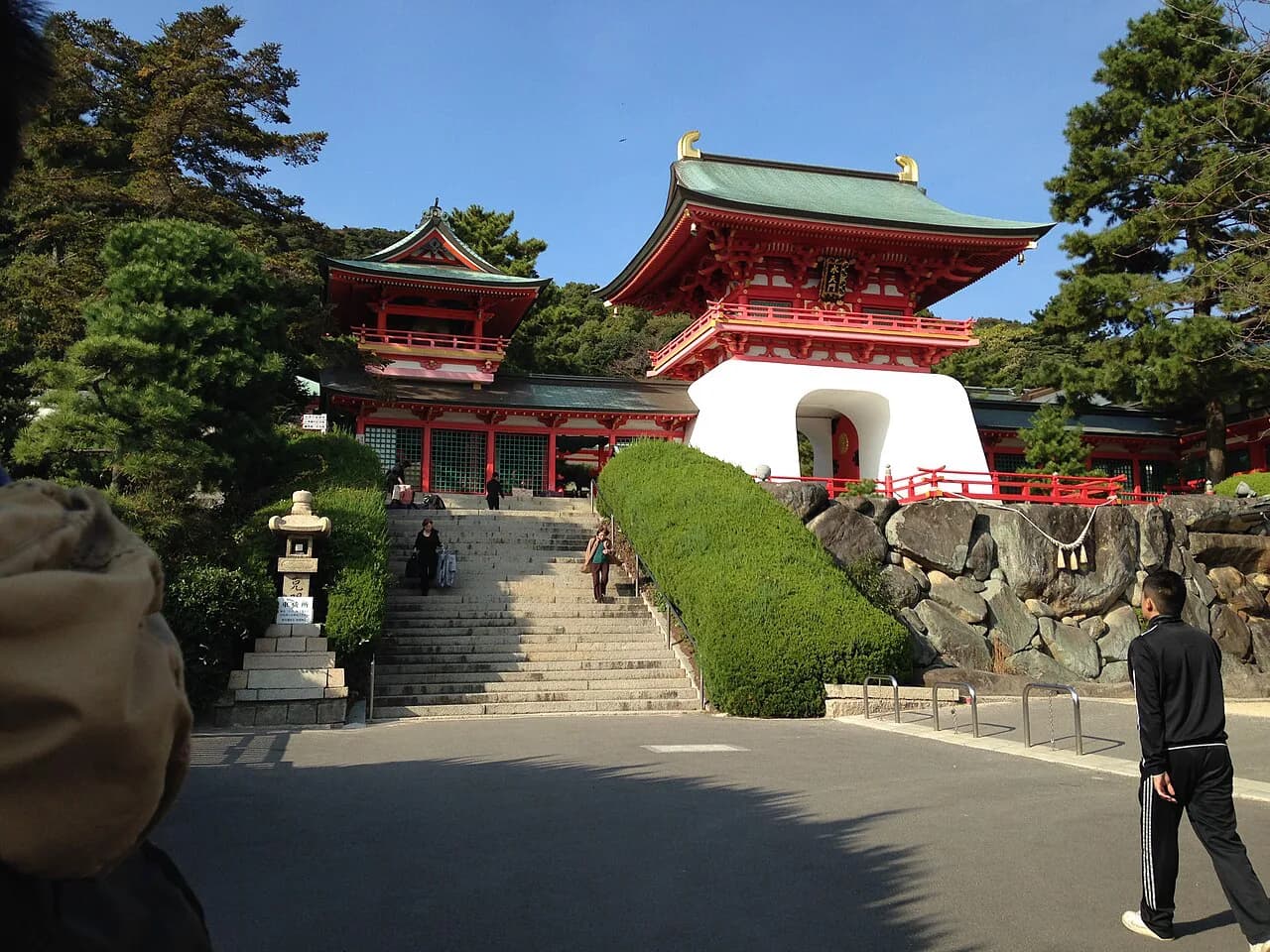
The shrine's most recognizable feature is the Suiten-mon, a vivid vermillion gate built in the style of Ryugu-jo, the mythical underwater dragon palace of Japanese folklore. According to the Shimonoseki Tourist Guidebook published by the Shimonoseki City Tourism Department, the design choice traces back to Nii-no-Ama's final wish. As she prepared to drown with Antoku, she asked that their resting place be imagined as an underwater palace. The Tale of Heike has her tell the young emperor only that they were headed to a palace beneath the waves, without naming Ryugu-jo directly. It is Antoku's mother, Kenreimon-in, who later dreams of the pair living in Ryugu-jo itself, and that dream image is what shaped the shrine's red-and-white, palace-like architecture. The effect is deliberate and visual rather than subtle: the bright red gate and rooflines sit directly on the Kanmon Strait waterfront, with the water and passing ships as a backdrop. That contrast between the vermillion structure and the strait is the shrine's signature photograph and the reason it reads as unmistakably coastal rather than forested, unlike many of Japan's best-known shrine complexes.
The shrine's signature gate represents Nii-no-Ama's final wish for an underwater palace. But the shrine memorializes more than this imperial tragedy: the Hoichi-do and Nanamori-zuka together honor the entire Taira (Heike) court and ordinary warriors lost at Dan-no-ura, not just the child-emperor.
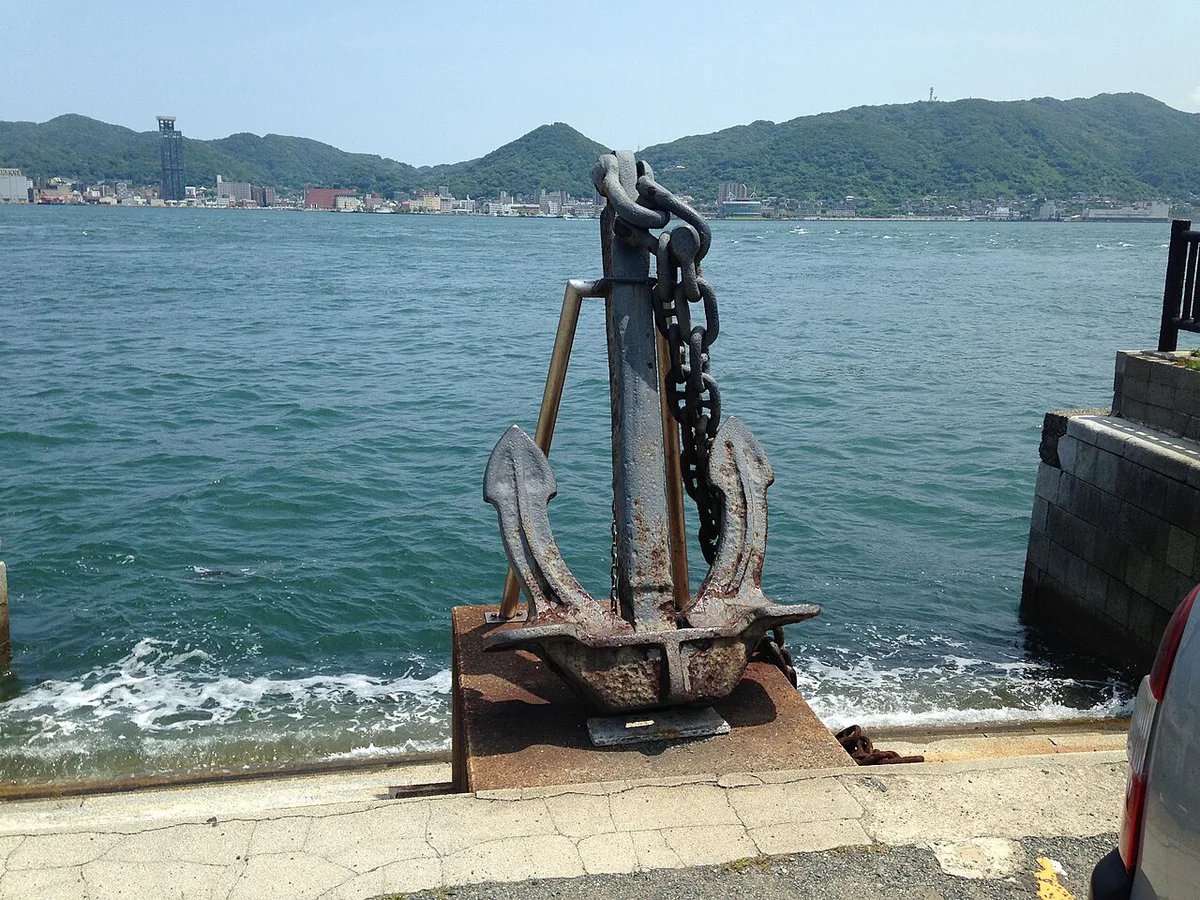
The Legend of Hoichi the Earless: Visiting the Hoichi-do Hall
Inside the shrine grounds, the Hoichi Hall (Hoichi-do) holds a statue of Hoichi the Earless, a blind biwa-playing monk from one of Japan's best-known ghost stories. The tale was introduced to Western readers by Lafcadio Hearn in his collection Kwaidan. It is set explicitly around Akama Shrine and the ghosts of the Heike warriors who died at Dan-no-ura. In the story, Hoichi is summoned nightly to perform the epic of the battle for an audience he cannot see, unaware that his listeners are the spirits of the fallen Taira. When temple priests try to protect him by painting protective sutras over his body, they miss his ears, and the ghosts tear them off. For literary-minded travelers, the Hoichi-do is one of the more distinctive stops on the grounds. It connects a physical shrine feature to a widely translated piece of writing, rather than to history alone. It rewards a slower look rather than a quick walk-past, and pairs naturally with the more solemn Nanamori-zuka mounds nearby.
The Nanamori-zuka Mounds: Honoring the Fallen Heike Warriors
Also on the grounds are the Nanamori-zuka, or seven mounds, which represent the Heike (Taira) warriors lost alongside Emperor Antoku at Dan-no-ura. Where the Suiten-mon gate and Hoichi-do hall lean into color and legend, the Nanamori-zuka are the shrine's quieter, more explicitly memorial space. They directly honor the ordinary retainers and soldiers who died in the same battle as their emperor, rather than to the imperial family alone. Seeing the mounds alongside the Hoichi-do and the main hall gives a fuller picture of what the shrine actually memorializes. It represents not just a single tragic child-emperor, but an entire defeated court and its fighting men, sea-bound in local memory ever since 1185.
Planning Your Visit: Hours, Admission, and Best Time to Go
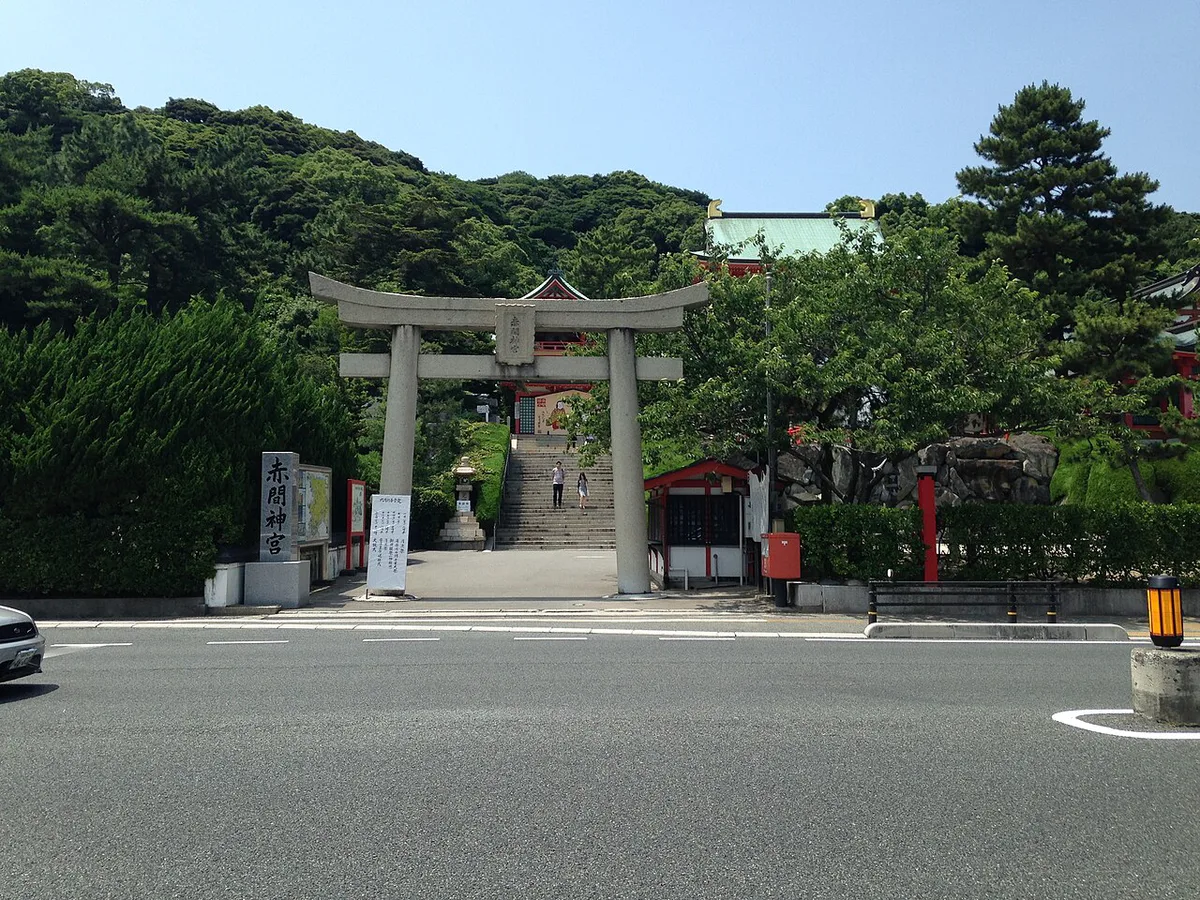
The shrine grounds themselves are free to enter, though travelers should confirm locally whether the treasure house (Homotsu-kan) or any specific interior halls carry a separate admission fee. This is because that has varied by hall in the past. Budget 30 to 45 minutes for a visit to the main gate, hall, Hoichi-do, and Nanamori-zuka, enough time to see every major feature without rushing, but not a half-day stop on its own. The site sits on a slope. The vermillion Suiten-mon is visible directly from the road, but reaching the inner sanctum and main hall involves a set of stairs, worth factoring in for travelers with mobility concerns or small children. The Shimonoseki City Tourism Department also lists the Senteisai Festival, held annually in May, as the shrine's major yearly event. It commemorates Emperor Antoku and the Heike dead with a procession that draws a heavier crowd than an ordinary weekday visit. Outside festival season, mornings tend to be quieter. Visiting after the initial breakfast rush at the nearby market spreads foot traffic across the waterfront rather than concentrating everyone at the shrine gate at once.
The shrine fits into a 30-45 minute stop within a half-day waterfront itinerary: 5-10 minutes from Karato Market, onward to the Kanmon Tunnel. During May's Senteisai Festival, expect crowds; outside festival season, mornings are quieter. Most visitors treat this stretch as one continuous outing.
- Grounds admission: free
- Treasure house (Homotsu-kan) and select interior halls: confirm locally for any separate fee
- Suggested visit length: 30-45 minutes
- Major annual event: Senteisai Festival, held in May
How to Get There: Access from Shimonoseki Station and Karato Market
The easiest approach is on foot from Karato Market, a walk of roughly 5 to 10 minutes along the waterfront that most visitors already plan to do anyway. From Shimonoseki Station, walking the entire distance takes longer, and a bus is the faster option, covering the route in around 10 minutes rather than the full walk. JNTO's transport guidance is a useful cross-check for current route numbers and stop names before heading out. This is because bus schedules can shift year to year. The shrine, market, and strait promenade all sit within a few minutes of each other. Most visitors therefore treat this stretch of waterfront as one continuous walk rather than as separate destinations.
Nearby Attractions: Building a Shimonoseki Waterfront Itinerary
Akama Shrine slots naturally into a half-day waterfront itinerary. A practical sequence starts with breakfast at Karato Market, moves to Akama Shrine for the history and architecture, and continues to the Kanmon Tunnel for a walk beneath the strait into Kyushu. This is a distinctive way to cross between Honshu and Kyushu on foot rather than by train or car. For lunch, Shimonoseki's signature fugu dishes are worth building the day around; see the fugu dining guide for where to eat before or after the shrine visit. After the shrine, Hinoyama Park offers an elevated viewpoint back over the strait and is an easy add-on for travelers who want a wider panorama than the shrine's sea-level setting provides. Travelers extending their trip further into Kyushu can also read up on Hakata's old town attractions as a follow-on stop once across the Kanmon Tunnel. For the fuller range of things to see in the city beyond this single shrine, the Shimonoseki things-to-do guide lays out the rest of the waterfront and beyond.
Mistakes to Avoid When Visiting Akama Shrine
The most common mismatch concerns expectations. Travelers hoping for a sprawling forest shrine complex on the scale of Tokyo's Meiji Jingu will find Akama Shrine is different by design. It is compact, vertical, and facing directly onto the sea rather than set back in woodland. It rewards visitors looking for a focused historical and literary stop, not a long nature walk. A second common error is mixing up the clans: the shrine commemorates the defeated Taira (Heike) side of the Genpei War, memorialized through Emperor Antoku and the Nanamori-zuka, not the victorious Minamoto (Genji). A third is treating the visit as a five-minute photo stop at the Suiten-mon gate alone and skipping the Hoichi-do and Nanamori-zuka, which is where most of the shrine's storytelling actually happens. Travelers interested in a full day of samurai-era sites can use the Chofu samurai district guide to plan a broader history-focused loop. This avoids limiting the day to a single shrine.
Senteisai Festival: When Akama Shrine Gets Crowded
If your Shimonoseki dates fall in early May, check whether Akama Shrine’s Senteisai Festival overlaps your visit. The annual observance commemorates Emperor Antoku and the fallen Heike, so it is not just a generic shrine festival; it is directly tied to the same Dan-no-ura story explained across the grounds. The best-known element is the courtly procession associated with the Taira memorial tradition, which can make the compact shrine feel much busier than usual.
For travelers, the main practical point is timing. Festival days are atmospheric if you want ceremony, photography, and a stronger sense of local devotion. However, they are less convenient if your goal is a quiet 30-minute stop between Karato Market and the Kanmon Tunnel. Arrive early, expect slower movement around the Suiten-mon gate and main stairs, and leave extra time for the waterfront walk back toward Karato Market or onward along the strait.
For trip-planning details, see Battle of Dan-no-ura - Wikipedia.
Frequently Asked Questions
Who is enshrined at Akama Shrine in Shimonoseki?
Akama Shrine enshrines Emperor Antoku, the child emperor who died at age six during the 1185 Battle of Dan-no-ura, along with a memorial to the Taira (Heike) warriors lost in the same battle.
How long should you plan for a visit to Akama Shrine?
Around 30 to 45 minutes is enough to see the Suiten-mon gate, main hall, Hoichi-do, and Nanamori-zuka mounds without rushing, since the shrine is compact rather than sprawling.
Is Akama Shrine free to visit?
The shrine grounds are free to enter; travelers should check locally whether the treasure house (Homotsu-kan) or any specific interior hall charges a separate admission fee, since that has varied.
What is the connection between Akama Shrine and Hoichi the Earless?
The shrine's Hoichi Hall holds a statue of Hoichi the Earless, the blind biwa player from the ghost story popularized in the West by Lafcadio Hearn. The story centers on the Heike ghosts of Dan-no-ura.
What is the best way to get to Akama Shrine from Shimonoseki Station or Karato Market?
Walking from Karato Market takes roughly 5 to 10 minutes; from Shimonoseki Station, a bus covers the route in about 10 minutes, faster than walking the full distance.
Free guide: Japan's Hidden Gems
12 under-the-radar places beyond Tokyo & Kyoto — with the best season to visit each and a local tip you won't find in the guidebooks.
You might also like
Continue reading
More guides you'll find useful