10 Romantic Things to Do in Kamakura for Couples (2026)
Discover the most romantic things to do in Kamakura for couples, from sunset beach walks to hidden bamboo groves and the legendary Love Bell of Enoshima.
On this page
After visiting Kamakura three times over the last five years, I still find it the most charming escape near Tokyo. The city blends ancient Zen atmosphere with a laid-back coastal vibe that feels tailor-made for a romantic retreat. Whether you prefer quiet temple walks or seaside dining, this coastal town in Kanagawa Prefecture offers a refreshing change of pace from the capital.
This guide was last refreshed in 2026 to ensure all pricing and seasonal details remain accurate for your trip. Kamakura serves as a perfect backdrop for shared memories, especially when you venture beyond the standard tourist trails. Follow this local guide to discover how to navigate the city's most enchanting corners together.
Planning a Kamakura itinerary requires a balance of spiritual sites and relaxing coastal moments. You will find that the best experiences often happen in the quiet gaps between the major landmarks. The entries below are ordered to follow a natural east-to-west flow across the city, which makes logistics easier on the day.
Walk Through the Ethereal Bamboo Grove at Hokokuji Temple
Hokokuji Temple in the eastern hills of Kamakura contains a stand of over 2,000 madake bamboo stalks that form a natural green cathedral. The stalks grow so densely that almost no sky is visible overhead, and the rustling sound in the wind creates an atmosphere of complete calm. Admission is ¥500 (roughly €3) per adult, and the temple opens daily at 09:00 and closes at 16:00.
After walking the bamboo path, stop at the small tea shelter tucked at the far end of the grove. A bowl of whisked matcha with a seasonal wagashi sweet costs ¥600 extra and is one of the quietest, most intimate moments you will find anywhere in the city. Arrive right at 09:00 to have the grove almost entirely to yourselves before the first tour groups reach the eastern hills, typically around 10:30.
Read our Hokokuji bamboo temple guide for exact bus routes from Kamakura Station and the best position inside the grove for photos. The temple is about 15 minutes from the station by bus (route 23 or 24) or a brisk 30-minute walk.
Arrive at opening time (09:00) to have the bamboo grove almost entirely to yourselves before tour groups arrive around 10:30. The matcha tea service at the shelter costs ¥600 extra and should be reserved in advance on weekends.
Ring the Love Bell of Ryuren on Enoshima Island
The Ryuren no Kane — the Bell of the Dragon and the Goddess — sits on a rocky promontory on Enoshima Island with an unobstructed view of Sagami Bay and, on clear days, the full silhouette of Mount Fuji. The legend behind it is worth knowing before you visit. According to local tradition, a five-headed dragon that had terrorized the region fell in love with the Buddhist goddess Benzaiten when she descended from the heavens. The dragon reformed and the two were united, which is why the bell has become a symbol of love overcoming all obstacles.
Couples ring the bell together and attach a pink padlock engraved with their names to the surrounding fence. The padlocks and small engraving service cost around ¥1,000 at the nearby souvenir shop. The bell itself is free to visit, though entering the Samuel Cocking Garden (the botanical garden immediately below the bell) costs ¥500 per person.
Sunset is the best time to come. The western light turns the bay a deep amber and the bell catches the colour directly. Arriving by 17:00 in summer (around 16:00 in autumn) gives you enough light for photos before the sky shifts to purple. Take the Enoden line to Enoshima Station and allow 20 minutes of easy walking across the Benten Bridge to reach the island.
Watch the Sunset Over Sagami Bay at Yuigahama Beach
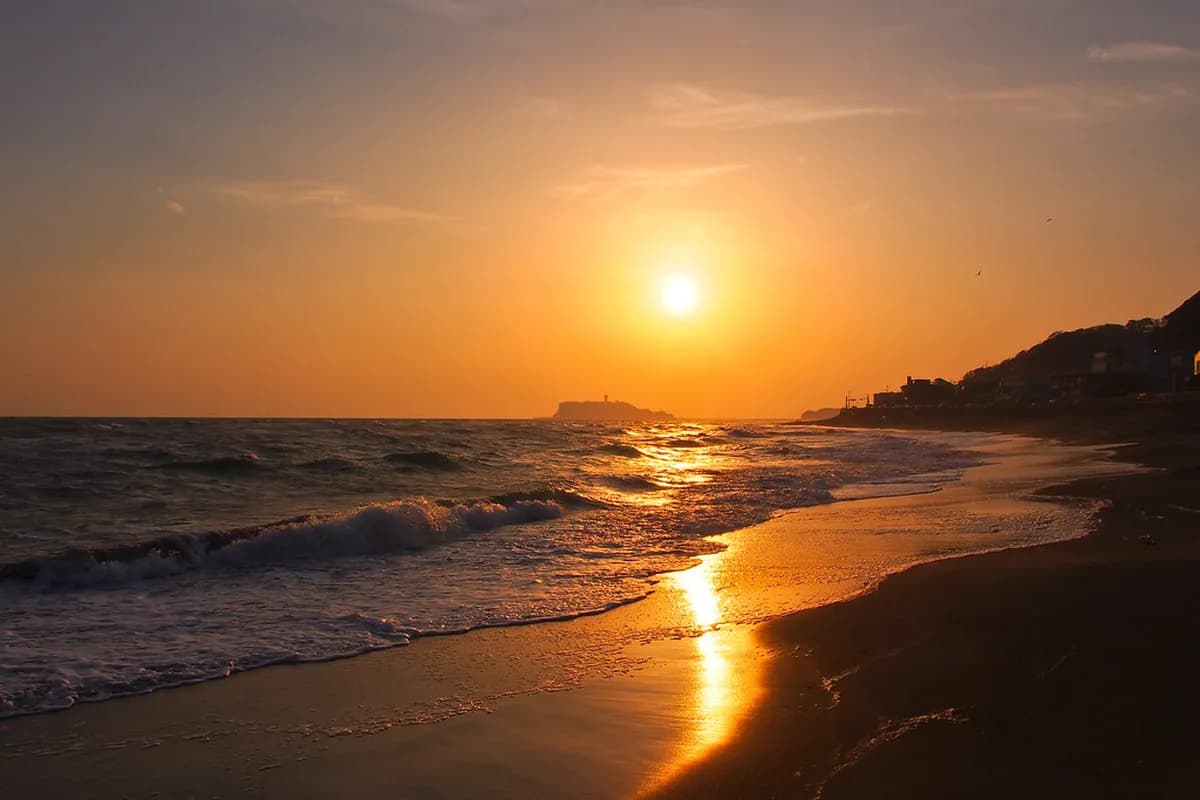
Yuigahama is the longest and most accessible beach in the Kamakura area, and it offers one of the most reliably romantic sunsets in the Kanto region. On clear days, the entire profile of Mount Fuji appears above the western horizon as the sun drops behind it. The beach is free and open at all hours, and access is a 15-minute walk from Kamakura Station or a 5-minute stroll from Yuigahama Station on the Enoden line.
The best spot for photographers is the western end of the beach near the Inamuragasaki headland, where the rock formations frame the sunset behind Mount Fuji. In practical terms, golden hour begins roughly 60 to 90 minutes before the official sunset time in spring and autumn. During June and July, the sun sets farther north and Fuji is less likely to be visible due to summer haze, so late October through early December is the most reliable window for that iconic Fuji silhouette shot.
After the sun goes down, the beach area stays lively. Several small beach bars and snack stands open in the warmer months (April to October), and the walk back along the shore toward the station feels entirely different once the sky turns deep blue. Check our guide to the Yuigahama beach guide for nearby gelato shops and the best cafes on the coastal road.
Explore the Seasonal Blooms at Hasedera Temple
Hasedera is justifiably called the temple of flowers. Its hillside gardens produce a continuous succession of colour from January through December, which makes it worth visiting in almost any season. The upper terrace overlooks the ocean and the city rooftops below, creating one of the finest panoramic views in all of Kamakura. Entry is ¥400 per adult, and the temple opens at 08:00 (closing at 17:00 from March to September, 16:30 from October to February).
The single most dramatic season at Hasedera is June, when roughly 2,500 ajisai hydrangea plants bloom across the hillside. The temple opens a special timed-entry hydrangea viewing path during this period; expect a 30- to 60-minute queue on weekends. The autumn maple foliage in November is a strong second choice and far less crowded. Plum blossoms arrive in February, wisteria in April, and lotus flowers in late July — each month brings something distinct.
Hidden in the lower garden are the small Ryo-en Jizo statues, which locals believe bring good luck to couples who find them. They are easy to miss if you walk straight to the upper terrace. Take the Enoden line to Hase Station and follow the signs for a five-minute walk to the entrance.
Take a Nostalgic Journey on the Enoden Railway
The Enoden is a single-track tram line that has connected Kamakura and Fujisawa since 1902. Its vintage green-and-yellow cars pass through residential back streets where neighbours hang laundry within arm's reach of the windows, then break suddenly onto the open coastline for a sweeping view of the Pacific. That contrast — intimate neighbourhood, then open ocean — is what makes a ride on the Enoden feel cinematic.
A one-day Enoden pass (Noriorikun) costs ¥800 per adult (around €5) and allows unlimited rides across all 15 stations. Buy it from the vending machines at any Enoden station. For current schedules and station details, check the official Enoden railway website. Trains run every 10 to 12 minutes from 06:00 until after 23:00, making it easy to ride multiple times throughout the day. Sit on the ocean-side seats (left side when travelling from Kamakura toward Fujisawa) for the best coastal views during the segment between Shichirigahama and Kamakura-koko-mae stations.
For photography, the stretch near Kamakura-koko-mae is famous — it is the level crossing frequently recreated from the anime Slam Dunk. The crossing itself is now perpetually crowded with fans. A quieter alternative is the stretch of track between Inamuragasaki and Gokurakuji, where the train cuts through a forested cutting that feels entirely removed from the city. Ride this segment during the late afternoon and the low light through the trees is genuinely beautiful.
Stroll the Historic Dankazura Path to Tsurugaoka Hachimangu
The Dankazura is a raised stone path lined with cherry trees that runs for roughly 500 metres from Wakamiya-oji Avenue directly to the main gate of Tsurugaoka Hachimangu, Kamakura's most important Shinto shrine. Minamoto no Yoritomo, the first shogun of the Kamakura period, built the original path in the 12th century as a devotional approach to the shrine. Walking it still carries that sense of arrival and ceremony.
In late March and early April, the cherry trees over the Dankazura create a tunnel of pale pink blossom that is among the most photographed sights in the city. Even outside blossom season the path is a beautiful 10-minute walk — wide, level, and easy underfoot. The shrine grounds themselves are free to enter, open from 06:00 to 20:30 (the main hall from 08:30 to 16:30).
The path begins just a few minutes north of Kamakura Station's east exit. Making it your first stop of the day allows you to reach the shrine before 09:00 when the grounds are quiet. A traditional Shinto wedding procession occasionally passes through the grounds in the morning, which is an unexpected and beautiful cultural moment if the timing works out.
Share a Matcha Moment at Jomyo-ji Temple
Jomyo-ji is the least visited of Kamakura's five great Zen temples, which makes it ideal for couples who want genuine quiet. The main garden is a classic karesansui dry landscape composition of raked gravel and moss-covered stones, framed by low walls and backed by the green hills of eastern Kamakura. Entry to the grounds is ¥200 per adult.
The teahouse at the back of the garden, called Kisen-an, serves a bowl of thick matcha with a seasonal wagashi sweet for ¥500. You sit on low wooden benches overlooking the garden, and there is rarely a wait. The temple is open from 09:00 to 16:30 and is a short bus ride or 25-minute walk from Kamakura Station (bus route 23, get off at Jomyoji stop).
Jomyo-ji is best combined with Hokokuji in the same morning, since both temples are in the eastern hills and within 10 minutes' walk of each other. Doing both early leaves the rest of the day free for the coastal section of the itinerary, which is better in the afternoon light.
The teahouse rarely requires a wait, but on weekends the garden path can fill up by mid-afternoon. The Kisen-an matcha service is worth the ¥500 extra—it's a uniquely quiet moment that many tourists miss entirely.
Enjoy a Romantic Seaside Lunch in Shichirigahama
Shichirigahama is the most scenically positioned dining strip in the Kamakura area. A row of cafes and restaurants lines the coastal road above the beach, all facing the open ocean with a clear view of the Enoshima island silhouette and Oshima Island on clear days. This is where Kamakura couples go for a proper sit-down meal rather than a quick snack.
Expect to pay between ¥2,000 and ¥5,000 per person for lunch at the better-known spots. Most restaurants open around 11:00 and stay open through dinner, though several close on Tuesdays. The most consistently recommended venue is bills Shichirigahama, an Australian-inspired brunch restaurant in a glass-walled space right above the beach — arrive before 11:30 on weekends or you will wait for a table. For a quieter option with equally good views, the independent cafes on the inland side of the coastal road are typically half the price and far less crowded.
Get off at Shichirigahama Station on the Enoden line and walk toward the sea. Check our full guide to the best restaurants in Kamakura for current reservation details and which specific spots are worth booking in advance during peak season.
Visit the Great Buddha of Kamakura at Kotoku-in
The Kotoku-in Great Buddha — a 13.35-metre bronze Amida Buddha cast in the 13th century — sits outdoors in a clearing surrounded by wooded hills. The statue lost its enclosing hall in a typhoon around 1498 and has remained open to the sky ever since, which gives it a different quality from temple Buddhas housed in dark interiors. Standing together at its feet provides a real sense of scale and the weight of 800 years of history.
Entry is ¥300 per adult, open daily from 08:00 to 17:30 (until 17:00 from October to March). For an extra ¥20 per person, you can enter the hollow interior of the statue through two oval windows in the back and see the casting seams from the inside — an unusual and strangely moving experience. The site is a seven-minute walk from Hase Station and is most naturally combined with Hasedera Temple in the same half-day.
Morning visits on weekdays are the least crowded. The grounds are small and fill quickly once tour groups arrive after 10:00. Arriving at opening means you can spend 20 to 30 minutes in relative calm before the day-trip crowds begin to build.
Discover the Quiet Matchmaking Shrine at Kuzuharaoka
Kuzuharaoka Shrine is dedicated to Kamakura Kagemasa, a warrior revered for his loyalty and strength, but the shrine has accumulated a secondary reputation as a place where couples come to pray for an unbreakable bond. It sits in the forest above the main city along the Daibutsu Hiking Trail — a path of packed earth through cedar and bamboo stands that most day-trippers never find. The shrine itself is free to enter and normally unstaffed, which means you often have the grounds entirely to yourselves.
At the shrine office (open 09:00 to 16:00 on most days), couples can purchase heart-shaped wooden ema plaques for ¥500 each to write a shared wish and hang on the cedar frame near the main hall. The walk to Kuzuharaoka from the trailhead near Kamakura Station's west exit takes about 20 minutes at an easy pace through forest. It is the single most private romantic spot in the city — no crowds, no tour buses, no audio guides.
This is also a useful addition to any itinerary because the Daibutsu Trail continues from Kuzuharaoka all the way to the Great Buddha at Kotoku-in, meaning you can walk the forested section between these two sites rather than backtracking to the station. The full trail section is about 2 kilometres and takes 40 minutes.
When to Go: Seasonal Blooms and the Right Day Pass
Choosing the right month dramatically changes what you will see at each temple. For a comprehensive overview of Kamakura's cultural calendar and attractions, visit the official Japan National Tourism Organization page. Here is a quick reference for the main bloom windows in 2026:
- February: Plum blossom at Zuisen-ji and Tokeiji Temple (mid-February peak).
- Late March to early April: Cherry blossom along the Dankazura and at Tsurugaoka Hachimangu (peak varies; typically late March in mild years).
- April: Wisteria at Hasedera Temple and at Kamakura-gu Shrine.
- Late July: Lotus flowers in the ponds at Hasedera and Tsurugaoka Hachimangu.
- June: Hydrangeas at Hasedera Temple (roughly 2,500 plants) and along the Jojuin garden path at Meigetsu-in, called the "temple of hydrangeas."
- November: Autumn maple foliage at Hokokuji, Engakuji, and Zuisen-ji (peak typically second week of November).
For the transport pass, most couples who plan to use the Enoden more than three times in a day should buy the Enoden Noriorikun one-day pass at ¥800 per adult. If you plan to combine Enoshima Island with Kamakura in a single day, consider the Enopass instead (officially the Odakyu Enoshima-Kamakura Freepass). The Enopass covers the Odakyu limited express from Shinjuku to Katase-Enoshima, unlimited Enoden rides, and entry into several Enoshima Island attractions — at ¥2,000 from Shinjuku it saves a couple roughly ¥2,400 compared to buying everything separately. If you are coming from Tokyo Station or Yokohama on the JR Yokosuka Line and skipping Enoshima entirely, the Enoden Noriorikun alone is sufficient and simpler to purchase.
Getting to Kamakura from Tokyo
The fastest and most direct route is the JR Yokosuka Line from Tokyo Station, which runs to Kamakura Station in approximately 55 to 60 minutes without transfers. Trains depart every 15 to 20 minutes. The Shonan-Shinjuku Line from Shinjuku or Shibuya also reaches Kamakura in about 55 minutes and is often less crowded than the main Yokosuka service. Both lines are covered by IC cards (Suica, Pasmo) or by the JR Pass if you hold one.
A useful alternative for couples coming from Shinjuku is the Odakyu Enoshima-Kamakura Freepass (Enopass), which covers the Odakyu Romance Car or regular express train to Katase-Enoshima Station, unlimited Enoden rides between Enoshima and Kamakura, and discounts at several island attractions. At ¥2,000 per adult from Shinjuku it typically works out cheaper than individual fares if your day includes both the island and the coastal temples.
From Kamakura Station you can reach the eastern temples (Hokokuji, Jomyo-ji) by bus or on foot, and the Enoden line covers everything on the coastal strip from Hase Station to Shichirigahama. The city is compact enough to navigate entirely without a taxi — most couples manage the full itinerary on a combination of the Enoden and short walks. For detailed itineraries, accommodation options, and real-time updates on attractions, the official Kamakura tourism site provides comprehensive planning resources.
Keep planning your trip with our complete Kamakura attractions guide, and explore Kamakura's hidden gems and the best cafés in Kamakura next.
Frequently Asked Questions
What is the most romantic spot in Kamakura for a proposal?
The Love Bell (Ryuren no Kane) on Enoshima Island is the premier choice for a proposal. It offers stunning ocean views and a legendary backstory of eternal love between a goddess and a dragon. Visit at sunset for the most magical atmosphere.
How long does it take to get to Kamakura from Tokyo?
The journey takes approximately 50 to 60 minutes via the JR Yokosuka Line from Tokyo Station. Trains run frequently throughout the day, making it a very convenient day trip. You can also use the Shonan-Shinjuku Line from Shinjuku.
Are there romantic dinner options in Kamakura?
Yes, the Shichirigahama coastline is lined with upscale restaurants offering panoramic sea views. Many places serve fresh local seafood and Italian-inspired cuisine in a sophisticated setting. Reservations are highly recommended for weekend evenings.
Kamakura remains one of the most enduringly romantic destinations in Japan for a very good reason. The combination of ancient history, lush nature, and coastal beauty creates a diverse itinerary that never feels repetitive. Whether you are ringing the love bell on Enoshima or sharing tea in a bamboo grove, the city invites you to slow down.
By following this guide, you can navigate the crowds and find those quiet moments that make a trip truly special. I hope your visit to this coastal gem is filled with the same wonder I felt during my first sunset at Yuigahama. Safe travels as you explore the timeless charm of Kamakura together.
Free: The Kamakura Essentials guide
Top things to do, where to stay, a perfect day plan, getting around, and the best time to go — a Kamakura mini-guide you can take offline.
You might also like


Continue reading
More guides you'll find useful