Kyoto Autumn Foliage: 10 Best Places and Planning Tips
Plan your Kyoto autumn foliage trip with our guide to the 10 best spots, peak timing forecasts, night illuminations, and tips to avoid the crowds.
On this page
Kyoto is one of the best places in Japan to see autumn foliage, and for good reason. More than 2,000 shrines and temples dot the city, most of them surrounded by maples and ginkgo trees that ignite in red, orange, and gold between mid-November and early December. This guide covers the top spots, how to read the official forecasts, night illumination events, and the exact crowd-avoidance tactics that actually work in 2026.
Planning around the kyoto autumn foliage season requires timing and strategy in equal measure. Crowds peak hard during the last two weeks of November. Book your accommodation in Kyoto at least three months ahead — rooms near Higashiyama and Arashiyama sell out first. Many popular temples hit capacity by 10:00 AM on weekends, so early starts are non-negotiable.
Best Time to Visit Kyoto for Fall Color
The peak window for kyoto autumn foliage typically runs from November 15 to December 5, though in recent years the peak has shifted slightly later. Colors begin in the northern mountains around Kurama and Kifune, then move south through the city center. The deeper cold snaps of late November are what trigger the most vivid crimson in the maples.
The Japan Meteorological Corporation (JMC) publishes live Autumn Foliage Forecasts from September through November. These are called "koyo" (紅葉) maps and are distinct from the sakura forecast — they show two separate trackers, one for maple (momiji) and one for ginkgo. Check the forecasts weekly from early October to narrow your travel dates. The JMC map color codes show "approaching peak," "peak," and "past peak" by region, so you can time Kyoto specifically rather than relying on a generic "mid-November" rule.
Temperatures during peak season range from 8–16°C / 46–61°F. Mornings feel sharp but afternoons warm up enough to walk comfortably in a light jacket. Clear, calm days produce the best colors; Kogarashi — the season's first cold wind — is what pushes the leaves from green to red practically overnight. If the forecast shows Kogarashi arriving in mid-November, expect peak color within a week of that date.
For the best experience, follow a kyoto itinerary that clusters your top two or three sites into each morning slot. Most temples open at 08:30–09:00, but you can walk the Philosopher's Path and Arashiyama bamboo grove from around 06:30 before any gates open. Weekdays are noticeably less crowded than weekends, especially Monday and Tuesday.
Peak foliage in Kyoto runs November 15 to December 5, with the deepest colors in late November. Arrive at major temples by 09:00 or earlier — sites like Kiyomizu-dera that open at 06:00 let you see the maples in soft morning light before tour buses arrive.
Eikando Temple: The Ultimate Foliage Destination
Eikando Zenrin-ji is the undisputed highlight of the Kyoto autumn foliage season. The temple grounds hold roughly 3,000 maple trees whose leaves reflect in Hojo Pond, creating one of the most photographed scenes in Japan. It sits on the northern end of the Philosopher's Path, making it easy to combine with Nanzen-ji or Honen-in in a single morning.
Admission during autumn foliage season costs 1,000 yen per adult (around ¥1,000 / approx. $7). Daytime hours run 09:00 to 16:00. The temple also runs evening illuminations from November 11 to December 10, with gates open from 17:30 to 21:00 (last entry 20:30). The night light-up transforms the maples into something theatrical — the combination of still pond and lit foliage is unlike any daytime visit. Expect a 30–40 minute queue for the illumination on weekends; arrive by 17:00 for the shortest wait.
If you only see one temple during the autumn season, make it Eikando. Plan at least 90 minutes inside the grounds — the garden is larger than it looks from the entrance, and the climb to Tahoto Pagoda adds sweeping hillside views to the experience.
Kiyomizu-dera: Iconic Views and Night Illuminations
Kiyomizu-dera sits high above the Higashiyama district with a wooden stage that overlooks a valley of fire-red maples. Founded in 778 AD, the main hall was built entirely without nails — an architectural detail that matches the visual drama of the autumn view from its veranda. The panorama below the 13-metre platform, with the city of Kyoto stretching beyond the treetops, is the most iconic single shot of the Kyoto foliage season.
Admission is 400 yen per adult. Daytime hours run 06:00 to 18:00 (last entry 17:30). That 06:00 opening is important: arriving at gate opening gives you the soft morning light on the maples before the crowds arrive. By 10:00 AM the approach streets — Sannen-zaka and Ninen-zaka — are already packed. The temple also operates evening illumination events in autumn, typically from late November to early December (check the official site for 2026 exact dates as they are confirmed each September). Illumination hours run sunset to 21:00.
The Otawa Waterfall inside the grounds has three streams; visitors drink from them for longevity, academic success, and luck in love. Drinking all three is considered greedy. The waterfall and the nearby Kyoto attractions in the Higashiyama district make Kiyomizu-dera an easy full-morning itinerary anchor.
Arashiyama: Riverside Colors and the Sagano Scenic Railway
Arashiyama, on Kyoto's western edge, transforms into a wall-to-wall foliage display in late November. The district is far more than just the bamboo grove — the forested hills frame the Hozugawa River in shades of crimson and gold, and the density of temples here means you can spend an entire day without retracing a single step.
Tenryu-ji Temple (garden admission 500 yen, add 300 yen for temple buildings, hours 08:30–17:00) is the anchor site in Arashiyama and a UNESCO World Heritage property. Its central pond reflects the maple-covered Arashiyama mountains behind it in a composition that feels designed specifically for November. Right behind it, Hogon-in sub-temple runs its own evening illuminations in autumn, with the garden pond reflecting glowing maples after dark.
The Sagano Scenic Railway (also called the Sagano Romantic Train) runs a 7.3 km route along the Hozugawa River gorge between Saga-Torokko and Kameoka-Torokko stations. In autumn, the forest canopy on both sides of the track turns the journey into a moving tunnel of color. Tickets sell out days in advance during peak foliage weeks — book online as soon as you fix your dates. The train runs approximately four round trips per day; the 25-minute ride is fully open-air on one side. It stops running in January and February.
For crowd avoidance in Arashiyama, the bamboo grove is best at 06:30. By 07:45 it is full. The Okochi-Sanso Villa, just through a wooden gate at the back of the bamboo grove, offers quiet garden paths overlooking Kyoto with matcha tea included in the 1,000 yen admission — and almost no one knows to go there.
Tofuku-ji: Navigating the Famous Maple Ravine
Tofuku-ji was founded in 1236 and holds one of the largest concentrations of maple trees of any temple in Japan. The Tsutenkyo Bridge spans a deep ravine where hundreds of maples grow in a bowl below — looking down from the bridge in late November is genuinely disorienting in the best possible way. Colors at Tofuku-ji typically peak a few days before Eikando, making it a good first stop if you arrive in mid-November.
Admission to the Tsutenkyo Bridge viewing area costs 600 yen during autumn foliage season. The temple grounds themselves are free; only the bridge approach requires a ticket. Gates open at 09:00. Tripods are prohibited on the bridge — the viewing platform is narrow and tripods create a bottleneck that the temple management stopped tolerating years ago. A monopod is technically allowed but use judgment. The best photography light hits the ravine between 09:00 and 11:00 when the sun clears the ridge to the east.
Tofuku-ji is walkable from Tofukuji Station on the Kintetsu Line, a 10-minute ride from central Kyoto. This is actually one of the rare major foliage sites where the train is faster and less congested than the bus — a useful point during peak-season gridlock.
Hidden Gems: Quiet Temples to Avoid the Crowds
Shinnyodo Temple (formally Shinsho Gokurakuji) sits just northwest of Okazaki and charges no admission during regular hours. The grounds are genuinely beautiful — thick maple coverage, a three-story pagoda, and a small pond — and the temple never appears in most tour group itineraries. In the final days of November when Eikando is at capacity, Shinnyodo is still accessible without queuing.
Honen-in, tucked just off the Philosopher's Path between Eikando and Ginkaku-ji, is another low-traffic gem. Its thatched gate looks extraordinary framed by red maples, and the temple interior is free. Visit between 07:00 and 09:00 to have it largely to yourself. Photographers particularly like Honen-in for the dark wood structure against the vivid red canopy — the contrast is difficult to replicate at busier temples.
Enko-ji Temple in northern Higashiyama charges 500 yen but allows visitors to sit on tatami mats inside the main hall and look directly out at a framed garden of maples and bamboo. It is a deliberately slow experience — not for those ticking off a list, but ideal if you want 30 undisturbed minutes with one of Kyoto's finest autumn compositions.
In the northern mountains, the Kifune area offers foliage that peaks one to two weeks earlier than central Kyoto because of the higher elevation. Take the Eizan Railway from Demachiyanagi Station — the train passes through the famous Momiji Tunnel, a canopy of maple trees that arch over the track. In autumn this stretch is lit up in the evenings, making the Eizan Railway one of the most underrated foliage experiences in all of Japan. Get off at Kibuneguchi Station and walk up to Kifune Shrine for a dramatic maple-lined stone staircase approach.
Understanding Autumn Foliage Types: Maple vs. Ginkgo
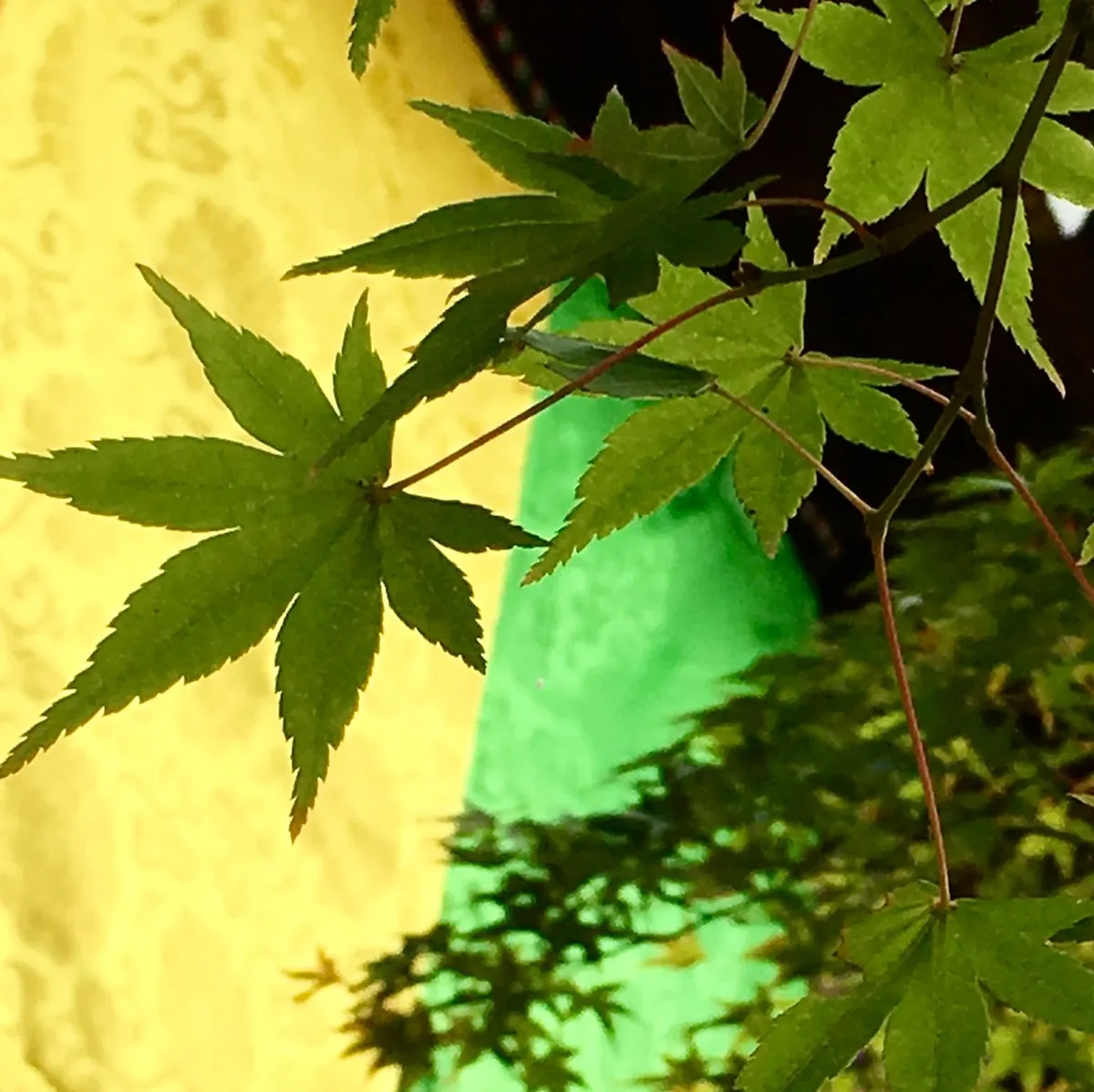
Japan's autumn palette comes primarily from two trees: the momiji (Japanese maple) and the icho (ginkgo). Maples produce the deep crimson and scarlet tones that dominate most Kyoto foliage photography. Ginkgo produces a uniform, bright yellow — a striking contrast when both appear together. The word "koyo" (紅葉) technically refers to all autumn leaves but is most closely associated with maple; confusingly, "momiji" also means autumn leaves in older usage while simultaneously naming the maple tree.
Timing matters: maples typically reach peak color about one week before ginkgo trees do. If you visit in the third week of November, you are most likely to catch both simultaneously. Pure maple views are best at Eikando, Tofuku-ji, and Honen-in. For ginkgo, the avenue at Nishi Hongan-ji Temple and the approach to Heian Shrine are the go-to spots. Kinkaku-ji (the Golden Pavilion) has a good mix of both, with ginkgo surrounding the outer perimeter and maples closer to the pond — the golden leaves against the gold-leafed pavilion is a shot most visitors do not expect.
Ginkgo trees drop their leaves faster than maples — a single gusty day can clear an entire tree. If the JMC forecast shows ginkgo at peak, prioritize those spots immediately. Maples hold their color for 10–14 days once peak starts; ginkgo often lasts only 5–7 days.
Night Illuminations: Day vs. Evening Visits
Several major temples run ticketed evening light-up events during the autumn season. These illuminations change the character of a visit completely — the maples glow from below against a dark sky, reflections appear in garden ponds, and the usual daytime crowds thin out (though popular events like Eikando's illumination still attract significant queues).
Eikando's illumination (mid-November to mid-December, 17:30–21:00) is the gold standard. The pond reflection at night is one of the most photographed sights of the season. Admission is the same 1,000 yen. Kodaiji Temple in Higashiyama runs a different kind of event — digital projection mapping onto its rock garden, which blends traditional architecture with modern art. Kiyomizu-dera's evening illumination focuses on the city-panorama view, which takes on a different quality after dark. All three events require separate admission from the daytime entrance; some nights are ticketed in advance only, so check official websites from October onward.
The trade-off between day and evening visits: daytime gives you better photography in natural light and access to the full garden interiors. Evening is more atmospheric but often limited to specific viewing zones. If possible, visit Eikando twice — once at 09:00 when it opens, and once for the illumination on a different evening. The experience is genuinely different enough to justify both entries.
Illumination events draw heavy crowds on weekends, particularly at Eikando and Kiyomizu-dera. Expect 30–40 minute queues after 18:00 during peak weeks. Arrive by 17:00 for the shortest wait, or visit on a weekday evening instead.
Kyoto Fall Festivals and Seasonal Cultural Events
The Jidai Matsuri (Festival of Ages) takes place on October 22 each year. A procession of around 2,000 participants walks from the Imperial Palace to Heian Shrine in period costumes spanning every era of Japanese history, from the Heian period through the Meiji era. It is one of Kyoto's three great festivals and free to watch from the street along the parade route. The festival predates the autumn foliage peak by about three weeks, making it a compelling reason to arrive in Kyoto in late October.
The Gion Odori runs from November 1 to 10, with geisha performers from the Gion Higashi district presenting traditional dance at the Gion Kaikan theater. Tickets must be purchased in advance through the Kyoto City Tourist Association or participating travel agencies. This is one of the few structured opportunities to watch a geisha performance outside a private reservation — prices run around 4,000 yen per seat.
The Higashiyama Jidai Matsuri and the various temple illumination events overlap into a dense cultural calendar across October and November. If you plan to attend the Gion Odori (first ten days of November) and also catch peak foliage (late November), you effectively have two distinct trips inside one broader autumn visit window.
Temple Fees, Hours, and the Early Bird Strategy
Crowd management is the most important logistical issue during Kyoto's autumn foliage season. Buses on the main foliage routes (100-series and 206) can run 30–45 minutes late during peak weeks. Subway and rail are far more reliable. Walk when sites are within 20 minutes of each other — the Philosopher's Path route (Ginkaku-ji to Eikando to Nanzen-ji) is flat and faster on foot than waiting for buses.
Here is a practical comparison of the major sites for daytime planning in 2026:
| Temple | Opening Time | Admission | Night Illumination |
|---|---|---|---|
| Eikando | 09:00 | 1,000 yen | 1,000 yen (17:30–21:00, Nov 11–Dec 10) |
| Kiyomizu-dera | 06:00 | 400 yen | Check official site (late Nov–early Dec) |
| Tofuku-ji (Tsutenkyo Bridge) | 09:00 | 600 yen | No illumination |
| Tenryu-ji garden | 08:30 | 500 yen (+ 300 yen for buildings) | No illumination at main temple |
| Kinkaku-ji | 09:00 | 400 yen | No illumination |
| Ginkaku-ji | 08:30 | 500 yen | No illumination |
| Shinnyodo | Open hours | Free | Minimal wait times |
The early bird strategy: at Kiyomizu-dera, which opens at 06:00, you can be inside by 06:10 and have the platform view largely to yourself until 08:00. Pair this with a walk down Sannen-zaka before the shops open for an atmospheric 90-minute start. From there, take the Kintetsu Line directly to Tofukuji Station, arriving at Tofuku-ji around 09:10 for first entry. By 11:30 you have cleared two of the biggest sites before the tour buses have finished loading. Spend the afternoon at Eikando and return for the illumination that evening. That single day covers three unmissable spots with manageable crowds at each one.
For accommodation, staying in Higashiyama puts you within walking distance of Kiyomizu-dera, Kodaiji, Honen-in, and Eikando. Arashiyama lodgings are better if you prioritize the western district but come with a longer commute to the eastern temples. Check the Kyoto food guide for restaurant options near each district — Pontocho and the Nishiki market area are both useful dinner options regardless of where you base yourself. If you're deciding where to stay, review our best area to stay in Kyoto guide to match your priorities with each neighborhood.
Explore Kyoto's Autumn Foliage Season
Dig deeper into when and where to see koyo across Kyoto, from month-by-month timing to the temples, hikes, and festivals that define the season.
Explore autumn foliage guide in other cities
Frequently Asked Questions
When is the best time for fall foliage in Kyoto?
The peak usually occurs between mid-November and early December. Colors stay vibrant for about two weeks depending on the wind. Check local forecasts for real-time updates.
Is Kyoto worth visiting in autumn?
Yes, it is widely considered the most beautiful season in Japan. The combination of ancient architecture and red maples is unique. Just be prepared for high prices and crowds.
Are there night illuminations in Kyoto?
Many temples like Eikando and Kiyomizu-dera hold special evening light-ups. These events usually run from sunset until 9:00 PM. They offer a completely different perspective of the leaves.
Experiencing the kyoto autumn foliage is a bucket-list event for many. With careful timing using the JMC forecasts, an early morning start, and at least one night illumination visit, you can see the season at its most spectacular. Focus on Eikando as your anchor, add Tofuku-ji early in the trip, and save a morning for a hidden gem like Shinnyodo or Honen-in. If you're building out your full itinerary, check our 3-day Kyoto itinerary for how to structure autumn foliage season with other attractions. The combination of ancient temples and vivid seasonal color is unlike anywhere else in the world.
Don't forget to explore nearby areas like the Osaka Fall Foliage spots. You can also see Tokyo's Best Fall Foliage Spots if you travel through Japan. Kyoto remains the heart of Japan's autumn beauty. Enjoy the crisp air and the stunning seasonal transformation.
Pair your autumn-leaf hunting with our full guide to the best things to do in Kyoto for the wider city overview.
Free: The Kyoto Essentials guide
Top things to do, where to stay, a perfect day plan, getting around, and the best time to go — a Kyoto mini-guide you can take offline.
You might also like


Continue reading
More guides you'll find useful