Tokyo Subway Guide 2026: 10 Steps to Use the Metro
Master the Tokyo Metro in 2026. Our guide covers 10 essential steps including Suica/Pasmo setup, 24-hour passes, navigation apps, and expert transfer tips.
On this page
Navigating Tokyo for the first time can feel like solving a giant neon puzzle. I remember my first trip when I spent twenty minutes wandering Shinjuku Station looking for an exit. The massive network of tunnels and trains is daunting but incredibly efficient once you learn the basics. Last updated June 2026, this guide reflects the latest pricing and digital ticketing rules.
Tokyo's rail system is the backbone of Getting Around Tokyo: Complete Subway & Train Transport Guide 2026 effectively. It combines the Tokyo Metro, Toei Subway, and the JR East lines into one seamless web. We used the subway daily on our last visit to reach every major landmark quickly. This guide simplifies the process so you can focus on enjoying the city's incredible sights.
Understanding the Tokyo Subway Map and Network
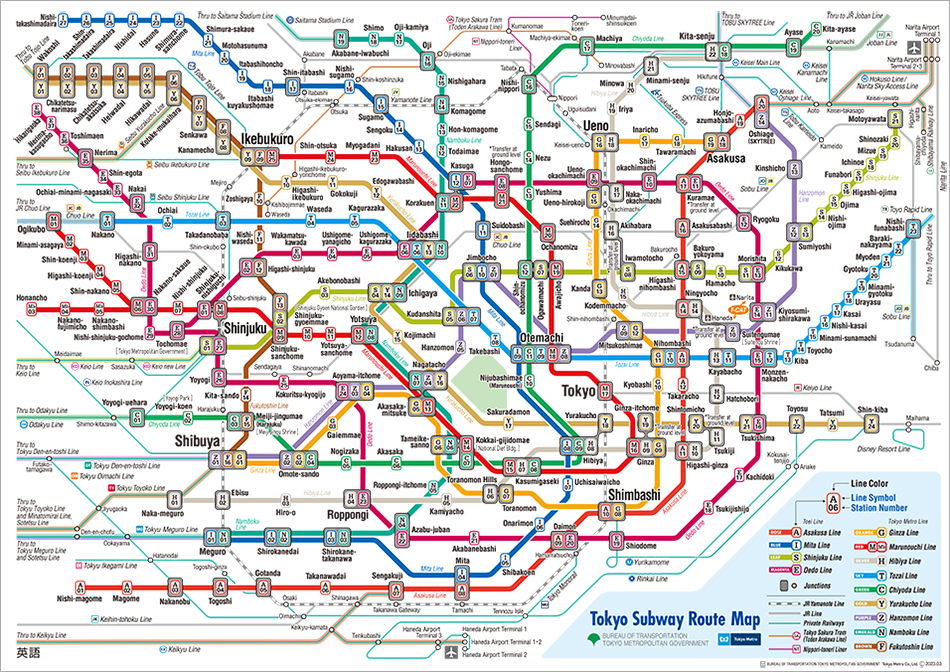
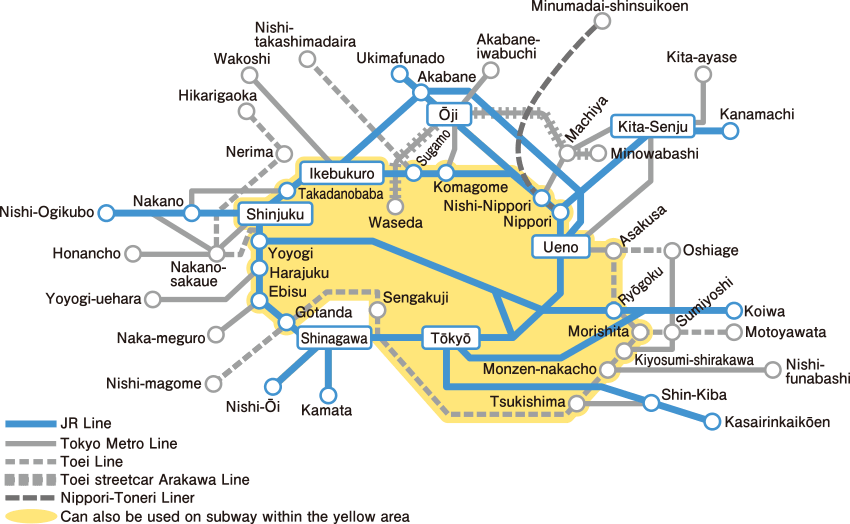
The Tokyo subway system divides into three main networks: JR East, Tokyo Metro, and Toei Subway. Tokyo Metro runs nine lines — Ginza (G), Marunouchi (M), Hibiya (H), Tozai (T), Chiyoda (C), Yurakucho (Y), Hanzomon (Z), Namboku (N), and Fukutoshin (F). Toei Subway adds four more: the Asakusa (A), Mita (I), Shinjuku (S), and Oedo (E) lines. JR East operates the famous Yamanote Loop and connects central Tokyo to suburban areas and airports.
Each line has a letter code and a color. Stations also carry alphanumeric codes — for example, Ginza Station is G09 on the Ginza Line and M16 on the Marunouchi Line. Using these codes is far easier than reading Japanese station names. Look for the code on platform signs, train displays, and every wall map inside the station.
Download the Tokyo Metro Official Map before you arrive and save it offline. The JR East Official Map shows which JR lines overlap with Metro stations. Most stations have large wall maps with English labels, but having a phone copy means you never need to stop in a crowd. All Tokyo Metro stations operate between 05:00 and midnight, seven days a week.
Choosing the Right Pass or IC Card: Cost Comparison
Choosing the right payment method depends on your daily travel volume. Digital IC cards like Suica and Pasmo are the best default for casual travelers doing two or three short trips a day. If you plan to visit four or more spots spread across the city, a 24-hour Tokyo Subway Ticket saves money immediately. The table below shows the main options for 2026.
| Payment Method | Cost | Coverage | Best For |
|---|---|---|---|
| IC Card (Suica/Pasmo) | Free (digital) or ¥500 deposit (physical); ¥170–¥330 per trip | All trains, buses, convenience stores | Flexible travelers with <4 trips/day |
| Tokyo Subway Ticket — 24h | ¥800 (~$5.50); ¥400 for children | All 9 Tokyo Metro + all 4 Toei Subway lines | 1-day city tours; break-even after 3–4 rides |
| Tokyo Subway Ticket — 48h | ¥1,200 (~$8.20) | All 9 Tokyo Metro + all 4 Toei Subway lines | 2-day focused sightseeing sprints |
| Tokyo Subway Ticket — 72h | ¥1,500 (~$10.30) | All 9 Tokyo Metro + all 4 Toei Subway lines | 3-day visitors; foreigners only (requires passport) |
| Tokyo Metro 24-Hour Ticket | ¥700 (~$4.80) | 9 Tokyo Metro lines only (no Toei) | Budget option; generally worse value than Subway Ticket |
One practical trick most guides miss: the validity period starts from your first tap, not from midnight. If you first use a 24-hour Subway Ticket at 18:00 on Day 1, it remains valid until 18:00 on Day 2 — covering an entire evening plus the following day's sightseeing. Activating your ticket after dinner on arrival day is a smart way to stretch coverage across what effectively feels like two full days.
How to Buy Tickets and IC Cards at the Station
Every Tokyo Metro and Toei station has multilingual ticket machines with an English button in the top-right corner. For a single trip, press English, then select your destination from the fare map above the machine — fares range from ¥170 to ¥330 for adults. Insert cash (machines accept ¥1,000, ¥5,000, and ¥10,000 notes) or use a credit card for pass purchases. Collect your ticket or IC card top-up receipt before walking away.
To buy the Tokyo Subway Ticket at a machine, look for the "Discount Tickets" or "Otokuna Kippu" option on the main menu. At Narita and Haneda airports, dedicated ticket windows sell the tourist pass without queuing at machines — bring your passport. Online purchase is also possible; QR code tickets are valid for 90 days and activate on first tap, though a small number of older station gates do not yet read QR codes.
For IC card top-ups, select "Charge" on any machine and insert your card into the slot or tap it on the reader. Add ¥1,000 to ¥10,000 in increments. Keep at least ¥2,000 / ~$14 loaded at all times to avoid gate errors at the end of a long day. If you run short inside the gate, yellow "Fare Adjustment" machines at every exit let you pay the difference before you leave.
Setting Up Your Digital Suica or Pasmo Card
In 2026, physical IC cards are often in short supply for short-term visitors. Setting up a digital version on your smartphone is the most reliable method. Apple users can add a Suica or Pasmo directly through the Wallet app in under two minutes — no counter visit required. The card works instantly at gates without unlocking your phone, and you top it up with any international Visa, Mastercard, or Amex stored in Apple Pay.
Android users may need a Japan-purchased phone for full Osaifu-Keitai NFC compatibility. If your Android device is not compatible, look for the Welcome Suica physical card. These tourist cards are valid for 28 days, require no deposit fee, and are sold at kiosks inside Haneda and Narita airport train stations. Keep the reference paper that comes with it — station staff may ask to see it.
Digital cards also work at vending machines and convenience stores across Japan. I always keep at least ¥2,000 on my card to avoid delays at exit gates. You can track your balance and top-up history directly in the Wallet app. Unlike the Tokyo Subway Ticket, an IC card never expires and works on JR lines, private railways, and buses — making it the best long-term tool for frequent riders.
For a deeper look at how the subway fits into your daily plan, see our Tokyo Neighborhoods Guide: 16 Best Districts to Visit to match each district with its nearest Metro line.
Good to know
Keep ¥2,000 on your IC card at all times. Low balances cause gate errors at exit, and if you're caught short, staff can run your card through a fare adjustment machine — but it adds a few minutes to your exit time. Top up whenever you pass a convenience store (FamilyMart, Lawson, 7-Eleven all have readers) rather than waiting until you hit the gate.
Navigating Stations and Platforms Step by Step
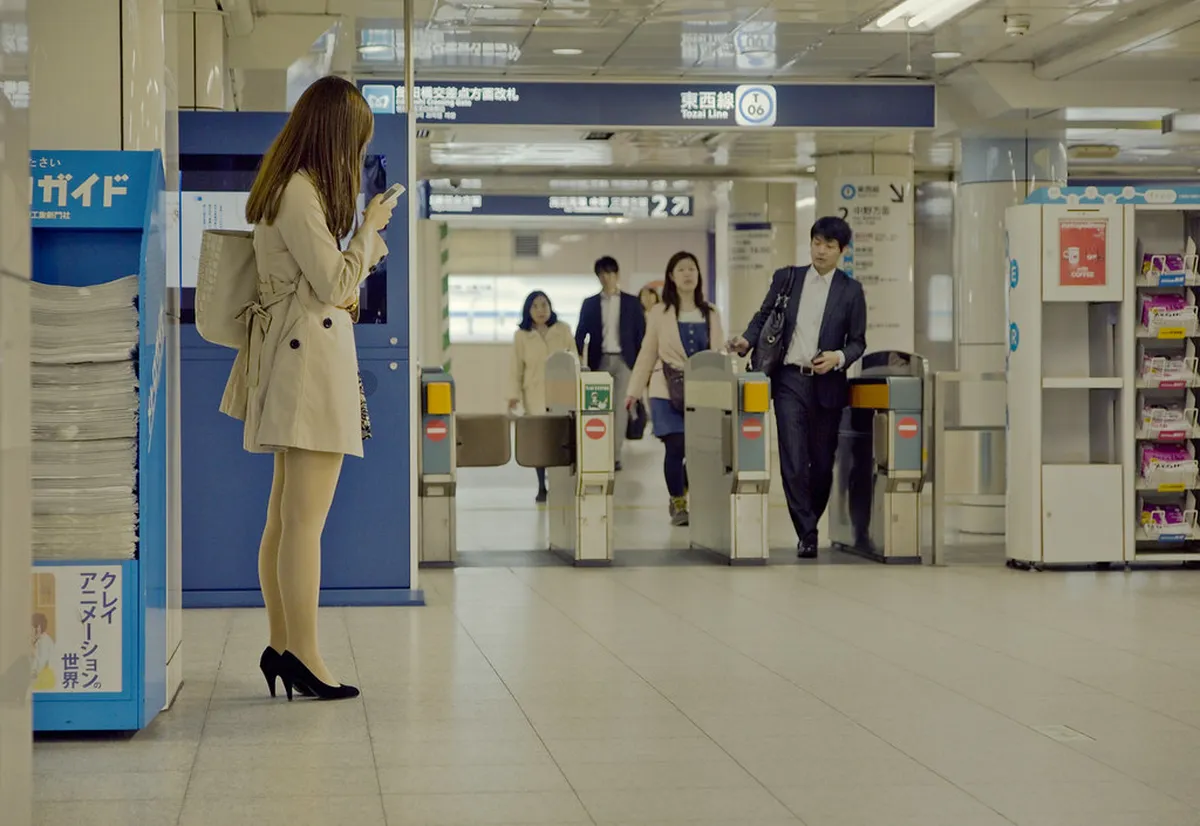
Mastering the physical process of riding the subway saves you time and stress. Station alphanumeric codes like G09 (Ginza Line, Station 9) make it straightforward to confirm you are heading in the right direction without reading Japanese. Check the large route map at the ticket gate area, confirm your destination code, and follow color-coded signs to the correct platform. Platform-level signs always show the "bound for" terminal station in both Japanese and English.
- Identify your destination code. Use the letter and number (e.g., H07 for Roppongi on the Hibiya Line). Spend two minutes on the wall map before purchasing.
- Purchase or top up your payment method. Use the English-language ticket machine or tap through with a digital Suica/Pasmo. A typical single trip costs ¥170–¥330.
- Tap your card at the gate. Hold your phone or card over the blue sensor for one second. Gates with green arrows are open; red X gates are exit-only or closed.
- Follow platform signs. Walk toward the correct platform, usually 3–5 minutes in larger stations. Electronic displays show train arrival times in minutes.
- Board and watch the displays. Line up behind floor markings and wait for passengers to exit first. Trains run every 3–5 minutes during peak hours. English announcements play at each stop.
- Tap out at your destination. Touch your card at the exit gate to calculate the final fare. If your balance is low, use the yellow Fare Adjustment machine before exiting.
Station staff stand near the gates during busy hours and carry translation devices. They can print a route slip for you if you show them your destination on Google Maps. Never be afraid to ask — Tokyo station staff are accustomed to helping tourists navigate even the most complex interchanges.
Best Apps for Tokyo Subway Navigation in 2026
Google Maps is the most reliable starting point. It reads real-time Tokyo Metro schedules, shows platform numbers, and highlights which train car to board for the fastest transfer exit. For 2026, Google Maps also flags service alerts and brief delays on the major lines. Download your map area offline before you land so it works without a data connection.
Japan Transit by Jorudan is the local favorite for serious transit planning. It shows fare breakdowns across multiple ticket types, highlights priority seating availability, and identifies barrier-free routes for travelers with luggage or strollers. The app also lets you filter routes by price, transfer count, or travel time — useful when you are weighing whether to use your Subway Ticket or pay a separate JR fare. Download it free from the App Store or Google Play and update it before your trip for 2026 schedule changes.
JapanTravel by NAVITIME adds a re-routing feature that is particularly useful in 2026. Tokyo's Metro lines experience brief but frequent signal delays, especially on the Tozai and Chiyoda lines during morning rush. NAVITIME detects these in real time and suggests alternative routes, showing you exactly which platform to switch to. The app also supports Tokyo Subway Ticket pass routing, calculating which rides are covered and which cost extra.
The Tokyo Metro official app (available at Tokyo Subway App by Mapway) provides a clean offline map with search by station code. It's the fastest way to look up a line without loading a full route query. Use it as a backup when NAVITIME or Google Maps is slow to load underground.
Mastering Transfers: The Orange Gate Rule and the 30-Minute Window
Transferring between different subway companies can be costly if you don't know the rules. When moving between Tokyo Metro and Toei Subway lines, look for the orange-colored ticket gates marked "Transfer" at the connecting corridor. Passing through these gates keeps your journey continuous and applies the inter-operator discount. If you exit through a standard gate instead, the system treats your next boarding as an entirely new trip — you pay full price again.
You have exactly 30 minutes to complete a transfer through orange gates. Start the clock from the moment you tap out at one company's gate. If you exceed 30 minutes — say, you stopped for a convenience store snack in the connecting corridor — the discount is lost and you pay two separate base fares. Some major interchange stations like Otemachi and Oshiage involve a long underground walk, so factor in the time and move directly to the orange gate first.
Note that this transfer rule applies to IC card users and single-journey ticket holders. If you hold a Tokyo Subway Ticket covering both Metro and Toei lines, you can transfer freely between all 13 lines with a single tap — no orange gate required and no time limit to worry about. This is one of the strongest practical reasons to choose the Subway Ticket over the Metro-only 24-hour pass.
CHIKATOKU Discounts, Baby Metro, and Accessibility Tips
Holding a valid Tokyo Metro 24-Hour Ticket or Tokyo Subway Ticket unlocks the CHIKATOKU benefit program. Show your pass at approximately 180 affiliated venues across Tokyo to receive discounts and small gifts. Partner venues in 2026 include observation decks like Tokyo Tower Main Deck, aquariums such as Sumida Aquarium inside Tokyo Skytree, the Roppongi Hills Tokyo City View observatory, and dozens of museums, restaurants, and shopping malls. Check the CHIKATOKU official website before each day's sightseeing — the list changes seasonally and new venues join throughout the year.
Travelers with strollers, heavy luggage, or mobility needs should use the Baby Metro Accessibility Guide before planning routes. Baby Metro maps every station's elevator locations, wide ticket gates, and barrier-free paths to each platform. Major tourist stations like Shibuya, Shinjuku, and Ueno have full elevator access, but some smaller interchange stations still require stairs for at least one transfer direction. The guide updates in real time when elevators are under maintenance — check it the morning of your visit to avoid getting stuck mid-transfer with a stroller.
If you are traveling with an infant or oversized luggage, note that the Oedo Line runs the deepest underground of any Tokyo subway line — some platforms are more than 40 meters below street level, with long elevator rides. The Ginza Line and Marunouchi Line run much shallower and have shorter connections between street and platform. For itineraries heavy with luggage, prioritizing shallower lines reduces the physical effort significantly.
Tokyo Subway Etiquette and Rules
Tokyo commuters follow a precise social contract on the trains. Set your phone to silent and avoid voice calls — even quiet talking on the phone draws disapproving looks. Do not eat or drink while on the train, even on a long Tozai Line crossing. Priority seating (silver-blue seats near the doors) is reserved for elderly, pregnant, and disabled passengers; vacate without being asked if someone approaches.
On the platform, line up behind the floor markings and let passengers exit fully before you board. During rush hours — 07:30 to 09:30 and 17:30 to 19:30 on weekdays — the Yamanote and Marunouchi lines are intensely crowded. Remove your backpack and hold it in front of you, or place it in the overhead rack to create space. Move toward the center of the car to allow more passengers to board near the doors.
Avoid spreading large maps or luggage in the aisle. If you need to check your route, step aside at the edge of the platform area before entering the boarding queue. Trains in Tokyo arrive to within seconds of their scheduled time — standing on the yellow safety line is not necessary and station staff actively discourage it.
Good to know
Avoid peak rush hours if possible. Between 7:30–9:30 AM and 5:30–7:30 PM on weekdays, trains on the Yamanote and Marunouchi lines are packed shoulder-to-shoulder — women-only cars are designated on some trains, and pickpocketing risk increases slightly. If you must travel during these windows, avoid boarding near the doors and keep your phone in a front pocket, not a backpack.
Common Tokyo Subway Problems and How to Fix Them
Even with a perfect plan, minor transit hiccups happen. The most common is an "insufficient balance" error at the exit gate. Don't panic — step to the side and use the yellow Fare Adjustment machine next to any exit gate. Insert your IC card, pay the difference shown on screen, and exit normally. The process takes under 30 seconds.
- Gate beeps red: Check your card balance at the nearest yellow adjustment machine. Ensure you didn't accidentally tap two cards simultaneously. Ask the station attendant at the staffed gate if the screen shows an error code.
- Wrong exit taken: Large stations like Shinjuku have over 200 exits leading to different streets. Check the yellow wall maps to find your current street position. It is often faster to walk outside than to re-enter the paid area.
- Missed the last train: Most subway lines stop between midnight and 05:00. Taxis are available but expensive late at night. Look for a nearby 24-hour convenience store or café if you are waiting for first service.
- Lost physical ticket: You must pay the maximum possible fare from the starting station to exit. Explain your situation to the station attendant using a translation app. Always keep paper tickets in a secure pocket until you exit.
- Digital NFC not reading: Restart your phone's NFC and try again. Remove any thick phone case that can block the signal. If the issue persists, ask the attendant to manually process your card balance.
Tokyo is incredibly honest about lost property. If you leave a bag or passport on a train, report it immediately to the station master's office. Most items are returned to the nearest station's lost property counter within a few hours. Keep the station name and time of travel noted so staff can identify the correct train.
Essential Preparation Checklist Before You Enter the Station
Being prepared before you enter the station makes the experience much smoother. Check your phone battery before heading into underground tunnels — charging stations are rare inside the paid area, so carry a portable power bank. A small amount of physical cash (¥2,000–¥3,000) is still useful for older ticket machines and fare adjustment situations.
- Download and update your transit app: Google Maps or Japan Transit by Jorudan for real-time platform numbers and transfer guidance. Update for 2026 schedule changes before arrival.
- Add Suica or Pasmo to your mobile wallet: Eliminates queuing at ticket machines and lets you track spending directly on your phone.
- Carry a portable battery pack: Navigation apps and digital tickets drain smartphone batteries quickly. Most convenience stores sell pre-charged emergency packs if you forget one.
- Check station accessibility: Use the Baby Metro site if you have heavy luggage or strollers. It identifies which exits have elevators and which platforms have wide ticket gates.
- Learn basic etiquette: Silent mode, no food or drink, let passengers exit first. These habits make the entire journey faster and more comfortable for everyone.
Also check our Where to Stay in Tokyo: 10 Best Neighborhoods guide to see which Metro lines serve your accommodation area — choosing a hotel near a key interchange like Otemachi or Shinjuku-sanchome puts you within one stop of nearly any line in the city.
Continue planning with Tokyo Trip Planner 2026: Attractions, Neighborhoods and Itineraries.
Frequently Asked Questions
Can I use the JR Pass on the Tokyo Subway?
The standard JR Pass only works on JR-operated lines like the Yamanote Loop. It is not valid on Tokyo Metro or Toei Subway lines. You will need a separate IC card or subway pass.
What is the 30-minute orange gate rule?
When transferring between different subway companies, you must use the orange gates. You have 30 minutes to complete the transfer to keep the fare discount. Exceeding this time results in a higher total cost.
Are Tokyo subways open 24 hours?
No, the Tokyo subway system closes nightly between midnight and 5:00 AM. Always check the last train time for your specific line to avoid being stranded. Taxis are the only alternative during these late hours.
Using the Tokyo subway in 2026 is easier than ever thanks to digital tools and the clear station numbering system. By setting up a mobile IC card and downloading a real-time navigation app, you can glide through the city effortlessly from day one. The combination of speed, cleanliness, and punctuality makes it a world-class transit experience.
With this guide, you are ready to explore every corner of the Japanese capital. Don't be afraid to ask station staff for help if you feel lost — they are used to it, and usually have a translation device ready. Enjoy the ride and the incredible views as you travel between Tokyo's vibrant districts.
Free: The Tokyo Essentials guide
Top things to do, where to stay, a perfect day plan, getting around, and the best time to go — a Tokyo mini-guide you can take offline.
You might also like


Continue reading
More guides you'll find useful