Getting Around Tokyo: Complete Subway, Train & Suica Guide
Tokyo's March 2026 fare changes explained: Suica vs Pasmo, which tourist pass to buy, airport transfers, and how to read two subway systems.
On this page
Navigating Tokyo's rail network can feel overwhelming at first glance. Dozens of lines, multiple operators, and two separate subway companies all share the same underground tunnels. This guide cuts through the confusion so you can get from the airport to your hotel and from Asakusa to Shibuya without standing frozen in front of a fare chart.
March 2026 brought real changes to the system — new ticket prices, a fare hike on JR lines, and the launch of a replacement for the old PASMO PASSPORT. If you read a guide from 2024 or early 2025, some of those figures are now wrong. Use this resource to plan a smooth Tokyo Itinerary: The Ultimate 5-Day Guide for 2026 with the correct 2026 prices.
The most important decisions happen before you tap through the gate for the first time: which card to carry, whether a pass makes financial sense, and how to get from the airport without overpaying. Everything else follows naturally once those basics are settled.
Understanding the Tokyo Rail Network: JR, Metro, and Toei
Three major entities handle the bulk of journeys you will make during a typical Tokyo visit. Recognising their logos and understanding where each one operates is the single most useful thing you can learn before arriving.

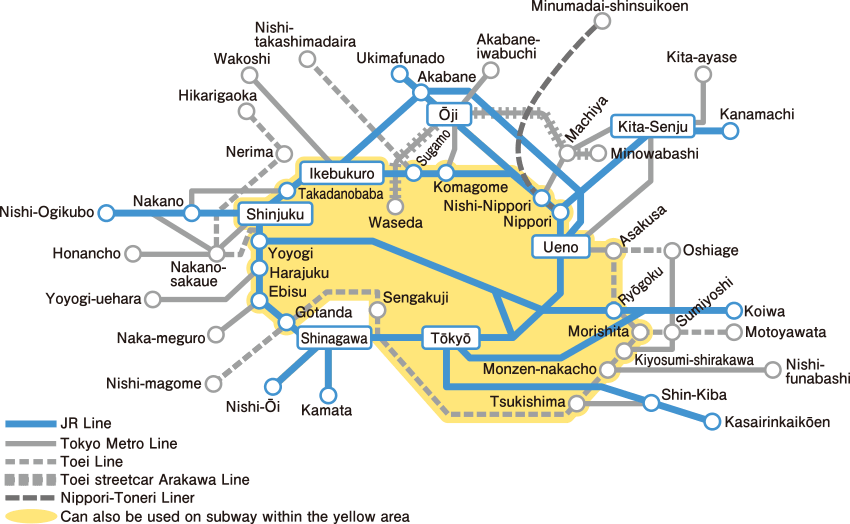
JR East runs the Yamanote Line, the green loop that circles the central districts. It also operates the Chuo Line, the Keiyo Line (essential for Tokyo Disneyland), and the Narita Express to the airport. JR is above ground for most of its Tokyo routes, which makes it easier to orientate yourself than deep underground sections.
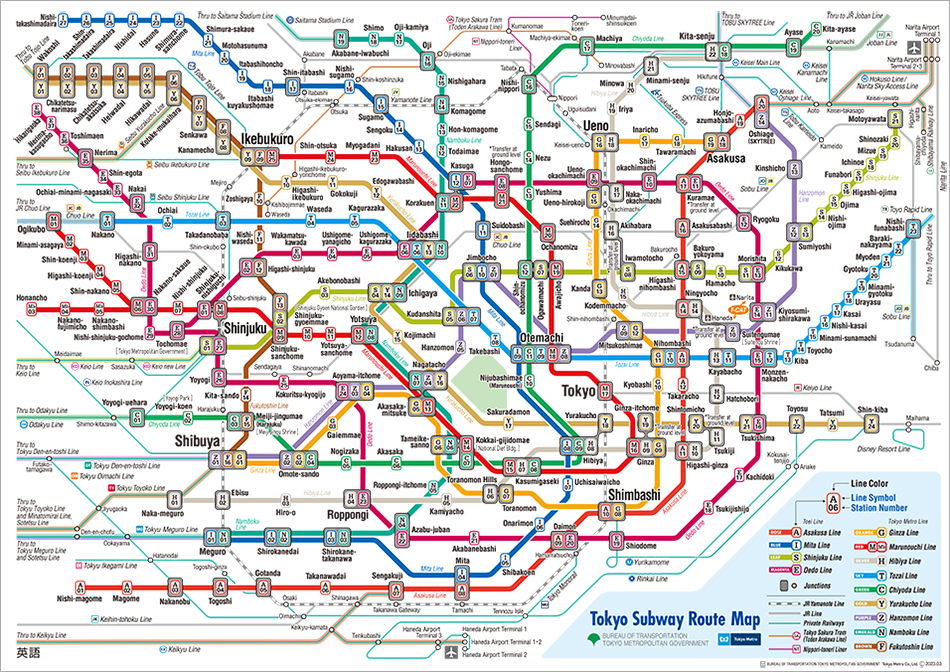
Tokyo Metro Co., Ltd. operates 9 underground lines across roughly 195 km of track, carrying about 6.84 million passengers per day. These lines cover the vast majority of tourist destinations in central Tokyo. Each line has a colour, a letter code, and numbered stations — the orange Ginza Line is G, and Shibuya is G01 while Asakusa is G19.
Toei Subway is the second underground operator, run by the Tokyo Metropolitan Government. It adds four more lines: the Oedo (E), Shinjuku (S), Mita (I), and Asakusa (A) lines. Toei and Tokyo Metro are completely separate companies, which matters enormously for fares and passes — a ride that crosses both systems costs more than one that stays on a single operator.
The 2026 Tokyo Metro Map: Lines and Colors
Every Tokyo Metro line has a colour, a one-letter code, and numbered stations. The orange Ginza Line is G; the red Marunouchi Line is M; the leaf-green Chiyoda Line is C. Once you start reading stations as letter-plus-number combinations — say, H07 for Roppongi on the Hibiya Line — navigation becomes far faster than trying to read Japanese station names.
Toei lines follow the same logic but with different letters. The Oedo Line is E, the Shinjuku Line is S. Both systems display station codes on platform signs, in-carriage displays, and on most maps, so you can track your progress stop by stop without needing Japanese.
Always keep a copy of the Tokyo Metro Official Subway Map saved to your phone for offline use. Connectivity in the deepest tunnels can be unreliable, and the map loads faster than any app when you are in a hurry. The JR East network map is equally useful for planning any ride on the surface loop lines.
Some subway trains continue onto private suburban rail tracks when they reach the end of their official Metro section. This is called a through service. The train changes its destination sign mid-journey and the fare may adjust when you exit. Watch the in-carriage display screens and you will see the final stop update — this is normal and not a malfunction.
Tokyo Transportation Cards Guide: Suica, PASMO, and IC Cards
Prepaid IC cards are how most visitors pay for every single train, bus, and subway ride. Suica and PASMO are the two main brands and they are interchangeable across all operators. You tap the card on the reader at the gate, the fare deducts automatically, and you walk through — no fare chart required.
The Welcome Suica is the tourist-oriented version of the standard Suica card. It is valid for 28 days from purchase, requires no refundable deposit, and is sold at Narita and Haneda airports plus major JR stations such as Tokyo, Ueno, Ikebukuro, Shibuya, and Shinagawa. Any remaining balance at the end of 28 days is non-refundable, so spend it down on convenience store purchases or vending machines before you leave. Welcome Suica Mobile launched in March 2025 for iPhone and Apple Watch, and is valid for 180 days from issue — the longest of any tourist option.
The PASMO PASSPORT was discontinued. Its replacement, the TOURIST PASMO, launched in May 2026. It is valid for 28 days from first use and is sold at Narita (preloaded with ¥2,000) and Haneda (choose ¥1,000 to ¥10,000). Functionally it works identically to a regular PASMO and covers JR, all private railways, Metro, Toei, and buses. If Welcome Suica is unavailable at the machines when you arrive — shortages still occur during peak travel periods — TOURIST PASMO is the direct alternative.
Digital Suica cards work on iPhone, Apple Watch, and Android phones via Google Pay or the Suica app. You can top up using most international credit cards directly from your phone. For more on navigating the system day-to-day, see our Tokyo Subway Guide 2026: 10 Steps to Use the Metro for 2026.
Should You Buy a Pass or Use an IC Card?
The decision comes down to how many rides you expect to take per day and which operators you will use. An IC card is the most flexible tool because it works on every single rail operator and bus. A pass saves money only when your ride count is high enough to beat the per-ride cost.
The Tokyo Subway Ticket covers unlimited rides on both Tokyo Metro and Toei Subway. After the March 14, 2026 price revision, adult prices are now ¥1,000 for 24 hours, ¥1,500 for 48 hours, and ¥2,000 for 72 hours. You break even on the 24-hour pass at roughly four to five subway rides in a day. If you mostly take the JR Yamanote Line between stations, the pass does not cover those rides and an IC card is cheaper.
The Tokyo 1-Day Ticket costs ¥1,600 for adults and covers JR East lines within the 23 wards, all Metro lines, all Toei lines, Toei buses, and the Nippori-Toneri Liner. It is more expensive than the subway-only pass but makes sense if you plan multiple JR trips in a single day alongside subway rides. It can only be purchased at stations within Tokyo, not at the airport.
- Take four or more subway rides per day and you are staying in the central districts: the Tokyo Subway Ticket (¥1,000 for 24h) will save you money.
- Mix JR and subway heavily in one day: the Tokyo 1-Day Ticket (¥1,600) covers everything except private railways.
- Travel at a relaxed pace with two or fewer rides daily: keep the IC card and pay as you go.
| Pass Name | Price (Adult) | Duration | Coverage |
|---|---|---|---|
| Tokyo Subway Ticket 24h | ¥1,000 | 24 hours | Tokyo Metro + Toei Subway |
| Tokyo Subway Ticket 48h | ¥1,500 | 48 hours | Tokyo Metro + Toei Subway |
| Tokyo Subway Ticket 72h | ¥2,000 | 72 hours | Tokyo Metro + Toei Subway |
| Tokyo 1-Day Ticket | ¥1,600 | 24 hours | JR East (23 wards) + Metro + Toei + Buses |
| Welcome Suica | Varies | 28 days | All operators (IC card — pay-as-you-go) |
| TOURIST PASMO | ¥1,000–¥10,000 | 28 days | All operators (IC card — pay-as-you-go) |
Single-Ride Fares If You Don't Want a Pass
Buying single-ride tickets is perfectly sensible if you only plan one or two journeys. Every station has ticket machines with an English-language button. Look at the large fare map above the machines to find the cost for your destination, then pay that amount at the machine.
Tokyo Metro single-ride adult fares come in five tiers: ¥180, ¥210, ¥260, ¥300, and ¥330. These include a small station barrier-free surcharge introduced in recent years. Toei Subway single rides range from ¥180 to ¥430 depending on distance. Children aged five and under ride free; ages six to eleven pay half the adult fare.
JR East raised its fares on March 14, 2026 — the first system-wide revision since 1987, averaging around 7.1%. The minimum JR base fare rose from ¥150 to ¥160. A Tokyo Station to Shibuya ticket now costs ¥260, up from ¥210. This affects only JR lines, not the subway, but it is worth knowing when comparing route options. If you have a ticket for the wrong amount, the yellow fare adjustment machines at every exit let you pay the difference without penalty.
Single tickets are small magnetic slips you insert into the gate. Pick the ticket up from the other side as the gate opens — you must keep it and insert it again at the exit. IC card users never deal with this step, which is one practical reason most visitors prefer carrying a card even for only a few journeys.
Step-by-Step: Your First Ride on the Tokyo Subway
Find the station entrance by looking for the round Tokyo Metro logo — a stylised blue M — or the Toei green ginkgo-leaf symbol. Larger stations have multiple entrances labelled A1, B2, C3, and so on. Choose your entrance carefully because crossing underground between exits at hubs like Shinjuku or Otemachi can take ten minutes or more.
At the gate, tap your IC card flat against the reader panel until you hear a beep and the gate light turns green. The small screen briefly shows your remaining card balance. If you have a paper ticket, insert it into the slot and take it from the other side before walking through. Approach the gate at a normal walking pace — hesitating and then lunging causes the gates to close on you.
On the platform, wait behind the yellow tactile paving. Passengers queue in neat columns at the door markings on the floor. Always let people off the train before boarding. The in-carriage displays show the upcoming station in English, Japanese, Chinese, and Korean, so you can confirm you are heading in the right direction.
At your destination, follow the yellow exit signs. Exit numbers and nearby landmarks appear on signs above the paid area — check them before tapping out. Tap your IC card at the exit gate and the fare deducts automatically. If you used a paper ticket, the machine swallows it at the exit.
Transfers and Why They Get Expensive
Switching between different rail companies increases your total fare because each operator charges its own base fee when you enter their system. A trip that touches both JR and Tokyo Metro, or both Metro and Toei, will always cost more than one that stays within a single operator from start to finish.
A 70-yen discount applies when you transfer between Tokyo Metro and Toei Subway using an IC card. This discount is applied automatically — you do not need to do anything special. Look for the orange transfer gates at stations where the two networks share a building; swiping your card at these dedicated gates rather than the standard exit gates keeps your fare as one continuous journey with the discount applied.
Toei Oedo Line transfers are not included in Tokyo Metro's 60-minute same-operator grace period. And subway-to-JR transfers are always separate fares with no discount regardless of IC card use. This is precisely why the Tokyo Subway Ticket delivers strong value for visitors who make frequent mixed Metro and Toei trips: it eliminates the operator-split fare calculation entirely.
Some stations label transfer routes through long corridors. Walking distances between platforms at Otemachi-Tokyo Station and Shinjuku's multi-operator cluster are the most punishing. If you have the time and the weather is decent, exiting to street level and walking one or two stops can be faster than navigating a complex underground transfer — and costs you nothing extra with an IC card.
Airport Connections: Narita and Haneda Access
Getting from the airport to central Tokyo is the first transport decision of your trip, and the right answer depends on where you are staying and how much luggage you have. You can read the full breakdown of options on our Narita Airport to Tokyo City Transfer Guide 2026: 8 Best Ways page and our Haneda Airport to Tokyo City Transfer Guide 2026 guide.
From Narita, the two main rail options are the Narita Express (N'EX) and the Keisei Skyliner. N'EX costs around ¥3,070 one-way to central Tokyo and travels directly to Tokyo, Shinjuku, Shibuya, and Yokohama with no transfers. The Skyliner reaches Ueno in about 36 minutes — faster than N'EX to that particular destination — and is available as a bundle with the Tokyo Subway Ticket, saving roughly ¥570 to ¥670 compared to buying both separately.
From Haneda, the Tokyo Monorail and the Keikyu Line both reach central hubs within 30 minutes. Keikyu Line trains from Haneda Terminal 1 reach Shinagawa in about 11 minutes. Haneda's proximity to the city makes train fares noticeably cheaper than the Narita equivalent.
Limousine buses from both airports serve most major hotels directly and are the sensible choice if you have heavy luggage or are travelling with elderly companions. They are more expensive than trains and subject to traffic, but remove the need to navigate stairs and crowded platforms with a suitcase. A future Haneda Airport Access Line directly connecting the airport to Tokyo Station in 18 minutes is under construction and expected to open in 2029.
Common Pitfalls Tourists Make (and How to Avoid Them)
Shinjuku Station has over 200 exits spread across multiple operators. The most common mistake is following a sign toward "South Exit" and emerging on the wrong side of a 10-minute walk from your actual destination. Before tapping out, find the yellow exit guide maps posted inside the paid area and identify the specific exit letter nearest to your target building.
Buying a Tokyo Subway Ticket and then mostly riding JR is the second most common waste of money. The pass does not cover JR. If your hotel sits on the Yamanote Line and your day trips mostly hop that loop, an IC card gives you better value. Check your planned routes against the pass coverage map before purchasing.
Rush hour runs from 07:30 to 09:00 and again from 17:30 to 19:00 on weekdays. Carriages during the morning peak are genuinely packed. Travelling with luggage during rush hour is legal but widely considered inconsiderate, and you will find it physically difficult to board. Arrive at your first station before 07:00 or after 09:30 to avoid this entirely. You can check our Tokyo Neighborhoods Guide: 16 Best Districts to Visit for advice on where to stay to minimise long commutes.
The last trains run around midnight. There is no 24-hour service on any Tokyo Metro or Toei line. The first Yamanote trains begin around 04:30. If you stay out past midnight, your options are a taxi — expensive — or a manga cafe until morning. Plan late-night outings with this in mind, especially in areas like Roppongi where the temptation to stay late is real.
Quick Tips That Save Time
Platform floor markings show where each carriage door will stop. Some signs go further and indicate which car is closest to the stairs or escalators at your next station. Using these car position indicators can save you three to four minutes of walking per transfer, which adds up over a full day of sightseeing.
Google Maps and Apple Maps are both accurate for Tokyo transit in 2026. They show platform numbers, which car position to use, real-time delays, and fare estimates. The Japanese apps Jorudan and Yahoo! Transit are also reliable and sometimes give more granular transfer information. Download one offline route app before you arrive — underground connectivity is inconsistent.
Station coin lockers are available in several sizes and accept IC cards as the payment and retrieval key. If you arrive before hotel check-in opens, storing your bags at the station and heading out unburdened is far more comfortable than dragging a suitcase through busy platforms. Lockers at major hubs like Tokyo, Shinjuku, and Ueno fill up quickly on weekends, so arrive early in the morning to secure one.
Women-only carriages operate on several lines during the morning rush. They are clearly marked in pink on the floor and carriage signs. The rule is enforced informally — most men simply do not board — but it is worth being aware of when you are boarding a busy train and scanning for space.
Check Hotel Availability Near Transport Hubs
Your choice of accommodation changes how every single day of your trip begins. A hotel within 500 metres of a Yamanote Line station puts you one transfer or less from virtually any destination in central Tokyo. You can explore the best options in our Where to Stay in Tokyo: 10 Best Neighborhoods guide.
Ueno and Shinagawa are the strongest picks for airport-efficiency. Ueno is served by the Keisei Skyliner from Narita and the Ueno-Okachimachi Metro corridor. Shinagawa has direct Keikyu Line access from Haneda and is a stop on the Yamanote loop. Travellers doing day trips outside Tokyo often find Shinagawa ideal because it also connects to the Shinkansen network.
Shinjuku and Shibuya are the most central options for nightlife and shopping access, but the stations themselves are large enough to disorient first-time visitors. Staying in either area is very convenient once you learn the exits — a detail covered in our neighbourhoods guide. Book early for 2026, particularly around Golden Week in late April and the Obon period in mid-August, when central Tokyo hotels sell out weeks in advance.
Continue planning with Tokyo Trip Planner 2026: Attractions, Neighborhoods and Itineraries.
Frequently Asked Questions
Are Tokyo Transportation Passes Worth It in 2026?
Passes are worth it if you plan to take more than four subway rides daily. For most travelers, a 72-hour Tokyo Subway Ticket offers the best value. However, casual explorers may find a standard IC card more convenient for mixed travel on JR and Metro lines.
Should I buy a Suica or a PASMO card?
Both cards are virtually identical and work on all major trains and buses in Tokyo. In 2026, availability may vary, so buy whichever physical card is offered at the airport. Digital versions of both can be added easily to your smartphone wallet for instant use.
Can I use my iPhone for Tokyo subway fares?
Yes, you can use Apple Pay to add a digital Suica or PASMO card to your iPhone. This allows you to tap through gates without needing a physical card. You can top up your balance using most international credit cards directly within the Wallet app.
How do I get from Narita Airport to Shinjuku?
The Narita Express is the most direct way to reach Shinjuku Station without any transfers. The journey takes about 90 minutes and offers comfortable, reserved seating. Alternatively, you can take the Keisei Skyliner to Nippori and transfer to the JR Yamanote Line.
Mastering the Tokyo transport system is the key to a successful and enjoyable Japanese adventure. While the map looks daunting, the logical layout and helpful signage make navigation surprisingly intuitive. You now have the tools to travel like a local across this massive city.
Remember to keep your IC card topped up and your navigation apps ready for real-time updates. Avoiding the rush hour and choosing the right hotel location will further enhance your daily experience. We hope this getting around tokyo subway train transport guide 2026 serves you well.
The trains are more than just a way to get around; they are a vital part of the city's culture. Take a moment to appreciate the punctuality and cleanliness of the carriages as you move between districts. Your journey through Tokyo's vibrant neighborhoods is just a train ride away.
Free: The Tokyo Essentials guide
Top things to do, where to stay, a perfect day plan, getting around, and the best time to go — a Tokyo mini-guide you can take offline.
You might also like



Continue reading
More guides you'll find useful