Fukuoka to Kumamoto: Complete Travel Guide (Train, Bus, & Car)
Plan your trip from Fukuoka to Kumamoto with our guide to Shinkansen, buses, and car rentals. Includes maps, Kumamoto Castle updates, and local food tips.
On this page
The journey from Fukuoka to Kumamoto is one of the easiest inter-city trips in Kyushu. The two cities sit roughly 100 kilometres apart and are linked by Japan's most efficient transport networks. You can reach Kumamoto Station in as little as 32 minutes by Shinkansen, or stretch the trip into a scenic drive through active volcano country. This guide covers every option so you can choose what suits your schedule and budget in 2026.
Fukuoka's Hakata Station is the departure point for almost every traveler. From there, three distinct modes connect you to Kumamoto: high-speed rail, highway bus, and rental car. Each has a different cost structure, travel time, and practical advantage. Deciding Is Kumamoto Worth Visiting? A Guide to Japan's Land of Fire first? It almost certainly is — and the short distance makes it even easier to say yes.
Fukuoka to Kumamoto Transport Overview
Three options cover this route, each with a clear use case. The Kyushu Shinkansen is the fastest and most frequent, running from Hakata Station to Kumamoto Station roughly every 15 to 20 minutes throughout the day. The Hinokuni highway bus is the cheapest, costing about half as much as a train ticket and stopping closer to the city centre. A rental car is the right choice only if you plan to continue into the Aso highlands — the expressway drive alone takes 90 minutes and adds toll costs.
Use the table below to pick your option at a glance, then read the relevant section for booking details.
| Mode | Time | Cost | Notes |
|---|---|---|---|
| Kyushu Shinkansen (Mizuho) | 32 minutes | ~5,230 yen | Fastest, non-stop, departs every 15–20 min, JR Pass accepted on Sakura/Tsubame |
| Kyushu Shinkansen (Sakura) | 40 minutes | ~5,230 yen | 1–2 stops, very frequent, most reliable for pass holders |
| Kyushu Shinkansen (Tsubame) | 50 minutes | ~5,230 yen | All-stops service, best for sightseeing en route |
| Hinokuni Highway Bus | 2–2.5 hours | ~2,500 yen | Cheapest, stops near city-centre shops, no reservation needed, departs every 10–15 min |
| Rental Car (via Kyushu Expressway) | 90 minutes driving | ~9,200 yen/day + 2,000–3,000 yen tolls | Best for Aso day trips, ETC card recommended, international licence required |
- Kyushu Shinkansen — 32 to 50 minutes, ~5,230 yen one-way, departs Hakata every 15 to 20 minutes, JR Pass accepted on Sakura and Tsubame services
- Hinokuni Highway Bus — 2 to 2.5 hours, ~2,500 yen one-way, departs Hakata Bus Terminal and Tenjin Bus Center every 10 to 15 minutes, stops near city-centre shopping districts
- Rental Car via Kyushu Expressway — 90 minutes driving, ~9,200 yen per day for the car plus tolls (~2,000 to 3,000 yen each way), best for Aso day trips
If you hold a Japan Rail Pass or JR Kyushu Pass, the Sakura and Tsubame Shinkansen make this route essentially free, making it far more economical than buying a one-way ticket (5,230 yen each way = 10,460 yen round trip). Mizuho trains require a small supplementary fee from pass holders.
Most day-trippers from Fukuoka take the Shinkansen to Kumamoto and return the same way. Reviewing How to Get to Kumamoto: The Complete Transport Guide in full helps you compare these options against alternatives like the local limited express.
JR Shinkansen: The Fastest Way to Kumamoto
The Kyushu Shinkansen runs three service types on this route: Mizuho, Sakura, and Tsubame. Mizuho is the fastest at around 32 minutes, running non-stop between Hakata and Kumamoto. Sakura trains add one or two stops and take about 40 minutes. Tsubame services are the slowest at 50 minutes but stop at all intermediate stations including Shin-Tosu, Kurume, and Shin-Omuta.
Standard one-way fare for an unreserved seat is approximately 5,230 yen in 2026. Reserved seats cost a small premium and are worth booking during Golden Week, Obon, and the New Year period when trains fill quickly. The Japan Rail Pass and the JR Kyushu Pass both cover Sakura and Tsubame services at no extra charge. Mizuho trains require a small supplementary fee for pass holders, but most travelers find the Sakura a perfectly fast and comfortable alternative.
Tickets can be purchased at Hakata Station's JR ticket windows or via the JR Kyushu app. If you have a pass, reserve seats at the green ticket counter to avoid standing in unreserved cars during peak hours. The ride itself is smooth, quiet, and equipped with power outlets at seat rows in the reserved cars.
Highway Bus: The Most Affordable Option
The Hinokuni highway bus is operated jointly by Nishitetsu and Kyushu Sanko Bus, and it runs very frequently between Fukuoka and Kumamoto. Buses depart from the Hakata Bus Terminal (connected to Hakata Station) and from Tenjin Bus Center about every 10 to 15 minutes during daytime hours. The journey takes roughly two hours depending on traffic on the Kyushu Expressway.
A one-way ticket costs approximately 2,500 yen, and round-trip bookings reduce the total cost further. No advance reservation is required for the standard non-stop service — you can simply arrive at the terminal and board the next departure. The buses are modern coaches with reclining seats, and many routes offer free Wi-Fi on board.
One significant advantage over the train is the bus route's final stop locations. Buses drop passengers at Torichoji and near the Kumamoto Prefectural Office, both of which are much closer to the main shopping arcades and dining streets than Kumamoto Station. If your plan involves the Shimotori or Kamitori arcades, the bus saves you an extra tram ride. You can use the Things to Do with a Kumamoto Bus Pass to sort out local city travel once you arrive.
Driving from Fukuoka to Kumamoto (Rental Car Guide)
Renting a car is only worth the expense if you plan to leave Kumamoto city and explore the wider Aso region. The drive from Fukuoka via the Kyushu Expressway takes about 90 minutes without traffic. Tolls run approximately 2,000 to 3,000 yen each way, so factor that into your budget alongside the daily car hire. Request an ETC card from the rental agency to pay tolls electronically and avoid queuing at booths.
Nippon Rent-A-Car has a branch directly outside the east exit of Kumamoto Station. A standard compact car costs around 9,200 yen for a 12-hour rental including basic insurance. The vehicles come equipped with GPS units that can be switched to English — the staff at the counter will offer this option when you collect the keys. International driving permits are required; carry your home licence alongside it.
The main draw for drivers is Route 339, also known as the Milk Road, which winds north-east from Kumamoto city into the Aso caldera highlands. About an hour into the drive you reach Kabutoiwa Viewpoint (marked as かぶと岩展望所 in Google Maps), a lesser-known stop with panoramic views across the volcanic landscape. Most visitors stay 15 to 20 minutes here before continuing another 10 minutes to the main Daikanbo lookout. From Daikanbo you look directly down into the Aso caldera — one of the largest calderas on earth — with Mount Aso's smoking peaks visible on clear days. Plan your drive using the Route 339 to Daikanbo map before you leave the station. Always check for road closures on the Aso approach roads, which can be restricted after volcanic activity or landslides.
Visiting Kumamoto Castle: 2026 Restoration Status
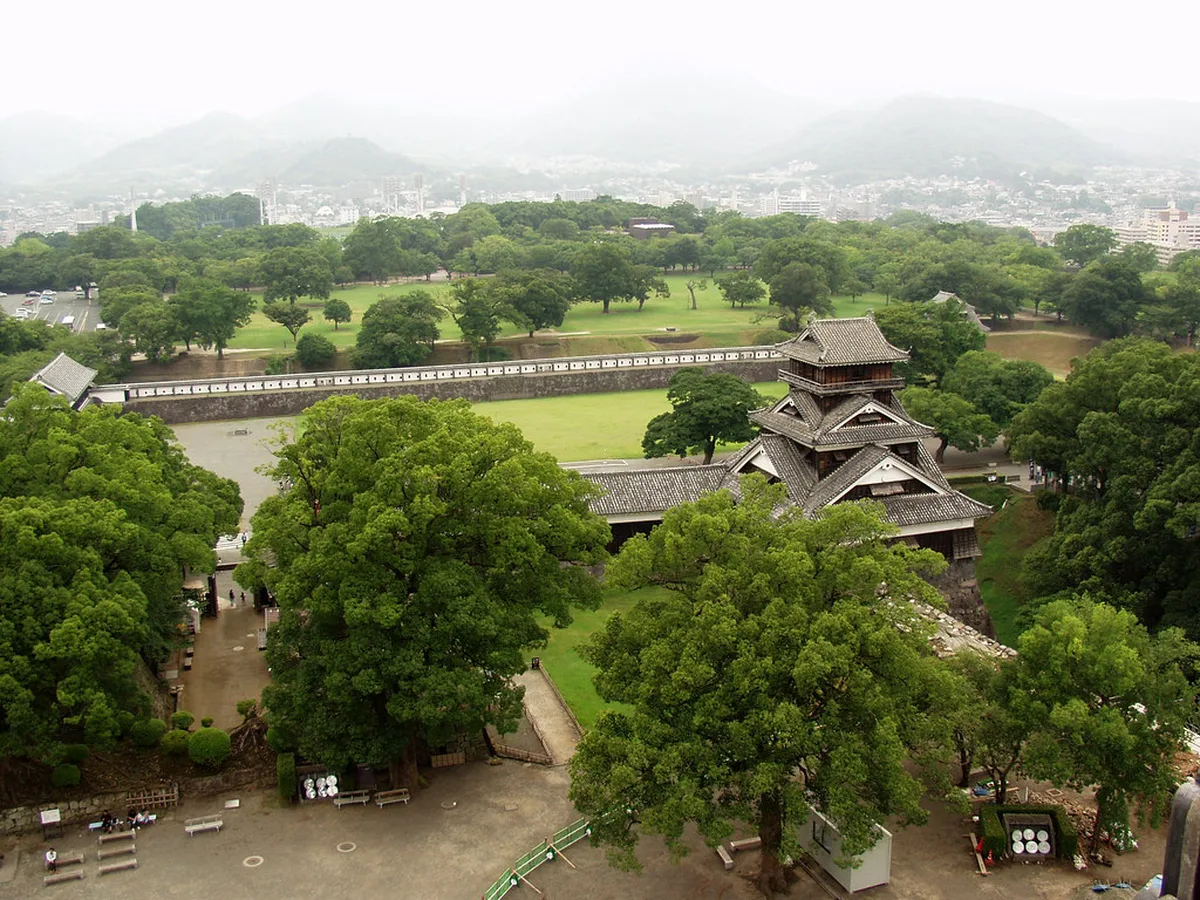
Kumamoto Castle is the city's defining landmark and the main reason most Fukuoka day-trippers make this journey. The April 2016 earthquakes caused severe damage — stone walls collapsed, roof tiles slid away, and the main tower was off-limits for years. Restoration has followed a painstaking phase-by-phase schedule. The main keep (Tenshu) was fully reopened to internal visitors in June 2021 and remains open in 2026, featuring three floors of historical exhibits and panoramic views from the top. For background on the earthquake's impact, the Japan Times Kumamoto Earthquake coverage provides useful context.
The outer grounds — stone walls, secondary towers, and the historic gate areas — are still undergoing masonry work. A specially constructed elevated viewing walkway loops around the restricted sections, giving visitors close-up sight lines of the repair process itself. Watching stonemasons reassemble hand-cut granite blocks using traditional techniques is genuinely worth the detour. Entry to the castle grounds costs 800 yen for adults in 2026; opening hours are 09:00 to 17:00 daily (last entry 16:30). You can find more detail in our Visiting Kumamoto Castle: Reconstruction and History Guide.
The castle grounds are at their most photogenic during cherry blossom season in late March and early April, when hundreds of trees bloom along the moat walls. Even with scaffolding visible in parts of the complex, the sheer scale of the black-walled fortress rising above the city is striking in any season. Budget at least 90 minutes on site to walk the full loop and visit the interior of the keep.
Top Things to Do in Kumamoto (Day Trip Highlights)
After the castle, the next stop for most visitors is Suizenji Jojuen Garden, a 17th-century landscape garden about 15 minutes by tram from Kumamoto Station (Suizenji-Kouen stop, 400 yen entry, open 08:00 to 18:00). The garden reproduces the 53 stops of the old Tokaido highway in miniature, including a small representation of Mount Fuji. It is calmer and less crowded than the castle in the early afternoon.
For lunch, the Shimotori and Kamitori covered shopping arcades run through the city centre about 10 minutes by tram from the castle. They are lined with restaurants serving Kumamoto ramen, tonkotsu dishes, and regional snacks. The arcades are also the best place to pick up Kumamon merchandise. If you have a full day rather than a half-day, consider adding the Former Hosokawa Residence (Gyobu-tei) inside the castle park — a well-preserved samurai villa open daily 08:30 to 17:00 for 300 yen. Following a Kumamoto Day Trip Itinerary: 10 Best Things to Do in One Day will help you sequence these stops efficiently.
Day-trippers who arrive by Shinkansen at 09:00 can realistically cover the castle, Suizenji Garden, and lunch in the arcades before a 16:00 or 17:00 return train. Those who arrive by bus and save the tram fare to the arcades should note that the bus drop-off near Torichoji puts you within a five-minute walk of the shopping streets without needing any additional transit.
Kumamoto Specialties: Kumamon and Ikinari Dango
Kumamon is the prefecture's black bear mascot, created in 2010 to promote tourism and now one of the most commercially successful regional mascots in Japan. His image appears on snack packaging, tram liveries, shop fronts, and even donation boxes for the castle restoration fund. Kumamon Square, inside the SAKURA-MACHI Kumamoto shopping complex near the bus terminal, has a dedicated area where visitors can buy exclusive merchandise and sometimes catch a costumed character appearance.
The local snack you must try is Ikinari Dango — steamed dumplings wrapped around a thick slice of sweet potato and a layer of red bean paste. The name means "sudden dumpling" in Kumamoto dialect, reflecting how quickly they are prepared. Every souvenir shop in and around Kumamoto Station sells them fresh, and the best ones have a slightly sweet potato flavour that contrasts well with the earthy bean paste. Prices run around 200 to 250 yen each at station stalls.
A more adventurous local speciality is Basashi — thinly sliced raw horse meat served with ginger, garlic, and sweet soy sauce. It is a prized dish unique to Kumamoto and is served at most izakayas and traditional restaurants around the castle area. The flavour is mild and lean, nothing like what the name might suggest to first-time visitors. You can find more regional food recommendations in our Kumamoto Foods and Dining Tips.
Practical Travel Tips for Day-Trippers
Luggage storage is a common concern for travelers arriving by Shinkansen with bags. Kumamoto Station has coin lockers at two locations: near the Shinkansen ticket gates on the second floor, and along the main concourse by the East Exit. Sizes in 2026 are small (300 yen), medium (500 yen), and large (700 yen). If you arrive on a weekend or holiday and the station lockers are full, the tourist information desk inside the station can direct you to the paid luggage room. Do not carry large bags to the castle — the site has no locker facility on-site, and the 20-minute tram ride is more comfortable without them.

For timing, the best morning departure from Hakata is the 08:30 to 09:00 Shinkansen window. This gets you into Kumamoto Station by 09:00 to 09:30, giving you the castle almost to yourself before tour groups arrive around 10:30. Last entry to the castle is 16:30, and the last Shinkansen back to Hakata departs Kumamoto after 22:00 — so there is no rush to leave immediately after sightseeing.
On the JR Pass question: if you already hold a Japan Rail Pass or a JR Kyushu Pass, the Sakura Shinkansen makes this route essentially free. Running the numbers, a day trip by Shinkansen (5,230 yen each way = 10,460 yen round trip) costs more than a one-day JR Kyushu Pass (2,160 yen), so buying the regional pass purely for this trip can save money if you are also making one other short hop in Kyushu on the same day. Safety information and local conditions for the region are available at Welcome Kyushu.
Bus drop-offs near Torichoji and Kumamoto Prefectural Office place you within walking distance of the city-centre shopping arcades, saving you an extra tram fare compared to Shinkansen arrival at Kumamoto Station. If exploring Shimotori or Kamitori arcades is your priority, the highway bus is the more convenient and economical choice.
Frequently Asked Questions
How long is the Shinkansen from Fukuoka to Kumamoto?
The Shinkansen journey typically takes between 32 and 50 minutes. Faster Mizuho and Sakura trains reach the city in just over half an hour. Tsubame trains are slightly slower as they make more stops along the route. For more advice, see our Kumamoto Travel Tips: The Ultimate Guide to Kyushu's Castle City guide.
Is the JR Pass valid for the Fukuoka to Kumamoto route?
Yes, the Japan Rail Pass and the JR Kyushu Pass are both valid for this route. You can use them on Sakura and Tsubame trains without any extra fees. Mizuho trains now allow pass holders to board if they pay a small additional supplement. This makes the train a very cost-effective choice.
How much does the bus cost from Fukuoka to Kumamoto?
A one-way ticket on the Hinokuni highway bus costs approximately 2,500 yen. You can often find discounted round-trip tickets or multi-buy booklets at the bus terminal. This is roughly half the price of a standard Shinkansen ticket. It is the best option for travelers on a tight budget.
Can you do a day trip to Kumamoto from Fukuoka?
A day trip is very easy due to the short travel time between the cities. You can leave Fukuoka in the morning and return by dinner time quite comfortably. This allows enough time to see the castle, a garden, and enjoy a local lunch. Many travelers find this a highlight of their Kyushu itinerary.
Is Kumamoto Castle open to the public now?
Yes, the main keep of Kumamoto Castle is open and features modern historical exhibits. While some outer walls are still being repaired, the special walkway provides excellent views. You can enter the castle daily between 9:00 AM and 5:00 PM. Always check official sites for the latest closure updates.
Traveling from Fukuoka to Kumamoto is a seamless experience with multiple transport options. Whether you prioritize speed, cost, or flexibility, there is a perfect method for you. The bullet train offers unmatched efficiency for those on a tight schedule. Alternatively, the highway bus provides a comfortable and affordable way to see the city.
Once you arrive, the city greets you with historical wonders and friendly faces. The ongoing restoration of the castle serves as a testament to the local spirit. Don't forget to try the local dumplings and keep an eye out for Kumamon. Every corner of the city offers something unique for curious travelers to discover.
We hope this guide helps you plan an unforgettable journey through Kyushu. Safe travels as you explore the vibrant culture and history of Kumamoto. For more help, you can consult Welcome Kyushu: Emergency & Travel Info for safety updates. Enjoy your time in one of Japan's most resilient and beautiful cities.
Planning the rest of your trip? See our main Kumamoto travel guide for the complete Kumamoto overview.
Free: The Kumamoto Essentials guide
Top things to do, where to stay, a perfect day plan, getting around, and the best time to go — a Kumamoto mini-guide you can take offline.
You might also like


Continue reading
More guides you'll find useful