12 Kagoshima Hidden Gems and Local Secrets (2026)
Discover 12 Kagoshima hidden gems, from the Mizonokuchi lava cave to the Izumi cranes. Plan your off-the-beaten-path Kyushu adventure with our expert guide.
On this page
After exploring the southern reaches of Kyushu three times, I have found that Kagoshima hides its best secrets well. While many travelers stick to the city center, the true magic lies in the rugged peninsulas and volcanic forests. This guide highlights the most rewarding spots that most tourists completely overlook during their first visit.
Updated June 2026 after my most recent trip to the Izumi crane grounds and remote coastal shrines. Kagoshima is often called the "Naples of the East" because of its stunning bay and active volcano backdrop. Beyond the famous views, you will find spiritual lava tubes, glass museums, and golden autumn canopies that most visitors never discover.
Planning a trip here requires a bit more logistical effort than visiting Tokyo or Osaka. You should consult a 10 Essential Kagoshima Travel Tips: A Complete Guide guide to handle the local ferry and bus systems. For up-to-date event calendars and seasonal announcements, the official Kagoshima tourism portal is invaluable. These hidden gems are spread across the prefecture, making every journey feel like a genuine discovery.
Nagasakibana: The Dragon Palace Cape
Nagasakibana is a dramatic headland on the southern tip of the Satsuma Peninsula, jutting out toward the perfectly conical silhouette of Mt. Kaimon across the blue water. Most visitors to Ibusuki never make the extra 20 minutes south to reach it, which means you often have the tide pools, the red Ryugu-jinja shrine, and the open ocean views entirely to yourself. Legend ties this cape to the Urashima Taro folk tale — the red shrine here is dedicated to the Dragon Palace that features in the story.
The cape is free and open around the clock. Allow about 45 minutes to walk the rocky headland, explore the shrine, and watch small crabs in the tide pools at low water. A bus from Ibusuki Station takes roughly 35 minutes; check the Ibusuki Makurazaki Line timetable before you go as afternoon departures thin out. If you are already driving to Mt. Kaimon, Nagasakibana is a natural half-day pairing — the two sites sit about 15 minutes apart.
Mizonokuchi Cave: A Spiritual Lava Tube
Hidden in the forests of Soo City, Mizonokuchi Cave was carved by ancient Kirishima lava flows and stretches over 140 metres into the hillside. A striking red torii gate marks the entrance, and the interior is cool even in August, dropping to around 15°C year-round. It is entirely free to enter and has no operating hours — the cave simply exists in the forest, unmarked on most tourist maps.
Getting there demands a rental car: it is a 90-minute drive from central Kagoshima with no bus service. The nearest town is Kanoya, about 40 minutes away. Visit early morning when dawn light catches the mossy entrance and the cave is freshest before any day-trippers arrive. If you are combining this with the Kirishima mountains, plan a full day and bring a torch for the deeper sections of the cave floor.
Kasasa Art Museum: Coastal Glass Architecture
The Kasasa Art Museum sits on a cliffside in the remote southern township of Minamikyushu City, with full-height glass walls framing the East China Sea. The building is as much the exhibit as any painting inside — the architects designed it to dissolve the boundary between gallery and ocean. On a clear afternoon, the terrace here delivers some of the finest sunset views in all of Kyushu.
Entry costs approximately ¥500 per adult and the museum is typically open 09:00–17:00. It closes on Tuesdays, so confirm opening days before making the two-hour drive from Kagoshima-Chuo Station. The isolation is part of the appeal: combined visitor numbers on a weekday barely reach double figures. Pair the visit with a stop at Nagasakibana on the way back for a full Satsuma coastal loop.
Izumi Crane Observation Center: Winter Migrations
Every autumn, over 10,000 cranes migrate from Siberia to the protected wetlands around Izumi in northern Kagoshima Prefecture — the largest wintering ground for Hooded Cranes and White-naped Cranes in the world. At peak season in January, the combined flock can exceed 15,000 birds across the flat paddy fields. No other location in Japan offers a comparable spectacle at this scale.
The Izumi Crane Observation Center is open November through March, with entry at approximately ¥200 per adult. Take the Orange Railway to Izumi Station, then a 15-minute taxi or the seasonal loop bus to the center. Arrive no later than 06:30 to watch thousands of birds take simultaneous flight as the sun clears the eastern hills — that morning liftoff is the defining moment and it is over within 20 minutes. Afternoons are quieter and better for closer photography of birds feeding in the fields.
Chiran Special Attack Peace Hall: History and Memory
The Chiran Special Attack Peace Hall preserves the letters, photographs, and personal effects of the young pilots who flew kamikaze missions from this airfield during the final stages of the Pacific War. The exhibits are sobering rather than nationalistic — the handwritten farewell letters to parents and younger siblings are the most affecting objects in any museum in southern Japan. This is not the Kagoshima that travel brochures foreground, but it is essential.
Admission is approximately ¥500 per adult and the hall is open 09:00–17:00 daily. Buses from Kagoshima-Chuo Station take around 75 minutes. Combine the visit with a walk through the adjacent samurai residence district, where seven Edo-period garden homes (each with a different clan aesthetic) are preserved along a straight stone-paved lane. The samurai gardens are free and add about an hour to the visit. Budget a full morning for both sites.
Tarumi Senbon Ginkgo: Autumn's Golden Canopy
A private landowner in Tarumizu City has spent decades planting over 1,000 ginkgo trees across a mountain slope to create one of the most dramatic autumn landscapes in Kyushu. In late November — typically the third week of the month — the entire hillside turns a brilliant, uniform gold. The fallen leaves build up into a thick carpet on the paths below, and local photographers set up before dawn to capture the best light.
Entry is free during peak season, with donations encouraged for maintenance. The site is in Tarumizu City, reached by ferry from Kagoshima Port (30 minutes) followed by a 30-minute drive from the ferry terminal. There is no direct bus to the trees, so a rental car or taxi from Tarumizu Port is necessary. Wear shoes with good grip — the leaf-covered slopes are deceptively slippery. The color window is narrow, typically just 10–14 days, so check local social media or the Tarumizu City tourism site before making the trip in 2026.
Tamatebako Onsen: Infinity Views of Mt. Kaimon
Tamatebako Onsen at the Ibusuki Healthy Land complex is frequently cited by Japanese travel media as one of the most scenic outdoor baths in the country. The rooftop pool sits at the edge of a cliff, with no visible barrier between the bather and the open ocean, and the perfectly conical silhouette of Mt. Kaimon rising to the right. The experience is genuinely otherworldly on a calm morning.
A single entry costs approximately ¥510 and the facility is open 10:00–19:30, closed alternate Wednesdays. Note that the male and female baths swap sides each day to give both a turn at the best view — check the schedule on the Healthy Land website before visiting. Located in the Ibusuki area, it is best reached by car or a short taxi from Ibusuki Station. If you want to combine sand baths with the onsen, the famous Sunamushi hot sand baths at Ibusuki are a 10-minute drive from Healthy Land. For more hot spring options across the region, see the Kagoshima onsen guide.
Kirishima Art Forest: Open-Air Contemporary Works
Kirishima Art Forest scatters massive contemporary art installations through a high-altitude forest on the slopes of the Kirishima volcanic range. Yayoi Kusama's permanent outdoor works are among the draws, but the setting itself — cloud-level mountain air, birch trees, and distant volcanic peaks — elevates every piece. The park receives a fraction of the visitors that comparable venues in Tokyo attract, and on a weekday in spring or autumn you may have whole sections to yourself.
General admission is approximately ¥320 and the park is open 09:00–17:00, closed on Mondays. A 15-minute bus ride from Kurino Station on the JR Hisatsu Line connects the park to the rail network. Bring a light jacket even in August — the mountain air runs 5–8°C cooler than Kagoshima City. The park pairs well with a visit to Kirishima Jingu, Japan's mythologically significant shrine complex about 30 minutes away by car.
Sengan-en: Finding Quiet in the World Heritage Site
While the main house at Sengan-en is well known, most visitors follow the official circuit and miss the upper forest trails entirely. These climb behind the Shimazu clan's former villa to a private volcano viewpoint where the crowds below are invisible. The borrowed-scenery design of the garden — with Sakurajima framed between manicured trees — is at its most powerful from this elevated angle.
Entry starts at ¥1,500 per adult and the grounds are open 09:00–17:00 daily. A new train station opened adjacent to the garden in 2025, making it an eight-minute ride from Kagoshima-Chuo Station on the JR network — covered by the Japan Rail Pass and Kyushu Rail Pass. The Sengan-en Official Heritage Site lists current opening times and special events. After the garden, walk 10 minutes north along the coast to reach Iso Beach — a local spot that most tour groups drive straight past. For the full picture of what to do across the city, the Kagoshima attractions guide covers the broader itinerary.
Sakurajima: The Buried Torii and Lesser-Known Lava Fields
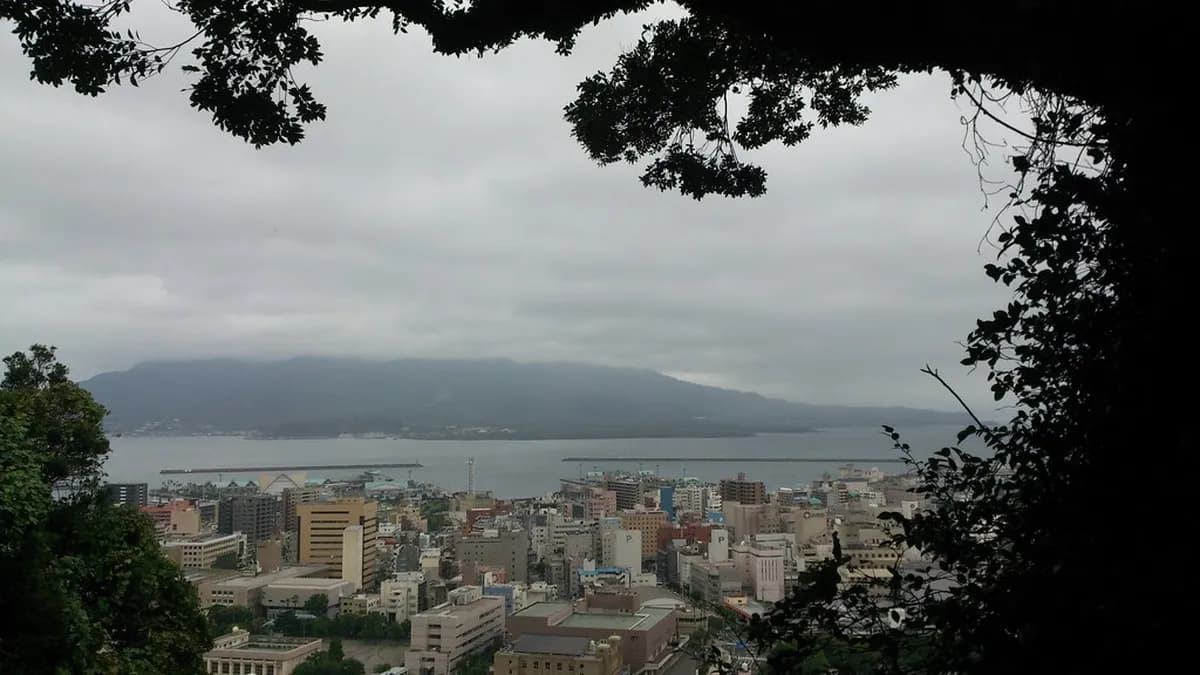
The famous Kurokami Buried Torii on the eastern side of Sakurajima is the single most powerful image of the 1914 eruption: the top of a shrine gate, its base swallowed by three metres of volcanic debris, rising from the black ground as if mid-sinking. The site is free and the eastern bus route from the Sakurajima ferry terminal passes near it, though a rental car gives you far more flexibility for timing and secondary stops.
Beyond the torii, most visitors skip the Nagisa Lava Trail near the ferry terminal — a 3-kilometre walk through the 1914 lava field that ends at a free foot bath with views back to Kagoshima City. The western Yunohira Observatory is the closest public viewpoint to the active summit craters and remains one of the most dramatic free lookouts in Kyushu. On the island's eastern rim, small citrus farms grow the famously tiny Sakurajima daikon radishes in the volcanic soil — a variety so dense with minerals they rarely exceed 3 cm in diameter yet weigh over a kilogram.
Yoshino Park and Tenmonkan: The Local Circuit No Guidebook Covers
Yoshino Koen in the Yoshino district north of the city centre has roughly 10,000 cherry trees that peak in late March, around two weeks after Sengan-en's early-flowering varieties. Because almost no tourist literature mentions it, the park draws an almost entirely local crowd — families, retirees, and school groups — who set up picnic sheets under the canopy and stay until dark when the trees are lit by paper lanterns. Entry is free and the park is open around the clock. Bus 30 from Kagoshima-Chuo Station takes about 25 minutes. Nearby, Terukuni Shrine offers spiritual grounding if you want to pair the park visit with a shrine blessing.
In the city centre itself, the covered Tenmonkan Shopping Arcade is usually dismissed as generic commercial space, and much of it is. But the side alleys behind the main arcade — particularly the Meizanbori stretch, which dates to the 1970s — preserve a very different atmosphere. Narrow counter-seat izakayas serve draft imo-jochu (sweet-potato shochu) starting from ¥400 a glass, poured from unlabelled house distilleries. This is where Kagoshima's long-established distillery culture meets everyday drinking culture: not a curated tasting room but a stool, a glass, and a conversation with a retired fisherman who has been coming here for 30 years. The alleys come alive after 19:00 and most places close by 23:00. For a wider look at local culture, the Kagoshima culture guide covers the samurai heritage and artisan traditions that underpin much of what you will see here.
Tenmonkan Meizanbori alley izakayas open nightly from 19:00, with most places closing by 23:00. Draft imo-jochu (sweet-potato shochu) starts at ¥400 per glass — order by the glass from house distilleries that have no official label. This is authentic Kagoshima drinking culture, not a tourist venue.
Seasonal Calendar: Which Gem to Visit and When
Timing your visit significantly shapes what you can see across this spread-out prefecture. Late March brings the Yoshino Park cherry blossoms at their peak, with none of the crowds at better-known spots. Late November is the ideal window for the Tarumi Senbon Ginkgo — a 10-to-14-day colour event that collapses quickly after the first cold front. The Izumi cranes are present from November through March, with January delivering the largest flocks.
Yoshino Park cherry blossoms peak in late March, roughly two weeks after Sengan-en's early varieties. The park draws mostly local crowds and stays open around the clock with free entry. Night viewing under paper lanterns is available during peak season — ideal for avoiding daytime tourist congestion.
For onsen and remote hiking, October and early November offer the best weather: mild temperatures, low humidity, and clear skies for volcano views. The Nagisa Lava Trail on Sakurajima and the Mizonokuchi Cave are year-round destinations but are most rewarding on clear mornings when ash drift is minimal. Summer (June–August) is viable for beach visits to Iso Beach and the sea views around Nagasakibana, though midday humidity makes long drives uncomfortable. Check the Kagoshima City ash-fall forecast before any Sakurajima excursion — it updates daily and takes 30 seconds to read.
Weekdays are consistently quieter than weekends at every site listed here. The most competitive crowds are at Sengan-en on Saturday afternoons and at Tamatebako Onsen during Golden Week (late April to early May). If your trip falls during Golden Week, prioritise the remoter car-dependent sites like Mizonokuchi Cave and Kasasa Art Museum where visitor numbers barely change regardless of the calendar. For free and low-cost options across the city, the free things to do in Kagoshima guide has a useful supplementary list.
Logistics of Remote Exploration: Car vs. Bus
A rental car is the most efficient way to reach Mizonokuchi Cave, Kasasa Art Museum, Nagasakibana, and Tarumi Senbon Ginkgo — four of the most rewarding spots on this list. Most major rental agencies operate from outside Kagoshima-Chuo Station and from the airport. Booking 48 hours ahead in peak autumn season (late November) is strongly recommended as local supply tightens. Expect to pay ¥6,000–¥9,000 per day for a compact car before fuel.
Travelers on a budget can cover the more accessible half of this list without a car. The SunQ Pass (¥3,000 for one day, ¥5,000 for three days) gives unlimited access to buses heading toward Chiran, Ibusuki, and the Izumi area. Always check the last bus times for rural services — evening departures from Chiran and Ibusuki often stop before 19:00. The Sakurajima ferry runs almost 24 hours and costs ¥200 per person, making the island the easiest half-day trip on this entire list. Driving in Kagoshima Prefecture is generally low-stress: coastal roads are well-maintained, parking at remote attractions is usually free, and toll roads on the main expressways are the only significant additional cost.
Frequently Asked Questions
Do I need a car to see Kagoshima's hidden gems?
Yes, a rental car is highly recommended for remote spots like Mizonokuchi Cave. While buses exist for Chiran and Ibusuki, they are infrequent. Driving allows you to visit multiple gems in a single day.
When is the best time to see the cranes in Izumi?
The cranes are present from November through March each year. January is the peak month for bird numbers and activity. Visit at sunrise to see the birds leave their roosting grounds.
Is Kagoshima safe to visit with an active volcano?
Kagoshima is very safe as the volcano is closely monitored by experts. Residents carry on with daily life despite frequent small ash eruptions. Check the local ash forecast and carry a small umbrella for protection.
Kagoshima remains one of Japan's most rewarding destinations for those willing to venture off the main path. From the spiritual depths of lava caves to the golden ginkgo forests, the variety of experiences is unmatched. By following this guide, you can avoid the crowds and find the quiet, magical corners of the Satsuma Peninsula and beyond.
Remember to pack for changing weather and keep a flexible schedule for the volcano's moods. Whether you are soaking in an infinity onsen or watching thousands of cranes take flight at dawn, Kagoshima will surprise you at every turn. Start planning your journey today and discover why this region is a favourite for seasoned Japan travelers.
Free: The Kagoshima Essentials guide
Top things to do, where to stay, a perfect day plan, getting around, and the best time to go — a Kagoshima mini-guide you can take offline.
You might also like

Continue reading
More guides you'll find useful