Dazaifu Tenmangu Plum Blossom Guide: 8 Essential Tips & Spots
Plan your visit to Dazaifu Tenmangu for the plum blossom season. Discover peak bloom dates, the Tobiume legend, and the Feb 25th ceremony. Book your trip today!
On this page
Dazaifu Tenmangu is home to over 6,000 plum trees of 200 different varieties. The sweet scent of the dazaifu tenmangu plum blossom fills the air during peak bloom from early February to early March. This shrine serves as the head of thousands of Tenmangu shrines across Japan. It honors Sugawara Michizane, the deified scholar known as Tenjin.
Planning a Dazaifu Tenmangu shrine day trip from Fukuoka is easy and rewarding. The plum season offers a quieter, more fragrant alternative to the cherry blossom rush. You will find deep cultural roots tied to these early spring flowers. Expect a mix of spiritual rituals and stunning natural beauty.
One important note for 2026 visitors: the main sanctuary (Honden) is currently undergoing major restoration work. A purpose-built temporary worship hall is open in its place and will remain so through early May 2026. The plum trees and shrine grounds are fully accessible, but expect scaffolding near the main building when planning your photography.
The Legend of Tobiume: Dazaifu's Flying Plum Tree
The most famous tree at the shrine is the legendary Tobiume. This "flying plum" tree stands to the right of the main sanctuary. Legend says it flew overnight from Kyoto to Dazaifu to follow its exiled master, Sugawara Michizane, who was unjustly banished from the capital in 901. His deep affection for plum blossoms is even reflected in the shrine's crest, which features a stylized five-petal plum motif.
The Tobiume is always the first tree to bloom each year, signaling the start of the plum blossom season across the region. The trees you see today are the tenth generation descended from the original, yet they carry the same symbolic weight for locals. Visitors pray here for academic success during exam season, connecting the tree's legend of loyalty directly to the deity of learning. The Tobiume is fenced off for protection — you cannot touch it, but you can stand close enough to appreciate its ancient form.
Surrounding the Tobiume are thousands of white and pink varieties fanning out toward the Honden. The contrast between the blossoms and the dark shrine wood is striking in morning light. The plum blossom is also the official flower of Fukuoka Prefecture, which deepens the regional significance of this one tree. It is one of the most photographed and spiritually resonant spots in all of Kyushu.
Best Time to Visit: Bloom Forecast and Peak Dates
The plum season at Dazaifu Tenmangu typically spans from late January to early March. The Tobiume itself can open as early as mid-January in warm winters. By early February most varieties begin to show color, and the air around the shrine starts carrying that faint, sweet fragrance that sets ume apart from every other flower.
Peak bloom — when most of the 6,000 trees are simultaneously open — almost always falls during the second half of February. Temperatures during peak run around 5–12°C / 41–54°F. Weekends become busy quickly; mid-week visits in the third week of February offer the best balance of full bloom and manageable crowds. If your schedule is flexible, the last ten days of February are the sweet spot for 2026.
Early March still has color, but petals drop fast once the "Haru-ichiban," the season's first strong spring wind, arrives. The fallen petals create a soft pink carpet on the gravel paths, which many photographers find equally beautiful. By mid-March the trees are mostly bare and the cherry blossom season begins to build toward late March and April at nearby Maizuru Park in Fukuoka City.
| Period | Temperature | Crowds | Bloom Status | Best for |
|---|---|---|---|---|
| Late Jan to early Feb | 3–10°C / 37–50°F | Low | First buds, Tobiume open | Quiet walks, close-up shots |
| Mid to late Feb | 5–12°C / 41–54°F | High | Full bloom, all varieties | Photography, Feb 25 ceremony |
| Early to mid March | 7–15°C / 45–59°F | Medium | Petals falling | Petal-carpet shots, spring air |
| Late March to April | 10–18°C / 50–64°F | Very High | Plum done, cherry begins | Cherry blossoms |
Top Spots for Plum Viewing at Dazaifu Tenmangu
The area around the Shinji-ike pond offers spectacular reflection shots. Red arched bridges cross the heart-shaped water near the shrine entrance. Plum branches hang low over the pond, creating a colorful frame around the reflections. This is one of the most photographed spots in the entire complex and works especially well in the golden hour just after sunrise.
Head behind the main sanctuary building to find the "wedded" plum trees. These intertwined trees represent harmony and strong relationships. The atmosphere here is much quieter than the main courtyard. For photographers, the best angle is shooting upward through the interlocked branches with sky behind them.
The 1,500-year-old camphor trees scattered across the grounds provide a permanent green backdrop to the fleeting pink and white blossoms. Their massive trunks are designated national natural monuments. Standing beside one of these camphor giants with plum canopy above is one of the most arresting compositions on the grounds. The contrast of ancient evergreen and ephemeral blossom is something no other plum-viewing spot in Japan quite replicates.
A smaller plum grove near the treasure house features rare varieties that bloom at staggered times through February and into early March. It is less trafficked than the front approach and gives a more intimate viewing experience. If you have already photographed the main areas, this grove rewards slower exploration with unusual color combinations.
The Plum Blossom Ceremony (February 25th)
The Baikasai, or Plum Blossom Ceremony, is held every year on February 25th to mark the anniversary of Sugawara Michizane's death in 903. It is the cultural and spiritual centerpiece of the plum season at Dazaifu. The ceremony brings together Shinto priests, shrine maidens, and worshippers in a procession of ancient rites that feels unchanged from the Heian period.
The key performance is the "Ume-no-uta-mai," a dance performed by shrine maidens (miko) dressed in formal robes of white and red. They carry freshly cut sprigs of blooming plum branches as they move through choreographed sequences in the outer courtyard. The dances are derived from the poem-songs Michizane himself composed in praise of plum blossoms, giving the performance a direct literary lineage of over 1,100 years. Priests chant prayers for national peace and prosperity while offerings of plum branches are placed before the inner sanctuary.
The public can watch the procession and dances from the outer courtyard at no cost. Crowds are exceptionally large on this day — arriving at least an hour before the ceremony begins (typically 11:00) is essential for a clear view. Make sure to check the Dazaifu transport guide for additional festival trains running from Hakata and Tenjin stations on this date.
February 25th (Baikasai ceremony day) draws exceptionally large crowds. Arrive at least one hour before the 11:00 start time to secure a clear sightline in the outer courtyard. Extra trains run from Hakata and Tenjin on this date.
Beyond the spectacle, the ceremony carries real Shinto significance. The deified Michizane is believed to be present in spirit at his shrine, and the offerings are a genuine act of appeasement and honor — not a performance staged for tourists. Attending with that understanding makes the experience considerably more affecting.
Students, Ema, and the Tenjin Connection
Dazaifu Tenmangu is Japan's primary shrine to Tenjin, the deified form of Sugawara Michizane, who was one of the greatest scholars of the Heian court. After his unjust exile and death, a series of natural disasters and deaths among his enemies were attributed to his vengeful spirit. The imperial court elevated him to divine status to appease that spirit — and in doing so created Japan's patron deity of learning and academic success.
This is why the plum season coincides with one of the busiest periods for student visitors. University entrance examinations in Japan are held in January and February. Students from across Kyushu — and many from further afield — come to Dazaifu during the plum bloom to buy ema, wooden votive tablets, and write their wishes for exam success. The ema boards hang in rows near the inner shrine, inscribed with university names, hoped-for scores, and personal pleas.
The connection between Michizane's love of plum blossoms and students praying for academic success creates a layered atmosphere during peak bloom that is unlike any other flower-viewing site in Japan. You are simultaneously watching one of Japan's most beautiful natural displays and participating in a living ritual that links the present to the 10th century. If you visit in the third week of February, you will notice clusters of students in school uniforms — a defining visual of the season at Dazaifu.
Must-Try Local Specialty: Umegae Mochi
No visit to Dazaifu during plum season is complete without trying Umegae Mochi rice cakes. Each cake is stamped with the five-petal plum blossom design and filled with sweet red bean paste inside a grilled mochi shell. The best way to eat them is hot and fresh from the iron grill, when the outside is lightly crispy and the inside is still soft.
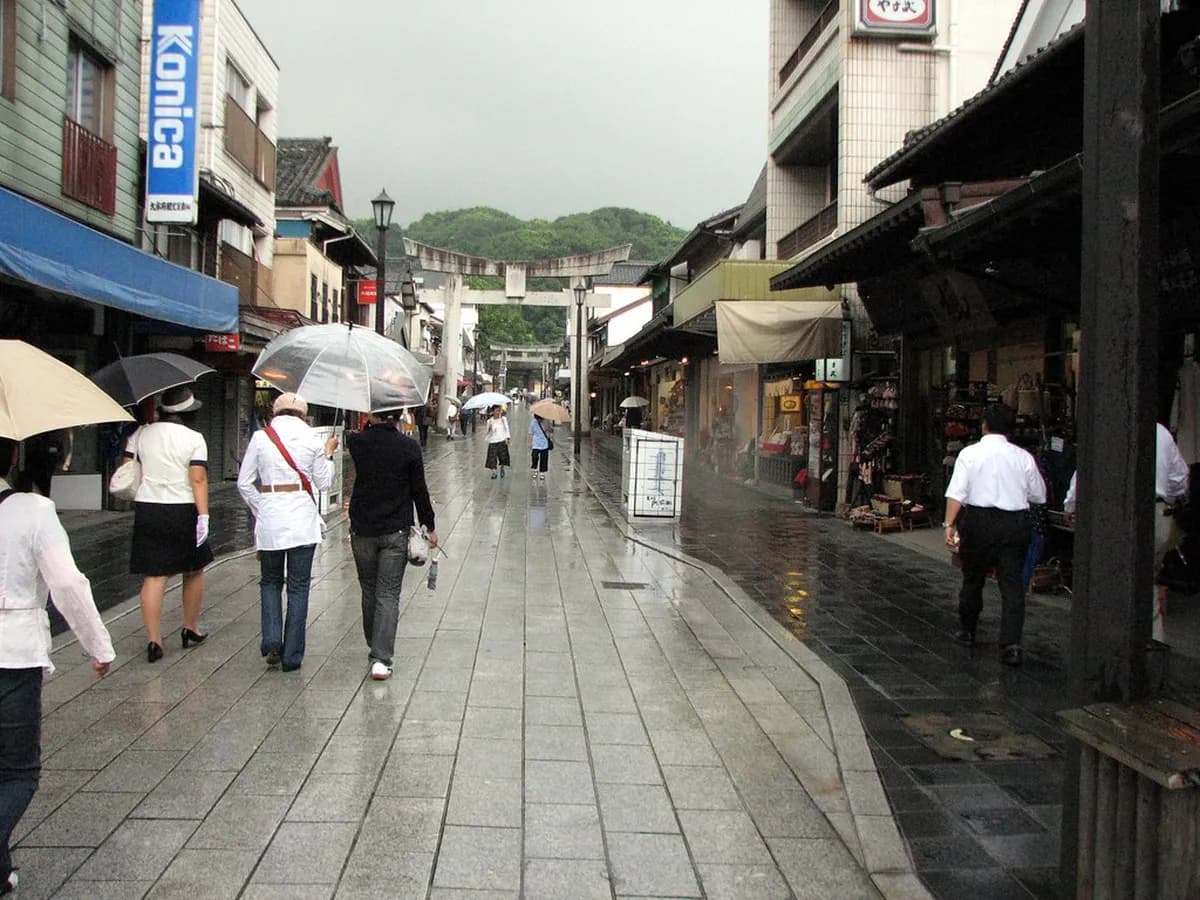
Legend says an elderly woman offered these cakes to Michizane during his exile, using a plum branch to pass the food to the exiled scholar. The snack's name commemorates that act of kindness. You will find dozens of shops selling them along the Omotesando approach road leading to the shrine. The queue at popular shops moves quickly, and most visitors end up buying a box of ten to take home as omiyage (souvenir gifts).
Expect to pay around 150 yen per cake. The texture is a satisfying mix of chewy mochi and crispy edges, and the sweetness is restrained enough that two or three in a row is perfectly reasonable. Some shops offer seasonal variations on festival days. Pair yours with hot matcha from one of the nearby teahouses for the full experience. You can read more about the shopping street and snack culture in the Dazaifu Omotesando shopping street guide.
Comparing Plum Blossoms vs. Cherry Blossoms
Many first-time visitors to Japan confuse plum and cherry blossoms. The simplest way to tell them apart: plum blossoms have round petals with no notch and grow directly attached to the branch, while cherry blossoms have a distinct split at the tip of each petal and hang on slender stalks. Plum flowers also tend to carry a sweet, detectable fragrance — cherry blossoms are nearly scentless.
The bloom windows are completely different. Plum blossoms open in late January and last through early March, while cherry blossoms typically peak in late March to early April in Fukuoka. This means you cannot see both at Dazaifu Tenmangu on the same trip. The plum season lasts several weeks longer than cherry season, making travel planning less stressful — you do not need to chase a precise five-day window the way cherry blossom chasers do.
| Feature | Plum (Ume) | Cherry (Sakura) |
|---|---|---|
| Petal shape | Round, no notch | Notched or split tip |
| Attachment | Direct on branch | On slender stalk |
| Fragrance | Strong and sweet | Faint to none |
| Bloom period (Fukuoka) | Late Jan – early Mar | Late Mar – early Apr |
| Bloom duration | 4–6 weeks | 1–2 weeks |
| Cultural meaning | Endurance, learning, hope | Fleeting beauty, renewal |
Culturally, the plum represents resilience — it blooms in the cold when nothing else does. The cherry blossom symbolizes the transience of life. Both are beloved in Japan, but the plum holds the stronger academic and scholarly association. At Dazaifu in particular, the plum is not decorative: it is the shrine's identity, its deity's emblem, and its most sacred natural element.
Beyond the Shrine: Nearby Plum Spots Worth Visiting
Dazaifu City itself is surrounded by excellent plum-viewing options if you want to extend your day. Bairinji Temple (梅林寺) in nearby Kurume City is one of the most scenic spots in the region: 500 trees of around 30 varieties line the banks of the Chikugo River, including the distinctive gnarled Garyubai (dragon plum) variety. It sits a five-minute walk from JR Kurume Station, making it a natural add-on before or after Dazaifu if you travel by JR rather than Nishitetsu.
In Fukuoka City itself, Maizuru Park's plum garden holds approximately 250 trees of 35 species. The park sits within the historic Fukuoka Castle ruins, and the combination of stone walls and blooming ume is particularly photogenic. The annual Plum Festival at Maizuru typically runs across a weekend in mid-February with food trucks and market stalls. It is accessible in 8 minutes on foot from Fukuoka City Subway Akasaka or Ohori Koen stations.
If you are traveling further afield, Kofuji Bairin in Itoshima has roughly 3,000 trees on the slopes of "Itoshima Fuji" overlooking Funakoshi Bay. The hillside panorama with sea in the background is unlike anything near Dazaifu. Note that much of this grove is on private farmland — stay on designated paths and use the donation box at the entrance. The Tsunashiki Tenmangu Shrine in Chikujo Town is another standout, with 1,000 trees and a plum festival running from mid-February to mid-March 2026.
Practical Tips for Your Dazaifu Plum Blossom Trip
Getting to Dazaifu is straightforward from central Fukuoka. Take the Nishitetsu Omuta Line from Nishitetsu Fukuoka (Tenjin) Station to Futsukaichi, then transfer to the Dazaifu Line — total journey is around 40 minutes and costs approximately 420 yen. On festival days like February 25th, extra trains run and the station is well-staffed with signage. The tourist information center near the station exit has the latest bloom maps and event schedules.
- Arrive before 09:00 on weekends to beat the main crowds on the approach road.
- Wear comfortable walking shoes — the shrine grounds are gravel and uneven stone, and you will cover several kilometers if you explore fully.
- Bring a windbreaker: the temperature can drop sharply in the early morning and the open shrine grounds channel the wind.
- The Tobiume tree is fenced and monitored — photography is fine but do not attempt to touch or reach over the barrier.
- Public restrooms inside the shrine grounds have long lines during peak weekends; use the facilities at Nishitetsu Dazaifu Station on arrival.
- The Kyushu National Museum Dazaifu is a 5-minute walk and makes an excellent rainy-day backup or indoor warm-up between plum-viewing sessions.
Budget travelers should consider visiting on a weekday in early February. Bloom is less complete but crowds are minimal, accommodation prices in Fukuoka are at their seasonal low, and you can walk the entire Omotesando approach without navigating shoulder-to-shoulder traffic. The plum fragrance is if anything more noticeable when the crowds are thin and the air is crisp.
The Tobiume tree is always the first to bloom each year, typically in mid-January to early February. It is fenced off for protection — photography is fine, but do not attempt to touch it or reach over the barrier.
Frequently Asked Questions
When is the best time to see plum blossoms at Dazaifu Tenmangu?
The peak bloom usually occurs from mid-February to early March. During this window, most of the 6,000 trees are in full flower. I recommend visiting in the last week of February for the best colors.
What is the legend of the flying plum tree (Tobiume)?
The Tobiume tree allegedly flew from Kyoto to Dazaifu to be with Sugawara Michizane. It is the first tree to bloom every year at the shrine. This legend highlights the deep bond between the scholar and nature.
What is the difference between plum blossoms and cherry blossoms?
Plum blossoms have round petals and grow directly on the branches. They also have a much stronger sweet scent than cherry blossoms. Cherry blossoms bloom later and have notched petals on long stalks.
Visiting Dazaifu during the plum blossom season is one of the most rewarding winter experiences in Kyushu. The combination of ancient legend, Shinto ceremony, student ritual, and 6,000 flowering trees is genuinely unlike anything else in Japan's seasonal calendar. Time your trip for the last week of February to catch full bloom plus the February 25th Baikasai ceremony.
Don't forget to try the Umegae Mochi before you catch your train home. Plan your trip today to see the legendary flying plum tree and experience Dazaifu at its most alive.
Free: The Fukuoka Essentials guide
Top things to do, where to stay, a perfect day plan, getting around, and the best time to go — a Fukuoka mini-guide you can take offline.
You might also like


Continue reading
More guides you'll find useful