Kanzeonji Temple Dazaifu Travel Guide
Plan kanzeonji temple dazaifu with top picks, neighborhood context, timing tips, and practical booking advice for a smoother trip.
On this page
Kanzeonji Temple is the oldest Buddhist temple in western Japan and the spiritual anchor of ancient Dazaifu. Founded in the seventh century by Emperor Tenji to honor his mother Empress Saimei, it once rivaled the great temples of Nara in scale and importance. Today the complex is quiet and unhurried, a deliberate contrast to the crowds at nearby Dazaifu Tenmangu Shrine. If you want to understand what this city was before it became a pilgrimage site, start here.
The temple grounds sit at 5-6-1 Kanzeon-ji, Dazaifu, Fukuoka and are freely accessible every day. The surrounding western district contains a cluster of ruins — the old government office, a provincial temple, and an ancient ordination hall — that together tell the story of Dazaifu as the capital of Kyushu. None of these sites appear on most tourist itineraries, which means you get them almost entirely to yourself.
This guide covers the temple itself, the Treasure House, and every significant ruin and shrine in the western historic zone. It also includes practical hours, admission fees, and walking distances so you can plan a coherent half-day route without doubling back.
Kanzeonji Temple: What Remains and Why It Matters
The main hall, or Kondo, is a reconstruction but it stands on the original foundation platform. Massive stone bases scattered across the grass show where enormous pillars once supported a seven-storey pagoda. At its peak, this complex was comparable in size to Todaiji in Nara — the scale is still legible if you walk slowly and pay attention to the stonework. For context on the temple's role in Japan's Buddhist heritage, Kanzeon-ji's Wikipedia entry documents its history and National Treasure status.
One practical point that no visitor information sign makes clear: the famous bronze Bonsho bell, Japan's oldest, is no longer kept at the temple. It was transferred to the Kyushu National Museum for conservation. If you plan to visit specifically to see the bell, you need to go to the museum instead. The temple grounds still display a replica, but the National Treasure original is in Kyuhaku's care.
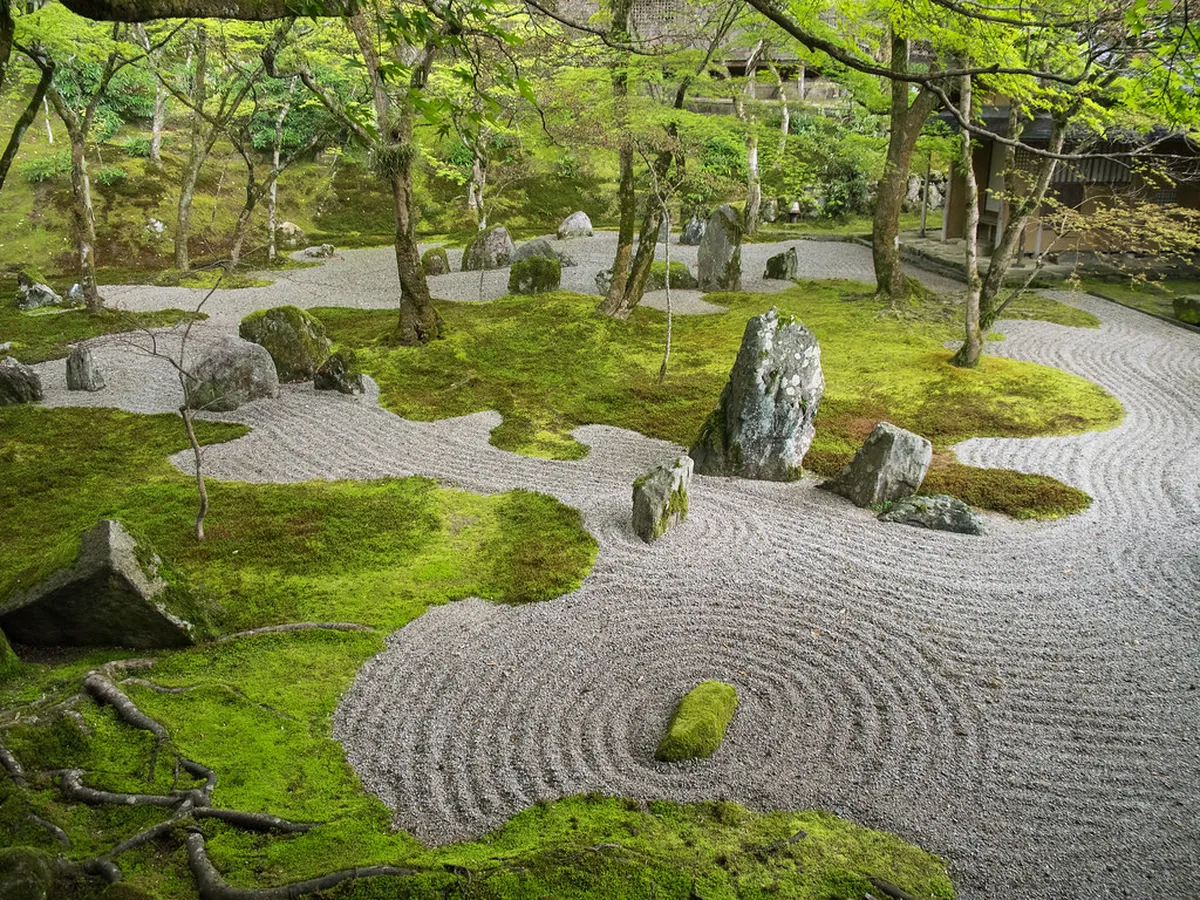
Most tourist maps and websites still show the Bonsho bell at Kanzeonji Temple — but the National Treasure original is now displayed at the Kyushu National Museum. Visit Kyuhaku if seeing the actual bell is a priority; the temple grounds only have a replica.
The adjacent Kaidanin Temple is part of the same complex and should not be skipped. It was one of only three official ordination halls in all of Japan — the other two were Todaiji in Nara and Shimotsuke Yakushiji in Tochigi. Monks traveled from across Kyushu to be ordained here. The courtyard is compact, the atmosphere deeply calm, and the entrance is free.
Access is straightforward: 20 minutes on foot from Nishitetsu Dazaifu Station, or 10 minutes from Nishitetsu Gojo Station. Gojo Station is the better choice if you plan to explore the western ruins district, as it puts you closer to the historical core.
The Treasure House: 16 Statues, No Crowds
The Exhibition Hall beside the main temple houses 16 Buddha statues dating from the eighth to the fourteenth century. These are carved from single blocks of wood and stand several metres tall. The figures represent a range of Buddhist deities and show distinct stylistic shifts across five centuries of craftsmanship. The collection is nationally significant but receives only a fraction of the visitors that the Kyushu National Museum draws.
Hours are Monday to Thursday 09:00–16:30 (last admission 16:00) and Friday to Sunday 09:00–17:00 (last admission 16:30). Admission is ¥600 for adults, ¥400 for high school and university students, and ¥150 for elementary and junior high school students. There are no holiday closures listed, but confirming before a national holiday is sensible.
| Site | Hours | Admission (adult) | Closed |
|---|---|---|---|
| Kanzeonji Treasure House | Mon–Thu 09:00–16:30; Fri–Sun 09:00–17:00 | ¥600 | No regular closure |
| Tofuro Exhibition Hall | 09:00–16:30 | ¥400 | Mondays; 28 Dec–4 Jan |
| Kyushu National Museum | 09:30–17:00 | ¥700 | Mondays |
| Mizuki Hall | 09:00–16:30 | Free | Mondays; 28 Dec–4 Jan |
The Treasure House and Tofuro Exhibition Hall close earlier on weekdays than the outdoor grounds. If your schedule is tight, visit the indoor museums first and leave the outdoor ruins circuit for the afternoon — the stone foundation platforms and Kaidanin courtyard remain accessible after the ticket offices close.
The low lighting inside protects the pigment on the older statues. You can stand very close to works that are over a thousand years old. Plan 30 to 45 minutes here. If you have already visited the Kyushu National Museum for the Bonsho bell and broader history, the Treasure House provides the focused Buddhist art experience that complements it.
Dazaifu Government Office Ruins (Tofuro)
The Dazaifu Government Office, known as Tofuro-ato, was the administrative center of Kyushu from roughly the seventh to the eleventh century. It controlled foreign diplomacy, military defense, and taxation for the entire island. The site managed Japan's relations with Tang China and the Korean kingdoms at a time when those connections shaped the country's culture, religion, and writing system. The Agency for Cultural Affairs lists the Tofuro ruins among Kyushu's designated cultural heritage sites.
What remains above ground are the massive stone foundation platforms of the main hall. They are laid out across a wide public park that is free to enter at any time. Walking through the footprint of the central building gives you a visceral sense of how deliberately planned this complex was — the proportions follow the same grid logic as the Nara imperial capital.
The Dazaifu Exhibition Hall on the grounds preserves a selection of excavated relics and includes scale models showing how the office complex looked at its height. Hours are 09:00–16:30 and it is closed Mondays (the following day if Monday is a national holiday) and 28 December to 4 January. Admission is ¥400 for adults and ¥200 for students. It is a small museum but worth 20 minutes for the context it provides. Access is via the Dazaifu Liner Bus Tabito (alight at Dazaifu Seicho-ato) or a 15-minute walk from Nishitetsu Tofuromae Station.
Sakamoto Hachimangu Shrine is a five-minute walk from the ruins. It gained national attention when the new imperial era Reiwa was named in 2019 — the word comes from the preface to the Manyoshu poetry anthology, written by Otomo no Tabito at a plum-viewing party held near this spot. The shrine is small and mostly unvisited, which makes it a pleasant stop between the ruins and Kanzeonji.
Chikuzen Kokubunji Ruins and Enokisha Shrine
The Chikuzen Kokubunji Temple Ruins mark the site of one of the provincial temples ordered built by Emperor Shomu in 741 to pray for national protection. It was a substantial complex — the pagoda foundation indicates a tower of at least five storeys. Today only the stone bases survive, embedded in a quiet residential neighborhood a 20-minute walk from Nishitetsu Tofuromae Station (or via the City Community Bus, alighting at Chikuzen Kokubunji Temple).
This is a site that rewards travelers who enjoy reading landscapes. There are no reconstructions and few interpretive panels. The contrast between the ancient stone and the surrounding houses is part of its appeal. Budget 15 minutes here as part of a walking loop through the western district.
Enokisha Shrine, a 15-minute walk from Nishitetsu Futsukaichi Station, sits on the west side of the old Suzaku Road that once ran north from the government office gate. This is where Sugawara Michizane lived during his two years of exile before his death in 903. The shrine is modest, but for anyone tracing the life of Dazaifu's most famous resident, it completes the story that begins at Tenmangu.
About Dazaifu Tenmangu
Dazaifu Tenmangu is the head shrine of over 12,000 Tenjin shrines across Japan and draws more than 10 million visitors a year. It enshrines Sugawara Michizane — the scholar and poet who was exiled to Dazaifu in 901 and died here two years later — as the deity of learning, culture, and the arts. Students across the country visit to pray for academic success, particularly in the months before university entrance exams. You can find detailed practical tips in a Dazaifu Tenmangu visitor guide before your trip.
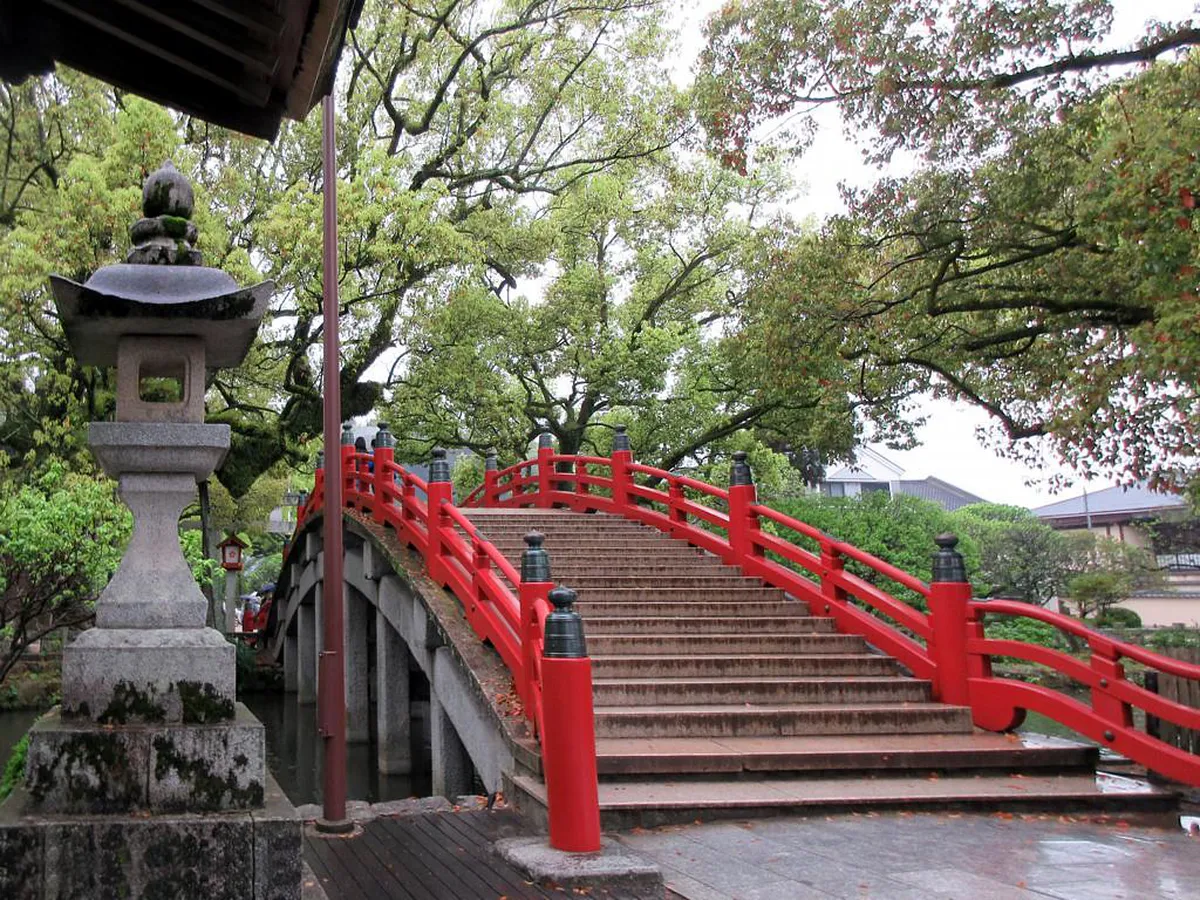
Opening hours run from 06:30 (as early as 06:00 in the busiest periods) to between 18:30 and 19:30 depending on the season. The shrine is a five-minute walk from Nishitetsu Dazaifu Station. The main sanctuary is built over Michizane's burial site. If you plan to visit during February or March, check the blossom season guide — the plum trees here are among the most famous in Japan, and the timing matters.
The grounds function as an open-air gallery alongside the religious function. Arched taiko-bashi bridges, shingyu ox statues, and commissioned contemporary artworks by international artists are distributed across the complex. Allocate at least an hour for the shrine grounds and the Dazaifu Tenmangu Museum. Combining this with a visit to Kanzeonji and the ruins district makes for a full day rather than a half day.
Kyushu National Museum
Kyushu National Museum, known locally as Kyuhaku, opened in 2005 as the fourth national museum in Japan. Its permanent Cultural Exchange Exhibition maps the formation of Japanese culture within the context of Asian history, with exhibits rotated regularly. The building is a short walk from Dazaifu Tenmangu through a covered escalator tunnel, making it easy to combine with the shrine visit. Visit Japan National Tourism Organization for broader context on Dazaifu's place in Kyushu's cultural tourism network.
Hours are 09:30–17:00 (last admission 16:30) and it is closed on Mondays (or the following day if Monday is a public holiday). Admission for the permanent exhibition is ¥700 for adults, ¥350 for university students, and free for visitors under 18 or over 70. Individuals with a disability certificate and their accompanying caretaker also enter free. Special exhibitions carry separate charges.
This is where the original Kanzeonji Bonsho bell is now displayed. If you plan the western ruins circuit first and end at Kyuhaku, you see the bell in the museum context after having stood on the temple grounds where it was cast. The sequence makes the history considerably more concrete. Access is a 10-minute walk from Nishitetsu Dazaifu Station.
Homangu Kamado Shrine
Homangu Kamado Shrine stands on the sacred slopes of Mount Homan to the northeast of the city center. It was positioned deliberately in that direction to protect the Dazaifu government office from evil spirits — a practice of directional spiritual defense common in Nara-period planning. The shrine is now equally famous for its connection to the Demon Slayer anime, which has drawn a younger generation of visitors since the mid-2020s.
The shrine is well-known for matchmaking and relationship blessings. The amulet office is open 08:30–18:00. You can reach it via the City Community Bus from Dazaifu Station (alight at Uchiyama), or by a 40-minute walk from Nishitetsu Dazaifu Station. The bus is the practical choice. The views from the shrine grounds over the Dazaifu valley are among the best in the area, and the cherry blossoms in spring and maple leaves in autumn make it worth a dedicated visit rather than a rushed addition to the Tenmangu itinerary.
Fortress Ruins: Onojo and Iwayajo
Onojo Fortress was built in 665 on the summit of Mount Shioji to defend the government office and store weapons and rice. It consisted of roughly 70 storehouses surrounded by earthen ramparts. Only the embankment and foundation stones survive. The site is about an hour's walk from Nishitetsu Dazaifu Station (to the Yakigomegahara area) or 15 minutes by taxi. It is a serious hike rather than a casual stop, suited for visitors who want to understand the military geography of the ancient capital.
Iwayajo Castle is 50 minutes on foot or 10 minutes by taxi from Nishitetsu Dazaifu Station. In 1586, more than 700 soldiers led by Takahashi Joun held the fortress against a much larger Shimazu force from Kagoshima before being overwhelmed — the Battle of Iwaya is one of the more dramatic episodes of the Sengoku period in Kyushu. The earthworks and a commemorative monument remain. The view of Dazaifu city from the hilltop is the best reward for the climb. There are no facilities on site, so bring water.
Both fortress sites are for travelers who have already covered Kanzeonji, Tofuro, and Tenmangu and want to extend into the military layer of the city's history. Neither is a substitute for the temple and ruins circuit; they are additions for a multi-day visit or for those with a specific interest in early medieval Japanese military sites.
Kyakukan Guesthouse and Mizuki Fortress: The Diplomatic Layer
The Kyakukan Guesthouse Site near Nishitetsu Futsukaichi Station (five minutes on foot) was the official accommodation for foreign envoys arriving at Dazaifu from the eighth to ninth century. Missions from Tang China and Silla Korea stayed here while waiting for permission to travel to the capital. Very little remains physically, but the location makes an interesting ten-minute detour for anyone thinking about Dazaifu's role as Japan's gateway to the Asian continent.
Mizuki Fortress is a more substantial ruin. Built in 664 in response to Japan's defeat at the Battle of Baekgang — a naval engagement against Tang and Silla forces — it runs 1.2 kilometres long, 80 metres wide, and originally stood 10 metres high. Combined with the natural geography of the area, it formed a barrier controlling access to Dazaifu from the west. Take the City Community Bus to the Ruins of Mizuki East Gate, or walk 20 minutes from Nishitetsu Tofuromae Station. Mizuki Hall, a small free museum with an observatory, is open 09:00–16:30, closed Mondays and 28 December to 4 January.
Planning the Western Ruins Circuit
The most efficient way to cover the western historic district is to use Nishitetsu Gojo Station as your base rather than Dazaifu Station. Gojo puts you within ten minutes' walk of Kanzeonji and the Tofuro ruins, whereas starting from Dazaifu Station means a 20-minute walk before you reach any of the key sites. If you plan to add Tenmangu and the National Museum later, finish the ruins circuit first and walk east toward the shrine district.
A focused half-day covers Kaidanin Temple, Kanzeonji grounds and Treasure House, the Tofuro park and Exhibition Hall, and Sakamoto Hachimangu Shrine in roughly three hours. Add the Chikuzen Kokubunji Ruins and Enokisha Shrine and you are looking at four hours. The full day — including Tenmangu, Kyuhaku, and Kamado Shrine — requires an early start and the City Community Bus for the Kamado leg.
For transit from Fukuoka, use the Dazaifu day trip guide for the Nishitetsu line options from Tenjin or Hakata. Wear comfortable walking shoes; the paths around the ruins are mostly gravel and compacted earth. The Exhibition Hall at Tofuro and the Kanzeonji Treasure House both close earlier on weekdays — confirm before you go if you are cutting it close.
Frequently Asked Questions
Which kanzeonji temple dazaifu options fit first-time visitors?
First-time visitors should prioritize the Treasure House and the ancient bronze bell. These provide the most immediate cultural impact and historical context. You can see the main highlights in under an hour. Consider visiting Komyozenji Temple afterward for a complete Zen experience.
How much time should you plan for kanzeonji temple dazaifu?
Plan for 60 to 90 minutes to fully explore the grounds and museum. This allows for a relaxed pace and time to read the signs. If you walk from the station, add another 40 minutes for the round trip. The site is compact but holds deep historical value.
What should travelers avoid when planning kanzeonji temple dazaifu?
Avoid visiting too late in the afternoon as the Treasure House closes earlier than the outdoor grounds. Do not rush through the museum, as the statues are the main attraction. Many people skip the Kaidanin sub-temple, but it is worth the extra five minutes. Check the local weather to avoid muddy paths.
Kanzeonji Temple and the western ruins district represent the layer of Dazaifu that most tourists miss. The combination of the Treasure House statues, the Tofuro foundations, and the Kaidanin ordination hall tells a coherent story about a city that was once the political and spiritual capital of an entire island. None of these sites are crowded. None require more than an hour individually. Together, they make a half-day that is more historically dense than almost anything else available in Kyushu.
Plan the ruins circuit first, walk east to the shrine and museum in the afternoon, and end the day at Kamado Shrine if the season is right for blossoms or foliage. The itinerary requires no special booking and very little expense. What it rewards is unhurried attention.
Free guide: Japan's Hidden Gems
12 under-the-radar places beyond Tokyo & Kyoto — with the best season to visit each and a local tip you won't find in the guidebooks.
You might also like

Continue reading
More guides you'll find useful